
Static vs Video Facebook Ads (2026)
When to run static vs video Facebook ads in 2026: production cost and speed, where each format wins, and how to brief both so cost per result decides.
Updated December 2026 · Likit Sae Lee, CTO

There is no universal winner. Statics are cheap and fast to produce, communicate one offer instantly, and still win plenty of auctions, which makes them ideal for retargeting and rapid angle testing. Video earns the demo and the story and owns the dominant placement: social video took 61.3% of US social ad spend and 60.6% of social time in 2025 per eMarketer, and Reels ran in over 50% of Instagram ad impressions. The right move is to brief both, run them against the same objective, and let cost per result pick the winner per account.
You do not have to choose between statics and video on principle. Both win auctions in 2026, and the brands that scale are usually running them side by side. The real questions are which format to lead with for a given offer, how much each costs to make and iterate, and which one your account's cost per result actually rewards. Statics are cheap, fast, and brutally clear about a single offer. Video earns the demo, the transformation, and the Reels inventory where attention now lives. This guide walks the honest trade-off so you can brief both well and let the data settle the rest.
The format question is really a cost-per-result question
The argument over static versus video has a clean answer that nobody likes: it depends on the account. There is no universal winner, only a winner for a specific offer, audience, and objective. The brands that scale on Meta in 2026 are not running statics or video. They are running both, against the same goal, and reading the cost per result to decide where the next dollar goes.
What makes this hard to accept is that the macro data leans hard toward video. In 2025, social video accounted for 60.6% of the time US adults spent on social networks and pulled 61.3% of US social-network ad spend, per eMarketer's analysis. Reels ran in over half of all Instagram ad impressions, up from 35% a year earlier, according to Sensor Tower data reported by CNBC. So "just run statics" ignores where the inventory and the attention have moved.
But macro share is not your cost per result. A static that communicates one offer instantly can beat a polished video on a retargeting audience, at a fraction of the production cost, every single week. The format that wins for a top-of-funnel awareness push is rarely the one that wins for a bottom-of-funnel sale. That is why the rest of this guide treats format as an empirical test you run, not a belief you hold.
Production speed and cost: the real difference
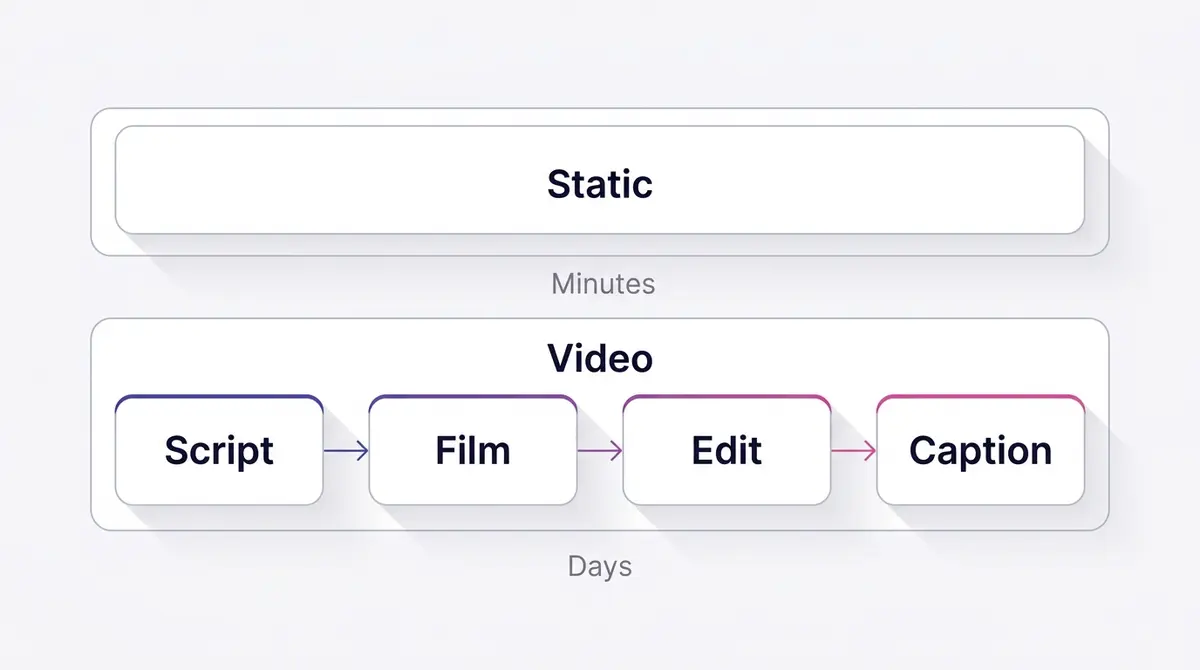
Before any performance debate, account for what each format costs to make, because that economics shapes everything downstream. A static is one image with one claim. You can design it, write the headline, and ship a variation in minutes. A video is a pipeline: a script, a shoot, an edit, captions, and a separate re-cut for each placement. That difference is not a footnote. It decides how fast you can learn.
Typical agency price ranges put a static variation in the low hundreds and a produced video anywhere from several hundred to several thousand per asset. Treat those as vendor pricing, not neutral research, because nobody publishes a clean third-party study on creative production cost. The directional truth holds regardless: statics are cheaper and faster by a wide margin.
| Factor | Static image | Video |
|---|---|---|
| Production time | Minutes to hours | Days to weeks |
| Cost per variation | Low (typical agency ranges in the low hundreds) | Higher (typical ranges from hundreds to thousands) |
| Iteration speed | Fast, many angles per dollar | Slow, throttled by the edit |
| Best for | Offers, retargeting, angle testing | Demos, stories, Reels-native reach |
| Placement fit | Native to feed, letterboxed in Reels | Native to Reels, Stories, and feed |
The strategic consequence is creative-refresh velocity. Ad fatigue, the slow rise in frequency and fall in results, is beaten by feeding fresh creative into the auction faster than the old creative wears out. Statics let you do that cheaply, which is why they remain a workhorse even as video takes the headlines. The teams that struggle with fatigue are often the ones whose entire pipeline is bottlenecked on video production.
Does one format fatigue faster?
Both formats wear out. Ad fatigue is driven by frequency, not by whether an ad moves: the more often the same people see the same creative, the more the response slips, and that holds for a static and a video alike. There is no neutral data proving one format decays faster than the other, so treat any vendor copy that quotes a fixed shelf life in weeks with suspicion.
What genuinely differs is the cost of the cure. The fix for a tired ad is a fresh ad, and a static is cheap and fast to remake, so you can rotate in a new angle before frequency does real damage. A worn-out video costs far more time and money to replace, which is why a video-only pipeline is the one that most often falls behind its own fatigue. That is the practical reason cheap, fast statics earn their place even in a video-first account: they keep refresh velocity high. Watch frequency and a climbing cost per result rather than the calendar, and refresh whichever format is decaying. The Facebook ad fatigue and creative refresh cadence guides cover the rotation method in full.
Where video clearly wins
Video earns three things a still image cannot. It earns the demonstration, it earns the story, and it earns the placement where attention now concentrates. When any of those is the core of your pitch, brief video first.
The demonstration is the obvious case. A smart-home brand showing an app unlock a front door is selling a moment of motion that no single frame can capture. A brand like Dasher Smart Home runs a how-to or demo ad for that exact in-use moment, where the value is the action itself. The same logic covers a skincare routine in use, a gadget unfolding, or a food product being made. If seeing it work is the argument, video is not optional.
The story and the transformation come next. Wyzowl's 2026 report found that 85% of consumers said a video convinced them to buy a product or service, and 82% of marketers said video gives a positive return on investment. These are survey figures, so treat them as directional sentiment rather than a hard performance guarantee, but the pattern is consistent across years: people respond to motion and narrative.
Then there is placement. Reels is now the dominant surface. In 2025 it took 46% of Instagram app time per Sensor Tower, which puts nearly half of Instagram attention on a video-first format, and on Facebook 29% of all ads ran on Reels globally. Meta said on its Q3 2025 earnings call that Reels crossed a $50 billion annual ad revenue run rate across Facebook and Instagram, a vendor figure worth labelling as such, but the direction is unmistakable. Reels is video-native. A static can run there, but it gets letterboxed and historically underperforms the feed. If you want the Reels inventory, you need video to claim it.
Where statics still win plenty of auctions
The case for statics is not nostalgia, it is economics and clarity. A single image carries one value proposition or one offer that a viewer absorbs instantly, with no sound, no watch time, and no hook to survive. That instant legibility is exactly what direct response wants.
Retargeting is the cleanest example. Someone who already visited your product page does not need a 20-second story. They need a reminder of the offer and a reason to act now. A static offer card carrying a price, a discount, or a single proof point does that faster than any video, and it costs almost nothing to produce. A brand like Shakura can run a testimonial ad for pigmentation fading as a fast static for warm audiences while reserving video for the cold-traffic trust build.
Rapid angle testing is the second case, and it is where statics quietly drive strategy. Because you can produce five static variations for the price of one video, statics are the cheapest way to discover which message resonates. Test the offer-led angle against the social-proof angle against the problem-solution angle, find the winner, then invest production budget in turning that proven angle into a video. The static is your scout. It finds the message so your expensive format does not gamble.
Cold prospecting can also reward statics on cost efficiency, even with all the attention on video. A clean, thumb-stopping static with a single strong claim can deliver a cheaper result than a mediocre video, because a weak video is just an expensive way to fail. The format does not save bad creative. A great static beats a forgettable video every time, and it costs a fraction to make.
The static archetypes that keep winning
Statics are not one thing. A handful of repeatable shapes do most of the heavy lifting, and knowing the menu makes briefing faster, because you are choosing a proven structure instead of starting from a blank canvas. None of these depend on a brand name to work. They are patterns you can fill with any product.
- The offer or price card: one price, one promotion, one deadline, set in type big enough to read at a glance. The workhorse of retargeting and direct response.
- The social-proof or review card: a single five-star quote, a star rating, or a screenshot of a real review, framed so the words carry the ad. Trust in one frame.
- The before-and-after: a split image showing a transformation a viewer believes. Strong in beauty, fitness, and home, and worth checking against Meta's rules on personal-attribute and health claims before you run it.
- The feature callout or comparison: arrows and labels pointing at what the product does, or a clean us-versus-the-old-way grid that answers the buyer's main objection.
- The scarcity or back-in-stock note: a plain message that a popular item has returned or is nearly gone, which works because it is true and time-bound.
- The urgency or last-minute card: a sale ending tonight or a shipping cut-off, aimed at the warm audience already deciding.
- The meme or pattern-break: a humorous or unexpected visual that stops the scroll on its own, then hands off to a clear line of copy.
Pick the archetype that matches the funnel stage and the offer, then brief it tightly using the steps below. The before and after ads and social proof ads guides break down two of the highest-converting shapes in depth.
How to brief a static so it earns its keep
A static has one job: communicate a single idea with such clarity that a scrolling thumb stops. The brief should be ruthless about that. One claim, one offer, or one proof point. Not three. The moment a static tries to say two things, it says nothing, because there is no watch time to unfold a second message.
Build the brief around three elements. First, the single message: the one claim, price, or transformation result you want the viewer to leave with. Second, the thumb-stopping contrast: a visual that breaks the pattern of the feed, whether that is a bold color, a surprising before-and-after framing, or a face making eye contact. Third, the offer and call to action: what they get and what to do next, legible at a glance.
Map the static to the funnel stage and the objective. For a warm retargeting audience under a Sales objective, the static should lead with the offer. For a cold audience under an Awareness or Traffic objective, it should lead with the hook or the problem. The same product needs different statics for different ODAX objectives, so brief per objective rather than designing one image and hoping it fits everywhere.
Finally, supply placement-specific crops. Design a 1:1 or 4:5 version for feed and a 9:16 version for Stories. If you let Advantage+ placements push a single square static across every surface, Meta will auto-crop it into the vertical slots, and your headline or logo can get clipped. A few extra minutes of cropping protects the message you spent the brief perfecting.
How to brief a video so it converts
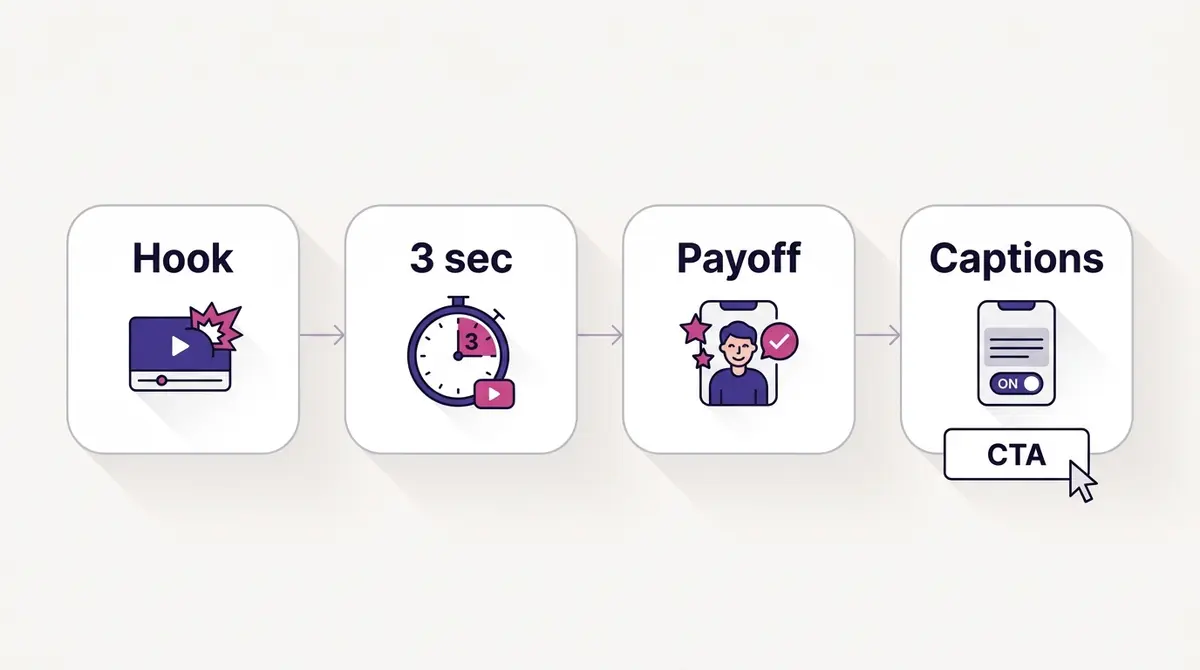
Video has more moving parts, so the brief has to control more. Four beats carry almost every winning short-form ad, and the brief should name all four.
The first beat is the hook, the opening three seconds that decide whether anyone watches the rest. With most of the feed scrolling sound-off and at speed, the hook has to land visually and fast. Lead with the most arresting moment, not a logo or a slow intro. If you want a deeper treatment of opening lines that stop the scroll, the Facebook ad hooks guide breaks down named hook patterns you can brief directly.
The second beat is the payoff: the demonstration, the transformation, or the story turn that the hook promised. This is where a brand like Fitness Achievers earns its conversion, with a before and after ad for the 12-week transformation that shows the result in motion rather than claiming it in text. Keep the body tight. Watch time falls off fast, so every second has to advance the argument.
The third beat is captions. Most viewers watch with the sound off, so burn captions into the file rather than relying on auto-generated ones that a viewer can switch off or that misspell your product name. The fourth beat is the call to action, matched to where the click lands: Shop Now for a product page, Learn More for a longer consideration page, Get Offer for a promotion.
For a full production walkthrough, the Facebook video ad guide covers specs, hook rate, and the test loop in detail, and the specs section below consolidates the per-placement crops that both formats need.
Where carousel, collection, and dynamic ads fit
Static versus video is the most common framing, but it is not the whole menu. Several Meta formats sit alongside the binary, and they often answer the question better than either pure static or pure video does.
A carousel runs two to ten cards a viewer swipes, each its own image or video, which suits a multi-product range or a step-by-step story a single frame cannot hold. A collection ad pairs a hero image or video with a tappable product grid, turning the ad into a mini storefront. Dynamic formats go further: a dynamic creative ad feeds Meta several images, videos, headlines, and texts and lets the system assemble and test combinations, while dynamic product ads (catalog ads) pull the exact items a shopper viewed straight from your product feed, so the creative is built per person rather than per campaign.
The practical read is that these are not a third rival to statics and video. They are containers that hold both. A carousel can be all statics, all video, or a mix, so decide the message and the format together. For the deeper comparisons, see carousel vs single image ads, Facebook dynamic creative, dynamic product ads, and the full Meta ad formats explained rundown.
Specs and placements: one reference for both formats
Whichever format you brief, the asset has to fit the surface it lands on, or Meta crops it for you. The placements fall into three shapes, and designing for them up front saves a clipped headline later. The ratios below come from Meta's own Ads Guide.
| Placement | Recommended aspect ratio | Best fit |
|---|---|---|
| Facebook and Instagram Feed | 1:1 square or 4:5 vertical | Statics and feed-cut video; 4:5 takes more mobile screen |
| Stories and Reels | 9:16 full-screen vertical | Video-native; statics get letterboxed here |
| In-stream and other landscape video | 16:9 (1:1 also supported) | Longer-form video placements |
The rule that ties both formats together is to supply placement-specific assets rather than one file for everything. If you leave a single square static or a feed-shaped video to Advantage+ placements, Meta auto-crops it into the 9:16 vertical slots, and a caption, face, or logo near the edge can get cut. A single 9:16 sound-on master video can be cut down to a 4:5 feed version, and a static usually needs both a feed crop and a vertical crop. Open the per-placement previews before you publish and re-crop anything that clips. For the full detail, see the Facebook ad placements, automatic vs manual placements, and Facebook and Instagram ad sizes guides.
Which format for your budget, stage, and product
Three questions usually settle which format to lead with, before you run a single test.
Budget and stage come first. If your monthly spend is small, in the low hundreds of US dollars, lead with statics. They cost a fraction of video to produce, so the same money buys several angle tests instead of one expensive shoot, and a beginner reaches a clean, legible ad faster with an image than with a four-beat video. Video earns its production cost once spend and volume are high enough that a winning asset is worth filming properly. You can scale a long way on statics alone by rotating fresh angles, but most accounts eventually add video to claim the Reels inventory and to carry the demos a still cannot.
Then the product and the message. If the value is understood in a glance, a price, a single feature, a clear promotion, a static communicates it instantly, which suits simple-value, offer-led, and compliance-sensitive categories where a tightly controlled frame is safer. If the value has to unfold, a demonstration, a transformation, a considered or higher-ticket purchase, or a direct-to-consumer story, video does the job a frame cannot. Match the format to how quickly the offer can be understood, then let the test confirm it.
AI is closing the production gap
The old premise of this debate, that video is always slower and dearer to make, is softening. AI creative tools can now take a single product input and generate both a static and a short video from it, which collapses part of the speed-and-cost gap that made statics the default scout. That does not make filmed, human-directed video obsolete: a real demo, a founder on camera, or a genuine customer story still earns trust a generated clip can struggle to match. It does mean the cost argument is no longer as one-sided as it once was.
Two caveats keep this honest. AI-assisted creative still has to clear Meta's ad review like anything else, and Meta labels AI-generated content with an AI info tag (the label it introduced in May 2024 and renamed from Made with AI on July 1, 2024) when it detects industry-standard AI indicators or when you disclose it. So the principle this guide rests on holds regardless of the tools: brief both formats, run them against the same objective, and let cost per result decide. For more, see the AI Facebook ads and made with AI label guides.
Running the test that settles the argument
The whole point of treating format as empirical is that you can resolve it with a clean test instead of an opinion. The setup is simple: hold everything constant except the format. Same objective, same audience, same landing page, same offer. Ideally the same core message, so a static offer card and a video both pitch the identical promise, and the only variable left is static versus video.
Then read the right metric. Click-through rate is the seductive trap here, because video tends to earn more clicks and engagement, but clicks that do not convert flatter the wrong format. Sprout Social reports that 52% of Instagram users and 48% of Facebook users are most likely to interact with short-form video, and you will often see video win on engagement while a static wins on cost per acquisition. The metric that pays the bills is cost per result, the cheaper conversion, lead, or purchase. Whichever format delivers your actual goal at the lower cost wins that round.
Give each format room to learn. A format needs enough budget and impressions to exit the learning phase and produce a stable number before you judge it, usually a few days and as many conversions as your spend allows. Judging too early reads noise as signal. The Facebook ad creative testing guide covers how to structure these tests so the result is trustworthy rather than a coin flip.
| Step | What to hold constant | What to read |
|---|---|---|
| Build | Objective, audience, landing page, offer | Nothing yet |
| Launch | Same budget per format | Learning-phase exit |
| Read | All of the above | Cost per result, not CTR |
| Decide | Keep winner, feed new variations | Running account benchmark |
The honest ending is that this is not a one-time verdict. The winner shifts with the offer, the season, and the audience temperature, so you re-run the comparison as you scale and as creative fatigues. A static that won in week one can lose to a fresh video in week six, and a brilliant video eventually wears out and needs a cheaper static to keep the account fed.
The metric that diagnoses each format
Cost per result decides the winner, but it does not tell you why the loser lost. For that, read the upstream metric that matches the format, because a static and a video fail in different places.
A static lives or dies on the scroll. Its leading indicators are click-through rate and CPM: a low CTR means the image or the offer did not land, and a high CPM next to weak engagement means the auction is not rewarding the creative. There is no watch time to diagnose, so a failing static is almost always a weak message or a weak visual, which is quick and cheap to rebuild.
A video has more to read. The hook is measured by the share of people who watch the opening few seconds, often tracked as a hook rate built from three-second video views over impressions, while a ThruPlay (which Meta counts once a video plays to completion or runs for at least 15 seconds, whichever comes first) reads sustained attention. A strong hook rate with a weak ThruPlay means the opening worked but the body lost people; a weak hook rate means the first frames never stopped the scroll. Hook rate and hold rate are practitioner conventions, not official Ads Manager columns, so build them from the raw view metrics. Both formats then roll up to the same cost per result. See the hook rate benchmark and thumbstop rate guides for the diagnostic detail.
Putting both formats to work
The teams that win on Meta in 2026 stop arguing about format and start running a portfolio. Statics do the cheap, fast scouting: testing angles, holding the retargeting line, and keeping creative-refresh velocity high so fatigue never catches up. Video does the heavy lifting where it earns its cost: the demo, the transformation, the story, and the Reels inventory where 46% of Instagram time now lives. Neither replaces the other, and the data backs running both. Video carries the attention and the spend, but Wyzowl's 91% video-adoption figure also means video is where the auction is most crowded, which is exactly when a sharp static can slip through cheaper.
The practical workflow is a loop. Scout angles with cheap statics, promote the winning message into a properly briefed video, run them side by side against the same objective, and let cost per result pick the next dollar. When research, generation, editing, and Meta launch live in one place, a platform like AdPlay.ai keeps that loop tight enough that you can test both formats every week instead of every month. For a wider view of how the formats fit into a 2026 creative plan, the Facebook ad creative testing guide connects the format question to the testing cadence that makes it pay off.
Example ad angles
Representative hooks and formats from the category.
“How-to or Demo ad for the app unlocking the front door, a moment only video can show”
“Testimonial ad for pigmentation fading that runs as a fast static while a customer-story Reel earns the trust”
“Before and After ad for the 12-week transformation, a punchy static offer split-tested against a montage Reel”
By the numbers
Frequently asked questions
Are static or video Facebook ads better in 2026?
Neither wins everywhere, so the question is wrong on its own. Video owns attention and the dominant placement: social video took 61.3% of US social ad spend in 2025 per eMarketer, and Reels ran in over half of Instagram ad impressions per Sensor Tower data. But statics are cheaper and faster to make, communicate one offer instantly, and still win auctions for retargeting and direct response. The honest answer is to run both against the same objective and let cost per result decide for your specific account, offer, and audience.
Which costs more to produce, a static or a video ad?
Statics are far cheaper and faster, and that gap matters more than most people realise. A static is a single image with a clear claim, so you can produce and revise it in minutes, which means you can test more angles per dollar. Video carries a real production bottleneck: scripting, filming, editing, captions, and re-cuts per placement. Typical agency price ranges put statics in the low hundreds and a produced video in the high hundreds to several thousand per asset, though these are vendor ranges, not neutral research. AI generation is starting to narrow the gap, since the same brief can now spin out both a static and a short video, but a polished, filmed video still costs more time and money than an image. The practical effect is that statics let you keep creative-refresh velocity high, which is the real defense against fatigue.
When should I lead with video instead of a static?
Lead with video whenever the product needs to be seen in motion, the proof is a transformation or a story, or you want top-of-funnel attention on Reels. A smart-home app unlocking a door, a skincare routine in use, or a 12-week fitness transformation cannot be communicated by a single frame, so video does the job a static cannot. Video also matches the placement where time now lives: Reels was 46% of Instagram app time in 2025 per Sensor Tower. If the asset can only show a still result, a static is fine, but if the value is in the demonstration, brief video first.
When is a static the better choice?
Statics shine for offer-led direct response, retargeting warm audiences, and rapid multivariate angle testing. A single image can carry one price, one claim, or one promotion that a returning visitor reads in under a second, which suits the bottom of the funnel. Because statics are cheap to make, you can run five angle variations for the cost of one video, find the message that resonates, then invest in producing that winning angle as a video. They are the fast, economical way to learn what your audience responds to before you commit a production budget.
Which format should I start with on a small budget or as a beginner?
Start with statics. They cost a fraction of video to make, so a small monthly budget, say a few hundred US dollars, buys you several angle tests instead of one expensive video gamble. A clean image with one claim, one offer, and one call to action is also the easiest creative to get right while you are learning, and it is cheap to refresh, which helps an ad set exit the learning phase. Use statics to find the message your audience responds to, then commit production budget to a video once your spend and volume justify it. You can scale a long way on statics alone before video becomes necessary.
How do I run a fair static vs video test?
Hold everything constant except the format. Same objective, same audience, same landing page, same offer, and ideally the same core message, so the only variable is static versus video. Give each enough budget and impressions to exit the learning phase and produce a stable cost per result, usually a few days and at least a few dozen conversions where possible. Then read the cheaper cost per result, not the higher click-through rate, because clicks that do not convert flatter the wrong format. Whichever delivers your goal at the lower cost wins that round, and you feed in fresh variations of the winner.
How long does a static ad last before it fatigues, and does video last longer?
There is no fixed shelf life, and no neutral data that says one format wears out faster than the other. Fatigue is driven by frequency: the more often the same people see any ad, static or video, the more its results slip, and that holds for both. What differs is the cost of the fix. Because a static is cheap and fast to remake, you can refresh it before frequency bites, which is its real advantage. A tired video costs far more to replace, so video fatigue hurts more. Watch frequency and a rising cost per result rather than the calendar, and refresh whichever format is decaying.
Does video really get more engagement than statics?
Directionally yes, video tends to earn more engagement on Meta, but treat the exact multipliers with caution. Sprout Social reports that 52% of Instagram users and 48% of Facebook users are most likely to interact with short-form video, and Wyzowl found 85% of consumers say a video convinced them to buy. Commonly cited benchmarks claiming video roughly doubles static click-through rate trace back to vendor reports repeated secondhand, so use them as a directional signal, not a fixed number. The reliable read is your own account data, where engagement only matters if it lowers your cost per result.
Sources
- 1.eMarketer, US Social Ad Spending vs. Time Spent 2025 (2025)
- 2.CNBC, Most of Instagram's ads ran on Reels in 2025, data shows (2026)
- 3.Wyzowl, State of Video Marketing 2026 (2026)
- 4.Tubefilter, Meta Q3 2025 Earnings: Reels at a $50B Annual Run Rate (2025)
- 5.Sprout Social, Social Media Video Statistics (2026)
- 6.Meta Ads Guide, Facebook Feed Video Ad Specs (2026)
- 7.Meta Ads Guide, Instagram Reels Video Ad Specs (2026)
- 8.Meta Ads Guide, Facebook In-Stream Video Ad Specs (2026)
- 9.Meta Ads Guide, Carousel Ad Specs (2026)
- 10.Meta Business Help Center, About ThruPlay (2026)
- 11.About Meta, Our Approach to Labeling AI-Generated Content (2024)
Keep exploring
Turn ad research into winning ads
Research the ads that work, generate the creative on-brand, and launch to Meta, all in one tool.
7-day free trial · No credit card required