
15 Facebook Ad Hooks That Work (2026)
The 15 Facebook ad hook patterns that stop the scroll, why each one works on the brain, and a real Malaysian brand example for every single pattern.
Updated August 2026 · Likit Sae Lee, CTO
The Facebook ad hooks that work in 2026 group into 15 repeatable patterns: proof hooks (before-and-after, testimonial, social proof numbers, comparison), curiosity hooks (curiosity gap, question, myth-busting, pattern interrupt), problem and product hooks (problem callout, demo, how-to promise, unboxing), and story or urgency hooks (founder story, offer-led, seasonal urgency). The hook has to land fast and on mute: Hootsuite advises putting your main message and branding in the first 3 seconds, and about 85% of Facebook video is watched without sound (Digiday). Pick the pattern that answers what your buyer doubts, write it into the first frame and the first line, then test several against each other.
The campaign is built, the budget is set, and the ad still has to do the one thing money cannot buy directly: stop a thumb. That thumb has options. A single evening scroll carries any buyer past skincare clinics, fashion boutiques, insurance agents and property listings, all opening with their best line. The good news is that winning openings are not invented from nothing. They follow patterns that repeat across categories, and you can study them in the wild. This piece names the 15 patterns that keep showing up in the feed, explains why each one works, and pairs every pattern with a real ad example, so your next test starts from a proven angle instead of a blank page.
Why the hook carries the ad
On most Facebook ads the large majority of the people reached keep scrolling, and what separates the few who stop is rarely the budget or the bid. It is the opening. Every other lever (the targeting, the offer, the landing page) only gets a turn once the first frame has earned it, which is why a strong hook is worth more than another point of budget.
Just how fast that opening has to work is easy to underestimate. Meta's own feed-attention research found it takes only 0.25 seconds of exposure for people to recall mobile feed content at a statistically significant rate, and that people spend on average 1.7 seconds with a piece of content on mobile versus 2.5 seconds on desktop (Meta for Business, 2016). A quarter of a second to register, under two seconds to decide: the hook is not the part of the ad with the most time, it is the part with the least. Hootsuite's guidance follows from that physics, land your main message and branding inside the first 3 seconds, because clearing that bar is what buys the rest.
And clearing it pays compounding interest. The first frames are not a toll you pay once; they are the gate every later second sits behind. The viewer who is still watching at ten seconds is, almost always, a viewer the hook stopped at one. Win the opening and most of the watch-through comes with it. And most of that attention arrives silent, so the hook has to work as a first frame, never as a voiceover the viewer will not hear.
None of this requires genius. Winning hooks follow patterns, and the same fifteen keep resurfacing across the feed, from facial clinics to insurance agents closing leads over chat.
The 15 hook patterns
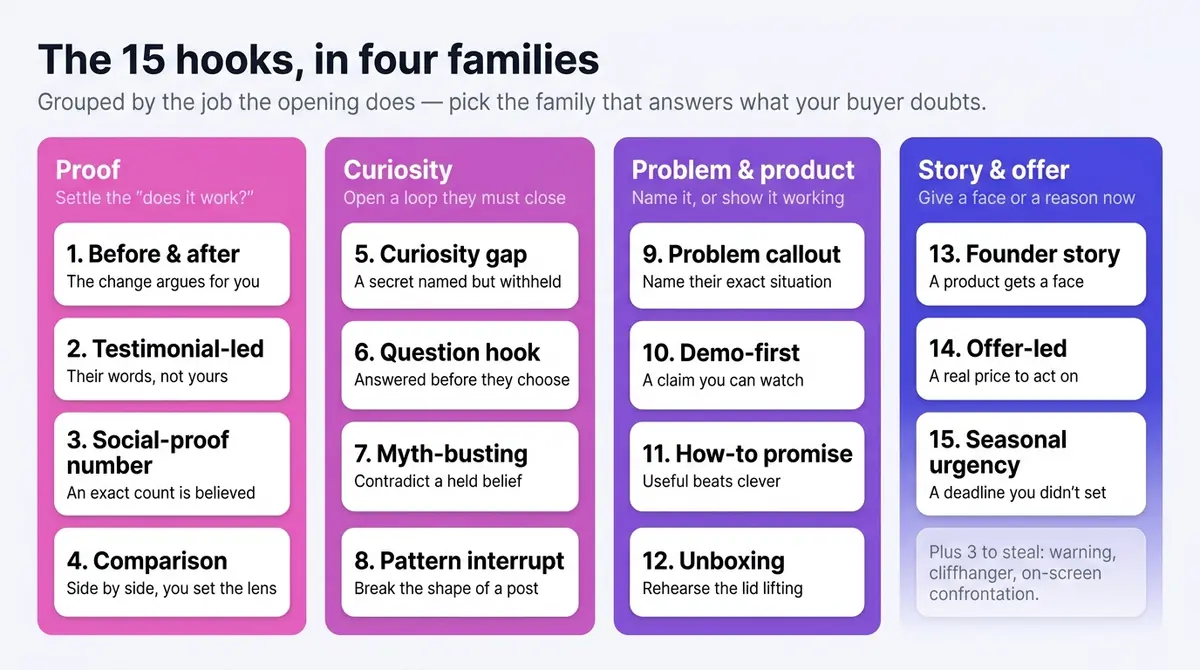
The fifteen split into four families by the job they do: proving a claim, opening a curiosity loop, naming a problem or showing the product, and telling a story or pressing an offer. Each comes with the psychology behind it and a real brand running it.
Proof hooks
1. Before and after. Nothing argues like visible change. A transformation reads in under a second, no copy required, and it answers the skeptic's first objection (does this actually work?) before it is asked. Sofa Repair Sifu runs the pattern far from the beauty aisle where it was born: a worn leather sofa restored like new, the argument made by the repair.
2. Testimonial-led. A customer's words carry trust an advertiser's cannot, because the speaker has nothing to sell. Specificity does the convincing: a real person, a real complaint, a believable result. NMN3+ Pro leads with mum's wrinkles easing after she drank the supplement, a claim told the way family actually talks about it rather than the way a label would.
3. Social proof numbers. A precise count is a decision shortcut. If three million people already bought it, the risk feels pre-tested by everyone who went first. Beyond Collagen+ opens on exactly that, Asia's no.1 collagen with three million bottles sold. Vague brags about thousands of happy customers wash past; exact numbers are believed.
4. Comparison. Putting two options side by side does the shopper's homework for them, and the advertiser picks the frame. EARTH & ME sets bamboo against normal diapers for rash-prone skin, turning a product feature into a choice a parent feels equipped to make on the spot.
Curiosity hooks
5. The curiosity gap. An opened loop demands closing. Tell someone a secret exists, withhold it, and the discomfort of not knowing buys your next ten seconds. Medicube's video opens on the K-beauty secret no one shared with me: specific enough to feel real, withheld enough to stop the scroll.
6. The question hook. A question is processed as if it were addressed to you, and the brain starts answering before it decides whether to care. The best ones borrow the viewer's own words. Fitness Achievers opens with "eh, got any gym nearby ah?", which sounds like a friend's message rather than an ad, and that is precisely the point.
7. Myth-busting. Contradict something the viewer believes and they re-read to check. Fish Club tells parents why they should not buy Atlantic cod for their baby, a hook that challenges a default supermarket habit and positions the brand as the expert in the same breath.
8. The pattern interrupt. Feeds train the eye to skim, so anything that breaks the expected shape of a post earns a second look. Futurizta dresses its creative as a fake AirDrop pop-up that reveals a triple Type-C cable. For half a beat it reads as your own phone's interface, and that half-beat is the game.
Problem and product hooks
9. The problem callout. Name the viewer's exact situation and the ad feels addressed, not broadcast. Perunding Takaful-Thaqif Alif speaks to a Grab driver facing a possible RM30,000 hospital bill with no employer safety net. The narrower the callout, the harder it lands on the person it names.
10. Demo-first. Showing the product work converts a claim into an observation, and observations skip the skepticism filter. Dherbs shows a henna shampoo darkening grey in 15 minutes with no dye, and the time-bound promise survives only because the demo backs it. If your product has a visible mechanism, the demo is usually your hook.
11. The how-to promise. Useful beats clever. A hook that promises competence earns attention even from people not ready to buy yet. Cermin Xpert walks through at-home windscreen replacement, insurance claim included, done in one hour. The process is the pitch.
12. Unboxing. The reveal rehearses the moment the buyer is really purchasing: the first lift of the lid. Bene Jewellery opens its box on a diamond clover necklace on camera and lets the packaging and the pause carry the desire a spec sheet cannot.
Story, offer and urgency hooks
13. The founder story. People extend a face with stakes the benefit of the doubt. A founder explaining why the thing exists turns a product into a person. Lubuk Printing Tudung's founder pitches starting your own printed-tudung brand straight to camera, part origin story, part invitation.
14. Offer-led. When intent already exists, clarity beats cleverness. A concrete price gives the viewer everything needed to act. UR Klinik leads with a doctor-operated pigmentation first trial from RM399. No riddle, no tease, just an offer that is cheap to evaluate.
15. Seasonal urgency. A deadline the brand did not invent is the most believable deadline there is, and every calendar supplies plenty: festive peaks, payday weeks, the year's big mega-sale dates. Celovis pairs the moment with the discount, up to 60% off rose gold bracelets for Raya, and the festival itself provides the reason to act now.
Three more patterns worth stealing
The fifteen above are the workhorses, but a few sharper plays show up once you read feeds closely. The warning, or reverse pitch, tells the viewer to hold off: "do not buy this serum until you read the label." Telling someone not to do a thing makes them want to know why, and the brand disqualifies the wrong buyer (which reads as honesty) before selling to the right one. It tips into gimmick the moment the payoff does not justify the setup.
The cliffhanger shows the result and withholds the method: a clinic posts a clean before-and-after frame, then makes you watch to learn what the patient did. It is the curiosity gap aimed at the part-convinced, a strong retargeting play.
The on-screen confrontation lays a line of text over the first frame that names what the viewer is doing right now: "still comparing tudung prices? Read this first." It interrupts the scroll with the scroll itself, and in a silent feed the words carry the whole hook.
Three hooks, taken apart
Patterns make more sense slowed down. Three teardowns, one per format, show the same principle paying off in a video, a static, and a hard offer.
The curiosity video. Take Medicube's curiosity-gap video, the K-beauty secret no one shared with me. Frame one, on mute, is a face close enough to read skin texture, with the hook line burned across the top. Nothing is sold yet; that first second exists only to make you wonder what the secret is. Seconds two to five deliver the routine and the product on skin, each beat answering a little without closing the loop. The brand name and the offer arrive late, after curiosity has bought the attention. Lead with the logo and the discount instead and the same footage stops far fewer people. The hook earns the seconds, the seconds earn the sale.
The comparison static. A static has no seconds to spend, so its whole hook is the composition of frame one. EARTH & ME's bamboo-versus-normal diaper image works because the eye lands on the split before it reads a word: two sides, two outcomes, the contrast doing the arguing. The text only labels what the layout already implied. That quarter-second of recognition is why a comparison built as a side-by-side image beats the same claim written as a sentence: the copy confirms the verdict the picture already delivered, it does not deliver it.
The offer static. When intent is already warm, the hook is the number. UR Klinik's doctor-operated pigmentation trial from RM399 leads with the price because a concrete figure is the fastest thing a ready buyer can evaluate. There is no loop to open: the RM399 is the stopping mechanism, set large and early so it survives a muted, half-second glance. Bury it three lines into the body and the same offer stops a fraction of the people, because the buyer who would have converted never reached it. On an offer hook the discipline is the opposite of the curiosity video: say the thing first, do not save it.
A fill-in-the-blank formula for writing one from scratch
Recognising a pattern is not the same as writing one. When the blank page is the problem, a scaffold beats inspiration. Fill these four slots in your customer's own words, then cut what does not earn its place.
| Slot | What goes here | Example |
|---|---|---|
| Who | The exact buyer, narrow not broad | "New mums with newborns" |
| The pain | The frustration they would say out loud | "diaper rash keeping baby up at night" |
| The shift | The result they want, stated concretely | "skin clear by morning" |
| The proof or twist | A number, a demo, or a phrase in their words | "switched to bamboo, no more rashes" |
Read top to bottom and you get a usable opener: "New mums, tired of diaper rash keeping baby up? We switched to bamboo and it stopped." Now rewrite it shorter, because the first draft always is. The slots are a starting frame, not a sentence to ship.
Make the hook survive a muted feed
Most of this audience watches with the sound off. About 85% of Facebook video is viewed without sound (Digiday, 2016), and the muted feed only matters more as full-screen vertical takes over: Reels alone now run about 46% of time on Instagram and 29% on the Facebook app (CNBC, 2026). A hook built on a voiceover or a jingle simply does not happen for four viewers in five, so build it to land on mute first. Three things carry it:
- The first frame. Before anything moves, the still that autoplays has to say something: a face mid-reaction, a visible before state, a bold price. Treat frame one as a static ad.
- On-screen text. Burn the hook line into the video, large enough to read on a phone, high where the caption sheet will not cover it. Captions do more than meet accessibility needs: adding them to a Facebook video has been measured to lift view time by about 12% (3Play Media, 2020, reporting a Facebook study).
- You and I. Pronouns make a broadcast feel like a message. "I tried this for 14 days" or "you have probably scrolled past this thrice" places the viewer inside the ad rather than in front of it.
Measure the hook: hook rate and hold rate
A pattern catalogue is useless until you can tell, for your own account, whether the hook actually worked. CTR and cost per result judge the whole ad. Two finer metrics judge the parts: hook rate reads the opening, hold rate reads everything after it. Neither is an official Meta column, both are practitioner conventions you build yourself, and together they turn a hunch ("this one feels stronger") into a number you can act on.
The formulas are standard usage across the industry, with no single owner:
- Hook rate = 3-second video plays divided by impressions. It answers one question: of the people the ad reached, what share did the first frames stop? A low hook rate means the opening lost the scroll before the ad got to say anything.
- Hold rate = ThruPlays (Meta's count of plays to 15 seconds, or to completion for shorter videos) divided by 3-second video plays. It answers the next question: of the people the hook stopped, what share stayed for the payoff? A low hold rate means the opening over-promised and the body under-delivered.
You can build both as custom metrics in Ads Manager: open Customize Columns, choose Create Custom Metric, and define each as the division above using the video-play and impression fields Meta exposes. Save them once and they sit next to cost per result on every video report after, no exporting and dividing by hand.
There is no official Meta benchmark for either, and the honest first move is to ignore any number a blog presents as the universal target. Build your own baseline: run a handful of creatives, record their hook and hold rates, and the median of your own winners becomes the bar new hooks have to clear. As rough orientation only, many practitioners treat a hook rate around 25-35% as solid (below roughly 25% usually needs a new opener, above 35-40% is strong) and a hold rate in the 40-50% band as healthy. Those are disputed, account-specific ranges that swing with vertical, placement, and audience temperature, not a fact. The durable truth is the formula and the practice: measure, baseline, then beat your own median.
Diagnose a dead hook from the two numbers
The real value arrives when you read hook rate and hold rate together. Four combinations, four different things to fix:
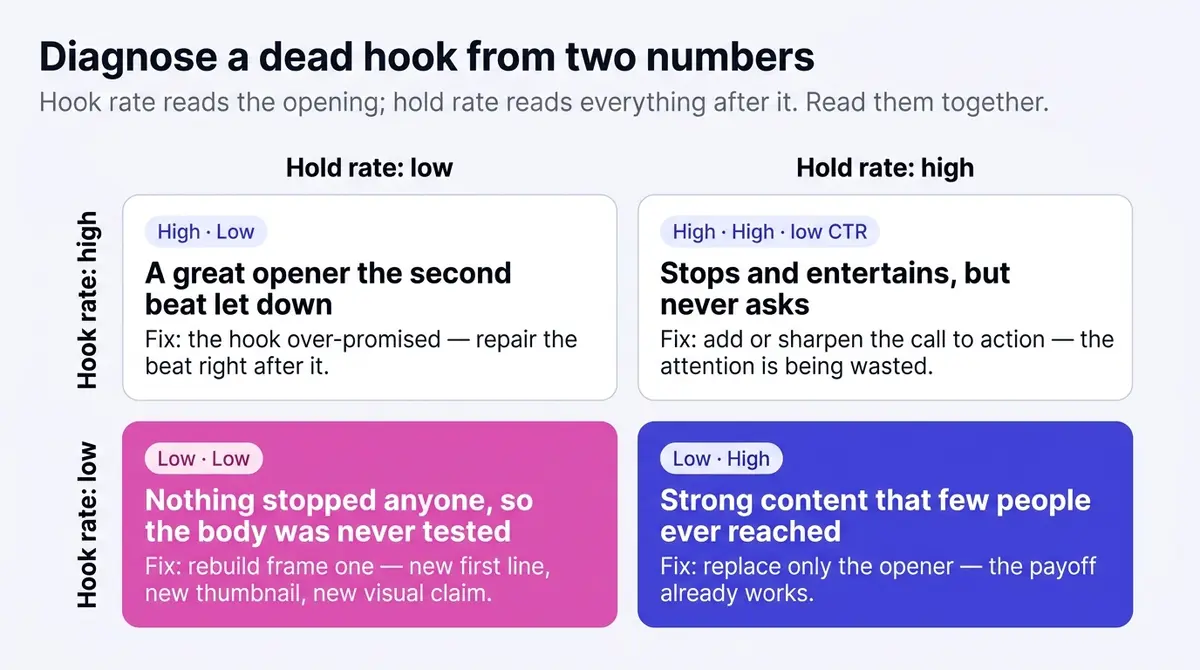
| Hook rate | Hold rate | What it means | What to change |
|---|---|---|---|
| Low | Low | The opening never stopped anyone, so the body was never tested | Rebuild frame one: a new first line, a new thumbnail, a new visual claim |
| Low | High | Strong content that few people ever reached | Keep the body, replace only the opener; the payoff already works |
| High | Low | A great opener that the second beat let down | The hook over-promised; fix the beat right after it or honour the promise sooner |
| High | High, but low CTR | The creative stops and entertains but never asks | Add or sharpen the call to action; the ad earns attention then wastes it |
Read it as a repair workflow. Fix the first frame when nothing stops the scroll. Fix the second beat when people stop then leave. And when both hold but nobody clicks, the problem was never the hook, the ad simply forgot to ask. Diagnosing in this order saves you from the common waste of rewriting a perfectly good opener when the real leak was three seconds later.
Where the hook lands: Feed, Reels, and Stories
A hook does not behave the same way in every placement, and treating "the feed" as one surface quietly costs reach. Attention has shifted hard toward full-screen vertical: in 2025, Reels accounted for about 46% of time spent on Instagram in the US (up from 37% in 2024) and roughly 29% of time on the Facebook app (CNBC, 2026). A hook written only for the in-feed unit is optimised for a shrinking share of the attention.
The three surfaces ask different things of the opening:
- Feed (4:5 or 1:1). The unit is partly visible and shares the screen with surrounding posts, the caption, and the UI. It autoplays muted and the viewer is mid-scroll, so the first frame competes sideways as much as it stops downward. A bold still and a burned-in line carry it; this is the placement the muted-feed rules above were written for.
- Reels (9:16, full screen). The ad takes the whole screen, sound is more likely to be on, and the next video is one swipe away, so the window is even shorter. The opening beat has to hit faster, framed vertical-first for a phone held upright rather than a square cropped into one.
- Stories (9:16, full screen). Also full-bleed and tap-paced, with viewers used to advancing every few seconds. The hook has to register before the thumb taps forward, which rewards one clear visual idea over a slow build.
The full-screen placements share a structural trap: persistent platform UI eats the edges of the frame. In March 2026 Meta unified Stories and Reels into one 9:16 safe zone, and any burned-in hook text has to sit inside it or the interface covers it. Meta's own guidance is to leave roughly the top 14%, the bottom 35%, and 6% on each side free of text and logos so the profile icon, caption, and call-to-action do not cover them (Meta Business Help Center, 2026). Treat the exact pixels as directional, but the durable rule is to reserve the top and bottom of the frame for platform chrome and pull every word toward the centre band:
| Placement | Aspect ratio | Where the hook text lives | First-beat note |
|---|---|---|---|
| Feed | 4:5 or 1:1 (1080 x 1350 / 1080 x 1080) | Upper-middle, clear of the caption sheet | Wins muted and sideways; the still must say something before motion |
| Reels | 9:16 (1080 x 1920) | Centre band, clear of the top ~14% and bottom ~35% | Faster open, vertical-first framing, sound more likely on |
| Stories | 9:16 (1080 x 1920) | Centre band, inside the unified safe zone | One clear idea before the tap-forward |
The practical move is to design the hook for the centre of a 9:16 frame and let it crop safely into Feed, not build a square and hope it survives full screen. A line that reads cleanly in the middle band works in all three; a line pinned to the bottom edge vanishes the moment it runs as a Reel.
Match the hook to the funnel stage
Not every hook belongs at the top of the funnel. The old AIDA idea, attention, interest, desire, action (a sequence whose three-step seed appeared anonymously in Printers' Ink in 1898 and that the adman E. St. Elmo Lewis is credited with developing into the familiar model), still frames it cleanly: a stranger needs attention first, while someone who already knows you needs a reason to act. That maps onto how you deploy the patterns:
| Funnel stage | Who they are | Hooks that fit |
|---|---|---|
| Cold | Never heard of you | Curiosity gap, pattern interrupt, problem callout, before and after |
| Warm | Engaged, not yet bought | Demo, comparison, myth-busting, founder story |
| Retargeting | Visited or added to cart | Social proof numbers, offer-led, seasonal urgency, cliffhanger |
A social-proof number or a discount is wasted on someone who does not yet know the product exists, but it is exactly the nudge a cart-abandoner needs.
Read the Ad Library by how long an ad has run
The cheapest research signal in this business is free, and most people walk past it. The Meta Ad Library shows when every active ad started running, and an ad live for months is one the advertiser is still paying to show. Nobody keeps paying for a hook that loses money, so run time is a rough proxy for performance, readable with no spend data.
Use it like this:
- Search a brand in your category whose ads you keep seeing in the Meta Ad Library.
- For each active ad, note the "started running" date, longest-running first.
- The hooks on the oldest survivors are your shortlist; they have outlasted every variation the brand killed. Screenshot the opening, tag it with the pattern, and feed it into your next test.
Two cautions. A long run proves the ad pays for that brand, not that the hook will pay for you, so treat the survivors as strong leads to test. And a brand new ad is not a failure; it has simply not had time to prove anything yet.
Turn a pattern into your next test
Pattern recognition is step one, and on its own it changes nothing. What compounds is speed: how fast a pattern you spotted this week becomes a live test in your account.
A working cadence looks like this. Pick the two or three patterns that match where your buyer sits in the funnel and what they doubt most. Write five opening lines per pattern in the language your customers actually message you in. Build creatives that differ at the hook and nowhere else, so the results read clean. Launch 3-5 per ad set, give them room to learn, then kill the losers and write the next round from what the winner taught you. If the campaign mechanics are slowing you down, the full setup is covered in how to run a Facebook ad.
The research half of the loop gets faster with a library you can actually search. A brand-by-brand, angle-by-angle archive of Malaysian ads, such as AdPlay.ai, turns "what hooked me last festive sale" into a five-minute look-back instead of a screenshot hunt. However you run it, run it weekly. The advertisers who win the feed turn these patterns into a steady stream of tests and let the audience decide.
Example ad angles
Representative hooks and formats from the category.
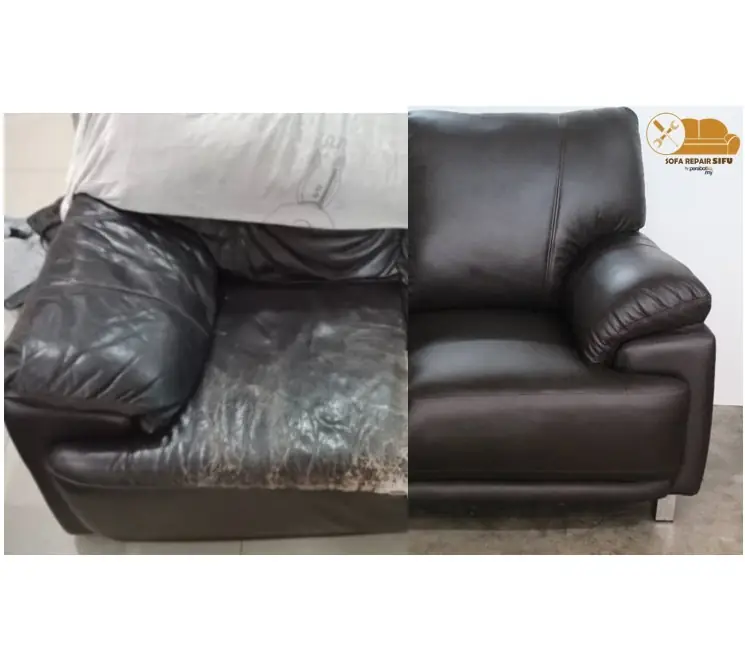
“Before-and-after ad for a worn leather sofa restored like new”

“Testimonial ad for mum’s wrinkles eased after drinking this”

“Social-proof ad for Asia’s no.1 collagen, three million bottles sold”
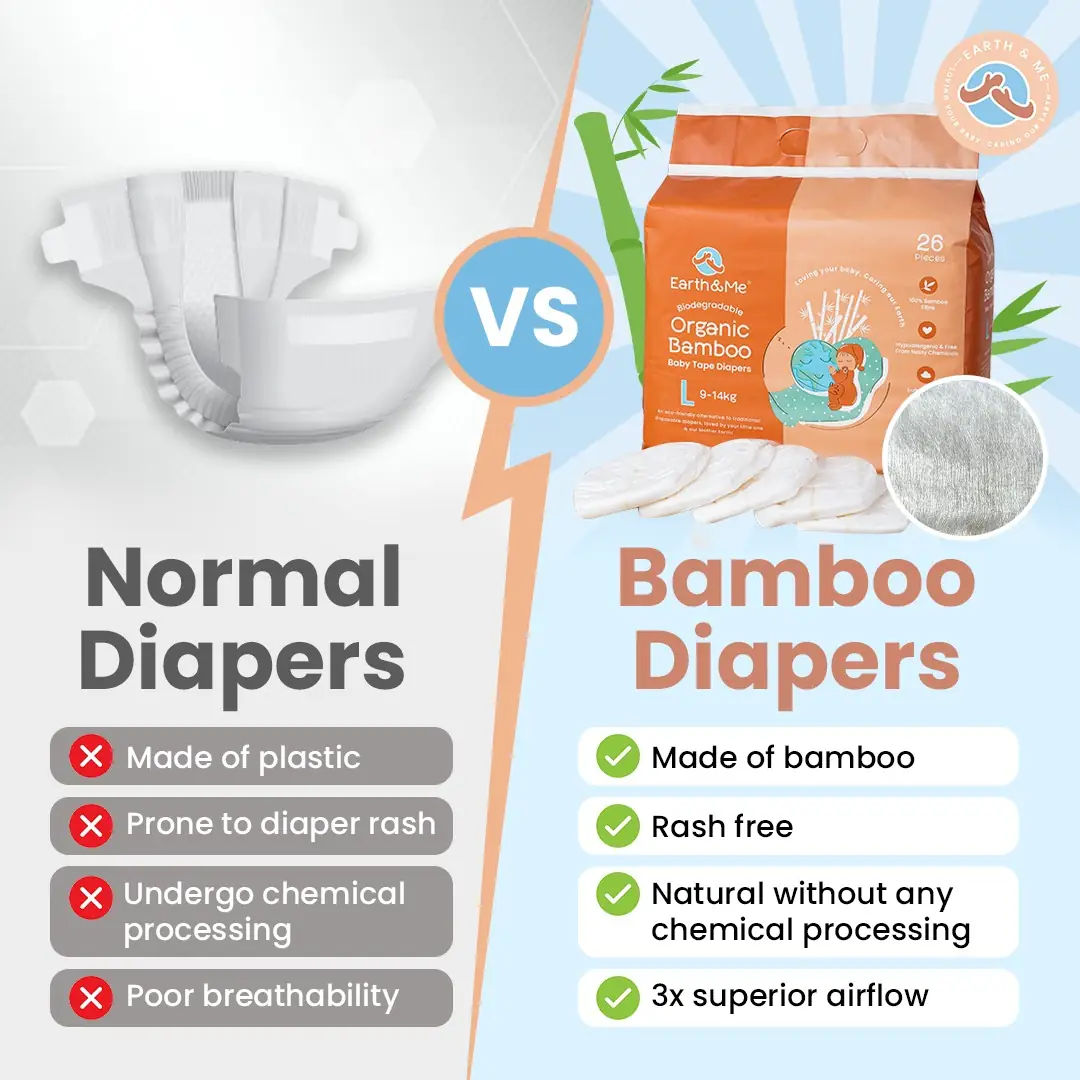
“Comparison ad for bamboo versus normal diapers for rash-prone skin”
“Curiosity-hook ad for the K-beauty secret no one shared with me”
“Curiosity-hook ad: eh, got any gym nearby ah?”

“Curiosity-hook ad for why you should not buy Atlantic cod for your baby”
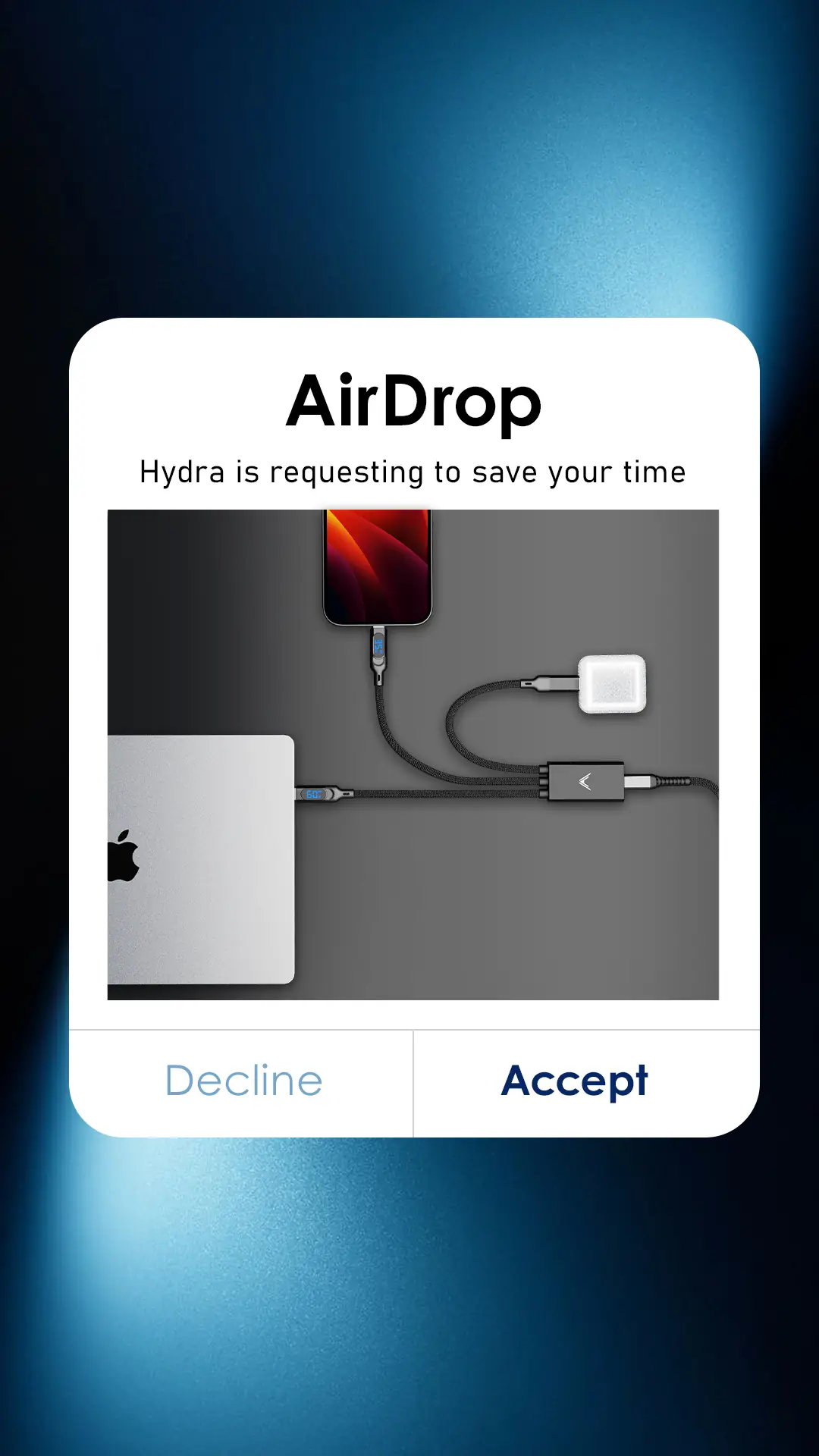
“Curiosity-hook ad: fake AirDrop pop-up reveals the triple Type-C cable”
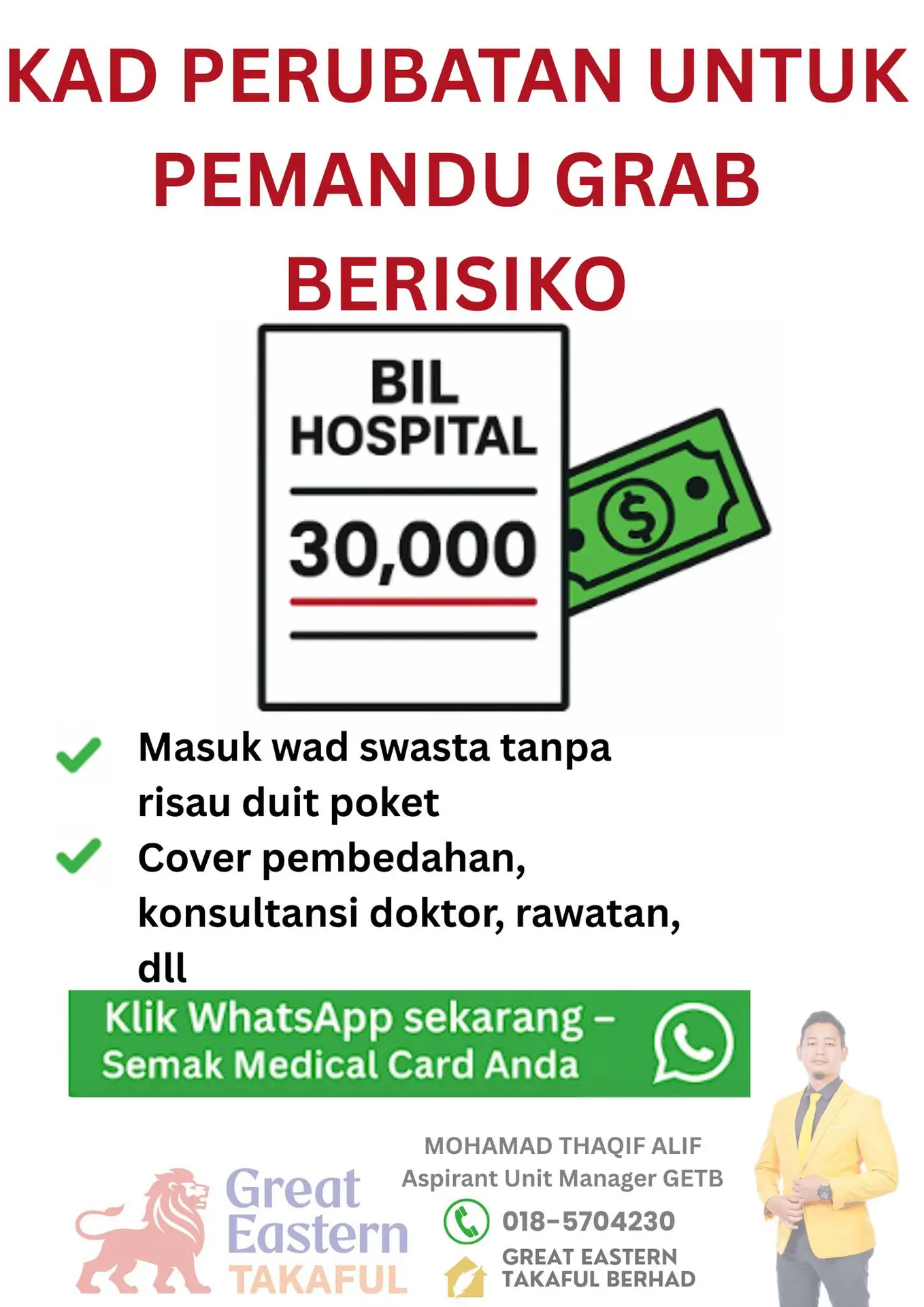
“Problem-solution ad for a Grab driver’s medical card against RM30,000 hospital bills”
“Demo ad for henna shampoo that darkens grey in 15 minutes, no dye”

“How-to ad for at-home windscreen replacement, insurance claim, done in one hour”
“Unboxing ad for a diamond clover necklace revealed in its box”
“Founder UGC for starting your own printed-tudung brand”

“Discount ad: doctor-operated pigmentation first trial from RM399”

“Discount ad: up to 60% off rose gold bracelets for Raya”
By the numbers
Frequently asked questions
What is a hook in a Facebook ad?
The hook is the opening element of the ad: the first line of primary text, the first frames of a video, or the image itself. Its only job is to stop the scroll and earn the next few seconds of attention. It is not the offer, the slogan, or the brand story. Hootsuite's guidance is to land the main message and branding within the first 3 seconds, so strong ads are built hook-first: decide what stops the thumb, then write the rest of the ad to pay that opening off.
Should different hooks be used for cold traffic versus retargeting?
Yes. Someone who has never heard of you needs a reason to stop, so cold traffic responds to curiosity gaps, pattern interrupts, and problem callouts that open a loop. Someone who already visited or abandoned a cart needs a reason to act, so retargeting is where social-proof numbers, offer-led hooks, and seasonal urgency earn their keep. Putting a discount in front of a stranger usually wastes it, and putting a teaser in front of a warm buyer stalls them. Treat the split as a hypothesis to test, then let your own results confirm it.
Why do my video hooks need captions or on-screen text?
Because most of the feed is silent. About 85% of Facebook video is watched without sound (Digiday, 2016), so a hook that lives in a voiceover or a jingle never reaches four viewers in five. Captions and burned-in text carry the opening line on mute, and adding captions has been measured to lift Facebook video view time by about 12% (3Play Media, 2020, reporting a Facebook study). Put the hook line high on the first frame, large enough to read on a phone, and treat sound as a bonus rather than the delivery vehicle.
Do question hooks work in Facebook ads?
They work when the question mirrors something the viewer already asks themselves, in the words they would use. Generic questions like 'Want to save money?' read as advertising and get skipped. Specific, colloquial ones get answered involuntarily, and that involuntary answer is the stopping mechanism. In Malaysia the strongest question hooks are often code-switched: a gym ad opening with 'eh, got any gym nearby ah?' sounds like a friend's WhatsApp message, and that familiarity is exactly what earns the pause.
Which ad hooks work best for Malaysian audiences?
The same 15 patterns work everywhere; the local texture decides how well. Offers anchored in ringgit (RM99, from RM399) read as concrete where percentages feel abstract. Halal claims, where they are true, are a real trust signal. Seasonal urgency has an unusually rich calendar here: Raya, payday weeks, and the 9.9 through 12.12 mega-sales. And code-switched Malay and English inside one creative often beats polished single-language copy, because it matches how the audience actually talks.
How many hooks should I test at once?
A practical baseline is 3-5 creatives per ad set that differ at the hook and nowhere else, so the result reads as a verdict on the hook rather than on a colour change. Give the set enough budget and time to exit the learning phase, then read the winner on hook rate (3-second plays divided by impressions), not just clicks: it tells you which opening actually stopped the most people. Keep that one, replace the losers with fresh patterns rather than small tweaks of a dead one. Cadence matters more than any single round; a steady weekly or fortnightly refresh compounds, and the median hook rate of your own winners becomes the bar each new round has to clear.
How can I tell if a competitor's hook is actually working before I copy the angle?
Read how long it has been running. The free Meta Ad Library shows the date every active ad started, and nobody keeps paying to show a hook that loses money, so an ad live for months is a strong signal the opening pays for that brand. Search the brand, sort its active ads by oldest first, and the survivors are your shortlist. A long run proves it works for them, not that it will work for you, so treat it as a lead to test rather than a guarantee, and remember a brand new ad simply has not had time to prove anything yet.
Are the example ads in this article currently running?
They are representative angles from real Malaysian brands, drawn from an archive of millions of Malaysian ads, and shown here to illustrate how each hook pattern looks in practice. Treat them as a guide to pattern and format, not as a live feed of ads running at this minute. The brands are real, and the angles are typical of how each one advertises.
Sources
- 1.DataReportal, Digital 2026: Malaysia (2026)
- 2.Hootsuite, How To Advertise on Facebook (2024)
- 3.Digiday, 85 Percent of Facebook Video Is Watched Without Sound (2016)
- 4.3Play Media, Captions Increase Viewership for Facebook Video Ads (2020)
- 5.Wikipedia, AIDA (marketing) (2026)
- 6.Meta for Business, Capturing Attention in Feed: The Science Behind Effective Video Creative (2016)
- 7.CNBC, Most of Instagram's ads ran on Reels in 2025, data shows (2026)
- 8.Meta Business Help Center, About text overlays and the safe zone for ads in Stories and Reels (2026)
Keep exploring
Turn ad research into winning ads
Research the ads that work, generate the creative on-brand, and launch to Meta, all in one tool.
7-day free trial · No credit card required