
Facebook Ad Creative Testing Method (2026)
A repeatable Facebook ad creative testing method: one variable at a time, concept before hook, enough budget to exit learning, and a weekly shipping cadence.
Updated August 2026 · Likit Sae Lee, CTO
Test Facebook ad creative one variable at a time, in a fixed hierarchy: concept first, then format, then hook, then details. Test a small set of meaningfully different concepts per ad set (a handful, not a dozen), give each enough budget and time to exit Meta's learning phase, around 50 optimization events in about a week, then judge the result on the metric the campaign exists for (usually cost per purchase or ROAS). Remember that exiting the learning phase only stabilizes delivery, it does not prove a winner: Meta's own A/B test tool calls a result a winner at 65% confidence, while the marketing standard for a real verdict is 95%. Never edit a live ad set, because a budget change over 20% or an audience swap restarts learning. Run the loop on a weekly cadence (read Monday, ship the next round Tuesday) instead of betting on hero launches. The leverage is real: an NCSolutions analysis reported in 2024 found creative drives 49% of incremental sales, far more than marketers typically credit it with.
Every ad account has a graveyard of tests that settled nothing: five ads launched, one winner, no idea why it won. The fix is a method, and the method is small enough to run every week. Test one variable at a time, in the order that moves results most (concept, then format, then hook, then details), give each test enough budget and time to exit Meta's learning phase, and judge it on the metric the campaign exists for. The whole loop fits inside one working week, and it compounds.
Why most creative tests teach you nothing
A typical "creative test" launches four new ads that differ in everything at once: new angle, new format, new hook, new offer. One wins. Nobody can say which change did it, so the next round starts from a guess again. The spend bought a winner but no knowledge, and knowledge is the only thing a test is for.
A method fixes that with three properties. Every test isolates one variable, so the result has one explanation. Every test gets enough budget and time to be readable, so you are not crowning lucky ads. And every result feeds the next test, so the learning compounds week over week. None of this needs a data team, only the discipline to change one thing at a time, and a calendar. (If the account itself is still being set up, start with how to run a Facebook ad, then come back here.)
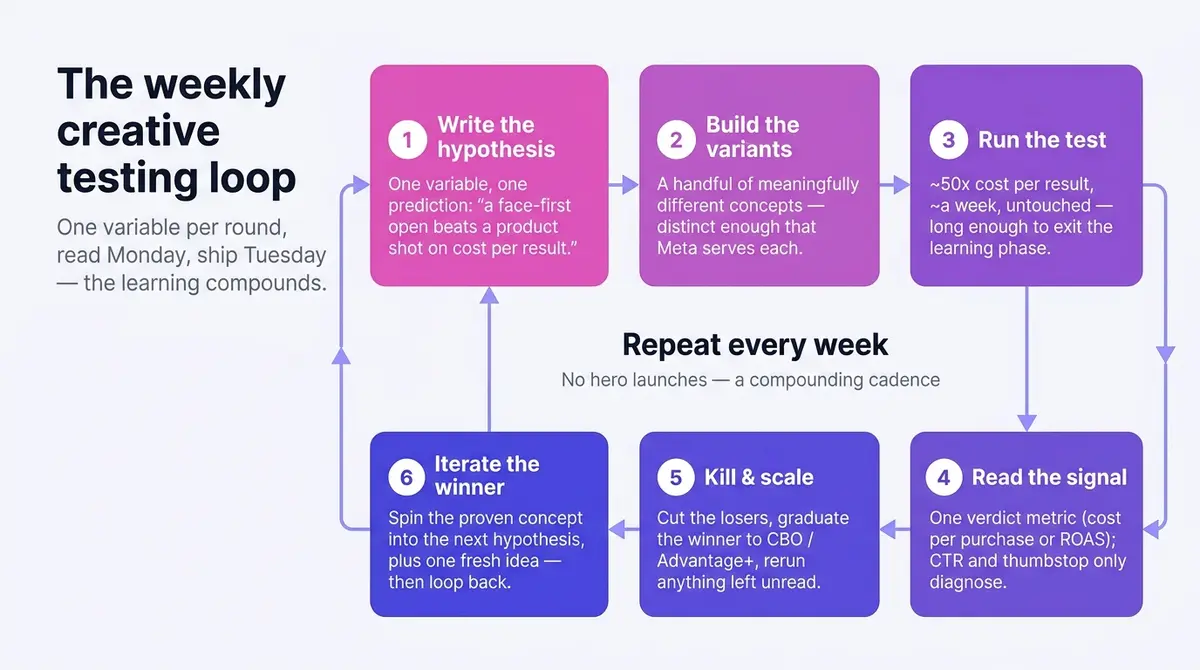
It starts with a written question. A test you can learn from names one variable and a metric you expect to move: "a testimonial open beats a product-shot open on cost per purchase." A test you cannot learn from is a vague hope, "let's see which of these five does better," where the five differ in everything. The first gives you a fact to carry forward whichever way it lands; the second gives you a winner and no reason. Write the sentence before you build the ads, and if you cannot, the test is not designed yet.
Test variables in the order that matters
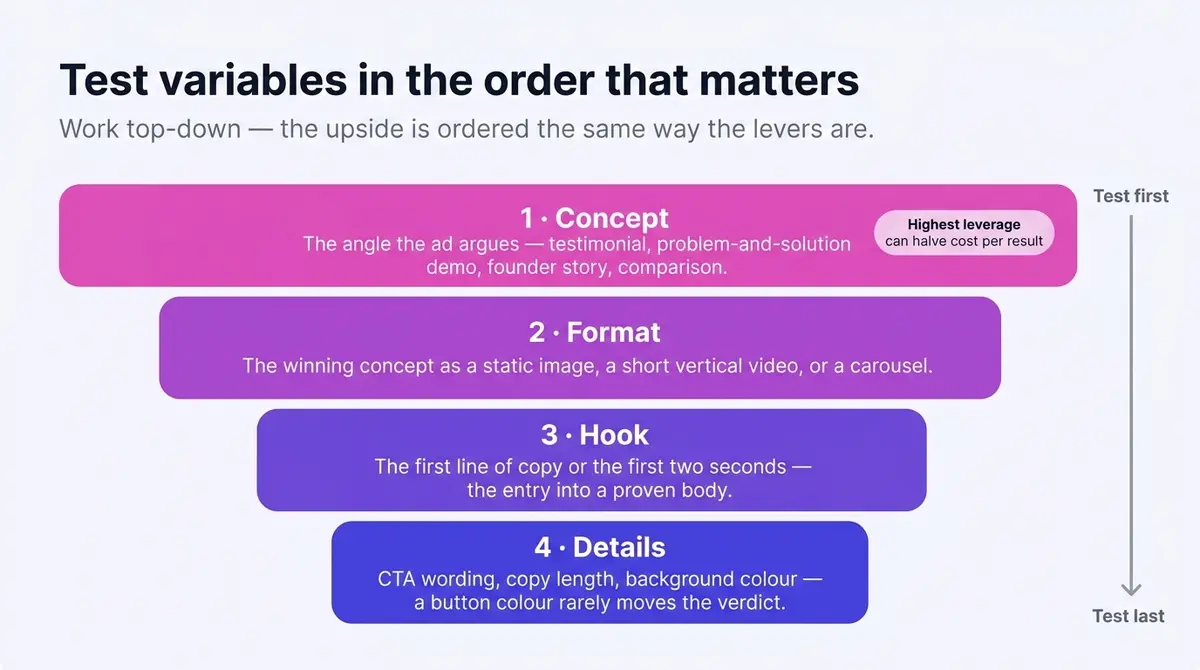
Not all variables are equal. Concept sits at the top: the angle the ad argues, whether a customer testimonial, a problem-and-solution demo, a founder story, or a side-by-side comparison. Below it sits format: the winning concept as a static image, a short vertical video, a carousel. Then the hook: the first line of copy or the first two seconds of the video. Details come last: CTA wording, copy length, background color.
Concepts are easiest to spot in a live feed. Real ad examples in skincare alone cover the spread: Skinlycious leans on testimonial (a mum describing her daughter's forehead pimples clearing), while Shakura runs before-and-after proof (stubborn dark spots faded without laser, an RM68 two-session trial attached). In supplements, FlexiGold opens on its founder explaining why joint pain is not only about joints. Three brands, three different arguments. That is the altitude a concept test operates at, before any hook or format question comes up.
Test top-down because the upside is ordered the same way. A new concept can halve cost per purchase; a new button color almost never will. The size of the prize is why creative deserves the testing budget at all: an NCSolutions analysis found the creative itself drives 49% of incremental sales from advertising, while surveyed marketers credit it with just 19% of the effect (Westwood One, 2024). Most accounts underinvest in exactly the variable with the most leverage. Once a concept proves itself, move down a level and iterate formats and hooks inside it; do not return to detail-tuning until the bigger questions are settled.
Give every test enough data to be readable
Meta's delivery system enters a learning phase whenever an ad set launches or changes significantly, and Meta recommends around 50 conversion events per ad set per week to exit it (Hootsuite, 2026). Before that threshold, performance is volatile by design, so an early read rewards noise. Budget backward from it: at a $20 target cost per purchase, an ad set needs roughly $1,000 across the week to produce 50 purchases (a few hundred dollars more if your target sits higher). If that is out of range, optimize one step up the funnel, for add-to-cart or initiate-checkout, so events arrive faster, and treat the result as a strong proxy rather than a verdict.
Then let the full seven days run even when a winner looks obvious on day three: weekend and weekday buyers behave differently, and a partial week reads only one of them. Above all, do not edit a live ad set, because a significant edit restarts learning and burns the data you already paid for. "Significant" has a specific meaning worth memorizing, so you do not reset a test by accident. These edits send an ad set back into learning:
| Edit that restarts learning | Edit that is usually safe |
|---|---|
| Changing budget or bid by more than 20% (either direction) | A budget nudge under 20% |
| Swapping the audience or the optimization event | Renaming the ad set |
| Changing the bid strategy | Editing the schedule inside the same week |
| Adding or removing an ad in the set | Pausing for under seven days, then resuming |
| Pausing the ad set for more than seven days | (the above leave the learning history intact) |
Two traps hide in that table. Under campaign budget optimization, where Meta shares one budget across several ad sets, editing one ad set can disturb the others, so a "small" change is rarely contained. And a budget jump over 20% counts as significant even when you raise it on a winner, which is why scaling is done in 15-20% steps every couple of days, not one leap (Cometly, 2026).
Exiting the learning phase is not the same as a verdict
Here is the line most testers blur. Exiting the learning phase and proving a winner are two different bars, and the gap between them is where accounts fool themselves. The roughly 50 optimization events covered above stabilize delivery, nothing more. They tell you Meta has stopped thrashing and is serving the ad consistently. They do not tell you the gap between Concept B at $18 and Concept A at $42 is real rather than a lucky week.
That second question is a confidence question, and the bar is much higher. Meta states its own thresholds plainly. In Meta's structured A/B test tool, a confidence percentage of 65% or higher is what it treats as a winning result, while lift tests need 90% or higher to count as statistically reliable, and Meta suggests a test have an estimated power of at least 80% before it runs (Meta Business Help Center, 2026). The broader performance-marketing standard is stricter still: a 95% confidence level is the usual bar for declaring one creative genuinely beats another. Detecting a modest difference between two creatives at 95% confidence takes far more conversions per variant than 50, often into the hundreds, so below that volume a leader is a strong lean, not a proof.
The practical translation for a small or mid-sized account, which is most accounts, is to grade your reads honestly. A two-day result is noise. A full-week result that cleared the learning phase is a directional read worth acting on. A result that also cleared the confidence bar in Meta's A/B tool is a verdict you can scale on with conviction. When you are short of significance, do not pretend otherwise: extend the test another week, raise the budget so events arrive faster, or optimize one step up the funnel (add-to-cart instead of purchase) so the same spend buys more events to read. The discipline is refusing to crown a winner the data has not actually earned.
Read the metrics: one verdict, paired diagnostics
A creative test has one verdict metric and several diagnostic ones, and mixing them up crowns the wrong ads. If the goal is sales, the verdict is cost per purchase or ROAS. CTR, hook rate, and thumbstop rate are diagnostics: they locate the failure rather than declare the winner. The benchmark you compare against depends on the objective, not a single magic number: WordStream's 2025 Facebook data puts the average CTR at 1.71% for Traffic campaigns but 2.59% for Leads campaigns (WordStream, 2025). An ad sitting well below the right benchmark for its objective has a hook problem. An ad with a strong CTR and a weak purchase rate is over-promising, or sending clicks to a page that cannot close them. Read the diagnostics to decide what to fix; read the verdict metric to decide what to scale. A creative that wins on comments, shares, and bargain clicks while losing on cost per purchase is entertainment, not a winner.
A single diagnostic tells you something is wrong; two read together tell you what to change. The funnel inside one ad runs scroll-stop, then click, then purchase, and each metric measures one handoff. Find the handoff that breaks and you have found the variable to test next.
| Two metrics read together | What it means | What to iterate next |
|---|---|---|
| Low thumbstop, low CTR | The first frame never stops the scroll | A new opening frame, hook, or format (try video over static) |
| High thumbstop, low CTR | People watch but the message does not earn the click | Rework the middle and the call to action, keep the open |
| High CTR, low add-to-cart | The ad oversells what the page delivers | Align the claim and the offer with the landing page |
| High CTR, healthy add-to-cart, low purchase | The friction is in checkout or price, not the creative | Stop iterating the ad; fix the checkout or the offer |
| Strong on every step but low ROAS | The product economics or audience value is the limit | Test a different offer or a higher-value angle, not the hook |
Use the matrix in reverse on a winner too: when a proven ad fatigues, the diagnostic that slips first tells you which part to refresh, so you remake only the half that is decaying.
Wire the test so the read is valid
How you structure the campaign in Ads Manager decides whether the result means anything. The choice is whether to let Meta move budget for you or hold it still so each creative gets a fair sample.
| Structure | What it does to the test | Best used for |
|---|---|---|
| Ad set budget optimization (ABO) | Fixed budget per ad set, so spend cannot stampede to an early front-runner | The cleanest read; one concept per ad set during testing |
| Campaign budget optimization (CBO) | Meta shifts one budget across ad sets toward early winners | Scaling proven creative, not a first read |
| Advantage+ sales (formerly Advantage+ shopping, ASC) | Heavily automated budget and placement, minimal manual control | Pushing volume on validated winners |
For a creative test, ABO is usually the most accurate: you control what each variant spends, so a slow starter is not strangled before it gathers data. The cost is efficiency, since ABO does not chase the early leader the way CBO does. Test in ABO, then graduate the winner into a CBO or Advantage+ campaign to scale, where automation finally helps.
One structural trap distorts more verdicts than any wiring choice: comparing a brand-new ad straight against your established winner. The incumbent carries delivery history, so Meta already knows who converts on it and hands it an auction edge a cold launch has not earned; a genuinely better new ad can lose that fight on day one. Run new creatives against each other first to crown the best newcomer, then stage that challenger against the incumbent on level ground.
How many creatives, and which testing mechanism
Two questions sit underneath every test plan, and the wiring table above answers neither. The first is how many creatives to put in one test. The trade-off is real in both directions: too few starves the test of contrast, so a flat read tells you nothing; too many splits a fixed budget so thinly that no variant clears the 50-event bar, and Meta's delivery makes it worse by latching onto one or two early favourites and starving the rest, which leaves the others unread rather than beaten. The 50x-cost-per-result budgeting from earlier therefore scales with the number of variants: four concepts at a $20 target is closer to $4,000 a week, not $1,000. The defensible default is a small set of meaningfully different concepts per ad set, a handful rather than a dozen. Meta's own A/B test tool caps a clean comparison at five variants, which is a useful ceiling to borrow even when you are testing manually.
The second question is which mechanism does the testing, because the wiring table above covered budget structures (ABO, CBO, Advantage+ sales) and those are not the same thing as the three ways Meta lets you actually compare creatives.
| Mechanism | How it tests | Best used for |
|---|---|---|
| Structured A/B (split) test | Non-overlapping random audiences, up to five variants, one variable, an explicit confidence score, run 7 to 30 days | The most rigorous read when you need to know why something won |
| Manual ABO, one concept per ad set | A fixed budget per ad set holds each concept's sample; you read cost per result across sets | The everyday workhorse for concept-level reads (the method in this guide) |
| Flexible ads (formerly dynamic creative) / Advantage+ creative enhancements | Meta mixes your assets (images, headlines, copy) and surfaces winning combinations automatically | Fast discovery and scaling, once you already have a proven direction |
Meta's structured A/B test compares up to five ad variants in non-overlapping random audiences and recommends running for a minimum of 7 days and a maximum of 30 so weekly buying patterns are captured before the result is conclusive (Meta for Business, 2026). Dynamic creative, which Meta has retired into its flexible ad format (with the enhancement suite renamed Advantage+ creative enhancements), is the muddier option for a clean read: it is excellent at finding combinations fast, but you give up clean attribution of which exact variant carried the win. So use the A/B test or a manual ABO concept test when the goal is knowledge, and let flexible ads and Advantage+ creative enhancements scale a direction you have already proven. (The interface around this keeps shifting, with every enhancement switched on by default for new sales, leads, and app promotion campaigns since February 2026, so treat the exact menu labels as directional and the principle as fixed.)
The empirical case for testing volume
The case for a weekly cadence over occasional hero launches is not a matter of taste; it is what the spend data shows. AppsFlyer's 2025 Creative Report analysed 1.1 million video creative variations across 1,300 apps (each running at least 200 variations) tied to $2.4 billion in ad spend from Q1 2024 to Q1 2025, which makes it one of the largest neutral looks at modern creative testing. Its headline finding is brutal for anyone betting on a single hero ad: the top 2% of creatives drove 53% of total ad spend in gaming and 43% in non-gaming (AppsFlyer, 2025). A winning account is carried by a tiny fraction of its creatives, and you cannot pick that 2% in advance. You find it by testing into it.
The brands that win are visibly testing more. In the same report, high-spending non-gaming apps grew their creative output 18% year over year, now averaging 2,365 distinct creative variations per quarter, with non-gaming output growth outpacing gaming by 80% (AppsFlyer, 2025). And the same data reinforces this guide's core thesis, that the concept beats the spend behind it: ads featuring music artists drove 50% higher seven-day user retention than ads featuring movie stars, despite receiving under 10% of the celebrity budget. The angle compounded; the bigger cheque did not. That is the whole argument for an ordered, weekly testing loop in one number.
A testing week, worked end to end
Picture a brand selling a $60 serum at a $20 target cost per purchase, with four concepts live, each in its own ad set with about $1,000 a week behind it.
Monday, 9 a.m.: pull the last seven days. Concept A, a founder-story video, finished at a $42 cost per purchase. Concept B, a before-and-after testimonial, came in at $18 with a 2.4% CTR. Concept C, an ingredient explainer, landed at $51 with a 0.9% CTR: nobody stopped scrolling. Concept D gathered only 21 events and never exited learning, so it is unread, not beaten. The verdicts take an hour: B wins, A and C lose, D reruns with more budget.
Tuesday, the next round ships. B keeps running untouched. Three hook variants of B enter testing, identical except the opening two seconds: one opens on the customer's face, one on the before shot, one on a bold claim. One genuinely new concept, a problem-and-solution demo, replaces C, because the pipeline should always carry a fresh idea. By next Monday the account answers two questions: which hook carries B further, and whether the new concept can challenge it. One read, one decision, one round live.
A menu of iterations to pull on a winner
"Iterate the winner" is useless without a list of levers. When a concept proves out, these moves each produce a next variant worth testing, changing one thing so the read stays clean:
- Reframe the same problem. Keep the product and the proof, open on a different pain point or objection; one winning message often has three more entry points.
- Swap the person, setting, or emotion. A new face, a new room, or a shift from reassuring to urgent can reach a slice of the audience the original missed.
- Port it to a new format. Turn a winning static into a short video, a carousel, or a Story, so the same idea reaches different placements.
- Add a trust element. A star rating, a press line, or a visible guarantee can lift conversion without touching the core hook.
- Change the hook only. New first line or first two seconds, everything else held constant, to find the strongest entry into a proven body.
- Bring in a credible voice. A practitioner, an expert, or a real customer can become the hook itself.
Keep most of the pipeline as variations of proven concepts, plus at least one genuinely new concept in rotation, so the account never settles into a local maximum.
One caution holds this together with the one-variable rule. Meta now recognizes near-duplicate creative, rewarding a diverse set of distinct ads while quietly under-delivering ones that look like copies of each other (Wonderful, 2026). Launch three variants that differ only by a button color and the system may treat them as one ad and barely serve two, leaving you no read at all. So keep variants one variable apart, but make that change real: a hook test pits three genuinely different openings against each other, a format test puts a true video against a true carousel. Isolating a variable and feeding the algorithm diversity point the same way, as long as the variable you change is meaningful.
The bottleneck is production, not analysis
Run the loop a few times and the pattern is obvious. The Monday read takes an hour. The hard part is everything between the read and the next live test: writing three new hooks, editing the variant videos, building the statics, trafficking them. That gap is where testing programs die: the verdict is in, the variants take two weeks to produce, and the account coasts on a fatiguing winner while it waits.
The fix is not producing hundreds of ads; volume without a hypothesis is noise with a budget. The fix is a pipeline that reliably turns Monday's read into a handful of quality variants live by Tuesday or Wednesday. Reusable templates, a standing brief format, and a creative library organized by concept rather than date all shorten that gap, and so does keeping research, generation, and editing in one place (a platform like AdPlay.ai runs that loop through to a Meta launch).
This week, then: pick the one variable you will test, write the hypothesis in a sentence, set each ad set's budget at 50 times your cost per result, and put the Monday read on the calendar. The method is small; repeating it is the advantage.
By the numbers
Frequently asked questions
How long should a Facebook ad creative test run?
About a week, or until the ad set has gathered roughly 50 optimization events, whichever comes first. Meta's delivery system needs that volume to exit the learning phase and stabilize, and a full week smooths out day-of-week swings, because weekend buyers behave differently from Tuesday browsers. If you use Meta's structured A/B test tool, Meta recommends a minimum of 7 days and a maximum of 30. Calling a test after two days rewards lucky ads, not good ones, so if you are still far from 50 events after a week, treat the result as directional and raise the budget or optimize for a more frequent event.
What budget do I need to test ad creative on Facebook?
Work backward from your cost per result. An ad set needs about 50 optimization events in a week to exit the learning phase, so budget roughly 50 times your expected cost per result, per ad set, per week. At a $20 cost per purchase that is about $1,000 a week, or near $145 a day; at an $80 cost per purchase, around $4,000 a week. If that is out of reach, optimize one step up the funnel (add-to-cart instead of purchase) so events arrive faster on a smaller budget, and treat the read as a strong proxy rather than a verdict. Higher-funnel events fire more often, so they clear the 50-event bar on less spend.
What changes restart my Facebook learning phase?
A handful of edits reset the clock and waste the data you already paid for. Changing the budget or bid by more than 20% in either direction, swapping the audience or the optimization event, changing the bid strategy, adding or removing an ad in the set, or pausing the set for more than seven days all send it back into learning (Cometly, 2026). Under campaign budget optimization, editing one ad set can disturb the others sharing that budget. The practical rule: once a test is live, do not touch it until the week is over, then act on the verdict.
Should I test the concept or the hook first?
Concept first, always. The concept is the angle of the ad (a customer testimonial, a problem-and-solution demo, a founder story), and switching it can move cost per result by multiples. The hook is the opening line or first two seconds of one execution, and tuning it usually earns smaller gains. Find a concept that converts, then iterate formats and hooks inside it. Polishing hooks on a weak concept optimizes a dead end. A good test question names one variable and a prediction, like 'a face-first open beats a product-first open on thumbstop rate.'
How many ad creatives should I test at once?
Test a small set of meaningfully different concepts per ad set, a handful rather than a dozen. Every ad you add has to clear the same roughly 50-event learning bar, so each one multiplies the budget the test needs, and overloading a single ad set backfires anyway: Meta's delivery concentrates spend on one or two early favourites and starves the rest, leaving the others unread. Meta's own structured A/B test tool caps a clean comparison at five variants for the same reason. Fewer, sharper, well-funded concepts beat many near-duplicates. If you have ten ideas, run them in waves over several weeks, not all in one ad set.
How do I know my creative test result is statistically significant, not luck?
Separate two thresholds that are easy to merge. Exiting the learning phase (around 50 events) only means delivery has stabilized, it is not a verdict. A real verdict is a confidence question: Meta's own A/B test tool calls a result a winner at 65% confidence, lift tests need 90% to be considered reliable, and the broader marketing standard for a proven result is 95% (Meta Business Help Center, 2026). Detecting a modest difference between two creatives at that bar takes far more conversions per variant than 50, so if you are short of it, treat the leader as a strong lean, not proof. Extend the test, raise budget, or optimize a step up the funnel for more events. Never crown a winner on a two-day, sub-significant read.
What is the difference between an A/B test, dynamic creative, and Advantage+ creative enhancements for testing?
Three tools, three jobs. Meta's structured A/B (split) test gives the cleanest read: non-overlapping random audiences, up to five variants, one variable at a time, an explicit confidence score, run 7 to 30 days. Dynamic creative (now folded into Meta's flexible ad format, with the enhancement suite renamed Advantage+ creative enhancements) lets Meta mix your assets and surface the best combinations automatically, which is fast and good for discovery but loses clean attribution of which exact variant won. A manual ad set budget optimization (ABO) test, one concept per ad set, sits between them and is the workhorse for concept-level reads. Use the A/B test or ABO when you need to know why something won, then switch to flexible ads or Advantage+ creative enhancements to scale once you have a proven direction.
How do I know a winning ad is fatiguing?
Watch three numbers move together. Rising frequency (the same person seeing the ad more often), a climbing cost per result, and a sliding click-through rate are the classic fatigue signature, and they tend to appear before the ad collapses outright. None of the three alone is conclusive, but together they say the audience has seen this creative enough. The fix is almost never a new audience, it is a new variant, which is why a weekly cadence keeps a successor in testing before the current winner decays.
Sources
- 1.Hootsuite, Boosted Posts vs. Ads: What to Know in 2026 (2026)
- 2.Westwood One, Marketers Vastly Understate the Sales Effect of Creative (2024)
- 3.WordStream, Facebook Ads Benchmarks 2025 (2025)
- 4.Social Media Examiner, How to Exit the Facebook Ads Learning Phase Quicker (2021)
- 5.Cometly, How To Improve Facebook Ads Learning Phase (2026)
- 6.Coinis, How Long to Test Facebook Ads (2025)
- 7.Wonderful, Meta's Andromeda Update: Creative Strategies for DTC Brands (2026)
- 8.Meta Business Help Center, About confidence in your tests and experiments (2026)
- 9.Meta for Business, A/B Testing (2026)
- 10.AppsFlyer, 2025 Creative Report (AI, Emotion and Creative Trends) (2025)
Keep exploring
Turn ad research into winning ads
Research the ads that work, generate the creative on-brand, and launch to Meta, all in one tool.
7-day free trial · No credit card required