
Made with AI Label on Meta Ads (2026)
What triggers the AI Info label on Meta ads, which edits are exempt, where the label shows, and how to avoid undisclosed-AI rejections.
Updated September 2026 · Likit Sae Lee, CTO

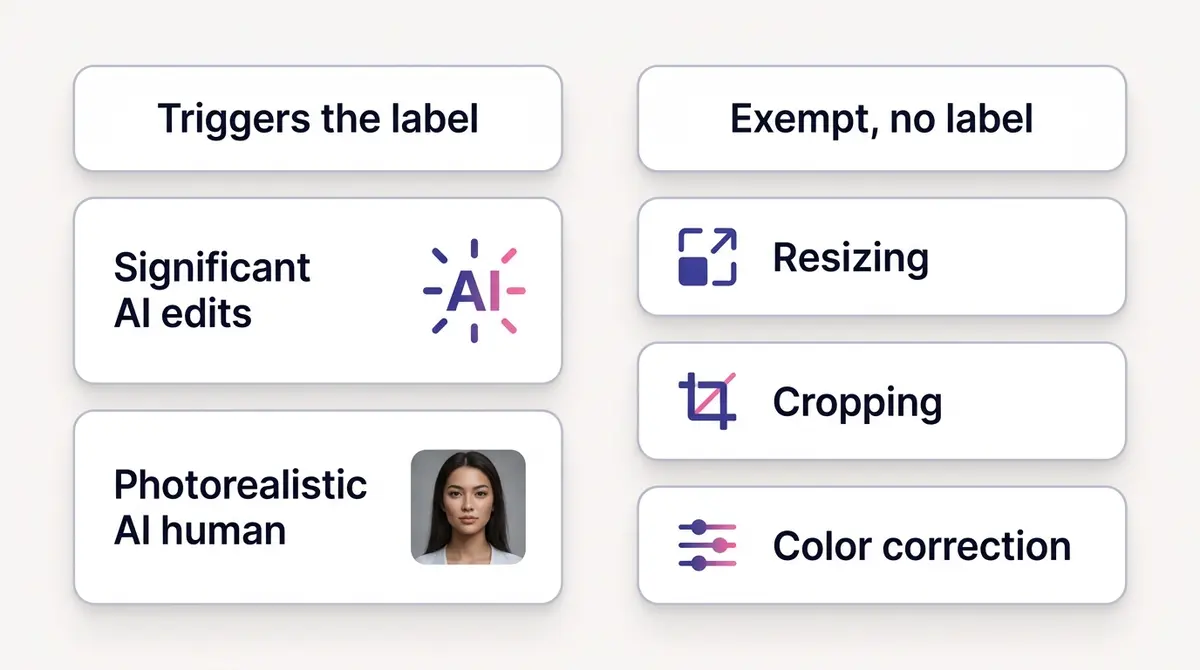
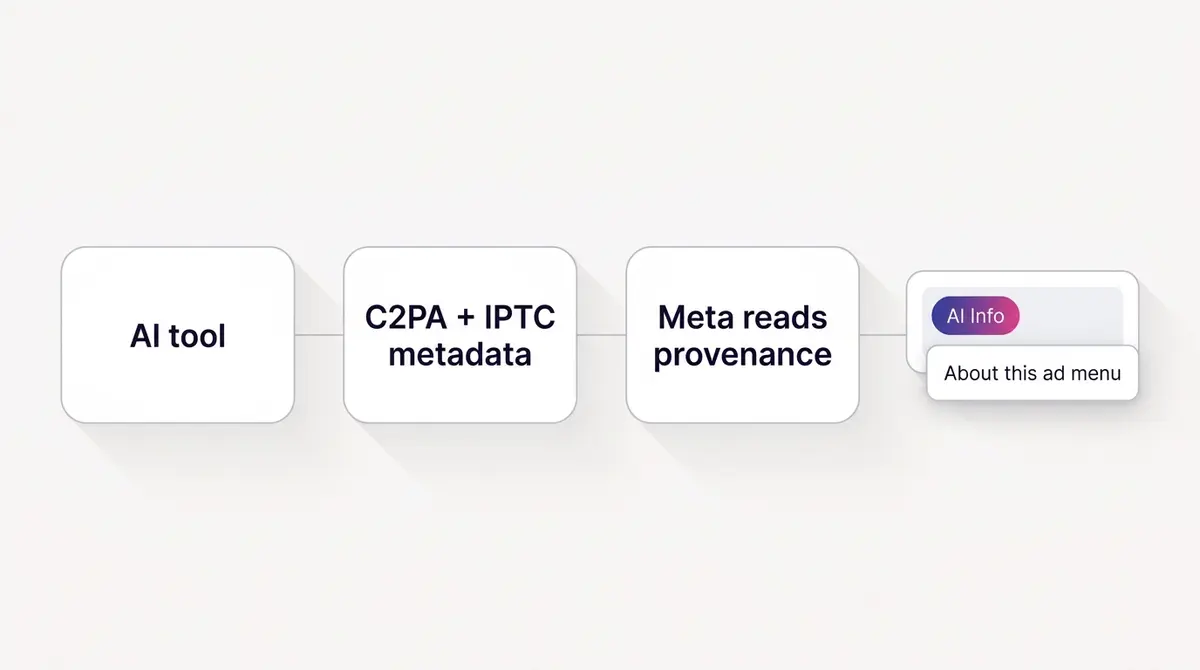
Meta auto-applies an AI Info label (renamed from 'Made with AI' on July 1, 2024, per TechCrunch) when an ad image or video is significantly edited with generative AI, such as a generated background or scene, or when it includes a photorealistic AI human. Minor changes like resizing and color correction get no label, and cropping is similarly routine (Meta Help Center, 2025). When a photorealistic AI human is present the label sits next to the Sponsored label on the ad face; for other significant AI edits it lives behind the three-dot 'About this ad' menu. Meta reads C2PA and IPTC provenance metadata to detect this, and from June 1, 2026 it also automatically detects ads made with third-party AI tools and labels them in 'About this ad' (Meta Transparency Center, 2026). Separate disclosure laws, the EU AI Act and California's AI Transparency Act, both take effect August 2, 2026.
You generated a clean studio shot for your next ad set, scheduled the launch, and then noticed a small AI Info tag appear once it went live. The label is not a penalty and it is not a rejection, but if you did not expect it, it feels like one. Meta now reads the provenance of your creative and tells viewers when generative AI shaped it, and the rules for what gets tagged are narrower and more specific than most marketers assume. Knowing exactly which edits trip the label, which ones are exempt, and where the tag appears lets you decide your disclosure posture before you hit publish instead of discovering it in the feed.
What the AI Info label is, and what it is not
The AI Info label is Meta's way of telling viewers that generative AI shaped an image or video they are looking at. It is a transparency marker, not a strike against your account. The label began life under a blunter name. Meta started rolling out AI-content labels in May 2024 (Meta Newsroom, 2024), branding them "Made with AI" based on industry-standard AI indicators, as it moved from a removal-based policy to a label-based one. Within weeks, photographers pushed back: a photo with a small AI-assisted edit was getting the same prominent "Made with AI" tag as a fully synthetic image, which misrepresented the work. Meta listened and renamed the tag to "AI Info" on July 1, 2024 (TechCrunch, 2024). The detection technology underneath did not change; only the wording softened.
That history matters because it tells you what Meta is optimizing for. The system is built to flag AI involvement at a glance while leaving room for nuance. The rename was an admission that "small edits can trigger it" is a real failure mode, and Meta's later guidance narrows exactly where the line falls. So the first thing to internalize: this is a disclosure layer, applied automatically, that you can plan around. Treat it the way you treat the Sponsored label. It is information, not punishment.
The label also reflects a deliberate policy shift. Before May 2024, Meta's default response to certain manipulated or AI media was removal. The move to labeling traded a binary keep-or-delete decision for a softer middle path: let the content run, but tell viewers what they are looking at (Meta Newsroom, 2024). For advertisers, that shift is good news. It means AI creative is welcome on the platform, with disclosure as the price of admission rather than a wall. The practical question stopped being "will my AI ad be allowed" and became "what will viewers be told about it, and where." Once you frame the label that way, it slots neatly into the same mental category as any other piece of ad metadata you already manage.
One caveat keeps that framing honest: labeling did not replace removal across the board. Meta has said it will still remove content, whether a person or AI made it, when it breaks the rules against voter interference, bullying and harassment, violence and incitement, or any other policy (Meta Newsroom, 2024). Debunked claims and harmful manipulated media are taken down or shown to fewer people, not simply tagged. So the label is the default outcome for ordinary AI creative, not a blanket substitute for enforcement. A genuinely policy-violating asset does not get to run just because it carries a disclosure, which is one more reason to keep the label question and the broader policy review separate in your head.
The label is also separate from Meta's broader ad policies. Your creative still has to clear the normal review for misleading claims, prohibited content and restricted categories, which the Facebook ad policies guide covers in full. The AI Info label answers a different question: not "is this ad allowed" but "did AI make or significantly edit this." Keeping those two questions separate in your head prevents a lot of confusion when an ad sits in review.
The AI labeling timeline at a glance
The policy did not arrive in one piece. It rolled out, got renamed, widened in scope, and then collided with new laws, across about two years. Here are the dates that actually matter, in order:
| Date | What happened |
|---|---|
| May 2024 | Meta begins rolling out AI-content labels under the name "Made with AI" (Meta Newsroom, 2024) |
| July 1, 2024 | The tag is renamed to "AI Info" after photographers said lightly edited photos were over-flagged (TechCrunch, 2024) |
| September 5, 2024 | Meta joins the C2PA Steering Committee, deepening its provenance commitment (C2PA, 2024) |
| February 2025 | Meta publishes its plan to auto-detect third-party AI tools in ads (Meta Newsroom, 2025) |
| June 1, 2026 | That third-party detection goes live: Meta detects ads made with non-Meta AI tools and labels them in "About this ad" (Meta Transparency Center, 2026) |
| August 2, 2026 | EU AI Act Article 50 disclosure duties and the California AI Transparency Act core requirements take effect (EU AI Act, 2026; Hintze Law, 2025) |
The single most important shift for planning in 2026: third-party detection is no longer a promise. As of June 1, 2026, Meta actively scans for the provenance signals that AI tools leave behind, whoever made them, and applies the label automatically (Meta Transparency Center, 2026). The rest of this guide reads against that live state, not the older "we plan to" framing, and the regulatory dates at the bottom of the table are why the label is now only half the story.
The two triggers that auto-apply the label
Meta's February 2025 newsroom post on GenAI transparency for ads, read alongside its Help Center, gives a clean two-part rule. A Meta ad gets the AI Info label when either condition is true:
- The image or video was created or significantly edited with generative AI. "Significant" means generating new content: a new background, a generated scene, an AI-built product environment.
- The ad includes a photorealistic human generated by AI.
If neither is true, no label is applied. That is the part most marketers miss. The trigger is the content of the creative itself, not how the campaign is run. Running an Advantage+ campaign does not add a label on its own, and using an AI tool to make a routine adjustment does not either. What matters is whether the pixels a viewer sees were generated or significantly altered by AI.
The photorealistic-human trigger is worth singling out because it is the one most likely to surprise an ecommerce advertiser. A generated model face, a synthetic spokesperson, an AI-built person holding your product: all of these flip the ad into AI Info territory by themselves, regardless of how the rest of the creative was made. A brand like Medicube running a glossy close-up where the face is AI-rendered to look like a real model would see that ad labeled, because the photorealistic human is the trigger. That is not a problem to avoid; it is a posture to plan. The fix is to know the face is synthetic before launch, not after.
What is exempt: the edits that stay unlabeled
Meta's Help Center (2025) names the carve-out explicitly: minor changes like image resizing and color correction do not get an AI Info label, and cropping is treated as the same sort of routine adjustment. These count as adjustments to an existing real image, not generative changes, even if you used an AI-powered tool to perform them. The principle behind the line is consistency: Meta labels when AI generates new content, not when it tidies up content that was already real.
This is the most practical knowledge in the whole topic, because it tells you how to keep a genuinely real asset unlabeled. A real product photo that you crop to fit a placement and color-grade for brand consistency stays clean. The moment that same photo is dropped into a fully generated studio backdrop, the edit becomes significant and the label applies. A brand like Skinlycious swapping a plain product shot into an AI-generated studio scene crosses that line; the same product simply cropped and color-corrected does not. The asset is identical; the edit is what Meta reads.
Here is the line laid out so you can sort your own assets fast:
| Edit | Labeled? | Why |
|---|---|---|
| Resize or crop a real photo | No | Routine adjustment, no new content generated |
| Color correction on a real photo | No | Tidies an existing real image |
| AI-generated background or scene | Yes | Significant edit, new content generated |
| AI fill or retouch that alters the subject | Yes | Significant generative edit |
| Photorealistic AI-generated human | Yes | Triggers the label on its own |
| Synthetic AI voiceover in a video | Yes | AI-generated media in the ad |
The takeaway is not "avoid the right column." Plenty of high-performing creative lives there. The takeaway is that the right column ships with a label by design, so you treat that as the plan rather than a surprise. Sorting assets into these rows before launch is the difference between a planned disclosure and an undisclosed-AI flag.
One subtlety trips people up: the tool you used does not decide the outcome, the change does. Marketers often assume that touching an AI-powered editor at all means a label. It does not. The same generative suite can resize a photo (no label) and generate a scene (label) in the same session. Meta is judging the nature of the edit recorded in the file's provenance, not the brand of software on your screen. So when you audit a campaign, ask of each asset, "did this create new visible content, or adjust content that was already real?" That single question maps almost perfectly onto the labeled-versus-exempt split, and it scales to any tool you might add to your stack later.
Where the label appears, and why placement matters
Once an ad qualifies for the label, Meta decides where to put it, and the two placements behave very differently. When the ad includes a photorealistic AI-generated human, the AI Info label sits next to the Sponsored label on the face of the ad (Meta Newsroom, 2025), visible to every viewer without a tap. For other significant AI edits, the label lives behind the three-dot "About this ad" menu, which a viewer has to open to see. Either way, the label is not a setting. It is applied automatically from the creative's provenance, so there is no toggle in Ads Manager to switch it off, and no opt-out for an asset Meta reads as AI. The only control you hold is upstream, in what you choose to generate, not downstream once the ad is live.
That split is easy to get wrong in your head. It is tempting to assume the tag is either always visible or never visible, but it is conditional. A generated human face is the strongest disclosure case, so Meta surfaces it. A generated background, which is a softer form of AI involvement, gets the quieter treatment behind the menu. For your planning, that means the most visible label is reserved for the creative that most looks like a real person who is not one. If you are weighing whether to use a synthetic face, factor in that the disclosure will be on the surface, not tucked away.
Meta has at times tested swapping the "Sponsored" wording for a simpler "Ad" label, so if you are writing internal documentation, keep the reference generic ("next to the ad label") rather than betting on one exact word. The behavior that matters, the AI Info tag sitting beside whatever the paid-content label is, is stable.
How Meta detects AI, and the C2PA backbone
Meta does not eyeball your creative to guess whether AI made it. It reads metadata. The detection runs on two industry standards: C2PA and IPTC (TechCrunch, 2024). When a participating AI tool generates or edits an image, it can embed tamper-evident provenance data in the file, and Meta reads that signal to apply the label. This is the same plumbing whether the creative came from Meta's own tools or a third party.
A note on terminology, because it gets muddled. C2PA is the coalition and the standard. Content Credentials is the tamper-evident metadata implementation built on that standard. IPTC is a separate, older metadata schema Meta also reads. They are not interchangeable. Meta's commitment to this approach is deepening: it signed onto Content Credentials in early 2024 and then joined the C2PA Steering Committee on September 5, 2024 (C2PA, 2024), giving it a governance seat in how provenance metadata evolves.
The detection scope widened in two steps. Meta first published its plan in February 2025 to automatically detect ads created or edited with third-party AI tools, not just its own (Meta Newsroom, 2025). That detection went live on June 1, 2026: from that date Meta scans for the same industry-standard signals in any ad and applies the AI Info label in "About this ad" (Meta Transparency Center, 2026). The practical implication: you cannot count on dodging the label by generating outside Meta's own tools. If the provenance metadata says AI, the label can follow. This is exactly why knowing which of your assets carry AI provenance beats guessing after the fact. For a fuller picture of how AI fits into the whole creative workflow, the AI for Facebook ads guide covers the production side.
Why detection has blind spots: provenance can be stripped
Metadata-based detection is strong, but it is not airtight, and it pays to understand the gap so you plan around it rather than gamble on it. C2PA provenance lives inside the file as a manifest, and that manifest can be removed. The C2PA standard says so plainly in its own security notes: it offers no protection against the complete removal of a manifest from an asset, and it lists manifest stripping as a known threat (C2PA, 2026). In ordinary handling the data simply falls off. Re-encoding a file, converting its format, or taking a screenshot can drop the embedded credentials, and many upload pipelines recompress an image in ways that destroy the manifest. So an AI asset can, in principle, arrive without the signal that would have triggered the label.
That does not make stripping a strategy. Two things close the gap. First, Meta reads more than one signal: alongside visible metadata it works with invisible markers and IPTC fields, and it has said it is building detection for the AI markers other companies' tools embed (Meta Newsroom, 2024). Second, the disclosure duty does not depend on whether detection caught you. The political-ad rule and the laws covered below put the obligation on the advertiser regardless of what survived in the file. The honest read: treat the label as the expected outcome of shipping generative creative, plan your disclosure on purpose, and never build a workflow that quietly relies on metadata falling off.
The ad label is not the "Imagined with AI" watermark
Marketers conflate two different things Meta does, and the distinction changes what a viewer actually sees. The AI Info label is an ad-level disclosure: it sits next to the paid-content label or behind the "About this ad" menu, and it tells people AI shaped a piece of sponsored creative. The "Imagined with AI" watermark is a consumer-product marker: Meta adds it to photorealistic images people generate with the Meta AI feature itself, as a visible tag on the image, alongside invisible watermarks and metadata (Meta Newsroom, 2024). One is about an ad. The other is about an image a person made in a Meta AI surface.
| AI Info label (ads) | "Imagined with AI" (Meta AI images) | |
|---|---|---|
| Applies to | Sponsored ad creative shaped by AI | Photorealistic images generated with Meta AI |
| What a viewer sees | A tag by the ad label or in "About this ad" | A visible watermark on the image plus invisible markers |
| Who controls it | Automatic, no advertiser toggle | Automatic on Meta AI output |
If you generate a base image inside Meta AI and then run it as an ad, you can meet both layers. For everyday ad planning, the one that matters is the AI Info label, because that is what appears on your sponsored creative. Do not promise a stakeholder that viewers will see a bold visible "Imagined with AI" stamp on the ad. For most ad edits the disclosure is the quieter AI Info tag, and for non-human edits it is often one tap away in the menu.
The one place disclosure is mandatory, not automatic
For most commercial ecommerce ads, the AI Info label is automatic: Meta detects, Meta applies, you do nothing. There is one category where the burden shifts onto you. For ads about social issues, elections or politics, you are required to disclose AI yourself, and Meta is specific about when. The duty triggers when synthetic media does one of three things (Meta Transparency Center, 2026):
- Depicts a real person saying or doing something they did not say or do.
- Depicts a realistic-looking person or event that does not exist, or alters footage of a real event.
- Depicts a realistic event alleged to have occurred that is not a true recording of it.
Read those together and the thread is deception: each one is about making something fabricated read as real. A cropped or color-corrected campaign photo meets none of them, which is the same line Meta draws for ordinary ads. The enforcement is sharper here than the auto-label. If you do not disclose when required, Meta rejects the ad, and repeated failures can bring penalties or restrictions on the account (Meta Transparency Center, 2026). This is a manual obligation, declared by the advertiser, and it does not wait for detection.
If you run any issue-based, electoral or political advertising, treat AI disclosure as a checkbox you tick yourself, every time relevant media is generative. Do not assume Meta's automatic detection covers you in that category. The standard ecommerce advertiser will rarely touch this rule, but it is worth knowing where the floor is. The direction of travel across the whole system is toward more disclosure, not less, and the political-ad rule is the leading edge of that.
The regulatory layer beyond Meta: the EU AI Act and California
Meta's label is a platform feature. It is not the whole of your obligation, and for a brand that sells across borders the law is catching up fast. Two regimes matter most, and both land on the same date: August 2, 2026.
In the European Union, Article 50 of the EU AI Act sets transparency duties for AI-generated content. A deployer of an AI system that generates or manipulates image, audio or video content amounting to a deep fake must disclose that the content was artificially generated or manipulated, and those duties apply from August 2, 2026 (EU AI Act, 2026). If you advertise to people in the EU with synthetic media, that disclosure duty can sit on you directly, no matter what any platform chooses to show or hide. The obligation attaches to the content and the advertiser, not to the channel.
In the United States, California passed the AI Transparency Act (SB 942). Its core requirements were first set for January 1, 2026, then moved to August 2, 2026 by AB 853, which Governor Newsom signed on October 13, 2025 (Hintze Law, 2025). The Act pushes generative AI providers to build provenance disclosures and detection tools into their products, which feeds the very signals platforms read. The net effect for an advertiser is convergence: the tools you generate with are being required to mark their output, and the places you sell into are being required to surface it.
None of this is specific to one platform, and none of it replaces the AI Info label. The practical move is to treat disclosure as a property of the creative itself, decided once at the source, so a single honest answer ("this asset is synthetic") satisfies the platform tag and any legal duty at the same time. A brand that knows which assets are AI before launch is already most of the way to compliant on every front, which is the same habit the next section turns into a checklist.
Scale: this is mainstream, not a fringe risk
It would be easy to treat AI labeling as an edge case, something that affects a handful of experimental advertisers. The numbers say otherwise. As of Meta's Q3 2024 earnings, more than 1 million advertisers had used its generative AI ad tools (Marketing Dive, 2024), and those tools produced more than 15 million ads in a single month, September 2024 (Marketing Dive, 2024). Meta also reported, directionally, that businesses using its AI Image Generation saw a 7% conversion lift (Marketing Dive, 2024); read that as a Meta-reported figure, not an independently audited benchmark.
The reason to lead with scale is that it reframes the label. When a million advertisers and fifteen million ads a month sit inside the labeling system, the AI Info tag is not a scarlet letter that marks you as an outlier. It is becoming the ambient texture of the feed. Viewers are growing used to seeing it on perfectly ordinary commercial ads. That normalization is your friend: it means a planned, honestly disclosed AI asset reads as standard practice, while the thing that still stands out, and still gets ads paused, is undisclosed AI that should have carried a label and did not.
Undisclosed AI has become a common rejection trigger as the labeling system matures. You may see vendor blogs put a precise percentage on how often it causes rejections; those figures are not traceable to any Meta or neutral primary source, so do not anchor your planning to a number. Anchor it to the principle instead: an asset that carries AI provenance and arrives without the expected disclosure is the risk, and it is entirely avoidable.
Building your disclosure posture before launch
Everything above collapses into one workflow habit: decide your disclosure posture before the ad set goes live, not after. That means keeping a simple inventory of every asset in a campaign and sorting it into three buckets. Real photos that are only cropped or color-corrected: no label, ship clean. Significant AI edits, a generated background or scene: expect the label behind the three-dot menu. Photorealistic AI humans or synthetic voiceovers: expect the label on the ad face, and decide deliberately whether that surface disclosure fits the brand.
A brand like Beyond Collagen+ shipping a UGC-style video with a synthetic voiceover knows, before launch, that the ad carries an AI Info label by design. A brand like Hexkin using AI fill to retouch skin in a before-and-after-style creative knows the same. Neither is a problem; both are planned. The failure mode is the marketer who generates a face or a scene, never logs that it was AI, and treats the label as a surprise when it appears, or worse, gets a set paused for an undisclosed asset.
This is where owning your generation pipeline pays off. When you generate AI creative you control and can edit, you know the provenance of every asset before it ships, which means you know your disclosure posture in advance. AdPlay.ai generates AI creative you own and edit, so you can sort each asset into the right bucket and walk into launch knowing exactly which tags to expect. The label stops being a mid-flight surprise and becomes a line in your launch checklist. Pair that habit with a clean read of Meta's creative enhancements, and AI disclosure turns from a rejection risk into a routine, planned-for part of shipping compliant ads.
Example ad angles
Representative hooks and formats from the category.
“Feature Callout ad for a glossy AI-rendered face that reads as a real model”
“Showcase ad for a product dropped into a fully generated studio scene”
By the numbers
Frequently asked questions
What actually triggers the AI Info label on a Meta ad?
Two things, per Meta's GenAI transparency guidance and Help Center. First, an image or video that was created or significantly edited with generative AI, where 'significant' means something like generating a background or a whole scene, not a small color tweak. Second, an ad that includes a photorealistic human generated by AI. If your creative has neither, no label is applied. The trigger is the content of the creative, not the campaign type, so running Advantage+ does not by itself add a label.
Which edits do NOT get an AI Info label?
Per Meta's Help Center (2025), minor changes such as image resizing and color correction do not earn an AI Info label, even if you used an AI-powered tool to do them, and cropping is treated as the same kind of routine adjustment. These count as adjustments to a real image rather than generative changes. The line Meta draws is between adjusting an existing real image and generating new content. A real product photo you cropped and color-graded stays unlabeled; that same photo placed into a fully generated studio scene becomes a significant edit.
Where does the label appear, and can I turn it off?
Placement depends on the trigger. When the ad includes a photorealistic AI-generated human, the AI Info label sits next to the Sponsored label on the ad face, visible without any tap (Meta Newsroom, 2025). For other significant AI edits, it lives behind the three-dot 'About this ad' menu, so a viewer has to open that menu to see it. You cannot turn the label off: it is applied automatically from the creative's provenance and is not a toggle in Ads Manager. The only real control is upstream, in deciding which assets are generative before you launch so the label is expected rather than a surprise.
When does Meta detect AI from third-party tools, not just its own?
From June 1, 2026, Meta automatically detects ads created or edited with third-party generative AI tools, not only its own, and applies the same AI Info label in 'About this ad' (Meta Transparency Center, 2026). It reads C2PA and IPTC provenance metadata embedded by participating tools (TechCrunch, 2024), and it joined the C2PA Steering Committee on September 5, 2024 (C2PA, 2024), so its reliance on that metadata is deepening. The practical point: you cannot count on dodging the label by generating outside Meta's own tools.
Do laws like the EU AI Act or California's AI Transparency Act require me to disclose AI in ads even if Meta does not label it?
Potentially yes, and that duty is separate from anything a platform does. Under the EU AI Act, Article 50 transparency obligations for AI-generated images, audio, video and deepfakes apply to deployers from August 2, 2026 (EU AI Act, 2026), so an advertiser using synthetic media for an EU audience can carry a disclosure duty of its own. In the United States, the California AI Transparency Act (SB 942) had its core requirements moved to August 2, 2026 by AB 853, signed October 13, 2025 (Hintze Law, 2025), pushing AI tools toward built-in provenance and detection. Treat the platform label as one layer and your own legal disclosure as another.
Will the AI Info label hurt my ad's performance?
There is no neutral, third-party evidence that the label itself depresses results, so treat it as a transparency signal rather than a penalty. Meta has reported directionally that businesses using its AI Image Generation saw a 7% conversion lift (Marketing Dive, 2024), which suggests AI creative can perform well even when labeled, though that figure is Meta-reported and should be read as directional. The bigger risk is not the label; it is an undisclosed AI image that triggers a manual review or rejection.
When is AI disclosure mandatory rather than automatic?
For ads about social issues, elections or politics, you must disclose AI yourself when synthetic media does one of three things: makes a real person appear to say or do something they did not, fabricates a realistic person or event that did not happen (or alters footage of a real one), or passes off generated media as a true recording of an event (Meta Transparency Center, 2026). This is a manual obligation, stricter than the automatic label, and it does not wait for detection. Fail to disclose and Meta rejects the ad; repeated failures can bring penalties on the account. Standard ecommerce ads rarely touch this rule.
How do I avoid an undisclosed-AI rejection?
Know which of your assets are generative versus lightly edited before you launch. Keep an inventory: which images use a generated background or scene, which include a synthetic human face or voice, and which are real photos you only cropped or color-graded. Do not assume that stripping provenance metadata on export hides AI: the C2PA standard itself admits manifests can be removed (C2PA, 2026), and Meta reads invisible markers too, so undisclosed synthetic media is exactly what triggers a manual review. Disclose where required, expect the auto-label where a generated human or scene is present, and never pass off a fully synthetic visual as an unedited real photo.
Sources
- 1.TechCrunch, Meta changes its label from 'Made with AI' to 'AI Info' (2024)
- 2.Meta Newsroom, Expanding GenAI Transparency for Meta's Ads Products (2025)
- 3.Meta Newsroom, Our Approach to Labeling AI-Generated Content and Manipulated Media (2024)
- 4.Meta Help Center, How AI-generated images in ads are identified and labeled on Meta (2025)
- 5.C2PA, Meta Joins the C2PA Steering Committee (2024)
- 6.Marketing Dive, Meta's generative AI tools find purchase with users and advertisers (2024)
- 7.Meta Transparency Center, Ads about Social Issues, Elections or Politics (2026)
- 8.EU Artificial Intelligence Act, Article 50 Transparency Obligations (2026)
- 9.Hintze Law, California Amends Artificial Intelligence Transparency Act (2025)
- 10.C2PA Specifications, Security Considerations (manifest stripping) (2026)
Keep exploring
Turn ad research into winning ads
Research the ads that work, generate the creative on-brand, and launch to Meta, all in one tool.
7-day free trial · No credit card required