
Facebook Retargeting: A 2026 Setup Guide
How Facebook retargeting actually works in 2026: building warm Custom Audiences, the Pixel plus Conversions API stack, excluding past buyers, and why warm creative beats audience slicing.
Updated October 2026 · Likit Sae Lee, CTO
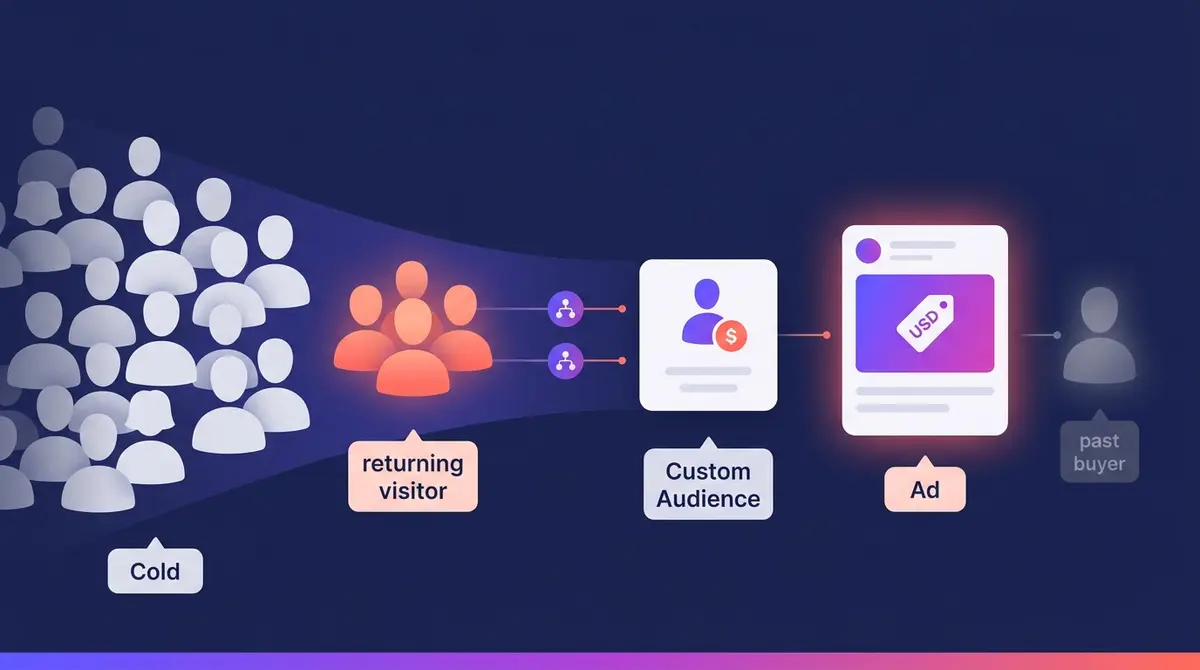
Facebook retargeting means showing ads to people who already interacted with you (site visitors, video viewers, your customer list) rather than cold strangers. In 2026 you build those warm pools as Custom Audiences fed by the Meta Pixel plus the server-side Conversions API, because iOS App Tracking Transparency (worldwide opt-in sat at 25% in April 2022, per Statista) means pixel-only retargeting under-counts the people you can reach. Meta now feeds your custom audiences into Advantage+ Audience as a starting hint and lets its Andromeda retrieval engine match a wide creative pool to each person, so the winning move is a genuinely different warm creative angle, not hand-sliced segments. A brand like Shakura can lean on a before-and-after reassurance ad for visitors who looked but did not buy, while excluding anyone who already purchased. The most-skipped step is that exclusion: stop paying to re-sell people you already converted.
Someone landed on your product page, scrolled the reviews, added to cart, then closed the tab. They are the warmest lead your budget will ever touch, and most accounts let them vanish. Retargeting is how you go back for them, but the 2019 playbook (drop a pixel, point one ad at everyone, hope) no longer matches how Meta delivers ads. In 2026 retargeting is a signal-and-creative problem more than an audience-builder one, and the accounts that win treat warm traffic as a closing layer, not an afterthought.
What Facebook retargeting actually is in 2026
Retargeting means serving ads to people who already interacted with you, against the cold audiences who never have. The interaction can be a website visit, a video view, a lead-form open, time spent on a page, or membership of a customer list you uploaded. That warm pool sits at the bottom of your funnel: these people already know the brand, so the job is no longer to introduce you but to close.
The 2026 shift is in how Meta delivers to that pool. The old approach treated retargeting as an audience-construction puzzle, slicing the warm crowd into ever-finer segments and pointing the same creative at each. Today the warm audience is built with Custom Audiences, but the matching is increasingly done for you: you feed Meta clean signal and a distinct warm creative, and the system decides who sees what. The cold, prospecting side has moved the other way, toward broad Advantage+ delivery. Retargeting is the precise, efficient counterpart: a small, high-intent layer that recaptures the traffic prospecting paid to generate.
That distinction sets up everything below. Retargeting cannot scale past the warm pool you create, so it is a closer, not a growth engine. Treat it as the last step of a sequence (cold ad introduces, your site or engagement audience captures the warm bounce, the retargeting ad closes with a different angle), and the whole structure starts to make sense.
The tracking foundation: Pixel plus Conversions API
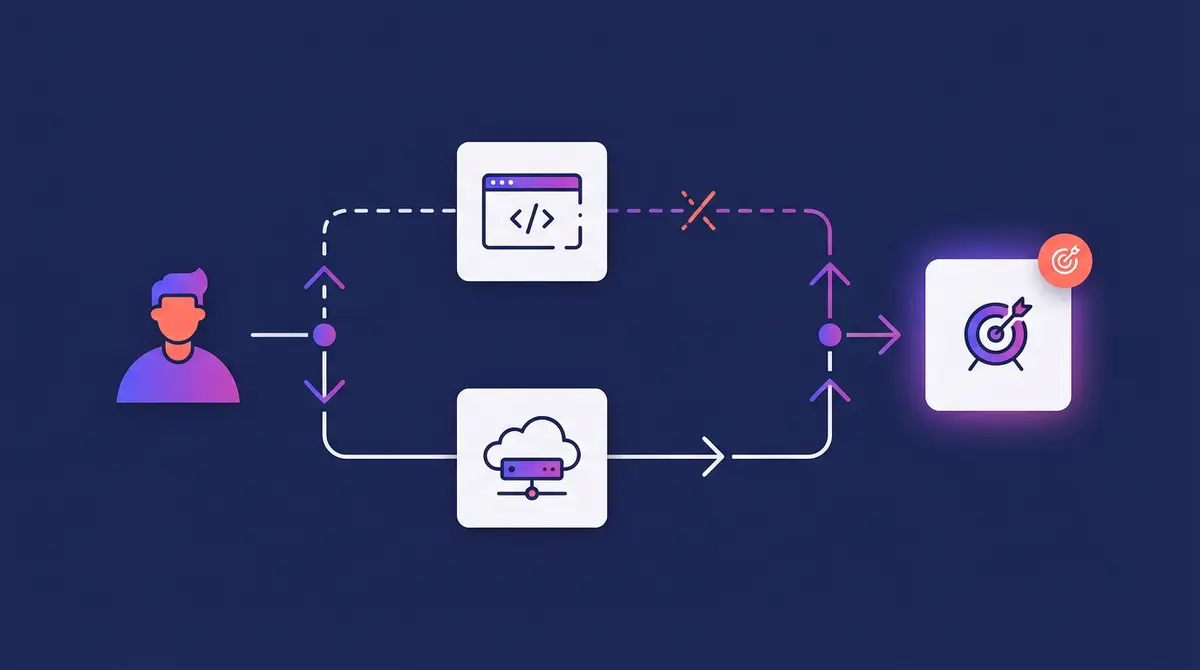
Every website-based warm audience starts with event tracking, and in 2026 that is a dual stream, not a single tag. The Meta Pixel still exists, though Events Manager now also refers to it as a dataset with a Dataset ID. The browser snippet is the Pixel; it fires from the visitor's browser when someone views a product, adds to cart, or buys. The problem is that a large share of browsers block that tracking. Apple's App Tracking Transparency let iPhone users opt out, and worldwide the opt-in rate sat at just 25% in April 2022, according to Statista. Pixel-only retargeting therefore under-counts your warm pool: a chunk of your real visitors never make it into the audience.
The fix is the Conversions API (CAPI), which sends the same events server-side, from your systems to Meta, where a browser block cannot intercept them. Pair CAPI with the Pixel and you recover much of the signal ATT removed. Meta reports that advertisers running CAPI plus Pixel for web events see 17.8% lower cost per result than Pixel-only setups; that figure is Meta's own (surfaced through PPC Land's April 2026 reporting), so read it as directional rather than an independent audit, but the direction is well established. CAPI used to mean developer work. In April 2026 Meta launched a one-click, no-code Meta-enabled Conversions API that hosts the server-side infrastructure for you, collapsing the setup that used to scare off small teams.
There is a business reason this matters more every year. Meta's Q4 2025 advertising revenue reached $58.1 billion with average price per ad up 6% year over year, per Storyboard18. As the price of reaching anyone climbs, recapturing the warm traffic you already paid to acquire is among the cheapest performance you can buy when it genuinely changes the outcome, and clean signal is what makes that recapture work.
Building your warm audiences: the Custom Audience menu
Custom Audiences are the umbrella, and they are not deprecated: they remain the building blocks of retargeting in 2026. The source types fall into a short menu, and choosing the right ones is most of the work.
| Audience source | Built from | Typical retention window |
|---|---|---|
| Website | Pixel or dataset events (page views, AddToCart, Purchase, time on site) | Up to 180 days; longer for purchase and value events |
| Customer list | Hashed emails or phone numbers you uploaded with permission | You control it; refresh every 60-90 days |
| Engagement (Page, Instagram) | People who interacted with your Facebook Page or Instagram account | Up to 365 days |
| Engagement (Video) | Video viewers, by 3-second, ThruPlay, or percentage watched | Up to 365 days |
| Engagement (Lead form) | People who opened or submitted an instant form | 90 days |
| Engagement (Events) | People who responded to a Facebook event | Up to 365 days |
(Confirm the exact current windows in Events Manager before you commit to a day count, since Meta adjusts them periodically.)
The website audience is the obvious one, but the engagement audiences quietly solve the hardest case: retargeting without a website. A local gym does not need a pixel to build a warm pool. Desire Gym or a brand like Fitness Achievers can retarget the people who watched a class clip or engaged with the Instagram page over the past year, then serve that curious crowd a trial offer. Video viewers in particular are the warm pool most service brands underuse: someone who watched 50% of your demo is a real lead, with no site visit required.
Customer-list audiences are the other underused asset. Upload hashed contacts from people who gave permission, accept Meta's Custom Audience terms, and refresh the list every 60 to 90 days because contact data goes stale and match rates decay. In 2026 the smartest use of a customer list is often not to retarget it directly but to feed it as a seed to Advantage+, where it shapes prospecting rather than just re-touching a list you already own.
Advantage+ Audience and the death of detailed targeting
If you last set up retargeting a few years ago, the audience screen has changed underneath you. Advantage+ Audience is now the default for most objectives. Instead of hand-building a stack of interests, lookalikes, and custom audiences, you hand Meta your custom audiences as audience suggestions, a starting hint, and the system can expand beyond them when it predicts better results elsewhere. The old manual path still exists, now labeled original audiences.
Two related changes sharpen the point. Detailed-targeting exclusions were removed, and on 15 January 2026 Meta stopped supporting deprecated and sensitive detailed-interest categories, so the granular interest stacking that used to define audience setup is largely gone. Meta cited a 22.6% median improvement in cost per result in its testing when it pushed advertisers off that manual narrowing, per Social Media Today; again, that is Meta's own framing for a change that benefits Meta, so weigh it as directional. The broader signal is unmissable: more than $60 billion in annual run-rate now flows through Meta's end-to-end AI ad tools as of Q3 2025, per PPC Land. The platform is betting hard that machine matching beats human slicing.
Here is the trap to avoid. It is easy to read "detailed-targeting exclusions removed" as "you can no longer exclude people," which would break retargeting. That is wrong. The removal applied to interest exclusions. You still exclude audiences, including past purchasers, at the custom-audience level. Lookalike Audiences also still exist, though they are de-emphasized in favor of feeding seed lists to Advantage+. The net effect for retargeting: spend less energy carving audiences and more on the two things that still move results, clean exclusions and distinct creative.
Catalog ads: show people the exact item they viewed
If you sell products from a catalog, the single highest-leverage warm ad on Meta does something a static cannot: it shows each visitor the exact item they looked at, pulled automatically from your product feed. This is the format Meta long called dynamic product ads and renamed Advantage+ catalog ads (the catalog feed, the pixel signal, and the optimization engine are the same; the label and the automation defaults are what changed). You connect a product catalog, map your pixel events (ViewContent, AddToCart, Purchase) to the matching products, and Meta assembles a personalized ad per person: the shoe someone viewed, the items left in a cart, or related products it predicts they will want next.
Per Meta's documentation, the classic retargeting setup targets people who viewed or added a product but did not buy, which is the exact warm pool this guide is about, rendered at the product level instead of one generic creative for everyone. A store with hundreds of SKUs cannot hand-build a warm ad per item, and a single "come back" creative ignores what the person actually wanted. The catalog ad closes that gap with the live image and price of the thing they were already considering, which is the most specific reminder you can serve. It is also the one warm format that needs the catalog plumbing in place first, so if you sell physical products and have not connected a feed, that is the build to prioritize. The setup and the format go deeper in setting up a Meta product catalog and Facebook dynamic product ads. For lead generation, local services, or a single-product brand, catalog ads are optional and the warm audiences above carry the work.
The abandoned-cart play
Cart abandonment is the canonical retargeting job, and the numbers explain why. The Baymard Institute, aggregating 50 studies from 2006 to 2025, puts the average documented online cart abandonment rate at 70.22%. Roughly seven in ten people who start a cart leave without buying, and most are not rejecting the product: they hit a shipping cost, a forced account sign-up, or simple distraction. That makes them the warmest, cheapest sales you can win back, because you are not introducing anything, you are removing the small thing that stopped a half-decided buyer.
The recapture ad does three jobs at once: it reminds the person of the exact item (a catalog ad does this automatically), it answers the objection that likely stalled them (free shipping, easy returns, a guarantee, a low-stock warning), and it gives a reason to act now. Build the audience from your AddToCart event, or InitiateCheckout, which is hotter still, and exclude anyone who fired Purchase so the ad only chases the people who genuinely stalled. The full build, including how to tier abandoners by recency, lives in the Facebook abandoned-cart ads guide. One honest caution on the offer: a discount or free-shipping code reliably lifts recovery, but lean on it too hard and you train shoppers to abandon on purpose, because they learn a coupon always follows. Use the incentive where it changes a decision, and prefer a non-price nudge (low stock, the review wall, a shipping guarantee) where the hesitation is reassurance rather than money.
Pick the objective, then pin delivery to your warm list
Two settings decide whether a retargeting campaign actually spends on your warm pool, and beginners miss both. The first is the objective: run retargeting on the Sales objective, optimized for the Purchase event (or your real money action), not Traffic or Engagement, which buy cheap clicks that never check out. Meta's guidance is that the Sales objective is built to find the people most likely to complete the event you optimize for, and a warm audience is exactly who it converts fastest. The 50-event learning rule still applies, so if purchases are too rare for a small warm pool, optimize for a higher-funnel event such as AddToCart and read the ad set on cost per result.
The second setting is delivery containment, and it changed with Advantage+. Because Advantage+ audience treats your custom audience as a suggestion it can expand past, leaving it on the default can spend your retargeting budget on cold strangers who merely resemble your warm list. When you genuinely need to talk only to people who already visited, switch to original audiences (the toggle reads "Switch to original audience options") and set the custom audience as the included audience. Expect Meta to show a reach or performance warning when you narrow like this; that is the system flagging a smaller pool, not an error. A clean warm-retargeting ad set then looks like this:
- Objective: Sales, optimizing for Purchase (or AddToCart if purchases are sparse).
- Switch to original audiences so delivery is pinned to your list.
- Include the warm Custom Audience: site visitors, AddToCart, video viewers, or your customer list.
- Exclude recent purchasers and converters at the audience level.
- Leave placements on Advantage+ and let creative, not hand-picked spots, do the work.
You can vary the message by intent tier without building ten ad sets. Map the warm pool to the right reminder instead:
| Warm tier | Recency that suits it | The message that closes |
|---|---|---|
| Cart or checkout abandoner | 1 to 14 days | The exact item, the stalled objection answered, a reason to act now |
| Product or category viewer | 7 to 30 days | Proof and reassurance: reviews, a guarantee, the result it delivers |
| All site visitors and content engagers | 30 to 180 days | A broader brand or bestseller reminder, lighter on urgency |
| Past buyer, for cross-sell | 30 to 180 days | A complementary product, a refill reminder, or a loyalty offer |
Mind the floor and the ceiling. Meta needs at least 100 people in a source audience to build a Lookalike from it, and a warm pool of only a few hundred tends to deliver poorly and struggle out of the learning phase, so widen the retention window or consolidate sources before you split anyone by tier. At the other end, an ad account is capped at 500 custom audiences, one more reason the ten-micro-segments habit is a dead end: you run out of room and starve each slice of scale long before you run out of ideas.
The exclusion step almost everyone skips
The fastest way to waste a retargeting budget is to keep advertising to people who already bought. It is the most-skipped step in retargeting, and fixing it costs nothing.
Build a Custom Audience of recent purchasers or converters, from your Pixel Purchase event or your customer list, and exclude it from every retargeting ad set. A visitor who added to cart but did not buy should see your closing ad; a customer who bought yesterday should not see the same "still thinking about it?" message, because you are paying to annoy someone you already converted and to depress the ad set's results. This is the audience-level exclusion that survived the January 2026 changes, so it is fully supported.
Home Concept, a furniture brand, shows the pattern cleanly. Someone who viewed the RM698 queen bedroom set with 0% instalment but did not check out is the ideal target for a financing-reminder warm ad. Anyone who already bought that set is the first audience you exclude, so your budget chases the cart-abandoners and not the satisfied buyers. (That RM offer is the brand's own real example, not a budget recommendation; lead your own planning in your account currency.) The same logic applies to a jewelry buy: a brand like Bene Jewellery can retarget the person who lingered on the diamond clover necklace with an unboxing ad that reduces purchase anxiety, while excluding the customer whose order already shipped.
Excluding buyers does not mean you never speak to them again; it means you stop paying to re-sell what they already own. The same customer list is one of your best assets for a separate post-purchase campaign: cross-sell a complementary product, prompt a refill before a consumable runs out, or invite repeat buyers into a loyalty offer. Keep the two conversations apart. The acquisition retargeting ad set excludes recent purchasers; a deliberate cross-sell or replenishment ad set targets them, with a message that assumes the first purchase instead of re-pitching it. Treating buyers only as an exclusion leaves repeat revenue on the table.
Warm creative is a different ad, not the same ad
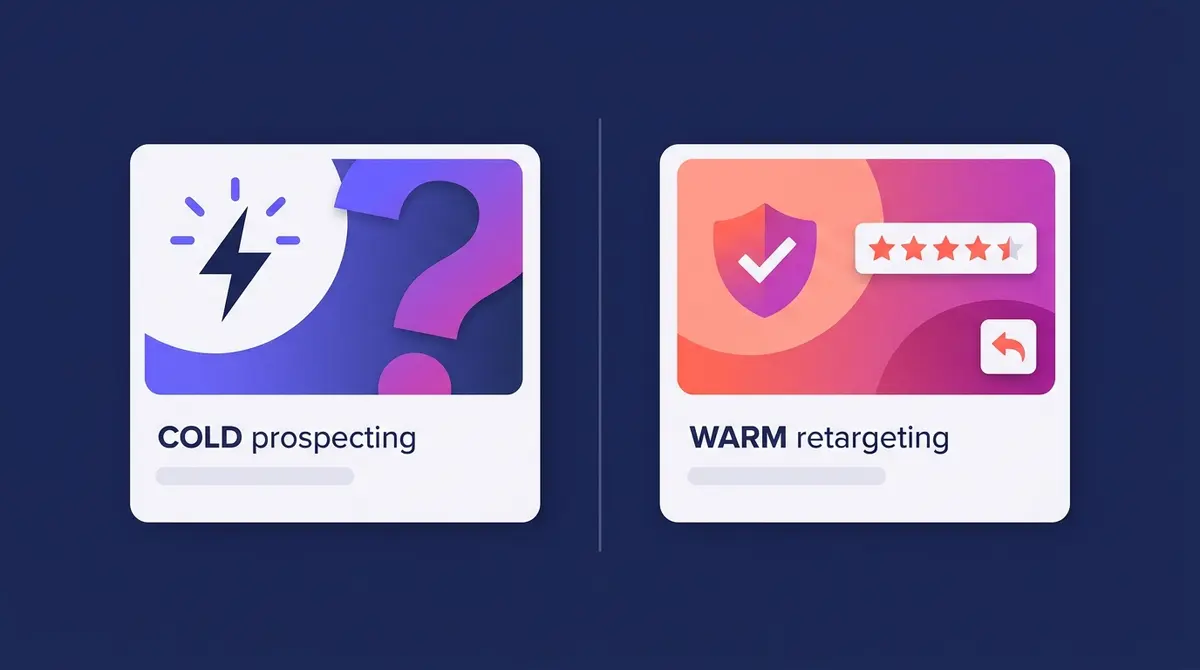
This is the lever that separates accounts that retarget well from accounts that merely retarget. The biggest mistake is serving warm audiences the same creative you serve cold ones. Cold and warm are different conversations.
Cold creative talks to a stranger: it needs a scroll-stopping hook that introduces the problem, because the viewer does not know you exist. Warm creative talks to someone who already met you: it can skip the introduction and lead with proof, a specific offer, a reminder of the exact item viewed, or objection-handling. A website visitor who looked at Shakura's pigmentation treatment but did not book is not waiting to learn that dark spots are a problem; they are weighing whether it works and whether it is safe. The warm ad that closes them is the before-and-after card showing dark spots faded without laser, the reassurance and proof angle, not the cold problem-hook that first caught their attention. That contrast (cold needs a hook, warm needs a reminder) is worth designing your two creatives around deliberately; if you want to go deeper on the hook side, see our guide to Facebook ad hooks.
The reason this matters more than ever is the retrieval engine that now sits ahead of the auction. Meta's Andromeda system, announced in December 2024, selects ads from a vast pool of candidates before the ranking auction even runs. It matches creative to people. So the way to win in 2026 is not to hand-slice the warm audience into ten micro-segments; it is to supply genuinely different warm creative for the engine to match against each person. Audience diversity has been automated. Creative diversity is the input you still own. A good test plan splits the warm and cold angles cleanly and measures each; our walkthrough on testing the warm versus cold angles covers how to structure that fairly.
Frequency, budget, and the sequence that ties it together
Warm pools are small, and small pools saturate fast. Frequency (how many times the average person has seen your ad) climbs much quicker on a few thousand warm users than on a broad cold audience, so retargeting fatigues first. A broadly safe range sits around 1.5 to 3.0; push past roughly 4 and response usually falls while costs creep up. A hard frequency cap is not a lever you have here, by the way: caps live in the Reach objective and reach-and-frequency (reservation) buying, where the default is about two impressions per seven days, not in a Sales-objective auction campaign. So with a warm audience you manage saturation by rotating the warm creative angle, not just the color or the headline. (The same people seeing the same ad is exactly why small warm pools fatigue fastest, and no targeting change cures it.)
Budget split follows from the math. Retargeting cannot scale beyond the warm pool your prospecting generates, so most 2026 accounts put the majority of spend on Advantage+ or broad prospecting to fill the funnel, with a smaller dedicated retargeting slice acting as a high-efficiency closer. Pour more budget into a small warm pool than it can absorb and you simply drive frequency up and efficiency down. The retargeting slice earns its keep on conversion rate, not on volume.
It helps to watch the right benchmarks while you do this. WordStream's 2025 figures put the average Facebook traffic-campaign CTR at 1.71% and CPC at $0.70, with leads campaigns averaging a $27.66 cost per lead (up 20.94% year over year) at a 7.72% conversion rate. Warm retargeting audiences should comfortably beat your cold campaigns on CTR and conversion rate, because they already know you; if your retargeting is not clearing your cold benchmark, the usual culprit is creative that forgot it was talking to a warm audience. Read those numbers as the market's rough middle, not a target, and judge your own warm layer against your own cold campaigns.
The structure that ties it all together is a sequence, not three separate campaigns you forget. A cold ad introduces the brand. Your website or engagement audience captures the warm bounce. The retargeting ad closes with a different angle, while excluding the people who already bought. Set up the campaign that captures this warm traffic first, then layer retargeting on top; if you need the foundational build steps, start with our Facebook ad campaign setup guide. Before you write the two angles, it is worth studying how strong brands structure their warm offers, and the Meta Ad Library is the free place to do exactly that.
Does retargeting actually deserve the credit?
Retargeting reports beautiful numbers, and that is the trap. The people in a warm pool were already likely to come back, so a warm ad often gets credited for a sale that would have happened anyway. A naive read of the dashboard makes retargeting look like free money; a mature read asks whether the spend caused incremental sales or just claimed them.
Two things distort the picture. The first is the attribution window. Meta's default counts conversions on a 7-day-click basis plus a 1-day-view window, and view-through credit flatters retargeting in particular, because warm users see your ads often and a sale gets attributed to an impression they may have ignored. In January 2026 Meta removed the longer 7-day-view and 28-day-view windows from reporting, effective 12 January, which alone cut reported conversions for some accounts. Before you judge the warm layer, know which window you are reading and read it consistently; the mechanics are unpacked in the Facebook ads attribution window guide.
The second distortion is the absence of a control. The honest test is a holdout: withhold the retargeting ads from a random slice of the warm audience, then compare conversion rates against the targeted slice. If the targeted group converts meaningfully better, the spend is incremental and worth scaling. If the two are close, the warm pool was converting on its own and the budget belongs in prospecting. You do not need to run that constantly, but running it once changes how much you trust the warm layer's headline return.
Putting it into a working routine
Retargeting in 2026 rewards a small set of habits over clever audience tricks. Wire up the Pixel and the Conversions API together so your warm pools are as complete as ATT now allows. Build the warm audiences that fit your business, website events if you have a site, engagement and video audiences if you do not, and feed customer lists as seeds rather than just re-touching them. Exclude past buyers from every retargeting ad set without exception. Then write a warm creative that is a genuinely different conversation from your cold one, and keep rotating it before frequency climbs past the point of diminishing returns.
The recurring work is producing those two distinct angles, the cold hook that introduces the problem and the warm reminder that closes, and keeping both fresh as they fatigue. That is where a platform like AdPlay.ai helps: you can research what is working in your category, generate the cold and the warm creative as separate angles, edit them, and launch both to Meta from one place, which shortens the gap between spotting a fading ad and shipping its replacement. If you want to generate those two angles quickly, our guide to AI Facebook ads shows how. The mechanics above are what make retargeting pay, but the habit is the point: feed Meta clean signal and a different warm story, exclude the people who already bought, and let the warm pool do the closing your prospecting can never afford to.
By the numbers
Frequently asked questions
What's the difference between Facebook retargeting and remarketing?
In practice they describe the same thing: showing ads to people who already interacted with your brand instead of cold strangers. Remarketing is the older, broader term (often used for email follow-up too), while retargeting is the phrase most advertisers use for paid ads served to warm audiences. Inside Meta there is no setting called either one. You build the warm pool as a Custom Audience, then run ads to it. The label matters less than the mechanic: reach the people who already raised a hand.
Do I still need the Facebook Pixel for retargeting in 2026, or is it the Conversions API now?
You want both. The Meta Pixel (now also called a dataset, with a Dataset ID, inside Events Manager) is still the browser-side tracker that builds website Custom Audiences. The Conversions API (CAPI) sends the same events server-side, which matters because iOS App Tracking Transparency means a large share of users block browser tracking (worldwide opt-in was 25% in April 2022, per Statista), so pixel-only setups under-count your warm pool. Meta reports the dual stream sees 17.8% lower cost per result than pixel-only (Meta's own figure, treat it as directional), and in April 2026 it launched a one-click, no-code Meta-enabled Conversions API that hosts the server-side infrastructure for you, so the bar to add CAPI is now low.
Can I retarget on Facebook without a website?
Yes. Engagement Custom Audiences need no website or pixel at all. You can build warm pools from people who engaged with your Facebook Page or Instagram account (retention up to 365 days), watched your videos (up to 365 days, choosing 3-second views, ThruPlay, or a percentage watched), opened a lead form (90 days), or responded to an event. For a local service business or a social-first brand, that engagement pool is often the only warm audience you need.
Should I use dynamic product ads (Advantage+ catalog ads) for retargeting?
If you sell products from a catalog, yes: it is usually the strongest warm format you can run. Dynamic product ads, which Meta renamed Advantage+ catalog ads, pull the exact item a visitor viewed or left in their cart straight from your product feed and assemble a personalized ad per person, with the live image and price. You connect a catalog, map your ViewContent, AddToCart, and Purchase events to the matching products, and Meta handles the per-person assembly. For lead generation, a service business, or a single-product brand you do not need a catalog: the warm Custom Audiences and a strong reminder creative do the same job.
What campaign objective should a retargeting campaign use?
Use the Sales objective, optimized for the Purchase event (or whatever your real money action is), not Traffic or Engagement, which buy cheap clicks that rarely check out. Meta's delivery is built to find the people most likely to complete the event you optimize for, and a warm audience is exactly who it can convert fastest. The roughly 50-event learning rule still applies, so if purchases are too sparse for a small warm pool to gather enough, optimize for a higher-funnel event such as AddToCart and judge the ad set on cost per result rather than raw volume.
What share of my budget should go to retargeting versus prospecting?
There is no fixed ratio, but the structure points one way: retargeting can only reach the warm pool your prospecting generates, so most of the budget has to fill the funnel while a smaller, dedicated slice closes it. Pour more into a small warm pool than it can absorb and you simply drive frequency up and efficiency down, because the same few thousand people see the ad on repeat. Size the retargeting slice to your warm pool rather than to a percentage you read somewhere, and let it earn its keep on conversion rate while prospecting carries the volume.
Is Facebook retargeting still worth it, and how do I know it is actually incremental?
It is worth it when it is genuinely incremental, and worth questioning when it is not. Warm audiences were already likely to return, so retargeting often gets credited for sales that would have happened anyway, and view-through attribution flatters it further. The mature check is a holdout test: withhold the ads from a random slice of the warm audience and compare conversion rates against the targeted slice. If the targeted group converts meaningfully better, the spend caused real sales and you can scale it. If the two are close, the pool was converting on its own and that budget belongs in prospecting.
Should my retargeting creative be different from my prospecting (cold) creative?
Yes, and this is where most accounts lose the value of retargeting. Cold creative needs a scroll-stopping hook that introduces the problem to people who do not know you. Warm creative can assume the problem and lead with proof, a specific offer, a reminder of the exact item viewed, or objection-handling (shipping, reviews, a guarantee). Serving your cold hook to a warm audience wastes the head start. Give Meta's retrieval engine a genuinely different warm angle to match, not the same ad with a new audience attached.
Sources
- 1.WordStream, Facebook Ads Benchmarks 2025 (2025)
- 2.Statista, iOS App Tracking Transparency Opt-In Rate Worldwide (2022)
- 3.PPC Land, Meta's Free One-Click Conversions API Is Now Live (2026)
- 4.Storyboard18, Meta Q4 2025 Advertising Revenue Surges to $58.1 Billion, Ad Pricing Rises 6% (2026)
- 5.Social Media Today, Meta Removes More Detailed Ad-Targeting Options (2025)
- 6.Engineering at Meta, Andromeda: Next-Gen Personalized Ads Retrieval Engine (2024)
- 7.PPC Land, Meta Reports 26% Revenue Growth Amid Infrastructure Spending Surge (2025)
- 8.Baymard Institute, Cart Abandonment Rate (aggregate of 50 studies) (2025)
- 9.Meta Business Help Center, About Meta Advantage+ Catalog Ads (2026)
- 10.Meta Business Help Center, About the Sales Objective in Meta Ads Manager (2026)
- 11.Meta Business Help Center, Choose Audience Settings in Advantage+ Campaigns (2026)
- 12.Meta Business Help Center, About Lookalike Audiences (2026)
- 13.Meta for Developers, Marketing API Audiences (custom audience limits) (2026)
- 14.Meta Business Help Center, Using Reach and Frequency Buying with the Reach Objective (2026)
- 15.PPC Land, Meta Restricts Attribution Windows and Data Retention in Ads Insights API (2026)
- 16.Search Engine Land, Meta Introduces Click and Engage-Through Attribution Updates (2026)
Keep exploring
Turn ad research into winning ads
Research the ads that work, generate the creative on-brand, and launch to Meta, all in one tool.
7-day free trial · No credit card required