
Facebook Abandoned Cart Retargeting Ads 2026
How to recover abandoned carts with Facebook and Instagram retargeting ads: tiered add-to-cart audiences, dynamic product ads, urgency creative, and a 48-hour recovery sequence.
Updated September 2026 · Xanny Lee, CEO

Around seven in ten online carts are abandoned, with Baymard Institute's 2025 aggregate of 50 studies putting the average at 70.22%. To recover them, build separate add-to-cart and purchase audiences from your Meta Pixel, exclude recent buyers, and serve dynamic product ads showing the exact items each shopper left behind. Fire the first ad inside 48 hours while intent is fresh, then layer urgency and proof creative over a short tiered sequence.
Most of the people who add a product to your cart never check out, and they leave with the highest intent you will ever see. A well built Facebook and Instagram retargeting sequence puts the exact product they abandoned back in front of them within hours, before the impulse cools. The work is less about clever copy and more about clean audiences, the right exclusions, and timing that respects how fast intent decays.
Why abandoned carts are your cheapest sales to win back
A shopper who fills a cart and walks away has done almost all the hard work. They found you, they chose a product, they pictured owning it. Something small got in the way at the last step, and the reason is rarely mystery: Baymard Institute's 2025 aggregate of 50 studies puts the average cart abandonment rate at 70.22%, and when you ask people why, the answers are blunt. Thirty-nine percent leave because extra costs like shipping, tax, or fees were too high. Twenty-one percent leave because delivery felt too slow. Nineteen percent abandon because the site forced them to create an account before checking out. The pool skews mobile, where shoppers bail even more often: in the third quarter of 2024 roughly 90% of carts started on a phone went unfinished worldwide, against about 83% on desktop (Statista, drawing on Salesforce data).
None of those are objections to your product. They are friction, hesitation, and timing. That is exactly why retargeting these shoppers is the cheapest acquisition you will ever run. You are not convincing a stranger that they have a problem worth solving. You are reminding a warm, half-decided buyer about the specific item they already wanted, and removing whatever small thing stopped them.
The mistake most advertisers make is treating cart abandoners as one undifferentiated blob and blasting them all with the same ad. The recoverable value is uneven. Someone who added to cart two hours ago is a very different prospect from someone who added two weeks ago and has clearly moved on. The rest of this guide is about building the structure that respects that difference, then putting the right creative in front of each tier at the right moment.
Reach the carts your email and SMS flow never can
If you sell online you probably already run an abandoned cart email, maybe an SMS too. Those owned channels are cheap and they work, so paid ads are not a replacement for them. They are the layer that reaches the shoppers your flow cannot touch, and they stay visible in places an inbox cannot.
Start with the gap an email flow leaves wide open. An abandoned cart email can only go to someone who gave you an email address, which means they reached the checkout step where you captured it or they were already a logged-in subscriber. A large share of carts never get that far. Someone browsing as a guest who bails before the contact field, or who adds to cart and closes the tab, leaves you nothing to email. Your Meta Pixel, on the other hand, recorded the AddToCart the moment it happened, no email required. That is the single strongest case for paid cart retargeting: it is the only recovery channel that reaches the anonymous, no-email-captured majority.
The two channels also do different jobs in time and attention.
| Abandoned cart email or SMS | Paid retargeting ads | |
|---|---|---|
| Who it reaches | Only shoppers who gave an email or phone number | Anyone the Pixel saw add to cart, including guests with no contact details |
| Cost basis | Near zero per send | Auction CPM, you pay per impression |
| Where it lands | Inbox or messages app, if opened | The feed, Stories, and Reels, whether or not they open anything |
| Best at | A fast, cheap first nudge to known contacts | Covering the no-email majority and staying visible for days |
In practice you run them together, not against each other. Let the owned flow fire first, because it is nearly free: a triggered email an hour or two after abandonment, an SMS to subscribers who opted in. Paid retargeting then covers everyone the flow could not reach and reinforces the ones it did, following them across Facebook, Instagram, and Reels where an unopened email cannot. The one rule worth enforcing is to avoid stacking incentives. If your email already offers ten percent off, do not also serve a paid ad with a second code, or you teach shoppers to abandon for the discount and you erode the margin on a sale you were close to making anyway. Decide which channel carries the offer, and keep the other on reminder and proof.
Build tiered audiences from add-to-cart and purchase events
Everything depends on clean signal. Your Meta Pixel, ideally paired with the Conversions API for resilience, needs to fire product-level events reliably: ViewContent when someone sees a product, AddToCart when they add it, InitiateCheckout when they start paying, and Purchase when they complete. Each of those events carries a content ID that matches your catalog, which is what makes dynamic recovery possible later. If those events are flaky, no amount of clever audience building will save you, so verify them first. Our walkthrough on getting the Meta Pixel firing correctly covers the setup and the common ways events go missing.
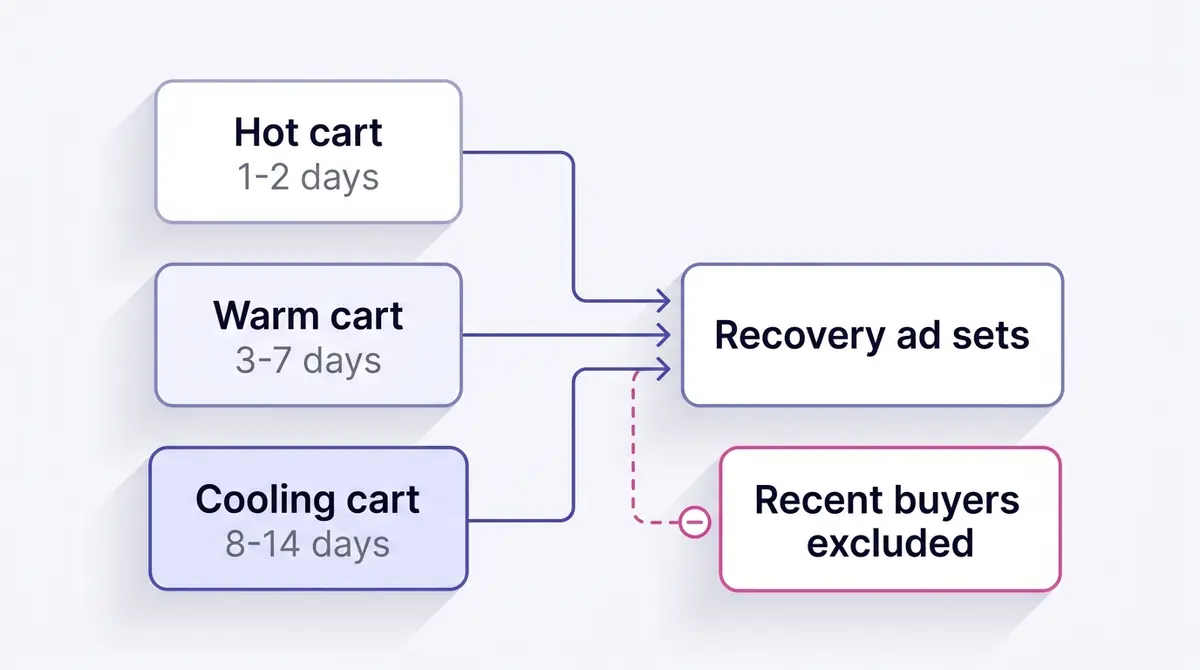
Once events are flowing, the core move is to build separate audiences by recency and by action, then combine them with exclusions. A practical structure looks like this.
| Audience tier | Window | Built from | Intent level |
|---|---|---|---|
| Hot cart | 1-2 days | AddToCart | Highest |
| Warm cart | 3-7 days | AddToCart | High |
| Cooling cart | 8-14 days | AddToCart | Moderate |
| Recent buyers | 14-30 days | Purchase | Exclude from all above |
The recency tiers matter because intent decays fast. A 1-day to 2-day add-to-cart window captures the people still warm enough that a single reminder often closes them. Wider windows are worth running, but they should carry a lighter touch and a smaller share of budget, because the further back you reach, the more browsers and accidental adds you scoop up. If you want to go deeper on how recency and behaviour shape these segments, our piece on Facebook Custom Audiences breaks down the building blocks.
There is a second split worth making inside the cart audiences themselves. Someone who added to cart and stopped is warm; someone who added to cart and then started checkout before bailing is hotter still, because they were one form field from paying. If your event volume is healthy enough to support it, carve out an InitiateCheckout segment and give it the most urgent creative and the largest budget share, since the friction that stopped them was almost certainly mechanical: a surprise shipping cost, a payment method they did not have, a forced account step. Those are the exact reasons Baymard documents, and they are fixable in a single line of ad copy.
The exclusion is the part people skip and regret. Build a purchase audience over a recent window and subtract it from every recovery ad set, so you stop paying to nag people who already checked out. For consumables a shorter exclusion lets repeat buyers re-enter sooner; for one-time purchases, a longer one keeps the experience clean. Keep these audiences dynamic so they update on their own. It is also worth excluding your hot cart audience from any cold prospecting campaign running at the same time, so a single shopper is not simultaneously chased by your recovery ads and your acquisition ads, which inflates frequency and muddies your read on which campaign actually earned the sale.
Keep a Sales campaign from quietly turning into prospecting
There is a trap built into how Meta runs the Sales objective in 2026. A Sales campaign defaults to Advantage+ audience, which treats any audience you add as a suggestion rather than a hard boundary. The system prioritizes people who match your starting hint, then expands beyond them to find other likely buyers across Facebook and Instagram (Meta, Advantage+ audience). That is exactly what you want for prospecting and exactly what you do not want for cart recovery, because a recovery campaign is only a recovery campaign if it stays inside the people who actually abandoned a cart.
So lock it down. Use the controls and exclusions that act as hard limits rather than suggestions: your recent-buyer exclusion belongs there, and so does any setting that keeps delivery inside your cart pool. If you leave your cart audience as a loose suggestion in a Sales campaign, Meta will happily spend your recovery budget on cold prospects who never saw your cart, and your reporting quietly blends recovery with acquisition. Treat the difference between a suggestion and a control as the line between a true retargeting campaign and an accidental prospecting one. Our guide to Advantage+ audience covers where each setting lives, and the broader picture is in Advantage+ Sales campaigns.
Why your cart audience is smaller than your add-to-carts
A common surprise: Ads Manager shows plenty of AddToCart events, but the audience you can actually retarget is far smaller. The usual culprit is not the attribution change covered later, it is signal loss. Browser tracking leaks events to ad blockers, Safari's tracking prevention, and Apple's App Tracking Transparency prompt, so a meaningful share of the carts your site records never reach Meta as a matchable person. The fix is the Conversions API, a server-to-server feed of the same events that sidesteps the browser entirely (Meta for Developers). Send the cart and purchase events from your backend, deduplicated against the Pixel by a shared event ID, and more of your real add-to-carts become people you can reach.
Then watch event match quality. Meta scores each server event from 0 to 10 on how well the customer information you send (hashed email, phone, name, location, click identifiers) matches to a real account (Meta for Developers). A low score means events arrive but cannot be tied to anyone, so your cart audience stays thin even with the Conversions API running. Send more identifiers, and clean ones. Our walkthroughs on the Conversions API, event match quality, and Pixel and CAPI deduplication cover the setup end to end.
Fire dynamic product ads within 48 hours
The single highest-leverage creative format for cart recovery is the dynamic product ad. Instead of designing one ad per product, you connect your product catalog and let Meta pull the exact item each shopper abandoned from your feed and render it automatically. A shopper who left a specific serum in their cart sees that serum, priced and pictured, not a generic brand banner. That relevance is the entire point, because the buyer has already decided what they want; you are just bringing it back into view.
One naming note before you go hunting in Ads Manager: Meta now labels this format Advantage+ catalog ads, the feature most advertisers still call dynamic product ads. It is the same idea renamed, and it runs in one of two modes that matter enormously for recovery. The retargeting mode shows products to people who viewed or added to cart but did not purchase, inside a lookback window you set. That is the mode a cart-recovery campaign needs. The broad mode shows catalog products to new prospects who never visited, which is prospecting, not recovery (Meta, Advantage+ catalog ads). Choosing the wrong one is the most common way a campaign labelled "cart" ends up paying to introduce strangers to your catalog. Our deeper guide to dynamic product ads walks the catalog setup, and Facebook retargeting covers the audience side.
Timing decides how much of that intent you actually capture. Aim to serve the first impression within the first 48 hours, and treat the same day as the ideal for your hottest tier. The further you drift from the moment of abandonment, the more the impulse has faded and the more likely the shopper has bought elsewhere or simply forgotten. A reminder that lands fast and shows the right product does most of the recovery work before you ever reach for a discount.
Dynamic ads also free you from the impossible task of guessing which of a thousand SKUs each person needs. The catalog does it. Your job shifts to the wrapper around the product: the headline, the primary text, the framing that answers whatever made them hesitate. Because Baymard's data tells you the top hesitations are cost and delivery, a strong default is to address those head on. If you offer free shipping over a threshold or genuinely fast delivery, say so in the ad. That single line resolves the objection that drove 39% of abandonments in the first place.
One product card is not always enough, because shoppers often abandon more than one item. When a cart holds several products, a carousel ad can show the whole abandoned set in swipeable cards, and a collection ad pairs a lead image or video with a grid of the items beneath it, opening into a fast mobile storefront when tapped. Both pull from the same catalog as a single-product ad, so you are not building anything by hand; you are choosing how much of the cart to put back in view. For a multi-item cart, showing the full set tends to beat showing one item, because it reminds the shopper of everything they were about to buy, not just the first thing.
One caution with dynamic ads: relevance is only as good as your feed. If your catalog carries stale prices, missing images, or out-of-stock items, the ad inherits those flaws and shows a shopper the wrong thing at the worst possible moment. Treat catalog hygiene as part of the campaign, not an afterthought, and audit the feed the same way you audit creative. A product card that loads a sold-out item is worse than no ad at all, because it converts fresh intent into frustration.
A skincare brand like Skinlycious illustrates the pattern well. A representative recovery angle is a short before-and-after style video showing the exact serum a shopper left in their cart, paired with the result it promises, so the product they already chose returns with a reason to finish the purchase rather than a generic plug. The dynamic card supplies the product and price; the surrounding video supplies the reason to come back today rather than someday.
Layer urgency and proof creative across the sequence
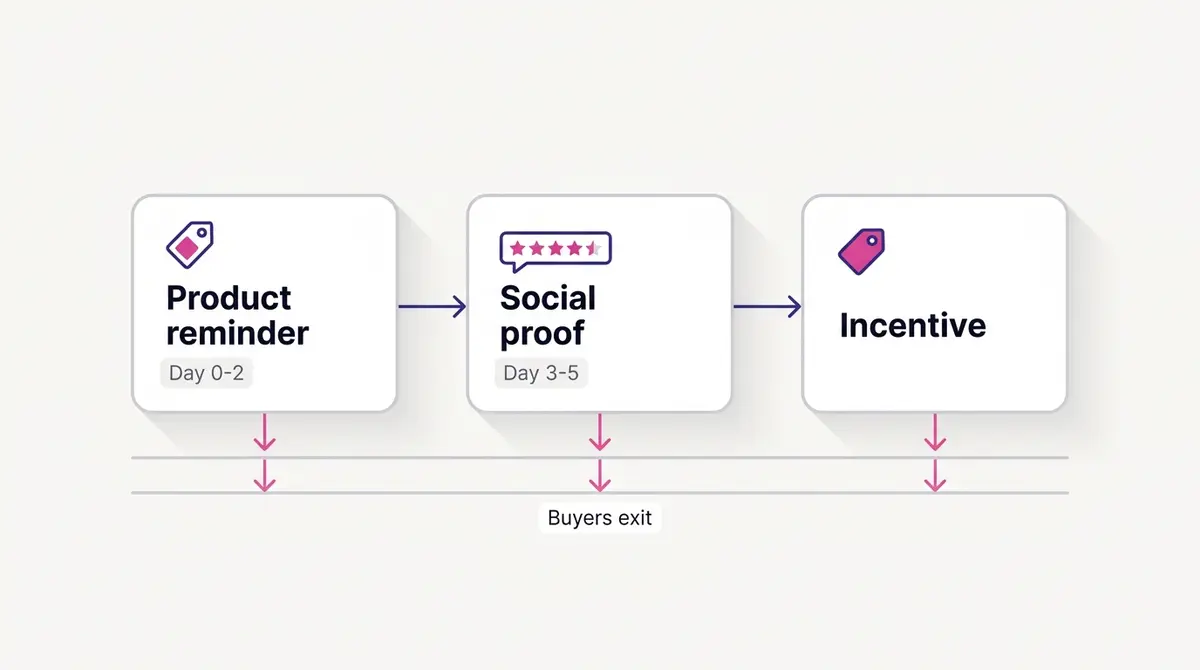
Dynamic product ads are the spine, but a sequence beats a single ad. Different shoppers hesitate for different reasons, and a short series lets you address more of them without raising frequency to fatigue levels. A clean three-step shape works for most stores.
| Step | Timing | Creative job | Typical angle |
|---|---|---|---|
| 1. Reminder | 0-48 hours | Bring the exact product back | Dynamic product ad, free shipping line |
| 2. Reassurance | Days 3-5 | Handle the objection | Reviews, returns policy, guarantee |
| 3. Incentive | Days 5-7 | Give a reason to act now | Limited offer, low stock, deadline |
The reassurance step is where social proof earns its keep. A shopper who hesitated over a higher-priced item is often looking for confidence that the product delivers and that buying is low risk. User-generated content, star ratings, and review counts answer that quietly. A collagen supplement brand such as Beyond Collagen+ might run a representative social proof angle here: a UGC style ad aimed at hesitant cart abandoners, foregrounding thousands of reviews on the exact product they nearly bought. Our guide to social proof ads covers how to assemble that kind of creative without it feeling staged.
The incentive step should be the exception, not the reflex. Leading every sequence with a coupon teaches shoppers to abandon on purpose, because they learn a discount always arrives. Reserve a real offer for the end of the window, or only for higher-value carts where the margin justifies it. A jewellery brand like Celovis shows the lighter approach: a representative showcase ad re-presenting the saved piece with free shipping and an easy returns policy spelled out, which removes friction without discounting the product itself.
Across all three steps, keep your exclusions live so buyers drop out the moment they convert, and watch ad frequency so the same person is not seeing the same product card a dozen times. There is no single official cap to chase here; the signal to watch is the trend. When frequency climbs and returns fall together, the recoverable intent in that audience is spent, and it is time to let the window close.
Set a budget for recovery, and do the math first
Cart recovery does not need a big budget, and over-funding it is its own mistake. The audience is small and finite by design: it is only the people who abandoned a cart in your window, so beyond a point extra spend just buys more frequency against the same faces. Recovery is the cheap, high-return line in the account, not where most of your money goes. The bulk of the budget belongs in prospecting, which fills the top of the funnel and feeds the cart audience in the first place. Think of it this way: prospecting grows the pool, recovery converts the warmest slice of it, so size recovery to the volume of carts you actually generate rather than a fixed percentage someone quoted you.
Translate that into a daily floor per tier rather than one lump. Each ad set needs enough budget to gather results and exit the learning phase, so a tier so starved it never collects roughly 50 conversions in a week will never stabilize. Give your hottest tier the largest share, because it converts best, and taper down the cooler windows. If a tier is too thin to fund on its own, fold it into the next one rather than running it on pennies. For where the cart pool sits against your wider account, our guide on how much to spend on Facebook ads sets the context.
A worked example makes the payoff concrete. Say your store sees 1,000 abandoned carts a month, an average order value of $80, and a retargeting campaign that recovers an extra 5% of those carts that would not have come back on their own. That is 50 recovered orders at $80, or $4,000 in incremental revenue. If chasing those carts costs you, say, $600 in ad spend across the month, the recovery line returns well over 6x on spend, before you count the lifetime value of customers you would otherwise have lost. The recovery rate here is illustrative, not a benchmark, so swap in your own numbers: carts per month, your real average order value, and a deliberately conservative recovery rate, then compare incremental revenue against spend. If the math only works at an optimistic recovery rate, lower the budget until it works at a pessimistic one. This is also why a very low average order value changes the calculus: when each recovered order is worth a few dollars, the CPM to chase it can swallow the margin, and a cheap email or SMS nudge may be the better-fit recovery channel for that store.
Measure recovery without fooling yourself
Cart recovery numbers are easy to misread, partly because the people you retarget were already likely to buy. Some share of them would have come back on their own, and a naive read of platform-reported conversions credits your ads for sales that would have happened anyway. The discipline is to judge incremental lift, not raw attributed revenue.
This got more pointed in 2026. Meta changed its attribution framework, and on January 12, 2026 it removed the 7-day view and 28-day view attribution windows from Ads Manager and the Ads Insights API, leaving 7-day click and 1-day view as the supported default. Shorter view-through credit means your reported recovery numbers may look smaller than they did under the old windows, even if the same sales are happening. That is a reporting change, not a performance drop, so do not panic and rebuild a campaign that was actually working. Our explainer on attribution windows walks through what changed and how to read results in the new framework.
Vendor benchmarks are useful as a directional sanity check rather than a target. As one reference, Klaviyo's abandoned cart benchmarks, drawn from 2023 flow data, put the average abandoned cart email flow conversion at 3.33% and the top decile at 7.69%, which tells you the spread between an average and an optimized recovery program is large. Paid retargeting sits in a different range and depends heavily on price point and offer, so the honest move is to compare each recovery cohort against itself over time. Track cost per purchase, frequency, and the trend in recovered revenue, and treat any single industry figure as context, not a scoreboard.
If you can run a holdout, do. Withhold ads from a slice of your cart abandoners and compare their purchase rate against the retargeted group. The gap is your true incremental lift, and it is the only number that tells you whether the budget is creating sales or just claiming them. A simple version costs you nothing but discipline: exclude a random 10% to 20% of your abandoner pool from the campaign for a few weeks, then look at how often that withheld group bought anyway. If they converted nearly as well as the targeted group, your ads were claiming organic recoveries; if the targeted group pulled clearly ahead, the spend is doing real work.
One more metric deserves attention: cart recovery sits downstream of cart abandonment, so the cheapest improvement is often not in the ads at all but in the reasons people leave. If 39% abandon over unexpected costs, a shipping threshold banner or a clearer total at checkout can shrink the pool you have to retarget in the first place, which lifts the whole funnel before a single recovery ad runs. Keep an eye on the abandonment rate itself alongside your recovery numbers, because a falling abandonment rate and a steady recovery rate together mean far more revenue than chasing recovery percentage alone.
A practical checklist to ship your recovery campaign
Pull the pieces together before you launch. Working through this list catches the failures that quietly drain budget.
- Confirm your Pixel and Conversions API fire AddToCart, InitiateCheckout, and Purchase cleanly, each with a content ID matching your catalog, and check event match quality so those events match to real accounts.
- Connect and clean your product catalog so catalog ads render real prices, images, and availability.
- Build tiered add-to-cart audiences (1-2 days, 3-7 days, 8-14 days) so you can weight budget toward the hottest intent.
- Build a recent purchase audience and exclude it from every recovery ad set, kept dynamic so it self-updates.
- In a Sales campaign, place your cart audience and buyer exclusion in the controls, not as loose suggestions, so Advantage+ audience cannot expand the campaign into prospecting.
- Coordinate with your email and SMS flow: let the owned channel fire first, point paid ads at the no-email majority, and never stack two discounts.
- Set the first creative as an Advantage+ catalog ad in retargeting mode (not broad), returning the exact abandoned items, with a free shipping or fast delivery line to answer the top abandonment reason, and use a carousel or collection for multi-item carts.
- Add a reassurance step with reviews or returns messaging for days 3 to 5, and reserve any incentive for the end of the window or higher-value carts only.
- Size the budget to your cart volume, give each tier enough to exit the learning phase, and check that the carts times average order value times recovery rate math clears your spend.
- Cap the sequence at roughly 7 days, watch frequency, and let the window close once returns fall.
- Judge results on incremental lift and cost per purchase under the current 7-day click, 1-day view attribution, ideally validated with a holdout.
Done well, abandoned cart retargeting is the most efficient line in a Facebook and Instagram account, because it sells to people who already chose your product. The structure matters more than the cleverness: clean events, tight audiences, ruthless exclusions, and creative that resolves the small hesitation that stopped a near-buyer the first time. Tools like AdPlay.ai can generate the urgency and proof creative for each step, but the win comes from getting the audiences and timing right first. Keep the sequence short, keep the product specific, and let the freshest intent do the work.
Example ad angles
Representative hooks and formats from the category.
“Before and After ad for the cart they left: that exact serum, with the result it promises”
“Showcase ad for the saved piece, re-shown with free shipping and easy returns spelled out”
“Social Proof ad for hesitant cart abandoners: thousands of reviews on the product they nearly bought”
By the numbers
Frequently asked questions
How soon should I show a Facebook ad after someone abandons a cart?
Treat the first 48 hours as the window where intent is freshest, and ideally serve the first impression within the first day. Intent decays quickly once a shopper has moved on, so a fast first touch tends to recover more than a polished one that arrives three days late. Build your tightest audience around a 1-day or 2-day add-to-cart window so the people most likely to convert see the product again while they still remember it. Looser windows of 7 to 14 days are useful for a second, lower-pressure touch, not the first.
What is the difference between add-to-cart and purchase audiences?
An add-to-cart audience is everyone whose Meta Pixel fired an AddToCart event in your chosen window. A purchase audience is everyone who completed a Purchase event. The point of separating them is exclusion: you want to retarget the people who added to cart but did not buy, so you subtract the purchase audience from the add-to-cart audience at the ad set level. Without that exclusion you waste budget showing recovery ads to people who already paid, which is annoying and expensive.
Do I need dynamic product ads or can I use a single static image?
You can recover carts with a single static ad, but dynamic product ads (the format Meta now labels Advantage+ catalog ads) usually do the heavy lifting because they pull the exact item each shopper abandoned from your catalog automatically. That relevance is the whole advantage of cart retargeting, since the shopper has already decided they want that specific product. A static or video ad works well as a second creative angle layered on top, carrying urgency, social proof, or a reason to act now that a plain product card cannot. When a cart held several items, a carousel or collection ad can show the whole set rather than one product.
Should I always include a discount in abandoned cart ads?
No. A discount can train shoppers to abandon on purpose because they learn a coupon always follows. Lead with the reason they hesitated instead: free shipping over a threshold, a clear returns policy, or proof that the product delivers. Reserve a real offer for a later step in the sequence, or only for higher-value carts, so you protect margin and avoid rewarding behaviour you do not want to encourage.
Can I retarget abandoned carts if the shopper never gave me their email?
Yes, and this is the biggest advantage paid ads have over an email flow. An abandoned cart email can only reach someone who already handed you an email address, which usually means they got deep into checkout or were a known subscriber. Most carts never get that far. A guest who adds to cart and closes the tab leaves you nothing to email, but your Meta Pixel still recorded the AddToCart event, so that person can enter a retargeting audience with no contact details at all. Paid retargeting is the only recovery channel that reaches the anonymous, no-email majority, which is why it layers onto an email flow rather than competing with it.
How much budget should I put into a cart-recovery campaign?
Less than your prospecting, because the audience is small and finite by design: it is only the people who abandoned a cart in your window, so past a point extra spend just buys more frequency against the same faces. Size it to the volume of carts you actually generate rather than a fixed percentage someone quoted you. Give each tier enough daily budget to gather roughly 50 conversions a week so it can exit the learning phase, weight the hottest tier highest, and fold a tier too thin to fund into the next one. Then sanity-check with the math: estimate carts per month times average order value times a deliberately conservative recovery rate, and make sure the incremental revenue clears the spend with room to spare.
How do I stop showing recovery ads to people who already bought?
Build a purchase Custom Audience from your Pixel covering a recent window, often 14 to 30 days, and add it as an exclusion on every retargeting ad set. For consumables you might exclude a shorter window so repeat buyers re-enter the funnel sooner, while for one-time purchases a longer exclusion makes sense. Keep these audiences dynamic so they update automatically as new purchases come in, rather than uploading static lists you have to refresh by hand.
What conversion rate is realistic for cart recovery campaigns?
Numbers vary widely by price point, traffic quality, and how aggressive your offer is, so treat any single figure as directional. As a vendor reference point, Klaviyo's abandoned cart benchmarks (drawn from 2023 flow data) put the average abandoned cart email flow conversion at 3.33% and the top decile at 7.69%, and paid retargeting sits in a different but adjacent range. The more useful habit is to compare a recovery cohort against itself over time, watch cost per purchase and frequency, and judge incremental lift rather than chasing a headline percentage from someone else's account.
Sources
- 1.Baymard Institute: Cart Abandonment Rate (50 studies, 70.22% average) (2025)
- 2.Contentsquare: Shopping cart abandonment statistics (70.19% across 48+ studies) (2025)
- 3.Klaviyo: Abandoned Cart Benchmarks (2023 flow data) (2023)
- 4.Meta Business Help Center: About attribution settings (2026)
- 5.PPC Land: Meta restricts attribution windows in the Ads Insights API (effective Jan 12, 2026) (2025)
- 6.Meta Business Help Center: About Advantage+ catalog ads (2026)
- 7.Meta for Business: Advantage+ catalog ads (broad and retargeting audiences) (2026)
- 8.Meta for Business: Advantage+ audience (suggestions vs controls) (2026)
- 9.Meta for Developers: Conversions API, Dataset Quality and event match quality (2026)
- 10.Meta Business Help Center: About the learning phase (roughly 50 optimization events in 7 days) (2026)
- 11.Statista: Cart abandonment rate by category and device (Q3 2024) (2024)
Keep exploring
Turn ad research into winning ads
Research the ads that work, generate the creative on-brand, and launch to Meta, all in one tool.
7-day free trial · No credit card required