
Good CPC for Facebook Ads: 2026 Benchmarks
What a good CPC for Facebook ads is in 2026, the 2025 medians by objective and industry, why there is no universal number, and the one lever that lowers it.
Updated August 2026 · Likit Sae Lee, CTO
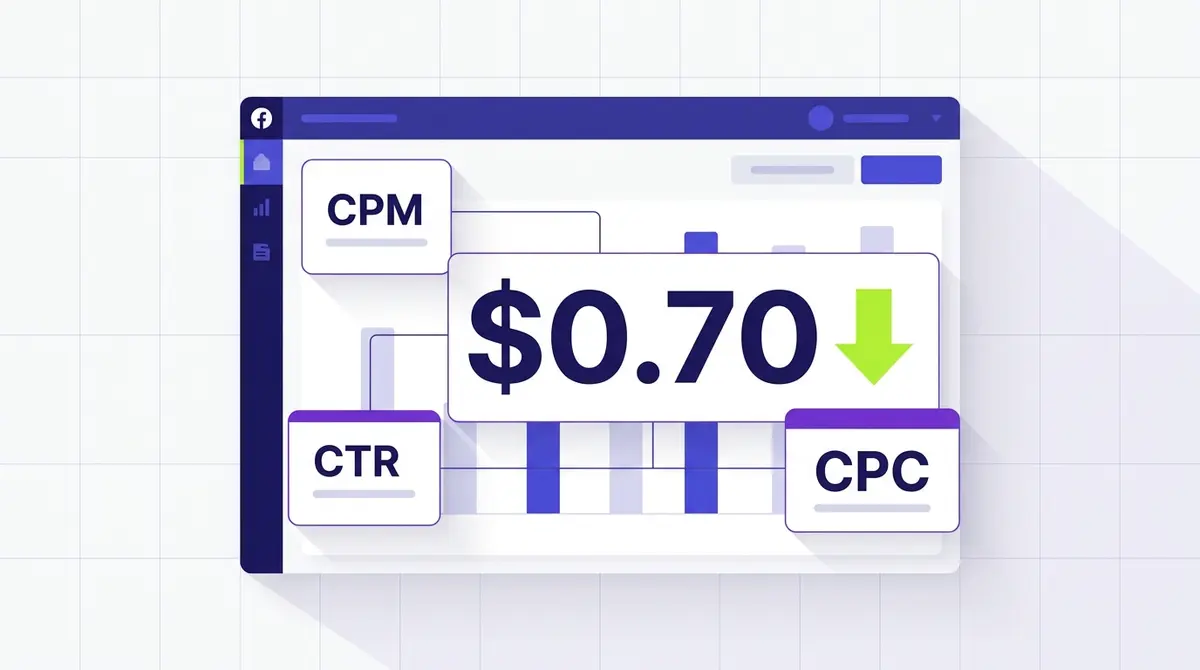
There is no single good CPC for Facebook ads, because cost per click is a downstream output of your CPM and click-through rate, not a price you set. In 2025 the US medians from WordStream were $0.70 for Traffic campaigns and $1.92 for Leads, but the spread by industry is huge: Shopping clicks averaged $0.34 while Finance and Insurance ran $1.22. The clean mechanic to remember is CPC equals CPM divided by CTR times ten, so a higher click-through rate lowers your cost per click at the same CPM. That makes creative that earns more clicks the single most reliable lever you control, since Meta's auction also rewards a more relevant ad with cheaper delivery.
Your campaign is live, the clicks are coming in, and the cost-per-click number in Ads Manager means nothing without something to compare it to. Is forty cents a steal or a fluke? Is two dollars a problem or just your industry? CPC feels like a price, but it is really an output: the auction reprices every click against your creative, your audience, and the calendar. Once you see what produces the number, judging it (and pulling it down) stops being guesswork.
Why there is no single good CPC
The honest answer to "what is a good CPC for Facebook ads" is that the question has no fixed number, and that is not a dodge. Cost per click is not a price you set in Ads Manager. It is a number the system produces after the fact, the byproduct of how much your reach cost and how often people clicked. Two advertisers running on the same day, targeting the same city, can pay wildly different CPCs because their creative earns clicks at different rates and their audiences cost different amounts to reach.
So a good CPC is always relative to three things: your industry and objective, your own trailing average, and the value each click eventually produces. A clothing brand paying forty cents a click and a law firm paying eight dollars a click can both be running healthy campaigns, because they are buying clicks from completely different markets toward completely different outcomes. Anchor to a universal "ideal CPC" and you will either panic over a normal number or feel good about a quietly failing one.
The 2025 benchmarks worth knowing
WordStream's 2025 Facebook Ads benchmarks, drawn from 554 Traffic and 726 Leads US campaigns running from April 2024 to June 2025 and reported as medians, are the cleanest neutral reference available. Across all industries, the median CPC was $0.70 for Traffic-objective campaigns, down 6.67% from $0.77 the year before, and $1.92 for Leads campaigns, up 2.13% from $1.88. Clicks aimed at simply driving traffic are cheap, and the year-over-year movement is small in both directions: there was no 2025 cost explosion at the click level.
The bigger story is the spread by industry, which dwarfs the year-over-year drift. On Traffic campaigns, Shopping, Collectibles, and Gifts had the lowest median CPC at $0.34, while Finance and Insurance topped the table at $1.22. On Leads campaigns the gap is far wider: Restaurants and Food clicked at $0.74, while Dentists and Dental Services paid $9.78, more than thirteen times as much. The pattern is consistent. Industries with high customer lifetime value and many competing advertisers, like finance, legal, and dental, bid up the cost of the same audience, so their clicks cost more before you do anything wrong.
The click-through rates underneath those costs explain why. In WordStream's data, Shopping, Collectibles, and Gifts posted both the cheapest Traffic clicks and the highest Traffic CTR at 4.13%, while on Leads, Dentists and Dental Services sat at the bottom for CTR at 1.05%. That is the formula made visible: the segment whose ads earn the most clicks pays the least per click, and the one whose ads earn the fewest pays the most.
| Objective and segment | Median CPC (US, 2025) | Source |
|---|---|---|
| Traffic, all industries | $0.70 | WordStream, 2025 |
| Traffic, Shopping & Gifts (lowest) | $0.34 | WordStream, 2025 |
| Traffic, Finance & Insurance (highest) | $1.22 | WordStream, 2025 |
| Leads, all industries | $1.92 | WordStream, 2025 |
| Leads, Restaurants & Food (lowest) | $0.74 | WordStream, 2025 |
| Leads, Dentists & Dental Services (highest) | $9.78 | WordStream, 2025 |
Two cautions before you treat these as your target. First, they are US medians, so they describe US accounts. The US is among the most contested, and so among the most expensive, Facebook markets, because more advertisers bidding for the same attention pushes the auction up; advertisers in cheaper markets, including much of Southeast Asia, typically pay materially less per click. Read the US figures as a ceiling, not a floor. Second, a median is a midpoint, not a goal: half of the campaigns in each cell paid more, and many were profitable doing so. For the full set of medians across every vertical, the benchmarks by industry guide breaks them down.
The math that explains your CPC
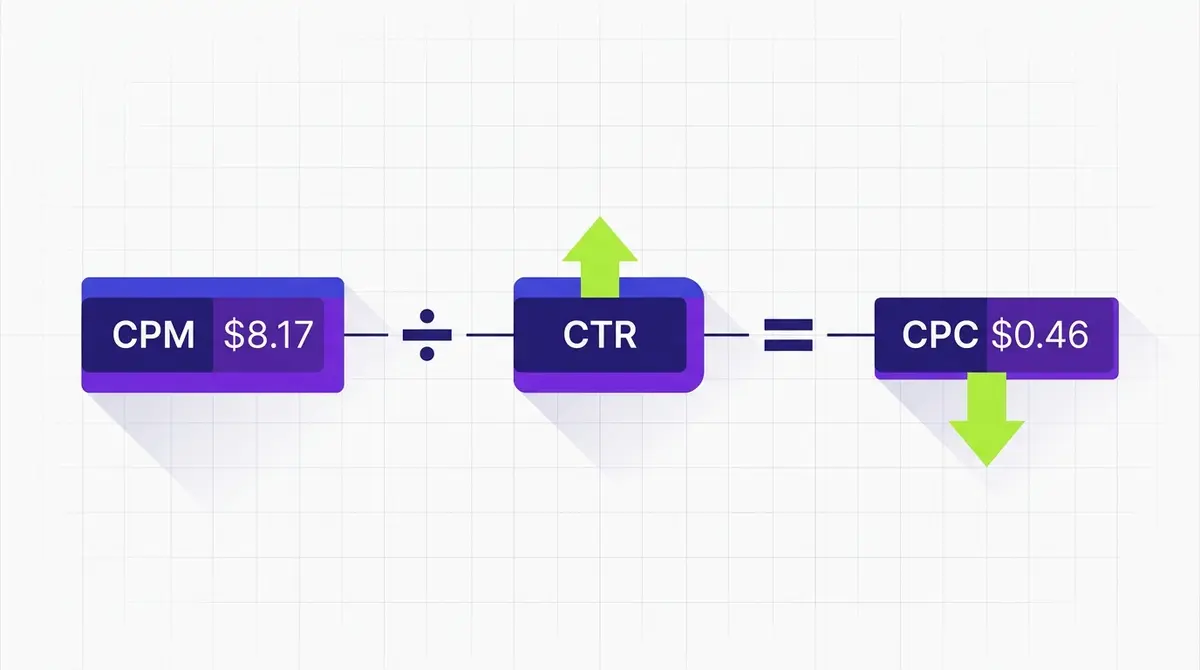
CPC is not random. It is mechanically tied to two metrics you already watch, by an identity worth committing to memory: CPC equals CPM divided by CTR times ten, when CTR is written as a percentage. Reaching people costs you a CPM, a fraction of them click at your CTR, and the cost of each click is just the cost of the impressions divided by the clicks they produced.
Run the numbers and the lever jumps out. Hold CPM steady at an $8.17 level (the Meta figure captured on Gupta Media's live tracker in October 2025) and watch what CTR alone does to your cost per click.
| CPM | CTR | Resulting CPC |
|---|---|---|
| $8.17 | 1.00% | $0.82 |
| $8.17 | 1.77% | $0.46 |
| $8.17 | 3.00% | $0.27 |
Same reach cost, same audience, same budget. Triple the click-through rate and the cost per click falls by two-thirds. That is the entire reason creative matters so much to CPC: the click-through rate is the part of the equation you can move with a better hook, and it moves the output hard.
One note on which number to read. Ads Manager reports two click metrics: CPC (all clicks) counts every click on the ad, including likes, comments, and image expands, while CPC (cost per link click) counts only clicks to your destination. Link-click CPC is the one to benchmark, because those are the clicks that can convert, and it is what neutral trackers like Gupta Media report. Add the cost-per-link-click and link CTR columns to your view, and keep your terms matched (all-clicks with all-CTR, or link-clicks with link-CTR) or the arithmetic above will look off.
The other input, CPM, drifts up over time for reasons outside your account. Meta reported its average price per ad rose 9% across the full year 2025, though ad impressions delivered grew 12% over the same period, so expanding supply partly absorbs the demand. The takeaway for CPC: the price of reaching people creeps higher year on year, so a flat CPC over time is itself a quiet win, possible only when CTR climbs to offset the rising CPM.
What CPC can your business actually afford
A benchmark tells you what other advertisers pay. It does not tell you what you can pay. The number that actually governs your account is your break-even CPC: the most you can spend on a click before the campaign stops making money. You can derive it from three figures you already know, and doing the arithmetic once turns a vague "is this click expensive?" into a hard line.
Start with what an order is worth to you. Average order value times gross margin gives the gross profit per order, the money you have to spend acquiring that order and still come out even. Multiply that by your landing-page conversion rate, the share of clicks that become orders, and you get the most you can pay per click at break-even. As a formula: break-even CPC equals average order value times gross margin times conversion rate.
The numbers below are illustrative, not live spend, but they reconcile. Say your average order value is $50, your gross margin is 60%, and your landing page converts 3% of clicks into orders. Gross profit per order is $50 times 0.60, or $30, which is your break-even cost per acquisition. Multiply by the 3% conversion rate and your break-even CPC is $0.90.
| Conversion rate (at $50 AOV, 60% margin) | Break-even CPC |
|---|---|
| 1% | $0.30 |
| 3% | $0.90 |
| 5% | $1.50 |
The table reframes everything. A $0.90 click is a disaster at a 1% conversion rate and a comfortable buy at 5%, on the same product, which is why the landing page and the offer move your affordable CPC as much as the auction does. And $0.90 is the break-even line, not the profit line, so the CPC you actually want sits below it, with the gap as your margin. Now a benchmark means something: a $0.70 traffic click looks cheap against the US median, but if your page converts at 1% on a thin margin, $0.70 is already underwater. Your ceiling is yours, not WordStream's.
How the auction actually sets your price
Behind the formula sits the auction, and it does not work the way most people assume. Meta does not hand the impression to whoever bids highest. Per Meta's own documentation, every impression goes to the ad with the highest total value, which Meta defines as your bid multiplied by the estimated action rate (the predicted chance this person takes your optimized action) plus a measure of ad quality. A more relevant ad with a higher estimated action rate can beat a richer competitor and win the impression at a lower effective cost.
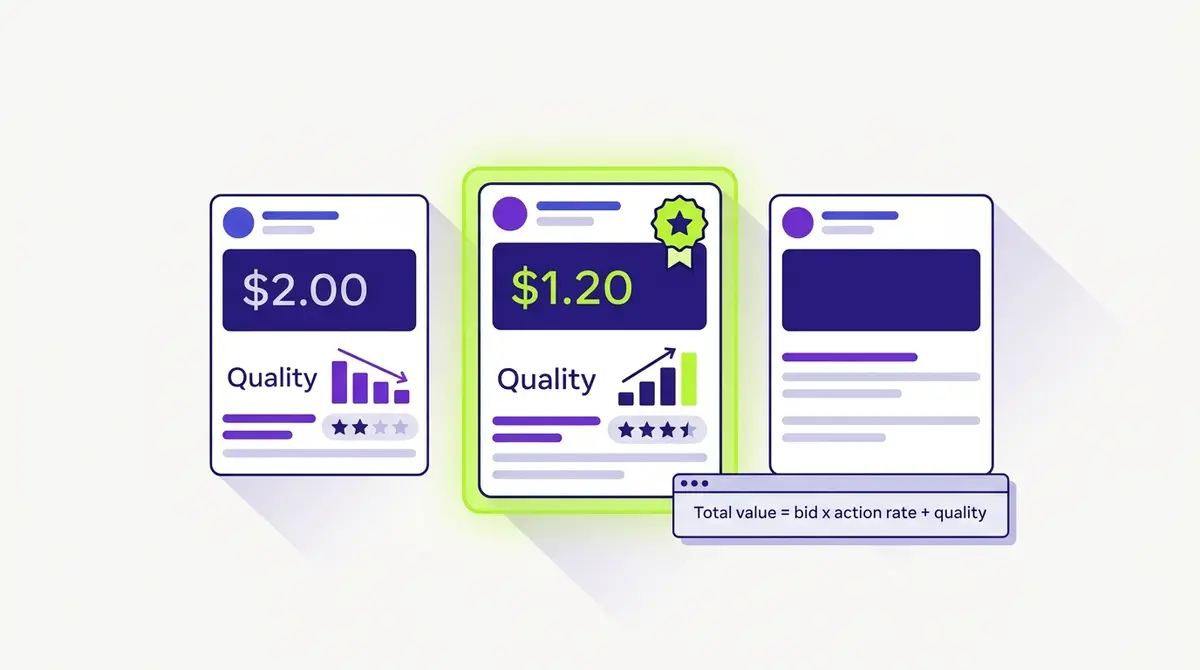
The lever inside the auction is the estimated action rate, and the strongest input to it is how people respond to your ad. An ad that earns clicks signals a high action rate, the auction values it more, and you win impressions other advertisers would have had to outbid you for. Better creative is, functionally, a discount on reach. A bigger bid does the opposite of what people hope: it can win more impressions, but it does not lower the price of each click.
Meta also tells you when weak creative is the problem. Ads Manager surfaces three ad relevance diagnostics, not the old single 1-to-10 relevance score, which Meta retired years ago. The three are Quality ranking, Engagement rate ranking, and Conversion rate ranking, each scored against the ads competing for the same audience. A below-average engagement ranking points straight at the hook and first frame; a below-average conversion ranking points past the click, at the offer or landing page. When your CPC drifts above your benchmark, these diagnostics are the fastest read on whether the creative is the cause.
Bid strategy: the dial you set, and what it cannot do
You do not set CPC, but you do choose a bid strategy, and the choice shapes how the auction spends. The default is highest volume (older accounts may still call it lowest cost): you hand Meta the budget and it gets the most results it can, bidding dynamically with no per-result ceiling. Cost per result can drift, but the system is free to chase the cheapest inventory, which is why this setting usually produces the lowest clicks. When you need a ceiling, a cost per result goal (cost cap) tells Meta the average cost you will pay and paces delivery to hold around it, while a bid cap sets the maximum bid Meta enters into any single auction. Per Meta's documentation, the bid cap reflects what you are willing to bid, not the cost you end up paying; the cost cap reflects the average cost you actually see in reporting.
The part that matters for CPC: none of these controls makes a click cheaper. A cost cap protects your cost per result by refusing the expensive auctions, but it does that by buying fewer, better-priced results, not by lowering the price of the ones you win. Set a cap too low and delivery stalls, because you have priced yourself out of the auctions that would have produced clicks. The lever that lowers the price you pay is still the creative and the relevance behind it. For when each strategy earns its place, the bid strategy guide lays out the full menu.
What strong creative does to the click-through rate
If CTR is the lever and creative moves CTR, the practical question is what kind of creative earns the click. A handful of proven angles pull different click-through rates from the same kind of product, which is exactly why two advertisers selling near-identical things can post very different CPCs.
Visual proof is the most reliable click earner. A skincare brand running a before-and-after angle on stubborn dark spots gets the kind of clear visual transformation that stops a scroll and pulls the click without a word of copy doing the work. A price anchor is a second proven lane: a high-ticket appliance store leads an air purifier ad with a sharp discount in the first frame, so the offer itself becomes the hook and the click follows the deal. Format and curiosity make a third: a gym runs a carousel that opens on an empty room and reveals it filled with equipment, a transformation hook that earns the swipe and the tap. And a low entry price lowers the friction to click at all, the lane a supplement brand works with a low-cost trial offer on an eye-health drink for new buyers.
Four different angles, four different click-through rates, four different effective CPCs, on the same platform in the same auction. None of them changed a bid. They changed the reason someone clicks, which is the only part of the CPC equation a marketer truly owns.
Format tilts the odds too. Short vertical video and carousels tend to earn more clicks than a single static image for the same offer, because movement holds attention longer and a carousel gives the scroller more reasons to tap, both of which lift CTR and pull the effective CPC down. A static image is cheaper and faster to produce, so it wins on iteration speed even when its click-through rate is lower. No format is always cheapest: run a couple against each other in the same ad set and let the CPC each one produces pick the winner. The discipline is to keep finding the angle that earns the click, then keep it fresh, because a strong hook that fatigues sees its CTR fall and its CPC climb right back up. A steady CPC depends on a steady supply of new creative, not one lucky winner.
Audience size, targeting, and the cost of over-narrowing
The instinct when CPC runs high is to tighten the audience, on the theory that a more precise target clicks more. Meta's own data says the opposite often happens. In tests where Meta removed detailed-targeting exclusions, it reported a 22.6% lower median cost per conversion, per Social Media Today, because over-constraining the audience starves the auction of the impressions it needs to find your cheapest clicks.
The targeting landscape has shifted hard toward broad in any case. Detailed Targeting still exists, but through 2025 Meta consolidated many granular interest options into broader groups and removed detailed-targeting exclusions entirely; as of January 15, 2026, legacy ad sets still relying on the removed options stopped delivering. The inputs you do set now behave more as suggestions than hard filters, and Meta positions Advantage+ audience, its AI-driven broad-targeting model, as the default path for most advertisers.
The CPC implication is direct. A pool narrowed to a few thousand people forces the auction to reuse the same impressions and bid against itself, lifting both CPM and CPC. Broad targeting paired with strong creative is now the platform-endorsed route to efficient clicks: give the system room to find the people most likely to act, and let the creative, not a tight interest stack, do the qualifying. Meta's own Advantage+ audience is built around that logic, and a disciplined approach to creative testing is how you find the angle worth scaling before you broaden.
Placement also prices your clicks
The same click costs different amounts depending on where it happens. A click in the Facebook or Instagram feed, in Reels, or in Stories comes from premium inventory: those surfaces hold the most attention and draw the most advertisers, so they carry a higher CPM and, all else equal, a higher cost per click. Clicks on the Audience Network (Meta's network of third-party apps and sites) and on Messenger tend to come cheaper, because attention there is thinner and demand is lower.
That is why opening your placements lowers CPC. Leaving them on Advantage+ (Meta's automatic placements) rather than hand-picking only the feed gives delivery the full menu of inventory, cheaper surfaces included, and routes spend toward whatever produces your result for less. Restricting to one premium placement forces every impression through the most contested, most expensive inventory. The catch is quality: a cheap Audience Network click is only a bargain if it converts as well as a feed click, so judge each placement by cost per result, not cost per click. If you are weighing whether to let Meta choose, the automatic versus manual placements guide walks the trade-offs.
Reading CPC against the rest of the funnel
CPC read alone is a trap in both directions. A cheap click that never converts is the most expensive traffic you can buy, and a costly click that purchases reliably is often the best money you will spend. The number only means something next to what happens after the click.
The clearest illustration is the gap between platforms. WordStream's 2025 data, as reported by Search Engine Land, put the average Facebook cost per lead at $27.66, up about 21% year over year, while the average Google cost per lead was $70.11. Facebook clicks are cheaper and its leads cost less than half of Google's, but neither figure tells you whether those leads close. That is the point: the cost of the click, and even the cost of the lead, is only half the equation. The other half is conversion quality, which lives downstream of anything CPC can show you.
| Metric | What it answers | Read it for |
|---|---|---|
| CPM | What do 1,000 impressions cost? | The price of reaching the audience |
| CTR | Is the creative earning the click? | The lever that moves CPC |
| CPC | What does one click cost? | Efficiency of buying attention |
| Conversion rate / CPA | Does the click turn into a result? | Whether the click was worth buying |
CPC and cost per result answer different questions, and confusing them is how money leaks. CPC is the price of a click; cost per result, your CPA, is the price of the outcome you optimize for, a purchase or a lead. A campaign can post an enviable CPC and a ruinous cost per result if those cheap clicks never convert, which is why the cost per result and the CPA benchmark are the numbers that decide whether a click was worth buying. So read the table from the bottom up: judge cost per result first, then walk back to see which metric explains it. A high CPC next to a strong conversion rate is usually a good trade; a low CPC next to a dead conversion rate is the one to kill. For the full routine, the ad reporting guide lays it out.
Why your CPC jumps in Q4 and around big sales
If your clicks suddenly got more expensive in November, the calendar is the likeliest culprit, not your creative. CPC rides on CPM, and CPM is set by demand: when more advertisers crowd the same auctions, the price of reaching anyone climbs, and your CPC climbs with it even if your click-through rate holds steady.
The fourth quarter is the clearest case. Gupta Media's tracker recorded Cyber Monday 2024 as the single most expensive ad day of the year, with a Meta CPM of $17.70, about 138% above the 2024 annualized average of $7.43; Black Friday ran $16.85. Early January, by contrast, is one of the cheapest windows, around $6.05 in January 2024. The swing from a quiet January to peak Black Friday week more than doubles the cost of the same reach, and your CPC moves with it.
The practical read: a CPC that spikes in late Q4 or around a major sale event is usually the auction, not a broken campaign. Plan your budgets and your break-even math around the higher seasonal cost rather than panicking at it, because the demand that lifts your CPM is often the same demand that lifts conversion rates. And lean even harder on creative in those windows, because when everyone's CPM is inflated, the advertiser whose CTR is highest pays the smallest premium per click.
Why your CPC spiked this week
A high CPC you have always had is an industry-and-creative question, answered by the benchmarks above. A CPC that was fine last week and jumped this week is a different problem, and it usually traces to one of a few causes you can check in order.
Start with the calendar. A sale event, a competitor's launch, or a seasonal crowd (see Q4 above) raises everyone's CPM, and your CPC rides along. If the spike lines up with a known demand window, it is the auction, not your account.
Next, check audience saturation. As an ad set runs, it shows the same creative to the same pool, frequency (the average number of times each person has seen the ad) creeps up, response falls, CTR drops, and CPC climbs through the formula. A rising frequency next to a rising CPC is the signature of creative fatigue, and the fix is a fresh angle, not a new bid. The frequency guide covers how high is too high.
Then check whether you edited anything. Changing the audience, the optimization event, the creative, or the budget by a large jump restarts Meta's learning phase, the window where delivery re-explores who responds and runs less efficiently until it gathers about 50 optimization events within roughly 7 days. CPC routinely runs high and unstable during learning, which advertisers misread as a failed ad and kill too early. If you just made a significant edit, the spike may simply be the ad set relearning, so give it the events to settle before you judge it.
Finally, check tracking. A broken Pixel or a misfiring Conversions API starves the auction of the conversion signal it optimizes on, so Meta delivers half-blind, relevance estimates slip, and the effective price of every click rises. If your CPC jumped right after a site change, a checkout update, or a consent-banner tweak, confirm your events are still firing before you touch the campaign at all.
How to judge and lower your own CPC
Put it together and the routine is short. Set the right benchmark first: judge against your own industry and objective median, not the blended average, so a $4 Leads CPC reads as alarming against the $1.92 all-industry figure but normal against the $9.78 dental one. Then work the lever you own, because CPC equals CPM divided by CTR times ten: a higher click-through rate from stronger ad hooks and fresh angles drags the cost down, while broadening an over-narrowed audience and opening placements lowers the CPM underneath it. The lower ad costs guide collects the full set of moves.
The connective tissue across all three is creative volume: enough genuinely different angles, refreshed often enough, to keep CTR high and fatigue at bay. That is the slow part of the work for most teams, and it is where a platform like AdPlay.ai helps, keeping research, on-brand generation, editing, and the launch to Meta in one place so the gap between spotting a tired ad and shipping its replacement stays short. The principle, though, does not need a tool to be true: you cannot set a good CPC, but you can earn one, one click-through rate at a time.
By the numbers
Frequently asked questions
What is a good CPC for Facebook ads in 2026?
There is no universal good number, because CPC is an output of your CPM and CTR, not a setting. As a reference point, WordStream's 2025 US medians were $0.70 for Traffic campaigns and $1.92 for Leads, but the right benchmark is your own industry and objective, then your own trailing average. A $2 click that converts at 10% beats a $0.40 click that never buys, so always judge CPC against downstream value, not in isolation.
What is the average cost per click on Facebook?
Across all industries in 2025, WordStream put the median Facebook CPC at $0.70 for Traffic-objective campaigns (down about 7% year over year) and $1.92 for Leads campaigns. Those are medians across 554 Traffic and 726 Leads US campaigns from April 2024 to June 2025, so they describe US accounts. Markets outside the US, including much of Southeast Asia, typically see lower clicks, which means a US median reads as a ceiling rather than a floor for many advertisers.
Why is my Facebook CPC so high?
Usually one of four things. Your CTR is low, so the auction charges more per click for the same CPM. Your CPM itself is elevated by season (Q4 and major sale events) or by an expensive, over-narrowed audience. Your industry is simply costly, like Finance, legal, or dental, where many advertisers bid for the same high-value people. Or your creative is fatigued, frequency climbing while clicks fall. Check CTR first, because it is the lever you control.
How do I lower my Facebook ad CPC?
You cannot set CPC directly, but the formula gives you the lever: CPC equals CPM divided by CTR times ten, so raising your click-through rate lowers your cost per click at the same CPM. Better creative does double duty, lifting CTR through the formula and improving how Meta's auction values your ad, so the effective bid to win each impression falls too. Broadening an over-narrowed audience and opening placements can lower CPM as well, which pulls CPC down with it.
How do I calculate my maximum or break-even CPC?
Work it back from your unit economics. Multiply your average order value by your gross margin to get the gross profit per order, which is your break-even cost per acquisition. Then multiply that by your landing-page conversion rate to get the most you can pay per click and still break even. As an illustrative example, a $50 order at a 60% margin leaves $30 of gross profit, and at a 3% conversion rate that puts your break-even CPC at $0.90. To actually profit, aim below that line. This is why a benchmark click can be cheap for one business and unaffordable for another.
What is the difference between CPC and CPM on Facebook?
CPM is the cost of 1,000 impressions, the price of reaching the audience. CPC is the cost of one click, the price of an action. They are linked by your click-through rate: CPC equals CPM divided by CTR times ten when CTR is a percentage. So a rising CPM raises CPC unless your CTR climbs to offset it, which is exactly why creative that earns more clicks protects your cost per click even when reach gets more expensive.
Why is my Facebook CPC rising suddenly?
A sudden jump, as opposed to a steadily high CPC, usually has a different cause than your industry. Check four things in order: a seasonal or sale-driven demand spike that lifts everyone's CPM, such as Q4 and Black Friday; audience saturation, where rising frequency drives CTR down and CPC up; a recent edit that restarted the learning phase, during which CPC runs high until the ad set gathers about 50 optimization events in roughly 7 days; and broken tracking, where a misfiring Pixel or Conversions API starves the auction of the signal it optimizes on. Match the spike to its trigger before you change the campaign.
How does Facebook decide how much I pay per click?
Meta runs an auction for every impression, and the winner is not the highest bidder. It is the ad with the highest total value, which Meta defines as your bid multiplied by the estimated action rate (how likely the person is to take your action) plus ad quality. A more relevant ad with a higher estimated action rate can win the impression at a lower effective cost. Your CPC falls out of that competition, which is why creative quality, not bid size, is the lever that moves it.
Sources
- 1.WordStream / LocaliQ, Facebook Ads Benchmarks 2025 (CPC, CTR, CPL by industry and objective) (2025)
- 2.Search Engine Land, Facebook ad costs jump in 2025, still beat Google (2025)
- 3.Gupta Media, Real-Time Social Media Ads Cost Tracker (2025)
- 4.Meta, Fourth Quarter and Full Year 2025 Results (2026)
- 5.Social Media Today, Meta consolidating detailed ad targeting options (2025)
- 6.Meta Business Help Centre, About Ad Auctions (2026)
- 7.Meta Business Help Centre, About Ad Relevance Diagnostics (2026)
- 8.Meta Business Help Centre, Updates to Detailed Targeting (2026)
- 9.Meta Business Help Centre, About Meta Bid Strategies (2026)
- 10.Meta Business Help Centre, About Cost and Bid Controls (2026)
- 11.Meta Business Help Centre, About the Learning Phase (2026)
Keep exploring
Turn ad research into winning ads
Research the ads that work, generate the creative on-brand, and launch to Meta, all in one tool.
7-day free trial · No credit card required