
Facebook Bid Strategy: Cost Cap vs Bid Cap 2026
Facebook bid strategies in 2026: lowest cost, highest value, cost cap, ROAS goal, and bid cap explained, with when to use each by stage to control CPA and ROAS.
Updated September 2026 · Likit Sae Lee, CTO

Facebook groups five bid strategies into three families. Spend-based (Highest Volume, the old Lowest Cost, and Highest Value) spends the full budget; goal-based (Cost per result goal, the old Cost Cap, and ROAS goal) and the manual Bid Cap can underspend when the target is unreachable. Start a new ad set on Highest Volume to exit the learning phase fast, then graduate to Cost per result goal to hold an average CPA, or to ROAS goal if you optimize for purchase value. Both value strategies need purchase values sent through the Pixel or Conversions API. Reserve Bid Cap for margin-critical campaigns where one overpriced result would break the model. WordStream's 2025 data put the average Facebook lead at $27.66, so map your control to the cost or return you can actually afford.
You set up a campaign, deliveries look fine for a week, then your cost per result drifts and you are not sure whether to clamp it down or leave Meta alone. The bid strategy field is where that tension lives. Picking the right one by stage, learn first then control, is the difference between a calm scale and a stalled ad set bleeding budget.
What a bid strategy actually controls
Every time your ad is eligible to show, it enters an auction against other advertisers chasing the same person. Your bid strategy is the instruction Meta carries into that auction on your behalf. It does not decide who sees the ad on its own; it decides how aggressively Meta competes for each impression and how much it cares about your cost or value target versus raw volume.
Meta sorts its five bid strategies into three families, and naming them is the mental model the rest of this guide hangs on. Spend-based strategies spend your full budget and chase either the most results or the most value: Highest Volume (the option older menus call Lowest Cost) and Highest Value. Goal-based strategies bid toward a target and will leave budget unspent rather than miss it: Cost per result goal (the renamed Cost Cap) and ROAS goal. The lone manual strategy is Bid Cap, which sets a hard ceiling on the actual bid in every auction. That spend-based versus goal-based split is the single most useful distinction here, because it predicts the one behaviour beginners get blindsided by: whether a strategy will quietly stop spending.
A naming note that trips people up: Ads Manager renamed Cost Cap to Cost per result goal in the interface, though older guides and the API still say cost cap. They are the same average-cost control, so when this guide says cost cap it means the field now labelled Cost per result goal. Do not confuse it with the cost-controlled feel of a bid cap; one manages your average, the other caps each bid.
Where you find the field depends on how your budget is set. By default the bid strategy lives at the ad set level, one per ad set. The moment you turn on Advantage+ campaign budget (the setting many still call CBO), the strategy moves up to the campaign level and every ad set in that campaign shares the one choice. If you cannot find the field, that is almost always why: it followed the budget.
The trap is treating these as interchangeable dials. They are not. Highest Volume optimizes for delivery, Highest Value for revenue, the goal strategies for a number you must hit, and Bid Cap for a hard limit. Choosing wrong does not just cost a little efficiency; the wrong control at the wrong stage can stall an ad set entirely. If you are still mapping how the auction ranks advertisers in the first place, the mechanics in our breakdown of how the Facebook ad auction works make the rest of this guide land harder.
Lowest cost: the strategy that learns
Lowest Cost is the right starting point for almost every new campaign, and the reason is structural, not stylistic. A fresh ad set has to exit the learning phase, and Meta's threshold for that is roughly 50 optimization events per ad set per week, measured over a rolling 7 day window. Below that volume the system cannot tell signal from noise, and delivery stays jittery.
Lowest cost gives Meta the freedom to bid however high it needs to in any auction to hit results cheaply. That freedom is exactly what gathers those 50 events fastest. The moment you bolt a cap onto a brand new ad set, you slow the very learning the ad set needs, because the cap can make Meta skip auctions it would otherwise have won.
This is also the cleanest example of a spend-based strategy. Highest Volume aims to use the entire budget by the end of the schedule, with no cost ceiling and no return target standing in the way. That matters because it sets up the contrast that runs through this whole guide: spend-based strategies will spend the budget, the goal-based ones further down will not if their target is out of reach. When you want maximum data fast, you want the strategy that refuses to leave money on the table.
The honest downside is variance. With no cost ceiling, your cost per result rides the market. A quiet Tuesday might deliver conversions cheaply; a competitive weekend or a seasonal demand spike pushes the same conversion higher. You accept that swing in exchange for speed and maximum delivery. If your costs are swinging more than the calendar explains, the usual culprits are budget pacing and audience size rather than the bid strategy, and our notes on why Facebook ads spend too fast cover the pacing side.
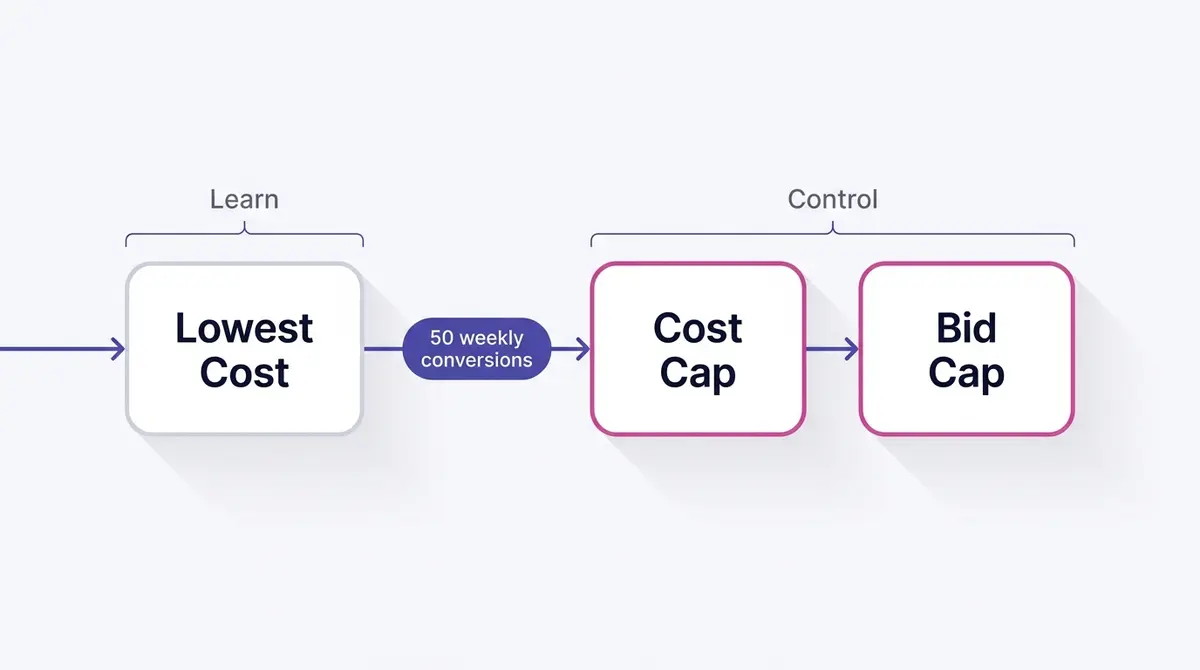
The practical rule: stay on lowest cost until the ad set has cleared learning and produced enough conversions, usually a few hundred, for you to read a stable, trustworthy cost per result. You cannot set a sensible cap on a number you have not measured yet.
Highest value: spending the full budget on your biggest sales
Highest Value is the other spend-based strategy, and it answers a different question than Highest Volume. Instead of asking for the most results your budget can buy, it asks for the most revenue. Meta still aims to spend the whole budget by the end of the schedule, but it steers that spend toward the purchases worth the most, not the cheapest conversions it can find. You are no longer counting orders; you are weighting them by what each one is actually worth.
That changes who wins your auctions. Two stores with the same $3,000 budget can end up in very different places. One on Highest Volume might book 100 orders at an average of $50, a busy-looking $5,000 in sales. The same budget on Highest Value might book 60 orders that skew toward $100 carts, fewer sales but $6,000 in revenue. Fewer results, more money. For a store with a wide spread between its cheapest and priciest products, that reweighting is the entire point, because Highest Volume happily fills the budget with low-value conversions that flatter the cost-per-result column and leave revenue on the table.
Highest Value comes with a prerequisite that Highest Volume does not. It is a value-optimization strategy, so it only works when Meta can see what each purchase is worth. That means a sales objective, optimization for value, and purchase events carrying a value and currency flowing in through the Pixel and the Conversions API. If your tracking sends a bare purchase event with no value attached, the option is greyed out, because the system has no revenue figure to steer by. Get value tracking right before you reach for either of the value strategies; the pixel and Conversions API setup is the gate, not an optional extra.
Use Highest Value when the budget is fixed and the job is to extract the most revenue from it, and you can live with the order count and the return floating. It is the spend-based answer for a store that cares about average order value, not lead count. If instead you have a specific return you must protect, that is a goal, and goals belong to the strategy below.
Cost cap: holding an average without killing scale
Cost cap is the natural graduation, and in current Ads Manager it is the field labelled Cost per result goal. It is the first goal-based strategy you will meet, which means it bids toward a number rather than simply emptying the budget. You enter the cost per result you want, and Meta uses machine learning to bid dynamically, going high in cheap auctions and low in expensive ones, to keep your average around that figure while still chasing volume. Meta's own framing is that cost cap reflects the cost of results you see in reporting and strives to keep costs near your amount regardless of market conditions, with the caveat that adherence is not guaranteed. The goal-based nature has a cost-side consequence too: if your target is unrealistically low, Cost per result goal limits unprofitable spending rather than chasing the budget, so it can underspend by design.
That averaging behaviour is the whole point. If your cost cap is set near a $20 target, Meta may happily pay $26 for one conversion when it can balance that against a $15 conversion elsewhere, keeping the blended average where you want it. You give up the absolute lowest possible cost in exchange for a steadier, more predictable one. In practice cost cap often delivers volume close to lowest cost while trimming the average, which is why it is the workhorse for advertisers who have moved past the learning stage.
Picture how this plays out for a skincare advertiser. A brand like Skinlycious, whose representative angle is a before-and-after video showing skin that cleared after a 28 day routine, will see its cost per purchase swing while the creative scales on lowest cost. Once that ad set has logged a few hundred sales and the cost per result has settled into a recognisable band, switching to cost cap a touch above that band lets the brand keep most of the volume while smoothing out the expensive days. The creative did the work of getting cheap conversions; cost cap just keeps the average honest as competition shifts.
Two failure modes are worth naming. Set the cap far below your proven CPA and delivery throttles, because Meta cannot find enough auctions cheap enough to honour it. Set it during a major demand event and the average slips above target, because the market simply costs more that week. The number you enter should be anchored to a real cost per result you have already achieved, nudged up slightly to give the system room. If you are unsure what good looks like for your category, calibrate against our Facebook ad CPA benchmark guide before you commit a figure.
There is also a creative dimension to the average that the cap alone cannot fix. Cost cap works by finding auctions where your predicted action rate is high enough to win cheaply, and that prediction leans heavily on how compelling the ad is. A weak hook lifts your real auction price, which forces the cap to skip more auctions and drags delivery down even when the number itself looks reasonable. So when a cost cap underdelivers despite a sane target, the answer is often a stronger creative rather than a looser cap. Strengthening the opening seconds lowers the effective price the cap has to clear.
ROAS goal: bidding to a return target
ROAS goal is the value-optimization cousin of Cost per result goal. Where cost cap holds an average cost, ROAS goal holds an average return: you tell Meta the ratio of purchase value to spend you want, and it bids to deliver against that target across the campaign's lifetime, going as high as needed in auctions that look likely to clear the ratio and skipping the ones that do not. Meta enters the control as a decimal, so a goal of 1.100 means you want about $110 in purchase value back for every $100 you spend. A goal of 2.0 means $2 of revenue for every $1 of spend.
Walk a worked example, because the ratio is where people fumble it. Say your store has run on Highest Volume long enough to know its blended return sits near 3.0: every $1 of spend brings back about $3 in tracked purchase value. You do not set the goal at 3.0, you set it a little under what you have proven, say 2.5, to give the system room. On a $5,000 budget, that 2.5 tells Meta to keep total purchase value at or above roughly $12,500 over the campaign's life. It bids up for the high-value carts it can win profitably and walks away from auctions that would drag the blended ratio below 2.5. The number you enter is a floor on efficiency, not a forecast of volume.
Now the failure mode that catches everyone. Set the goal above what your funnel can actually produce, a 5.0 on a store that has never cleared 3.0, and Meta does the honest thing. Delivery slows, then stops, and the budget goes partly unspent, because the system will not buy revenue it cannot find at your price. This is the defining trait of a goal-based strategy: it would rather under-deliver than overpay. Meta states the behaviour plainly, that a ROAS goal set too high to meet can make delivery stop and the budget not spend in full. When a ROAS goal campaign quietly stalls with money left over, the target is almost always the problem, and lowering it in steps is the fix.
ROAS goal carries the same prerequisite as Highest Value, and it is non-negotiable. You need a sales objective, optimization for value, and clean purchase events with a value and currency reaching Meta through the Pixel and the Conversions API, plus eligibility for value optimization. Without that revenue signal the strategy simply is not available, because there is no value for the auction to maximize. So the order of operations is fixed: wire value tracking, run Highest Volume to learn and confirm a real return, then switch to ROAS goal set just under that proven number. Reaching for a ROAS goal before you have a trustworthy return reading is how advertisers strangle a campaign that was about to work.
Bid cap: maximum control, less delivery
Bid cap is the lone manual strategy, the strictest lever, and the easiest to misuse. It sets a hard maximum on the actual bid Meta places in every auction. If winning an impression would require bidding above your cap, Meta does not bid at all. Crucially, Meta is clear that a bid cap reflects how much you are willing to pay for an action, not the cost you end up paying, and it does not cap the cost per result you see in reporting. Like the goal-based strategies, it can leave budget unspent: a cap below the going auction price simply loses, so the budget sits idle rather than overpaying.
That distinction confuses people, so hold it carefully. Cost cap manages your average outcome. Bid cap manages your input into each auction. A bid cap protects you from ever overpaying in a single auction, which is precisely what you want when unit economics are non-negotiable and one expensive conversion could erase the margin on several profitable ones.
Bid cap earns its keep in a specific situation: lead generation or considered purchases where the value of one action is well understood and a runaway cost would break the model. An aesthetics clinic running lead ads, the kind of representative offer where UR Klinik promotes a limited consultation slot at a fixed price, knows roughly what a booked consultation is worth downstream. If a lead is only profitable up to a certain cost, a bid cap set from that math protects the unit economics in a way an average target cannot, because it refuses to ever overpay for a single lead even on the most competitive day. The same logic suits a higher-consideration product like a collagen supplement, where a testimonial angle (a customer noticing firmer skin by week six, as Beyond Collagen+ might frame it) converts a smaller, more deliberate audience and one overpriced purchase stings.
The cost of that protection is delivery. A bid cap set below the real auction price for your audience loses most auctions, and spend collapses. This is the single most common bid cap complaint, and it is almost always the cap, not the audience, that is the problem. The disciplined approach is to start the cap modestly, watch delivery, and raise it in small steps until volume and cost reach an acceptable balance. Bid cap rewards advertisers who already know their predicted conversion rate cold and can calculate what a winning bid is worth; it punishes guessing.
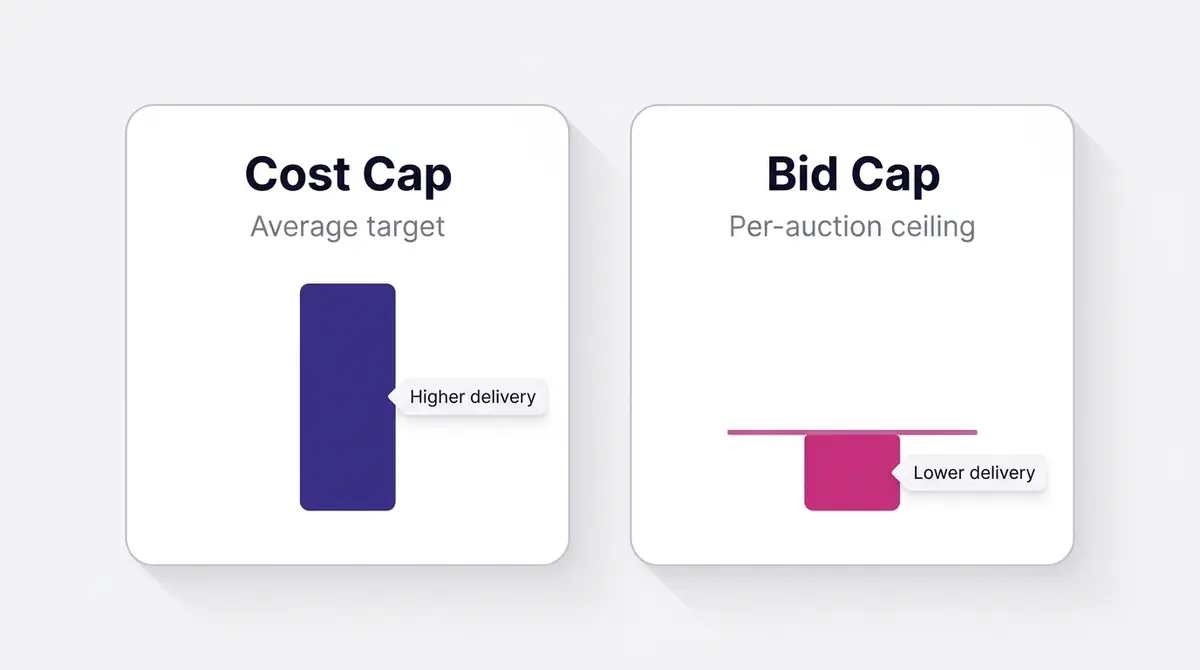
Read the two controls as answers to different questions. Cost cap asks, what average can I live with across everything? Bid cap asks, what is the most I will ever pay for one action? Most accounts need the first far more often than the second, which is why bid cap stays a specialist tool rather than a default.
Picking by stage: a switch framework
The decision is not which strategy is best in the abstract. It is which strategy fits where the ad set is in its life and whether you optimize for cost or for value. The table below maps all five strategies against their family, what each one optimizes for, and the signal that tells you to move on.
| Bid strategy | Family | Optimizes for | Best stage | Move on when |
|---|---|---|---|---|
| Highest Volume (Lowest Cost) | Spend-based | Maximum results in budget, fastest learning | New ad sets, before 50 weekly conversions | Cost per result is stable and you know your true CPA |
| Highest Value | Spend-based | Most revenue from a fixed budget | Value-tracked stores chasing revenue, not order count | You need to defend a specific return, not just maximize it |
| Cost per result goal (Cost cap) | Goal-based | A steady average cost per result | Post-learning scale with an efficiency target | Average holds and you want to optimize on value instead |
| ROAS goal | Goal-based | A target return on ad spend | Value-tracked stores protecting a proven return | Return holds well and you want to push volume |
| Bid cap | Manual | A hard per-auction ceiling on margin | Margin-critical campaigns, expert hands | Delivery is too thin or economics no longer require it |
Read it as two parallel tracks, not one ladder. If you optimize for cost, the path runs Highest Volume to learn, then Cost per result goal to hold an average CPA, with Bid Cap reserved for the campaigns where a single overpriced conversion is genuinely dangerous. If you optimize for value, the path runs Highest Volume to learn, then Highest Value or ROAS goal once purchase values are flowing and a real return is in hand. Either way the first move is the same, and the mistake is the same: jumping straight to a goal or a cap on day one, before there is any history to anchor it to.
One operational warning ties the whole framework together. Changing the bid strategy or the cost or bid amount is a significant edit, and significant edits can throw an ad set back into the learning phase, where it needs roughly 50 fresh optimization events before it stabilizes again. So switch deliberately, batch your changes, and avoid nudging the number every day. If you are also juggling budget structure while you switch, the trade-offs in campaign budget optimization versus ad set budgets interact directly with how caps behave across ad sets.
Reading the result and relaunching
A bid strategy is only as good as the number you read back from it, and that number is your cost per result over a window long enough to mean something. Give any new strategy the learning phase plus several stable days, usually at least 7 days and closer to two weeks when conversion volume is low, before you judge it. Judging a cap after 48 hours reads recalibration noise, not the steady state.
Watch for one status that is worse than a slow learning phase: Learning Limited. The normal learning phase is temporary and productive, an ad set actively working toward roughly 50 optimization events in a week, after which it stabilizes. Learning Limited is the failure version. Meta shows it when an ad set is unlikely ever to hit those 50 weekly events at the current pace, so it never finishes learning and delivery stays unstable indefinitely. A target set too tight is a classic cause: a cost or ROAS goal Meta cannot meet, or a bid cap below the auction price, throttles delivery so hard that the event count never accumulates. If you see Learning Limited rather than a clean exit, the fix is structural, loosen the target, widen the audience, or raise the budget, not patience. Waiting does not rescue an ad set that the math says cannot get there.
The benchmarks below are external averages, useful only as a rough floor while you build your own history. WordStream's 2025 data, which Search Engine Land reported as a 21% year-over-year jump, is drawn from US campaigns running between April 2024 and June 2025.
| Metric | WordStream 2025 average | What it tells your cap |
|---|---|---|
| Cost per lead | $27.66 | A starting reference for a cost cap on lead campaigns |
| Cost per click, traffic | $0.70 | Auction price pressure feeding into delivery |
| Click-through rate, traffic | 1.71% | Creative strength, which moves your effective cost |
| Conversion rate, leads | 7.72% | Landing-page and offer quality below the click |
Treat these as orientation, never as your target. Your own proven cost per result, read from your own account after the learning phase, beats any industry average for setting a cap. When the read is stable, the relaunch loop is straightforward: hold the strategy if cost and volume are healthy, raise a bid cap a step if delivery is too thin, loosen a cost cap slightly if the average is starving volume, or step back to lowest cost if a control has stalled the ad set entirely. Pulling the resulting cost per result into a single view, as platforms like AdPlay.ai do, makes that read-and-relaunch cycle faster than digging through Ads Manager column sets each time.
A clean weakening cost line is also the early signal that the problem is no longer the bid strategy but the creative behind it, and our guide to reading and fixing Facebook ad fatigue picks up exactly where the cap stops helping.
A short checklist before you switch
Run this before you touch the bid strategy field on a live ad set.
First, confirm the ad set has actually exited the learning phase. If it has not cleared roughly 50 weekly conversions, a cap will only slow it down, and lowest cost is still the right home.
Second, write down the real cost per result you are anchoring to, taken from a stable window of a few hundred conversions, not a target you hope to hit. A cap set below your proven CPA throttles delivery; a cap set above it leaves efficiency on the table.
Third, decide whether you are optimizing for cost or for value, because that picks your family before it picks your number. On the cost side, use Cost per result goal (cost cap) when you want a steady average and most of the volume, and Bid Cap only when a single expensive conversion would genuinely hurt and you can defend the per-auction ceiling you choose. On the value side, confirm purchase values are reaching Meta through the Pixel and Conversions API first, then use Highest Value to wring the most revenue from a fixed budget or ROAS goal to hold a proven return. Do not reach for a value strategy until the value tracking is verified, or the option will not even be available.
Fourth, change one thing, then wait. Batch your edits, let the ad set settle for at least 7 days, and resist the daily nudge that quietly resets learning.
Fifth, read the cost per result back and act on it. Healthy: hold. Thin delivery on a bid cap: raise a step. Starved volume on a cost cap: loosen slightly. Stalled entirely: revert to lowest cost and relearn. The strategy you reach for changes by stage, but the discipline, learn first, control second, read always, stays the same.
Example ad angles
Representative hooks and formats from the category.
“Before and After ad for skin that cleared after a 28 day routine”
“Discount or Offer ad for a limited consultation slot at a fixed price”
“Testimonial ad for firmer skin a customer noticed by week six”
By the numbers
Frequently asked questions
Is cost cap the same as cost per result goal in Ads Manager?
Yes. Meta renamed cost cap to Cost per result goal in the Ads Manager interface, and it works the same way: you enter the average cost per result you want, and the system bids as high or low as needed in each auction to keep your average near that figure while still chasing volume. Older guides and the API still say cost cap, so treat the two names as one control. It is not a hard ceiling. Bid cap is the strict per-auction ceiling, where Meta refuses to bid above your number in any single auction even if that means losing the impression.
Which bid strategy should a beginner start with?
Start with Highest Volume, the spend-based default that older menus call Lowest Cost, because it needs no manual number and lets Meta find the cheapest results inside your budget. It is the fastest way to gather the 50 weekly conversions per ad set that Meta needs to exit the learning phase. Once you have a stable read on your typical cost per result over a few hundred conversions, graduate to Cost per result goal to defend an average CPA. Bid cap and the value strategies are later tools that punish guessing.
What is the difference between Highest Value and ROAS goal?
Both optimize for purchase value rather than result count, but they sit in different families. Highest Value is spend-based: it spends your whole budget by the end of the schedule and steers that spend toward the biggest-value purchases it can find, with no return target. ROAS goal is goal-based: you enter a target return (for example 2.0, meaning $2 back for every $1 spent) and Meta bids to hold the campaign at or above that ratio, and may leave budget unspent if it cannot. Use Highest Value to maximize total revenue from a fixed budget, and ROAS goal to protect a specific return.
Which bid strategy should I use to maximize ROAS for an ecommerce store?
If you have a return you must hit, use ROAS goal and enter your true target as a ratio. If you simply want the most revenue a fixed budget can produce and can tolerate the ratio floating, use Highest Value. Both are value strategies, so both require purchase values flowing to Meta and a sales objective. Many stores still get there fastest by running Highest Volume to learn, confirming a stable blended return, then switching to ROAS goal a little below that proven number so delivery does not stall.
Do I need to send purchase values to use a ROAS goal?
Yes. ROAS goal and Highest Value are value-optimization strategies, so Meta needs a functioning Pixel or Conversions API sending purchase events with a value and currency, under a sales or conversions objective, and your ad set has to meet the eligibility requirements for value optimization. Without value data the option is unavailable, because the system has no revenue figure to bid against. Sending only a plain purchase event with no value lets you optimize for conversions, but not for return.
Why will not my ROAS goal or bid cap campaign spend its full budget?
Because both are designed to leave money unspent rather than buy results at a bad price. Meta warns that a ROAS goal set too high to meet can make delivery stop and the budget go partly unspent, and a bid cap below the real auction price loses most auctions the same way. Spend-based strategies (Highest Volume, Highest Value) spend the full budget; goal-based and bid cap do not when the target is out of reach. The fix is to loosen the target in steps until delivery resumes, or revert to Highest Volume to relearn your true price.
Can changing the bid strategy reset the learning phase?
Yes. Editing the bid strategy or the cost, value, or bid amount is a significant change that can push an ad set back into the learning phase, where performance is unstable until it gathers roughly 50 fresh optimization events. A target set too tight can also leave the ad set stuck in Learning Limited, where it never reaches 50 events a week at all. Avoid frequent tweaks, batch your changes, let a switch settle for several days, and read the result before touching it again.
How long should I wait before judging a new bid strategy?
Give it the learning phase plus a few stable days, which usually means at least 7 days and often closer to two weeks if conversion volume is low. Judging a fresh cost or ROAS goal after a day or two reads noise, not signal, because the auction is still recalibrating. Look for the cost per result or the return to settle and for delivery to hold, then compare against the window before the change.
Sources
- 1.Meta Business Help Center: About Cost and Bid Controls (2025)
- 2.Meta Business Help Center: About the Learning Phase (2025)
- 3.WordStream: Facebook Ads Benchmarks 2025 (2025)
- 4.Search Engine Land: Facebook ad costs jump 21% in 2025 (2025)
- 5.Meta Business Help Center: About Bid Cap (2025)
- 6.Meta Business Help Center: About Meta bid strategies (2025)
- 7.Meta Business Help Center: About ROAS goal (2025)
- 8.Meta Business Help Center: About cost per result goal (2025)
- 9.Meta Business Help Center: About highest volume (2025)
Keep exploring
Turn ad research into winning ads
Research the ads that work, generate the creative on-brand, and launch to Meta, all in one tool.
7-day free trial · No credit card required