
How the Facebook Ad Auction Works (2026)
How the Facebook ad auction works: the bid times estimated action rate plus ad quality formula, why the highest bidder loses, and how to win on creative.
Updated September 2026 · Likit Sae Lee, CTO

Every time someone is eligible to see an ad, Meta runs an instant auction and ranks competing ads by total value, which Meta defines as your bid multiplied by estimated action rates, plus ad quality. The highest total value wins, not the highest bid, so a relevant, engaging creative can beat a richer competitor while paying less. Meta also notes you usually pay only the minimum needed to win, so raising your estimated action rate and quality is the cheapest way to win more impressions.
You set a budget, pick an audience, and hope the math works out, but the part that actually decides whether your ad shows is an auction that fires in milliseconds for every single impression. Most advertisers assume the biggest spender wins. They do not. Understanding the bid, estimated action rate, and ad quality formula is the difference between buying impressions and earning them, and it points straight at the lever you control most: the creative.
The auction nobody sees
Every time a person opens Facebook or Instagram and a spot for an ad becomes available, Meta runs an auction. Not once a day, not once per campaign, but once per impression, billions of times over, in the fraction of a second it takes a feed to load. The advertisers competing for that exact person at that exact moment are ranked, a winner is chosen, the ad renders, and the auction is gone before anyone notices it happened.
This matters because the auction, not your budget, is the gatekeeper. You can fund a campaign generously and still lose almost every impression you want if the auction decides your ad is worth less than a rival's. The system is not deciding who has the most money. It is deciding who offers the most value to both the person scrolling and to Meta. Once you internalize that distinction, the whole platform starts to make sense, and the lever you actually control comes into focus.
The good news is that Meta is unusually open about the mechanics. The formula is published, the diagnostics are visible in your own reporting, and the logic is consistent. What follows is how the auction ranks ads, why the biggest bidder routinely loses, and where to push so you win more often without simply paying more.
Who you are actually competing against
It is tempting to picture the auction as a duel with the business down the street: two skincare brands fighting over the same shopper. The reality is looser and far more crowded. The auction is not organized by industry. It is organized by person and by moment. When a single user loads their feed, the advertisers eligible to reach that person right then all enter the same auction, and they usually sell wildly different things.
Picture one commuter opening Instagram on the train. A running-shoe brand wants that impression because the person follows fitness accounts. A language-learning app wants it because they travel a lot. A meal-kit service wants it because they shopped for groceries online last week. None of them compete in a store, yet all three compete for that one slot, and only one wins it. Your rival in any given auction is whoever else Meta judges relevant to that exact person, not whoever happens to sell a product like yours.
This reframes the whole game. You are not trying to out-relevance one named competitor. You are trying to be the most valuable ad for a specific person at a specific second, against a rotating field of advertisers you will never see and cannot predict. That is why a broad, generic creative struggles: it is vaguely fine for everyone and essential to no one, so it loses these person-level contests over and over. A creative that speaks precisely to a segment wins its slice, because for that person, in that moment, it is the most relevant thing in the auction.
The formula: bid times estimated action rate plus ad quality
Meta ranks competing ads by a single number it calls total value. In Meta's own words from the Business Help Center, total value is your bid multiplied by estimated action rates, plus ad quality. The ad with the highest total value wins the impression. That is the entire contest, expressed in one line, and each of the three inputs deserves a clear definition.
Your bid is how much you are willing to pay for the outcome you chose, whether that is a purchase, a lead, or a click. In most accounts you do not enter this by hand; Meta sets it for you based on your budget and your bid strategy. If you want to understand the manual options behind the scenes, the bid strategy options determine whether Meta chases the lowest cost or holds to a cap.
Estimated action rates are Meta's prediction of how likely this specific person is to take your optimized action if shown your ad. It is computed per person, per impression, using that individual's past behavior and your ad's own track record. Two people seeing the same ad can carry very different estimated action rates, and the same person can carry different rates for two different ads. This is the input that quietly rewards proven creative: an ad that keeps earning clicks and conversions accumulates a higher estimated rate and therefore wins more cheaply over time.
Ad quality is Meta's assessment of how good the experience is, beyond pure performance. It draws on feedback from people who hide, report, or engage with the ad, and on checks for low-quality traits such as withholding information, sensationalized claims, and engagement bait. A technically high-converting ad that annoys people can still be penalized here.
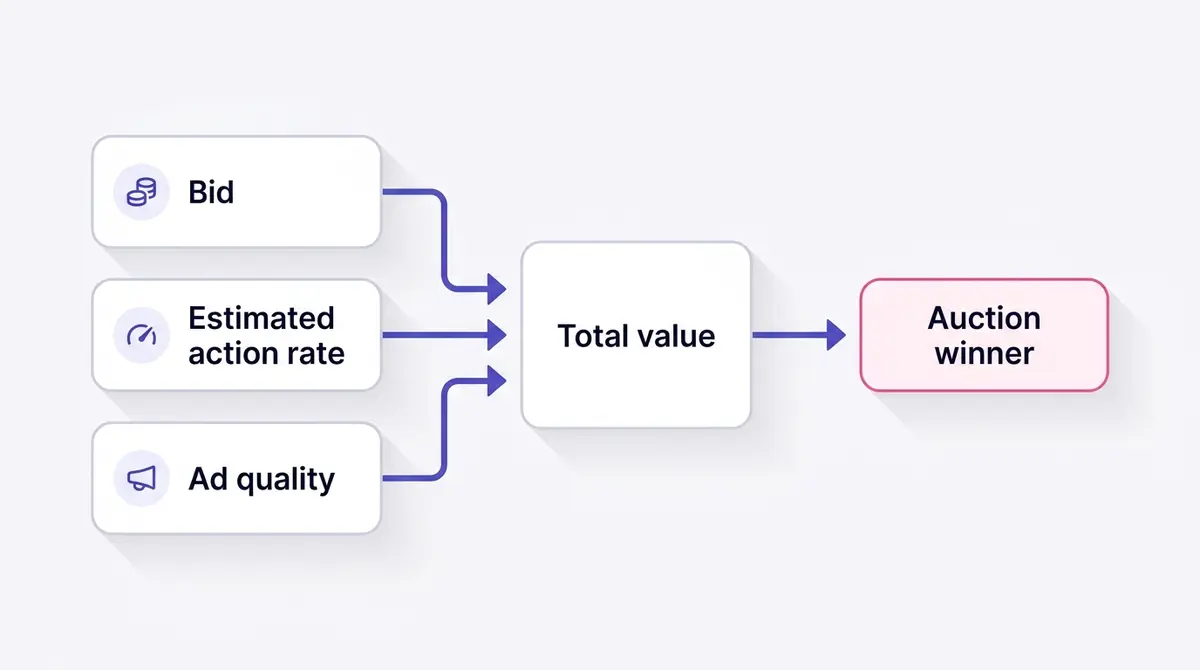
The structure of the formula is what makes it interesting. Because bid is multiplied by estimated action rate, a modest bid paired with a strong action rate can outrank a large bid paired with a weak one. And because ad quality is added on top, a relevant, well-made creative gets a further lift that money cannot buy directly. It is worth being precise here, because plenty of secondhand explainers get it wrong: Meta adds ad quality, it does not multiply it. That additive term is part of why a smaller bid-times-rate product can still edge out a larger one.
It helps to be precise about what estimated action rate is not. It is not your headline CTR sitting in a report, and it is not a fixed property of your ad. It is a fresh prediction made for every individual impression, blending what Meta knows about that person with what it has learned about your creative. That is why the same ad can be cheap to deliver to one audience and expensive to another: the person changes, so the prediction changes. It is also why creative that has been running and converting tends to get cheaper, while a brand new ad starts at a disadvantage until Meta has watched it perform. The auction is not loyal to your brand or your budget; it is loyal to the prediction, and the prediction is built from real behavior.
Ad quality works on a longer time horizon than a single impression. Negative signals such as a spike in people hiding your ad, or a pattern of complaints, can drag the quality input down across an entire account's worth of future auctions, not just the ad that earned the feedback. This is the quiet cost of a misleading or annoying creative: it does not just underperform once, it taxes everything you run afterward by lowering the total value Meta is willing to assign you.
What actually feeds estimated action rate
Creative is the input you touch most, but it is not the only thing shaping your estimated action rate. Meta computes that prediction fresh for every impression, drawing on three things: what it knows about the person, what it has learned about your ad, and the context of that specific impression. The same ad shown to the same person can carry a different estimate at one moment than at another, because the moment is part of the math.
The lever most advertisers underuse here is data infrastructure. For a conversion objective, estimated action rates lean heavily on the conversion signal you send back to Meta. The Meta Pixel on your site and the Conversions API feeding events from your server tell Meta who actually bought after clicking, which is the raw material its model uses to predict who will buy next. Meta's own Pixel documentation frames conversion tracking as what lets the system optimize delivery toward the people most likely to act. Weak or missing event data starves that prediction: the model cannot estimate an action rate accurately if it never learns which impressions led to purchases. Clean tracking is therefore not a reporting nicety, it is a direct input into how high your total value can climb.
This is why two advertisers with equally strong creative can still see different costs. The one with a well-instrumented Pixel and a server-side Conversions API feed gives Meta a sharper signal, so its estimated action rates are more confident and its ads win more of the auctions worth winning. The creative earns the click; the data teaches the auction who to show it to in the first place.
Why the highest bidder loses
Run the formula with numbers and the lesson becomes obvious. Suppose two advertisers chase the same impression. One bids high but has a creative people scroll past; the other bids modestly but has a creative people actually click and act on. Multiply each bid by its estimated action rate, add quality, and the second advertiser frequently wins despite spending less per impression.
| Advertiser | Bid | Estimated action rate | Ad quality | Relative total value |
|---|---|---|---|---|
| High bidder, weak creative | High | Low | Below average | Lower |
| Modest bidder, strong creative | Moderate | High | Above average | Higher |
This is not a hypothetical edge case. It is the normal state of a healthy account. WordStream's 2025 benchmarks put the average cost per click for Facebook traffic campaigns at $0.70 and the average CTR at 1.71%, up from 1.57% the year before, but those are averages hiding enormous spread. The advertisers paying well under the average are not outbidding everyone. They are feeding the auction creatives with high estimated action rates and strong quality, so each dollar of bid stretches further.
There is a second reason the highest bid rarely equals the highest price paid. Meta runs a second-price style auction, which means the winner usually pays only enough to beat the next-best competitor, not the full bid entered. So when you improve your estimated action rate and quality, you do not just win more often; you also tend to pay less for the impressions you win. The two effects compound. This is the mechanical reason that lowering your Facebook ad costs almost always starts with the creative rather than the budget slider.
The benchmark spread makes the stakes concrete. WordStream's 2025 data shows lead campaigns averaging a 7.72% conversion rate, down from 8.67% a year earlier, while the average cost per lead on Facebook climbed 21% year over year to $27.66, as reported by Search Engine Land citing the same dataset. Costs are rising across the platform, which means the gap between an auction-efficient account and an average one is widening, not shrinking. When everyone pays more for the same impressions, the advertisers who keep their estimated action rate and quality high are the ones who hold their costs while competitors watch theirs drift up. The auction is not a fixed tax; it is a competition you can win on relevance.
A useful way to picture it: your bid sets the ceiling on what you are willing to pay, but estimated action rate and quality decide how much of that ceiling you actually need to use. A great creative lets you win at the bottom of your range. A weak one forces you toward the top, and often still loses. Two advertisers can enter the identical bid and walk away with wildly different cost per result, purely because the formula valued their creatives differently.
A worked example: two advertisers, one impression
Numbers make the formula concrete. Say two advertisers are eligible for the same impression, both optimizing for purchases. The figures below are illustrative, chosen to show the mechanic, not benchmarks to copy.
Advertiser A bids aggressively at $25 but runs a tired, generic creative, so Meta estimates a 1% action rate for this person and reads the quality poorly. Advertiser B bids a modest $10 but runs a sharp, relevant creative, so Meta estimates a 3% action rate and reads the quality highly.
Total value is bid multiplied by estimated action rate, plus an ad-quality adjustment. Advertiser A works out to $25 x 0.01 = 0.25, and weak quality adds little, call it 0.02, for a total value near 0.27. Advertiser B works out to $10 x 0.03 = 0.30, and strong quality adds, say, 0.06, for a total value near 0.36. Advertiser B wins the impression while bidding 60% less than Advertiser A.
The gap is not a rounding artifact. B's higher action rate tripled the value each dollar of bid produced, and the quality bonus widened the lead. A could raise its bid to $35 to try to catch up ($35 x 0.01 + 0.02 = 0.37), but that is paying a steep premium to compensate for a weak ad, which is exactly the trap the auction sets for advertisers who reach for the budget slider first. The cheaper path to the same win is a better creative, because it lifts the multiplier instead of renting a higher bid.
What you actually pay: the second-price discount
Winning the auction and paying your full bid are two different things. Meta runs a second-price style auction, sometimes described as a generalized second-price or Vickrey-style mechanism. The winner does not pay the number they entered. They pay only the minimum needed to stay just ahead of the runner-up's total value. Meta says as much in its own guidance: you generally will not pay more than necessary to win and reach your goal.
Return to the worked example. Advertiser B won with a total value near 0.36, while the runner-up sat near 0.27. B did not need every cent of its $10 bid to hold that lead. It needed only enough bid that bid multiplied by its 3% action rate, plus quality, edged past 0.27. Solve for it and B could have held the win with a bid closer to $7, so it keeps the difference as a discount. Its strong action rate did double duty: it won the auction, and it lowered the price of winning.
This is the mechanical reason quality lowers cost rather than merely improving rank. A high estimated action rate and strong quality mean you clear the runner-up with room to spare, and the second-price rule hands that headroom back to you as a lower effective cost per result. A weak ad has the opposite experience: it barely clears, or fails to clear, so it pays near the top of its range for every impression it manages to win. Two advertisers can enter the identical bid and pay completely different prices, decided entirely by the value the auction assigned their creatives.
Your bid, and the five strategies behind it
Bid is one of the three auction inputs, yet most advertisers never type a number. You choose a bid strategy, and Meta sets the actual per-auction bids to match it. Meta offers five, and understanding what "your bid" really means starts with knowing which one you picked.
| Bid strategy | Category | What it tells Meta to do |
|---|---|---|
| Highest volume | Spend-based | Get the most results possible for the budget, with no cost constraint. The default for new campaigns. |
| Highest value | Spend-based | Spend the budget chasing the highest-value conversions, not just the most of them (needs value optimization). |
| Cost per result goal | Goal-based | Keep the average cost per result around a target you set, bidding dynamically to stay near it. |
| ROAS goal | Goal-based | Aim for a minimum return on ad spend, for example $1.10 back for every $1 spent. |
| Bid cap | Manual | Never bid more than a hard ceiling in any single auction. For advertisers who can calculate their true value per conversion. |
The spend-based strategies (highest volume and highest value) hand Meta the most freedom and tend to deliver most smoothly, which is why highest volume is the default. The goal-based strategies (cost per result goal and ROAS goal) trade some volume for cost discipline. Bid cap is the only truly manual lever, and it is easy to strangle your own delivery with it: set the cap below what the auction needs to win and your ad simply stops competing. Whichever you choose, the strategy only sets the bid, one of three inputs. It cannot rescue a low estimated action rate or weak quality, which is why the bid strategy is rarely the first thing to change when delivery disappoints.
Reading the scoreboard: relevance diagnostics
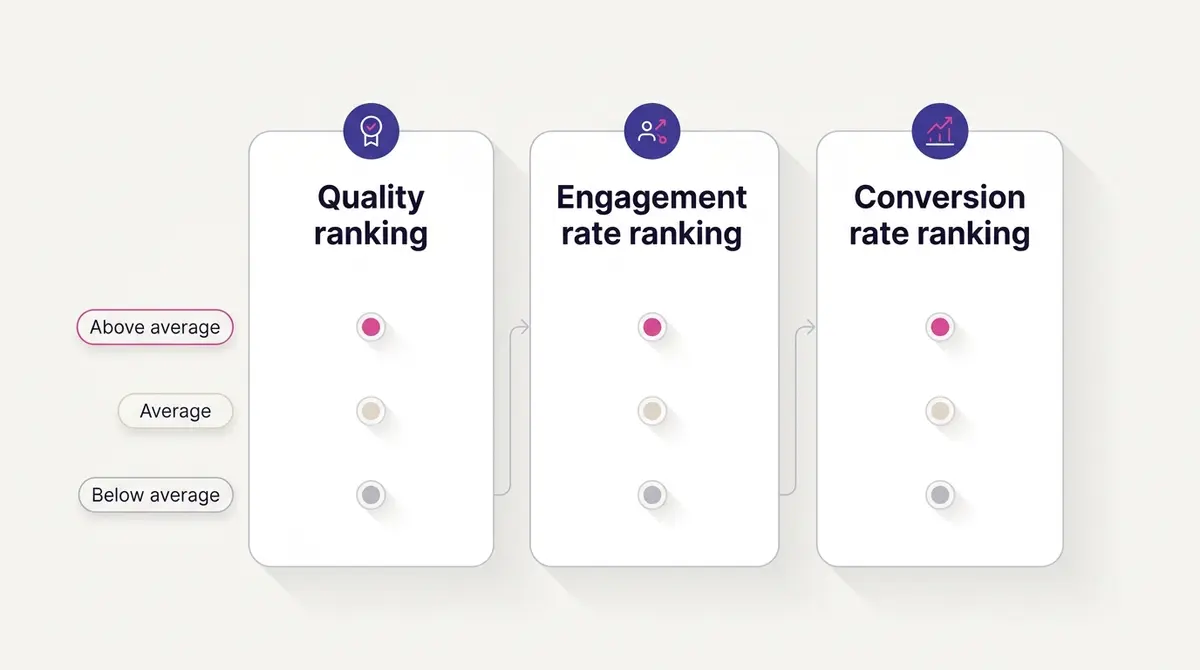
You cannot see your raw estimated action rate, and Meta does not publish a single quality number. What you can see is the closest practical proxy: ad relevance diagnostics. After an ad gathers enough delivery, Meta reports three rankings, each rated above average, average, or below average compared with ads competing for the same audience.
If you advertised before 2019, you may remember a single relevance score rated from 1 to 10. Meta retired that one-number metric in 2019 and replaced it with the three diagnostics below, precisely because a single score told you an ad was underperforming but never why. People still search for the old relevance score, and it is worth stating plainly: it no longer exists. The three diagnostics are its replacement, and they are more useful because each points at a different fix.
| Diagnostic | What it measures | What a low score points to |
|---|---|---|
| Quality ranking | Perceived quality versus competitors for the same audience | Creative experience, feedback, low-quality traits |
| Engagement rate ranking | Expected engagement versus competitors for the same audience | The hook, the first frame, the thumbstop |
| Conversion rate ranking | Expected conversion versus ads with the same optimization goal | The offer, the landing page, audience match |
These diagnostics populate after roughly 500 impressions, so give a new ad a day or two of delivery before reading them. The detail that makes them so useful is that they triangulate the problem. A below average engagement ranking sends you to the opening hook and the first second of the creative. A below average conversion ranking points past the ad to the offer and the destination. A below average quality ranking suggests the experience itself is irritating people. You are not chasing one score; you are localizing the weakest link.
Meta states that more relevant ads cost less and earn more results, though it does not publish a specific figure. Resist the urge to pin a precise percentage on that: Meta has never quantified the discount, so any exact number you see quoted elsewhere is a vendor guess rather than a platform figure. The direction is what matters, and it is consistent with how the formula works: above average diagnostics reflect a high estimated action rate and strong quality, which is exactly what lifts total value and lowers the price you pay.
The post-click experience counts too
Ad quality is not only about the creative in the feed. Meta's quality assessment reaches past the click to the page the ad sends people to. A slow-loading landing page, one buried in pop-ups and interstitials, or a destination that does not match what the ad promised, can all drag on quality ranking, because they produce exactly the poor experience the system is built to detect. Meta's guidance on quality counts disruptive, low-quality post-click experiences among the things that lower an ad's standing.
This closes a loophole advertisers often miss. You can build a brilliant creative, win the click, and still watch cost climb because the landing page frustrates people, they bounce, and that behavior feeds back as a weaker conversion signal and a softer quality read. The fix is unglamorous and effective: make the page fast, make it mobile-first, and make its headline and offer mirror the ad so the visitor lands exactly where the creative said they would. A tight ad-to-page match is not just good for conversion rate, it protects the quality input the auction prices you on.
How creative quality moves the auction
If estimated action rate and quality are the two inputs you most influence, then creative is your primary auction lever. A few patterns show up repeatedly in accounts that win cheaply.
The first second carries the engagement ranking. A strong opening, a clear visual payoff, or a question that names the viewer's problem lifts early engagement, which feeds estimated action rate. This is why short, punchy formats keep winning, and why the static versus video decision is really a question of which format hooks your specific audience fastest, not which is universally better.
Honesty protects the quality ranking. The same Meta signals that reward useful creative penalize withholding information, sensationalized language, and engagement bait. An ad that overpromises may win a click and lose the quality score, which raises cost on every future impression. Clean claims and a real offer are not just compliant; they are cheaper to run.
Relevance per audience beats one creative for everyone. Because the auction compares you to other ads chasing the same person, a creative tuned to a specific segment usually carries a higher estimated action rate than a generic one spread thin. Pairing tighter targeting with creative made for that audience compounds in your favor inside the auction.
Real advertisers show the pattern clearly. A skincare brand like Skinlycious leans on a before and after video that earns watch time and saves, which lifts engagement and conversion rankings together. Fitness Achievers runs member testimonial UGC that feels native to the feed, so people pause rather than scroll, raising the estimated action rate Meta assigns. A jewellery label such as Celovis uses a clean carousel that styles one everyday piece across multiple looks, holding attention across cards. Beyond Collagen+ keeps a simple feature callout static honest and specific, which protects its quality ranking. None of these win by bidding hardest. They win by being the most relevant, most watchable ad in their slice of the auction.
Meta's auction is not Google's auction
Many advertisers arrive with a Google Ads mental model, and it quietly misleads them. The two auctions rhyme but do not match, and the differences change what you should optimize. Google's search auction is pulled by intent: a person types a query, and advertisers bid on keywords to answer it. Meta's auction is push, not pull. Nobody searched for your ad, so it fires whenever a person is eligible to see an ad while scrolling, driven by the supply of impressions rather than by a query.
| Meta ad auction | Google Search auction | |
|---|---|---|
| What triggers it | An impression opens up as someone scrolls (supply-driven) | A person runs a search query (intent-driven) |
| What you target | Audiences: people and their behavior | Keywords: the words in the query |
| The ranking formula | Bid x estimated action rates + ad quality | Bid x Quality Score, plus context |
| The quality metric | Three relevance diagnostics, each above, average, or below average | A single Quality Score, rated 1 to 10 |
| The core creative job | Stop the scroll and earn relevance from an unprompted viewer | Match the searcher's stated intent |
The practical upshot: on Google, relevance is largely about matching words to a query someone already typed. On Meta, relevance is about earning attention from someone who was not looking for you at all, which is why the creative carries so much more of the weight. A Quality Score habit of tuning keywords and match types has no equivalent here. The closest Meta analog to Quality Score is the three relevance diagnostics, and unlike Google's single 1-to-10 number, they deliberately split the read into quality, engagement, and conversion so you can localize the fix.
When your own ad sets collide
The competitors you cannot control are one thing. The competitor you can control is yourself. Two common setups make your own campaigns work against your interests, and both are fixable once you see them.
The first is audience overlap. When two of your ad sets target audiences that share a lot of the same people, some of those people become eligible for more than one of your ads in the same auction. Meta calls this auction overlap, and its own handling is worth understanding precisely, because the popular explanation is slightly wrong. Meta does not let your ad sets bid against each other and inflate your own price. Instead, when two ads from your Page land in the same auction, Meta enters only the one with the highest total value and drops the rest. The hidden cost is not a bidding war, it is suppressed delivery: your other ad sets quietly lose the chance to reach those people, their data thins out, and the campaign gets harder to read. Meta's free Audience Overlap tool, under Audiences in Ads Manager, shows the overlap percentage between any audiences you select, so you can spot and consolidate the culprits.
The second is audience fragmentation. Splitting one market into many narrow, interest-based ad sets feels precise, but it starves each ad set of data. An ad set needs roughly 50 optimization events within 7 days to exit the learning phase and deliver stably, per Meta's guidance. Slice your budget across a dozen tiny interest ad sets and none of them may ever reach that threshold, so all of them sit in a rougher, less confident state and produce weaker estimated action rates than one consolidated ad set would. Broad targeting paired with strong creative usually beats a maze of narrow ad sets, not because targeting stopped mattering, but because the auction rewards the ad set that has enough data to be predicted well.
How the auction shows up in your CPM
Cost per click and cost per lead are outcomes, but the cost line that most directly reflects auction pressure is CPM, the price of a thousand impressions. CPM is essentially what the auction charges to put your ad in front of people, so when competition for a given audience rises, CPM rises with it, whether or not your own ad changed. Gupta Media's CPM tracker put the average Meta CPM at about $8.19 in 2025, but that annual average hides violent seasonal swings driven by auction competition.
The clearest example is the fourth-quarter shopping peak. As advertisers pile in for Black Friday and Cyber Monday, the auction gets denser and CPM spikes. Gupta Media recorded a Cyber Monday CPM of $17.70 in 2024, roughly 138% above that year's annual average, with holiday-season rates running as much as 66% higher than normal. Nothing about your ad has to change for your costs to jump in November: the field simply got more crowded. This is why a strong estimated action rate and quality matter most exactly when costs are highest. When everyone is paying more per impression, the advertiser whose ad clears the auction with room to spare holds its cost per result while less relevant competitors watch theirs balloon. The auction is a live market, and CPM is its price ticker.
Stop fighting the auction with your bid
The instinct when delivery stalls is to raise the bid or the budget. Sometimes that is right, but it is rarely the first move, because a higher bid on a low-quality ad just buys impressions at a worse price. Work the inputs in order of leverage instead.
Start with the diagnostics. If engagement ranking is low, the problem is the hook and the format, so test new openings before touching the budget. If conversion ranking is low, the ad may be fine while the offer or landing page is losing people, which a bigger bid cannot fix. If quality ranking is low, audit the creative for the traits Meta penalizes and clean them up. Only when estimated action rate and quality are healthy does spending more become efficient, because at that point you are scaling a winner rather than subsidizing a loser. When you do reach that stage, scaling Facebook ads is about feeding budget to ads the auction already favors.
It also pays to keep edits disciplined. New or recently changed ad sets carry rougher estimated action rates because Meta has thin data, which is the learning phase in action. An ad set exits that phase once it gathers roughly 50 optimization events within 7 days, and if it cannot reach that volume it sits in a "learning limited" state where delivery stays unstable and costs run higher. A significant edit to the audience, optimization event, budget, or creative resets the phase and sends your estimates back to a rougher state, so constant tinkering keeps your total value unstable. Let a promising ad gather conversions so the predictions sharpen and the auction starts working with you instead of against you.
This is the discipline behind every cheap account: more, fresher, more relevant creative tested faster, so the auction always has a high estimated action rate ad to reward. Platforms that shorten the loop from idea to live ad, such as AdPlay.ai, help you keep that supply of on brand, high relevance creative flowing, but the principle stands regardless of tooling.
A short checklist before you launch
Use this to pressure test any ad against the auction before you spend on it.
- Does the first second earn attention. The opening drives the engagement ranking; if it does not stop the scroll, the estimated action rate will be low no matter how good the rest is.
- Is the claim honest and specific. Vague, sensationalized, or bait-style copy risks the quality ranking and raises cost on every future impression.
- Is the creative made for this audience. A relevant ad carries a higher estimated action rate than a generic one, and the auction compares you to rivals for that exact person.
- Does the offer and landing page match the ad. A strong ad with a weak destination shows up as a poor conversion ranking that no bid increase will repair.
- Have you given it room to learn. Wait for roughly 500 impressions and a day or two of delivery before reading diagnostics, and resist editing while the estimates are still settling.
- Are you reading diagnostics before changing the bid. Localize the weak link first; the cheapest win is almost always a better ad, not a bigger number.
The auction is not a black box you have to outspend. It is a published formula that rewards relevance, and the inputs you most control, estimated action rate and ad quality, both trace back to the creative. Win there, and you win the auction at a lower price, impression after impression.
Example ad angles
Representative hooks and formats from the category.
“Before and After ad for a problem skin barrier visibly calmed over a few weeks of use”
“Testimonial ad for a member who finally stayed consistent after joining the gym”
“Showcase ad for an everyday gold-tone piece styled for work and weekends”
“Feature Callout ad for a daily collagen sachet that mixes clear with no chalky aftertaste”
By the numbers
Frequently asked questions
What are the three factors in the Facebook ad auction?
Meta ranks competing ads by total value, which it calculates from your advertiser bid, the estimated action rates for your ad, and ad quality. The bid is how much you are willing to pay for your chosen outcome. Estimated action rates predict how likely the specific person is to take the action you optimized for. Ad quality is Meta's read of relevance and experience, drawn from feedback and signals about the creative. The ad with the highest total value wins the impression.
Does the highest bidder always win on Facebook?
No. The auction rewards total value, not raw bid, so an ad with a high estimated action rate and strong quality can outrank a higher bid. An advertiser bidding less but earning far more clicks or conversions per impression frequently wins because Meta expects that ad to produce more value per impression. This is why two advertisers in the same category can pay very different prices for the same audience. Creative and relevance, not budget alone, decide the outcome.
What is estimated action rate in Meta ads?
Estimated action rate is Meta's prediction of how likely a particular person is to take the action you optimized for, such as a purchase or a lead, if they are shown your ad. It is calculated per person, per impression, using that person's past behavior and your ad's historical performance. A higher estimated action rate raises your total value, which helps you win more auctions at a lower effective cost. It is the main reason proven, high-engagement creatives keep getting cheaper to deliver over time.
How is ad quality measured in the auction?
Meta assesses quality using signals such as feedback from people who view, hide, or report the ad, plus checks for low-quality attributes like withholding information, sensationalized language, and engagement bait. After enough delivery, this surfaces as relevance diagnostics with three rankings: quality, engagement rate, and conversion rate. Each is rated above average, average, or below average compared with ads competing for the same audience. Clean, honest, genuinely useful creative scores best.
Do I actually pay my full bid when I win?
Usually no. Meta runs a second-price style auction, so the winner typically pays only enough to beat the next competitor rather than the full bid amount. The exact price is shaped by the estimated action rates and quality of the other ads in that auction, not just the dollar figures. This is why improving your action rate and quality lowers cost even when you do not touch your bid. You win more impressions and pay less for them.
When do ad relevance diagnostics appear and what do they tell me?
Relevance diagnostics populate after an ad has gathered roughly 500 impressions, so give a new ad at least a day or two of delivery before reading them. They report quality ranking, engagement rate ranking, and conversion rate ranking, each shown as above average, average, or below average against ads chasing the same audience. They are diagnostic, not a single score: a below average engagement ranking points you at the hook, while a below average conversion ranking points at the offer or landing page. If you remember the old single relevance score rated 1 to 10, that metric was retired in 2019 and these three diagnostics replaced it, precisely so you can see which dimension is failing rather than just that something is. Use them to find the weakest link, not to obsess over a number.
How does the auction relate to the learning phase?
When an ad set is new or recently edited, Meta has thin data on who responds, so its estimated action rates are less precise and delivery is less stable. An ad set exits the learning phase once it gathers about 50 optimization events within roughly 7 days; below that volume it can get stuck in 'learning limited', where delivery and cost stay erratic. As conversions accumulate past that threshold, the predictions sharpen and total value firms up. A significant edit to the audience, optimization event, budget, or creative resets the phase, so letting a promising ad gather data rather than tinkering daily lets the auction work in your favor.
How is the Facebook ad auction different from the Google Ads auction?
Both rank ads on more than bid, but they fire for different reasons and reward different things. Google's search auction is intent-driven: a person types a query, you bid on keywords, and Google ranks on bid multiplied by a single Quality Score rated 1 to 10. Meta's auction is supply-driven: nobody searched for your ad, so it fires whenever a person is eligible to see an ad while scrolling, and it ranks on bid multiplied by estimated action rates, plus ad quality. Meta reports quality as three relevance diagnostics (quality, engagement, and conversion), each above, average, or below average, rather than one score. The practical difference is that Google relevance is mostly about matching words to a query, while Meta relevance is about earning attention from someone who was not looking for you, which puts far more weight on the creative.
Sources
- 1.Meta Business Help Center, About ad auctions (2026)
- 2.Meta Business Help Center, About ad relevance diagnostics (2026)
- 3.Meta Business Help Center, About quality ranking (2026)
- 4.WordStream, Facebook Ads Benchmarks 2025 (2025)
- 5.Search Engine Land, Facebook ad costs jump 21% in 2025 (2025)
- 6.LocaliQ, Facebook Advertising Benchmarks by Industry (2025)
- 7.Meta Business Help Center, About the learning phase (2026)
- 8.Meta Business Help Center, About Meta bid strategies (2026)
- 9.Meta Business Help Center, Understanding auction overlap (2026)
- 10.Meta for Business, Replacing relevance score with ad relevance diagnostics (2019)
- 11.Meta for Developers, Meta Pixel Conversion Tracking (2026)
- 12.Gupta Media, Social Media Ads Cost and CPM Tracker (2025)
- 13.Google Ads Help, About Quality Score (2026)
Keep exploring
Turn ad research into winning ads
Research the ads that work, generate the creative on-brand, and launch to Meta, all in one tool.
7-day free trial · No credit card required