
CBO vs ABO: Meta Budget Strategy (2026)
CBO vs ABO on Meta in 2026: when to let Meta allocate budget at the campaign level and when to fix it per ad set, plus the test-then-scale rule.
Updated August 2026 · Likit Sae Lee, CTO
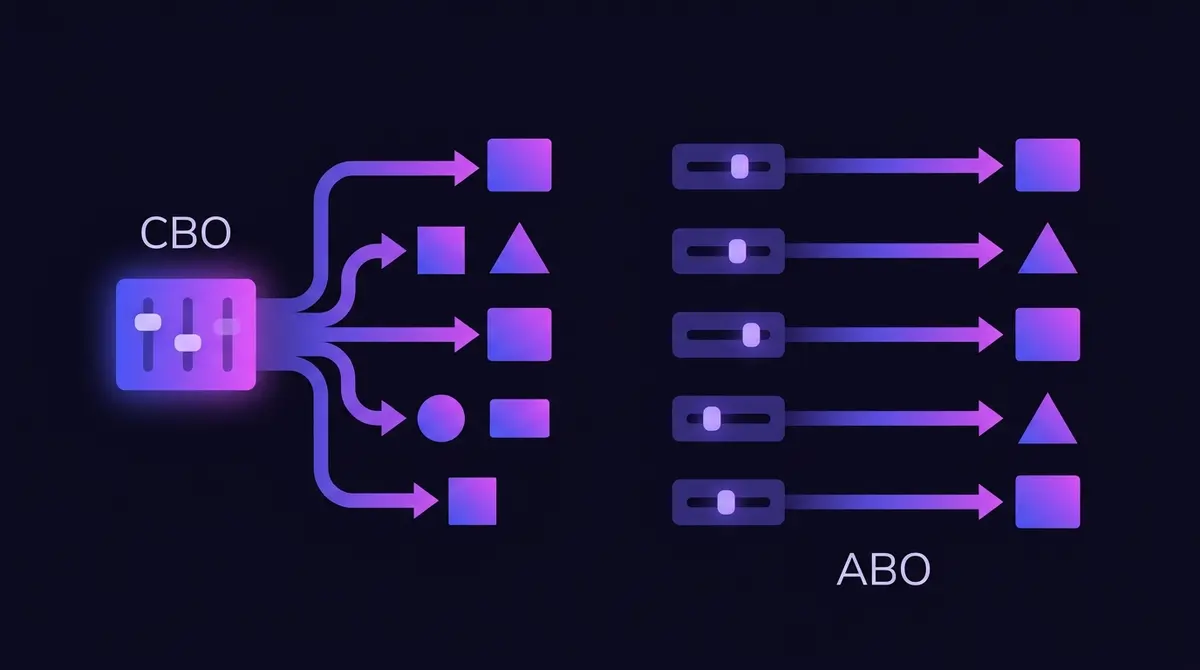
CBO (now called Advantage campaign budget) sets one budget at the campaign level and lets Meta shift spend toward the cheapest results in real time. ABO fixes a budget per ad set, so every test concept gets a guaranteed, fair shot at the roughly 50 optimization events per 7 days each ad set needs to exit the learning phase. The practitioner rule is ABO to test, CBO to scale: ABO protects unproven angles from being starved, CBO concentrates spend once you know what wins. Neither pays off without enough distinct creative to allocate between.
You have two budget switches and the same campaign. One lets Meta decide where the money goes; the other forces it to give each ad set a fixed share. Pick wrong and a brilliant new angle never gets the volume to prove itself, or a proven winner gets throttled by a weaker sibling sitting next to it. The choice is not really CBO versus ABO. It is whether you are testing or scaling, because the budget switch you flip changes how each ad set feeds the learning phase, and the learning phase is what decides whether your cost per result settles or drifts.
CBO and ABO, in the words Meta uses now
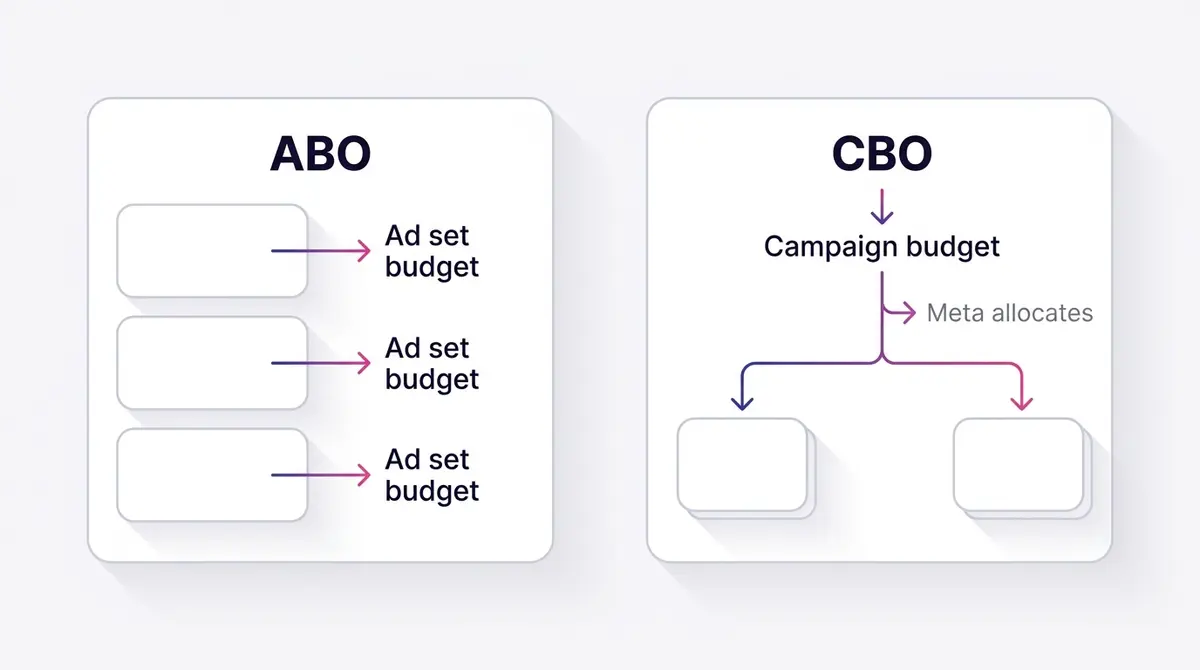
Two budget structures, one decision: who controls where the money goes. With ABO, ad set budget optimization, you set a fixed budget on each ad set and Meta spends exactly that there. With CBO, you set one budget at the campaign level and Meta moves it across ad sets in real time, chasing the cheapest results hour by hour.
The terminology has drifted, and using the wrong word in 2026 dates you instantly. Meta renamed CBO to Advantage campaign budget in Ads Manager. Note the absence of a plus sign: the budget setting is just "Advantage campaign budget," even though it lives inside the broader Advantage+ automation family. ABO never got an official rebrand; the interface simply shows the budget field at the ad-set level, and "ABO" survives as advertiser shorthand. Throughout this guide, CBO means Advantage campaign budget and ABO means a fixed budget per ad set.
Mechanically, the switch lives at the campaign level. You turn CBO on with the Advantage campaign budget toggle in the campaign settings, and ABO is that toggle left off, which moves the budget field down onto each ad set instead. There is no separate "ABO" button to find: choosing where the budget lives is the whole decision.
| Setting | Where the budget lives | Who allocates | Best for |
|---|---|---|---|
| ABO (ad set budget) | On each ad set | You, fixed | Testing new, unproven angles |
| CBO (Advantage campaign budget) | On the campaign | Meta, in real time | Scaling proven winners |
The reason this choice matters more than it looks is that the budget switch you flip changes how each ad set feeds the learning phase. Get the structure wrong and a good angle never gets the volume to prove itself, or a winner gets capped by Meta's even-handedness. So before you pick, you need to understand the one mechanic both structures share.
The learning phase is the thing both structures feed
Every new ad set on Meta enters a learning phase while the delivery system figures out who to show it to. The target is roughly 50 optimization events in a rolling 7-day window, per ad set, to exit learning and reach stable, efficient delivery. Fall short and the ad set sits in "Learning Limited," where results stay noisier and usually more expensive.
The single most important word there is "per ad set." The 50-event pool is measured at the ad-set level, not the ad level. Five ads inside one ad set share one 50-event budget of learning signal; they do not each get their own. This is the fact that decides everything downstream. If you spread a small budget across many ad sets, each one fights to reach 50 events and several may never get there. If you consolidate, the events pool up faster and ad sets graduate sooner.
The learning phase is also why a benchmark like the average $0.70 Facebook CPC for traffic campaigns in 2025, per LocaliQ, is only a midpoint. An ad set stuck in Learning Limited will run worse than that average not because the creative is bad but because Meta never got enough signal to optimise delivery. Structure decides whether your ad sets even reach the point where benchmarks become meaningful.
Why ABO is the structure for testing
ABO gives every ad set a guaranteed, fixed budget. That guarantee is the whole point when you are testing. Put three or four genuinely different angles into three or four ad sets, each on its own fixed daily budget, and every concept gets a fair shot at accumulating its own 50 events. The slow starter is not strangled by the early winner; it gets the volume to show whether it was a slow burn or a genuine dud.
A skincare brand like Skinlycious testing a before-and-after video against a testimonial against an ingredient demo would isolate each angle in its own ad set, fixed budget, and read each one's cost per result on its own merits. The clinic next door, a brand like UR Klinik running lead-gen with Instant Forms, would do the same with separate treatment offers, watching each ad set's cost per lead against the 2025 all-industry average of $27.66 before deciding which offer earns more spend.
Contrast that with what CBO does to a test. CBO is built to find the cheapest result and pour budget into it, fast. During a test, "cheapest result early" and "best long-term winner" are not the same thing. A concept that wins in the first six hours can be a fluke of who Meta happened to reach first. CBO will reward that early luck and starve a stronger angle that needed a day to warm up. You end up scaling noise. ABO removes that risk by refusing to play favourites until you tell it to.
The benchmarks give you the yardsticks to judge an ABO test. For lead campaigns, LocaliQ put the 2025 average CTR at 2.59% and the average conversion rate at 7.72%. For traffic, average CTR was 1.71%. None of these is a target so much as a reference: an ad set landing well above the CTR average but below the conversion average is telling you the hook works and the landing experience does not. ABO lets you read each ad set cleanly enough to see that.
There is a discipline to running an ABO test that pays off later. Keep the variables that are not the creative as identical as you can across ad sets: same audience definition, same placements, same optimisation event, same fixed budget. The only thing you want changing between ad sets is the angle you are testing. When you scale the survivors into CBO, that cleanliness is what lets you trust the read. If two ad sets differed in audience and creative at once, you never learned which one drove the result, and you carry that ambiguity into the campaign you are about to pour money into. Resist the urge to fiddle mid-test, too: every edit you make to a live ABO ad set risks tripping the significant-edit threshold and resetting that ad set's learning, which contaminates the very comparison you set up.
How to size an ABO test budget
"Test in ABO" is only useful once you know what number to type into each budget field, and that number is not a guess. It falls straight out of the learning phase. An ad set needs roughly 50 optimization events in a rolling 7-day window to exit learning, so the weekly budget each test ad set needs is your expected cost per result multiplied by 50, and the daily figure is that weekly number divided by 7.
Work it with a real benchmark. LocaliQ put the 2025 all-industry Facebook cost per lead at $27.66. Multiply by 50 and you get about $1,383 a week, or roughly $198 a day, for a single ad set to have a fair chance of clearing learning inside a week. If your own cost per result runs cheaper, the floor drops fast.
| Your cost per result | Events to exit learning | Weekly budget per ad set | Daily budget per ad set |
|---|---|---|---|
| $10 | ~50 | $500 | ~$71 |
| $20 | ~50 | $1,000 | ~$143 |
| $27.66 (2025 avg cost per lead) | ~50 | $1,383 | ~$198 |
| $40 | ~50 | $2,000 | ~$286 |
Two things follow. First, the per-ad-set budget in an ABO test is not a preference; your cost per result and the 50-event target dictate it. Set it below the floor and the ad set crawls in Learning Limited no matter how sharp the creative is. Second, this is why you cannot fairly test ten angles at once on a small total budget. Four ad sets at $198 a day is close to $800 a day before you have spent a cent on scaling. If that is out of reach, test fewer angles in parallel, or optimise for a cheaper event further up the funnel (an add-to-cart or a landing-page view instead of a purchase) so each event costs less and 50 of them is affordable, then switch back to the real conversion once you know which angle wins.
Meta does enforce a hard floor, but it sits far below any of these numbers: about $1.00 a day for an ad set charged on impressions, with a higher minimum for ad sets billed on clicks or other actions. That floor only keeps a campaign technically eligible to run; it does nothing to get you to 50 events. The real minimum is the one the arithmetic above produces.
Why CBO is the structure for scaling
Once you know which angles win, the logic flips. You no longer need fairness; you need concentration. CBO consolidates your proven creatives under one campaign budget and lets Meta push spend toward the best performer in real time, reallocating hour by hour as auction conditions shift. A brand like Beyond Collagen+ that has already cleared a testimonial angle through ABO would fold its proven creatives into one Advantage campaign budget and let Meta decide which of the winners deserves the next dollar.
This is also why consolidation helps the learning phase rather than hurting it. With spend pooled at the campaign level and flowing to the strongest ad sets, those ad sets gather their 50 weekly events faster and stay out of Learning Limited. Fragmented ABO structures, by contrast, can leave every ad set permanently short of events. CBO at scale is partly a learning-phase optimisation in disguise.
| Question | Lean ABO | Lean CBO |
|---|---|---|
| Are these angles proven? | No, still testing | Yes, winners identified |
| Do you need each concept to get a fair read? | Yes | No |
| Is your priority clean per-ad-set data? | Yes | No |
| Is your priority efficient spend at volume? | No | Yes |
The market context behind this is hard to ignore. Meta's automated budget products are where its growth is. By Meta's own Q4 2024 figures, reported through Marketing Dive, Advantage+ Shopping campaigns (the product Meta renamed Advantage+ Sales in February 2025) reached a $20 billion annual run rate, and Social Media Today cited 70% year-over-year growth for the same product. Treat those as directional vendor numbers, and note they describe the broader automation suite rather than CBO specifically. They do not prove CBO beats ABO. What they do show is that automated allocation is where Meta is investing, which is a reason to get comfortable handing the algorithm proven inputs, not unproven ones.
One naming note matters here, because old playbooks get it wrong. Advantage+ Shopping campaigns were renamed Advantage+ Sales in February 2025, and the legacy Advantage+ Shopping label was retired through early 2026. The renamed product now supports leads, not just ecommerce purchases, which widens where CBO-style automation is relevant. Over four million advertisers were already using at least one Meta generative-AI ad tool by Q4 2024, per the same earnings reporting, up from roughly one million six months earlier. The point is not that automation is magic; it is that the inputs you feed it, your proven creatives and clean ad-set structure, are doing more of the work than the budget switch itself.
The controls inside a CBO campaign: spend limits and bid strategy
CBO is less of a black box than the "it dumped everything into one ad set" complaint suggests. Two settings let you steer it without leaving Advantage campaign budget.
The first is ad set spend limits. Inside a campaign running Advantage campaign budget, you can set a minimum, a maximum, or both on an individual ad set, found under Budget and Schedule once the campaign budget is on. A minimum forces Meta to keep feeding an ad set you do not want starved (a prospecting set you are nursing, say); a maximum stops one ad set from eating the whole campaign. Meta cannot guarantee a minimum will be hit, only that it will try to spend it, and applying both a floor and a ceiling on the same ad set boxes the algorithm in so tightly that delivery usually suffers, so reach for one lever at a time. Spend limits are the direct answer to "why is CBO spending everything on one ad set": cap the greedy one or put a floor under the starved one.
The second is bid strategy, which CBO sits on top of and which changes how it allocates. By default a campaign runs on Highest volume, Meta's current name for what used to be called Lowest cost: there is no cap on what a result is allowed to cost, so Meta chases the cheapest results it can find and spends the full budget. Switch to a cost-per-result goal (the strategy formerly labelled cost cap) and Meta tries to hold your average cost per result near the figure you set, which protects efficiency but can leave budget unspent rather than buy expensive results. Bid cap is the strictest: a hard ceiling on each auction bid. The interaction with CBO is the part most guides skip. Under Highest volume, CBO sprints toward the cheapest ad set and spends in full; under a cost-per-result goal it will hold budget back rather than blow your target, which is exactly why practitioners pair CBO with a cost cap once they know the number a campaign can sustain. Changing the bid strategy on a live ad set counts as a significant edit, so set it deliberately rather than toggling it mid-flight. For the full breakdown of when each one earns its place, see the bid strategy guide.
The mixed-audience trap that breaks CBO for beginners
One CBO setup fails so reliably it deserves its own warning: putting cold prospecting and warm retargeting in the same campaign budget. Retargeting a warm audience (past visitors, add-to-carts, your customer list) almost always shows a lower cost per result than cold prospecting, because those people already know you. CBO sees the cheaper result and does exactly what it is built to do: it pours the campaign budget into the retargeting ad set. Within a day or two it has spent most of your money re-touching a small warm audience that was going to convert anyway, frequency on that audience climbs, and the cold prospecting ad set, the one that actually grows the business, sits starving.
The cheap result is a trap here, not a signal. Keep prospecting and retargeting in separate campaigns so each gets its own budget and you can read them on their own terms. If you genuinely want them under one CBO budget, use the ad set spend limits above: a minimum on the prospecting set and a maximum on the retargeting set stops the warm audience swallowing everything. Mixing audiences of very different temperatures under one automatic budget is how CBO "breaks" for most beginners, and it is a structure mistake, not a fault in the algorithm.
The 20% rule that bites CBO scaling hardest
Here is the trap that catches people scaling with CBO. Meta counts a budget change as a significant edit, and significant edits restart the learning phase. Meta does not publish a magnitude, but practitioners draw the line at roughly a 20% change: stay under it and delivery usually rides through, jump well above it and you risk a reset. In ABO, a careless budget jump resets one ad set. In CBO, editing the single campaign-level budget can reset every ad set inside the campaign at once.
That asymmetry matters precisely when you are most tempted to act: you have a winner, you want to scale it, so you double the campaign budget overnight. The next morning every ad set in the campaign is back in learning, delivery is noisy, and your cost per result has spiked, not because the creative failed but because you knocked the whole campaign back to the starting line. Raise CBO budgets in measured steps, stay under the significant-edit threshold, and let delivery stabilise between changes.
In practice that means raising the campaign budget by something like 10 to 20 percent and then leaving it alone for a few days while delivery re-settles, not nudging it daily. There is no Meta-published step size, so the discipline is simply staying under the roughly 20% line and giving each move time to read. When you need to scale faster than small steps allow, scale horizontally instead: duplicate the winning campaign or ad set into a fresh one and start the copy at the higher budget, which sidesteps the reset because the new structure begins its own learning rather than disturbing a running one. And the significant-edit net is wider than budget alone. Changing the bid strategy, the optimisation event, the audience, or the creative restarts learning too, and so does pausing an ad set for more than 7 consecutive days, so batch your changes and judge each on days of data, not hours.
The 50-event target traces to Meta's own Help Center page on the learning phase, and Meta's significant-edits page confirms that budget changes restart learning. What Meta does not publish is a magnitude: the roughly 20% line, like the exact step size you raise budgets by, is practitioner best practice rather than published law. So treat the 50-event figure as Meta-official and the 20% threshold as a reliable heuristic, not gospel.
There is a cost angle to protecting the learning phase, too. The all-industry Facebook cost per lead rose from $21.98 in 2024 to $27.66 in 2025, per LocaliQ's year-over-year benchmarks. In a market where the baseline cost of a result is drifting up, you cannot afford self-inflicted resets that push ad sets back into the less efficient Learning Limited state. Clean delivery is a cost lever, and budget discipline is how you keep it.
A practical playbook: ABO to test, CBO to scale
Put the pieces together and a simple sequence falls out. It is a heuristic, not a Meta rule, but it maps cleanly onto how the learning phase actually behaves.
- Test in ABO. One ad set per distinct angle, fixed daily budget each, sized so every ad set can realistically reach roughly 50 events in a week. Let them run without budget shuffling until each has a fair read.
- Read against benchmarks, not vibes. Compare each ad set's cost per result, CTR, and conversion rate to the all-industry averages, then within your own account. Kill the clear losers; keep the angles that beat your blended cost per result.
- Consolidate winners into CBO. Move the proven creatives into one Advantage campaign budget so Meta can concentrate spend on the strongest performer and the pooled events keep ad sets out of Learning Limited.
- Scale in steps. Raise the campaign budget under the significant-edit threshold, wait for delivery to settle, then raise again. Never double a CBO budget overnight.
If you want a deeper treatment of the scaling half, the guide to scaling a winning Facebook ad covers vertical versus horizontal moves; the learning phase guide goes deeper on the 50-event mechanic that underpins all of this.
Neither structure works without enough distinct creative
Here is the catch that the CBO-versus-ABO debate usually skips. Both structures are budget logic, and budget logic only has something to do when there is real variety to allocate between. A CBO campaign with one ad set and one creative has nothing to optimise; Meta cannot shift budget toward a winner when there is no field to choose from. An ABO test with two near-identical creatives is not a test; it is the same ad twice. Structure amplifies creative differences. It cannot manufacture them.
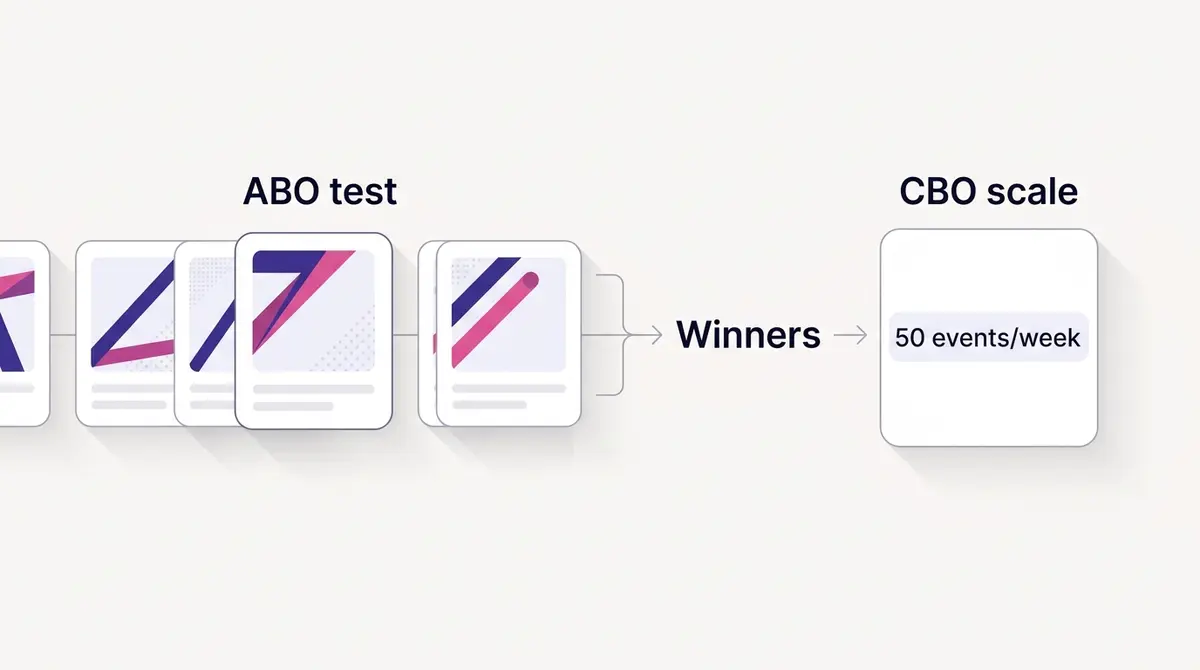
That is why the brands that scale cleanly tend to feed the algorithm a batch of genuinely distinct, on-brand variants rather than one hero ad and a couple of crops. A fitness brand like Fitness Achievers scaling a wave of UGC transformation clips gives CBO real choices to make, so the budget flows to the variant audiences actually respond to instead of being split thinly across near-duplicates. The volume of distinct creative, not the budget switch, is usually the constraint.
This is the practical reason it pays to generate a batch of on-brand variants and launch them straight into a test, then let the structure do its job: ABO to give each variant a fair read, CBO to scale the survivors. Producing that volume of distinct creative is exactly the workflow tools like AdPlay.ai exist to speed up, so the structure has something worth allocating. If you are still building the test itself, the campaign setup guide walks through the structure end to end, and the guide to lowering Facebook ad costs covers the efficiency levers that compound once your budget structure is right.
Pick the structure to match the job, not the trend. Test in ABO so every angle earns its read. Scale in CBO so spend concentrates on what won. Protect the learning phase on both sides by raising budgets in steps and leaving live tests alone. And keep the creative pipeline full, because the smartest budget allocation in the world has nothing to do if every option looks the same.
Example ad angles
Representative hooks and formats from the category.
“Problem and Solution ad for skin that finally cleared after one bottle”
“Testimonial ad for visibly firmer skin after 30 days of collagen”
“Before and After ad for members who hit their goal in 12 weeks”
By the numbers
Frequently asked questions
What is the difference between CBO and ABO?
CBO, now labelled Advantage campaign budget in Ads Manager, sets one budget at the campaign level and lets Meta distribute it across ad sets in real time toward the cheapest results. ABO sets a fixed budget on each ad set, so you control exactly how much every ad set spends. CBO optimises for the campaign as a whole; ABO guarantees each concept its own slice.
Is CBO still called CBO in 2026?
Not in the interface. Meta renamed campaign budget optimization to Advantage campaign budget, part of the broader Advantage+ automation family. The budget setting itself has no plus sign; only the campaign family carries the Advantage+ branding. Most advertisers still say CBO in conversation, which is why you see both terms used interchangeably.
When should I use ABO instead of CBO?
Use ABO when you are testing new, unproven angles. A fixed per-ad-set budget guarantees each concept enough spend to accumulate its own roughly 50 optimization events in 7 days, so a slow-starting angle is not starved before it gets a fair read. CBO can divert that budget to whichever ad set wins early, which is exactly what you do not want while you are still learning which creative deserves to win.
Does the 'ABO to test, CBO to scale' rule come from Meta?
No. It is a widely used practitioner heuristic, not a Meta-published law. It holds up because it matches how the learning phase works: ABO protects each test from being starved, and CBO concentrates spend on proven winners. Treat it as a reliable default, not gospel, and let your own results adjust it.
Does changing the budget reset the learning phase?
A large change can. Meta counts a budget edit as a significant edit that restarts the learning phase for the affected ad set, and so do changes to the bid strategy, optimisation event, audience, or creative, plus pausing an ad set for more than 7 days. Meta does not publish a threshold, but practitioners treat a change of roughly 20% or more as the line to stay under. The budget case bites CBO hardest, because editing a single campaign-level budget can reset every ad set inside it at once. Raise budgets in smaller steps and wait for delivery to stabilise between changes.
How many ad sets and creatives do I need for CBO to work well?
Enough that Meta has meaningful choices to make. If a CBO campaign holds one ad set with one creative, there is nothing to allocate between and the automation adds little. Several genuinely distinct creatives or ad sets give the algorithm room to shift spend toward real winners. Too many, and you fragment spend so each ad set struggles to reach the roughly 50 weekly events it needs to exit learning.
Can I use CBO for lead generation, not just sales?
Yes. Both budget structures work for lead campaigns using Instant Forms, and Advantage+ Sales now supports leads, not only ecommerce purchases. With the average Facebook cost per lead at $27.66 in 2025 per LocaliQ, the structure question is the same: test offers in ABO to see which clears a fair cost per lead, then consolidate the winners under one campaign budget to scale.
Why is my CBO campaign spending everything on one ad set?
That is CBO working as designed. It pushes budget toward whichever ad set is producing the cheapest results, even if that means starving the others. It is great once you have proven winners and want spend concentrated. It is a problem during testing, because a weaker ad set may never gather enough events to prove itself, which is why ABO is the safer structure for evaluating new angles. If you need to soften it inside a single CBO campaign, set an ad set spend minimum on the one being starved, or a maximum on the one hogging the budget.
Sources
- 1.WordStream / LocaliQ, Facebook Ads Benchmarks 2025 (2025)
- 2.WordStream / LocaliQ, Facebook Ads Benchmarks 2024 (2024)
- 3.Marketing Dive, Meta Q4 2024 earnings: Advantage+ run rate and gen-AI adoption (2025)
- 4.Social Media Today, Meta renames Advantage+ Shopping to Advantage+ Sales (2025)
- 5.Meta Business Help Center, About the Learning Phase (2026)
- 6.Meta Business Help Center, Significant Edits and the Learning Phase (2026)
- 7.Meta Business Help Center, About Daily Budgets (minimum budget) (2026)
- 8.Meta Business Help Center, About Ad Set Spend Limits with Advantage+ Campaign Budget (2026)
- 9.Meta Business Help Center, About Highest Volume (bid strategy) (2026)
Keep exploring
Turn ad research into winning ads
Research the ads that work, generate the creative on-brand, and launch to Meta, all in one tool.
7-day free trial · No credit card required