
Chinese New Year Ad Playbook Malaysia (2027)
How to run Meta ads for Chinese New Year 2027 in Malaysia: reunion and prosperity storytelling, ang-pao and huat offer framing, real lead times and the shift toward everyday restraint.
Updated December 2026 · Xanny Lee, CEO

Chinese New Year 2027 falls on 6-7 February, a two-day public holiday in most states, and the celebration runs all the way to Chap Goh Mei on 20 February, so the selling window is longer than two days. Shopping interest builds 8-10 weeks ahead, so Malaysian brands want festive Meta creative live by early-to-mid December. Lead with reunion and shared prosperity rather than pure cash: the most recent CNY survey (CNY 2026, directional for 2027 planning) of 500 Malaysians found 65% plan to spend about RM450 or more (around USD100), but the wider mood is restraint and financial realism, so everyday reunion stories beat extravagance. Frame offers as huat: e-voucher ang-pao, huat-tiered bundles and DuitNow QR redemption feel native now that PayNet processed 8.44 billion digital transactions in 2025. Keep the build Meta-native with Advantage+ sales campaigns and Advantage+ creative, and check Account Quality before a red-themed ad misses the short window.
It is the first week of December, the malls already have lanterns up, and Chinese New Year is a little over two months away. In 2027 the timing is tight: CNY lands on 6-7 February and Awal Ramadan falls on Monday 8 February, the day right after the festival weekend (the first full fasting day is around 9 February, subject to moon sighting), so reunion shopping and the run-up to Raya prep collide in one compressed back-to-back stretch. The brands that win the season are not the ones shouting the biggest discount in red. They are the ones telling a reunion story a scrolling thumb actually stops for, framing the offer as shared prosperity, and having the creative live weeks before the auction gets crowded.
CNY 2027 in Malaysia: the dates and the squeeze
Chinese New Year 2027 falls on 6-7 February, a Saturday and Sunday, a two-day public holiday in most states, per the Malaysia Public Holidays calendar. Kelantan and Terengganu mark only the first day, and because the festival lands on a weekend most other states add a holiday in lieu on Monday 8 February. That gives you a fixed deadline to plan against, and a twist that makes this year harder than most.
Awal Ramadan 2027 falls on Monday 8 February, the day right after the Chinese New Year weekend, with the first full fasting day around 9 February and the exact start moon-sighting dependent. The collision is sharp: in most states the CNY holiday in lieu and the start of Ramadan are the same Monday. Two of the biggest festive prep cycles in the Malaysian calendar land back-to-back in one tight stretch. Pos Malaysia's knowledge hub flags exactly this: reunion-dinner shopping, ang-pao planning and the early Raya rush all compete for the same delivery network in quick succession, which pulls buying forward and compresses the window for fulfilment. If you sell anything physical, your shipping cut-offs need to be earlier than last year, and your creative calendar should treat late January as the real peak rather than the week before CNY.
The lead time is longer than most brands assume. Search-trend analyses of Lunar New Year behaviour suggest shopping interest starts to build 8-10 weeks before the festival, per Awisee's read of Google search data. Counting back from 6 February, that puts the start of meaningful demand in early-to-mid December. Brands that wait until late January to switch on festive ads are launching cold into the most crowded, most expensive part of the auction, paying premium impressions while the early movers have already collected their warm audiences cheaply.
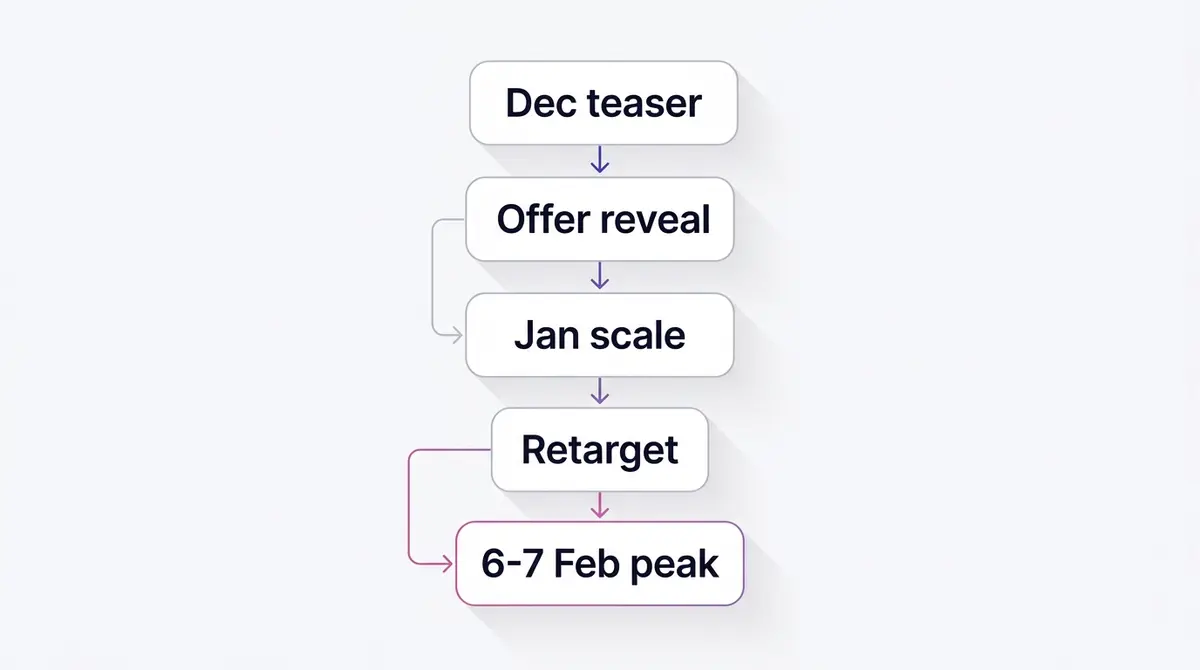
The practical reading: have your CNY hero creative live and learning by the second week of December, treat early January as the scaling phase, and reserve the final fortnight for retargeting the people who already engaged. The brands that compound through the season are the ones that started teaching the algorithm in December.
There is a second reason December matters beyond cheaper auctions. Meta's delivery system needs impressions to exit the learning phase and stabilise, and a festive campaign that only switches on in late January never collects enough conversion data before the peak to optimise properly. By the time the system has learned who buys, the holiday is over. Front-loading the teaser gives the algorithm a head start on the exact warm signals you will want to retarget when costs climb, so the December spend is less a brand gesture and more the foundation the profitable January scaling is built on.
There is also more runway than the two-day holiday suggests. The celebration runs a full fifteen days to Chap Goh Mei, which in 2027 falls on Saturday 20 February. Often called the Chinese version of Valentine's Day (the old custom has unmarried women tossing mandarin oranges into the water), it is a gifting and romance date in its own right, and it is not a public holiday, so people are back at work and scrolling. That hands the season a second selling moment roughly two weeks after the reunion-dinner peak, which most brands switch off too early to catch.
The Year of the Fire Goat: a creative anchor
Every CNY has a zodiac animal, and 2027 is the Year of the Fire Goat (Ding-Wei in the sixty-year cycle), the year that begins on 6 February. The animal is more than decoration: it is a ready-made theme the whole feed will reach for, so knowing what it stands for lets you use it with intent rather than as a sticker on the logo.
The Goat reads gentle. Neutral zodiac references such as StudyCLI describe Goat symbolism as kindness, calm, compassion and an artistic, creative streak, a softer register than the Dragon's power or the Tiger's boldness. That is a gift this year, because it lines up exactly with the restraint thesis below. A nurturing, homely, hand-made-feeling creative is on-theme for the Fire Goat and on-mood for a careful spending year at the same time, and the Fire element adds warmth without loudness: the glow of a hearth, not a firework.
Use it as a quiet thread, not a costume. A warm colour grade, a softer voiceover, a focus on tending to the home and the people in it, a single tasteful Goat motif in a corner of the frame. The brands that win the zodiac are the ones whose ad would still feel like CNY with the animal removed, because the warmth is carried by the story, not the mascot. If you do lean on the symbol, let it reinforce the reunion angle rather than replace it.
Why everyday reunion stories beat extravagance this year
There is genuine money in the season. The most recent CNY survey (CNY 2026, directional for 2027 planning), a Milieu study of 500 Malaysian respondents, found 65% plan to spend about RM450 or more (around USD100, at an FX rate near RM4.50 to the dollar) during the festival. But the same study describes the prevailing mood across Southeast Asia as one of restraint, intention and financial realism. People are still celebrating, still gifting, still gathering for reunion dinners, but they are more deliberate about where the money goes.
That changes the creative brief. The glossy, big-budget CNY film, the one with a sweeping orchestral score and a cast of fifteen, reads slightly out of step in a year of intentional spending. The angle that lands is the everyday reunion: a daughter arriving home with her bag still on her shoulder, a grandmother setting the table, the small specific moments that make the gathering feel real. Honesty about how people actually celebrate outperforms aspiration that feels detached from the bank balance.
Malaysian CNY gives you rich material for this. As Free Malaysia Today describes it, the Malaysian version of the festival is distinctively early, expressive and multicultural: malls decorate weeks ahead, open houses welcome friends across every ethnicity, and cross-cultural greetings are part of the texture. Reunion and prosperity storytelling lands here precisely because the celebration is so communal. A brand like Jealousness can run a founder or UGC ad built on the glow-before-the-open-house angle, restraint-led and relatable, rather than a high-gloss transformation promise.
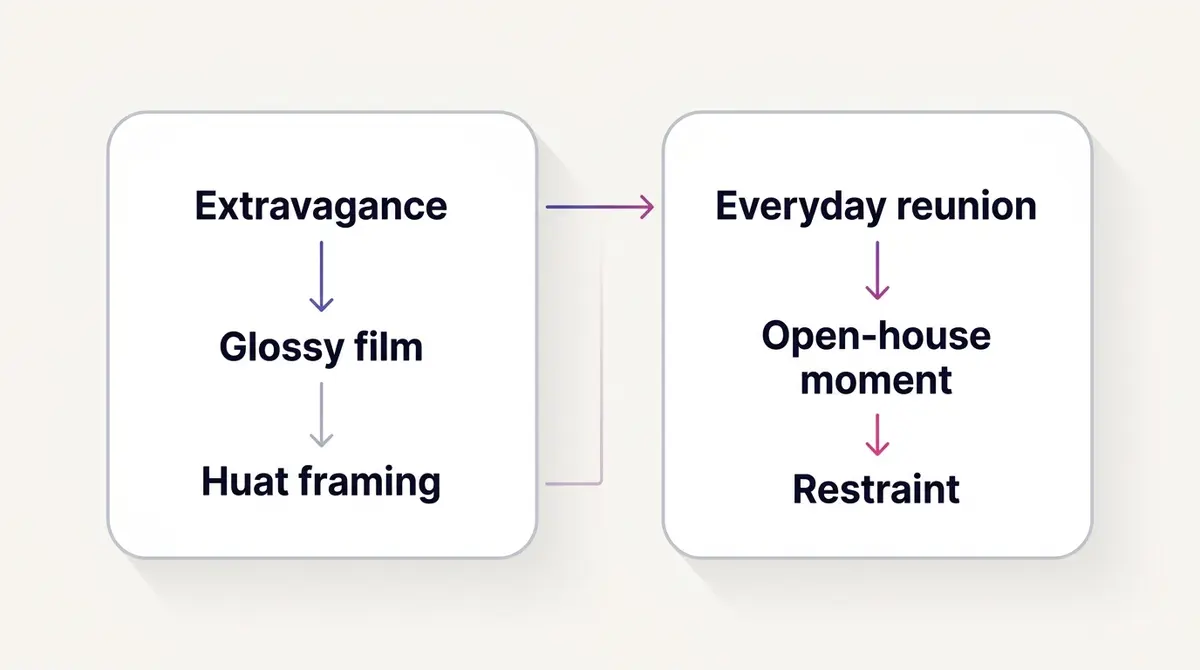
The shift is not about smaller production. It is about a different emotional register. Show the open-house moment, the reunion table, the new outfit worn for real, and let the prosperity framing carry the offer rather than the discount carrying the ad.
Framing the offer: ang-pao, huat, and digital redemption
The instinct on a festive ad is to slap a percentage in red and call it done. That is the weakest version of a CNY offer because the entire feed is doing the same thing. The stronger move is to wrap the saving in the language of the festival: prosperity, luck, shared fortune.
Lead with huat rather than cash. An e-voucher styled as an ang-pao, a huat-tiered bundle where spending more unlocks a more auspicious reward, a lucky-number price point: these read as part of the celebration, not a markdown war. The Milieu data adds nuance here. Across the region, ang-pao sentiment is softening, with 56% saying they enjoy receiving and 47% enjoy giving, and a large neutral middle. (That split is Singapore-specific in the survey, so treat it as directional for the wider region rather than a Malaysia-exact figure.) The takeaway is to frame offers around shared prosperity and reunion, not the literal transfer of cash, because the pure ang-pao reflex is no longer universal.
Digital redemption is what makes huat mechanics feel native in 2027. PayNet processed 8.44 billion digital payment transactions in Malaysia across 2025, with 681,250 new DuitNow QR acceptance points added that year, per Fintech News Malaysia. Digital ang-pao and QR redemption are now mainstream behaviour, not a novelty. An offer that asks the customer to scan a DuitNow QR to unlock a festive voucher, or sends an e-ang-pao on purchase, slots into a habit people already have.
Gamify the reveal, because Malaysians already expect it. The e-ang-pao has quietly become a game: a Touch 'n Go eWallet Money Packet lets one sender split a pot across up to 100 people who each scan a QR code and discover a randomised lucky amount, and bank and wallet apps run scan-and-win draws right through the season, per SoyaCincau. That open-the-packet-for-a-surprise mechanic is native behaviour now, so it travels well into an offer. A spin-to-reveal festive voucher, a scan-to-win at the till, or a tiered packet where the amount stays hidden until checkout turns a flat discount into something people actually want to open, and the reveal step is a clean reason to ask for an email or a follow. Wrap a real saving inside the surprise and you get the click and the data.
Match the mechanic to the category, too. NielsenIQ's holiday analysis recorded a Malaysia Homescan Index of 324 in the Alcohol category around Lunar New Year, 224% above the normal baseline, a vivid illustration of how sharply festive categories spike. The categories that surge hardest can lean into scarcity and bundling; quieter categories should lean into the reunion narrative and let the offer be a gentle nudge rather than the whole pitch.
One more thing on huat mechanics: make the auspicious wrapper visible in the creative itself, not just the landing page. A lucky-number price ending in 8, a red e-ang-pao graphic the thumb recognises in half a second, a tier that explicitly names the reward as a blessing rather than a coupon. The offer mechanic and the festive emotion should be the same element, so the viewer never has to mentally translate a generic discount into a CNY context. That single overlap, prosperity language doing the persuading while a real saving sits underneath, is what separates a festive ad from a discount ad wearing a red costume.
Picking the festive angle: a quick map by category
Not every brand should tell the same CNY story. The angle that converts depends on what you sell and where it sits in the reunion ritual. Use this as a starting map, then look at what is actually running in the Meta Ad Library before you commit.
| Category | Festive angle that lands | Offer wrapper |
|---|---|---|
| Jewellery and gifting | Heirloom and reunion-dinner gifting, gold-and-jade huat framing | Tiered huat bundle, gift-with-purchase |
| Apparel and hijab | New-outfit-for-reunion, CNY-into-Raya transitional looks | Bundle the set, early-bird festive pricing |
| Beauty and skincare | Glow-before-the-open-house, look-your-best-for-photos | Festive kit, e-ang-pao voucher on purchase |
| Home and smart home | Get-the-house-guest-ready before open houses | Pre-CNY install promo, free setup |
| Food and beverage | Reunion table, gifting hampers, prosperity sharing | Pre-order with delivery cut-off, bundle |
A jewellery brand like Bene Jewellery fits the heirloom-gifting angle naturally: a showcase Reel of gold-and-jade pieces tied to the reunion dinner, with the huat framing doing the persuading. Afabelle Hijab can run a lifestyle carousel of CNY-into-Raya transitional looks in auspicious red, an angle that is genuinely smart in 2027 because the same outfit photography earns its keep across two festivals just days apart. Dasher Smart Home maps cleanly to the open-house-ready angle, pairing a demo of the guest-ready home with an instant form for a pre-CNY install slot.
Keep these as illustrative playbook angles rather than claims that any specific ad is live. The point is to choose one clear story per creative, not to cram reunion, prosperity, discount and product specs into a single frame. A common festive mistake is treating the ad as a poster: every benefit, every spec, every offer crammed in because the season feels too important to leave anything out. The opposite works better. One angle, one offer, one emotional beat per ad, then let Advantage+ creative and a small set of variants find which version of that single story the audience rewards.
Food and gifting deserve more than one table row, because they are the categories CNY is built on. Mandarin oranges, bak kwa, cookies and hampers are the default gifts, and most are perishable or hand-delivered, so the offer that works is a pre-order with a clearly stated delivery cut-off. Open pre-orders in early January, name the last order date for guaranteed reunion-dinner delivery, then switch the same creative to a last-call countdown as that date nears. A hamper brand can ladder this as a huat-tiered bundle (spend more, unlock a more auspicious box) and still hit the cut-off message in the final week, then run a smaller romance-and-gifting flight into Chap Goh Mei for the people who missed the reunion-dinner deadline.
One more layer sits above Meta's own policy: cultural compliance. An ad can clear Account Quality and still land wrong if it breaks a festive taboo a Chinese-Malaysian viewer reads in half a second. Two rules are worth designing around:
- Lean into 8, avoid 4. The number 8 sounds like the word for prosperity, so prices and counts built around it (RM88, a set of eight) feel auspicious, per LTL Mandarin School. The number 4 sounds like the word for death, per China Highlights, so keep it out of prices, quantities and gift-set sizes.
- Keep the palette red and gold. White and black are mourning colours in Chinese tradition, per China Highlights, so a moody monochrome festive ad can read as condolence rather than celebration. Save the minimalist black-and-white treatment for another season.
None of this needs a disclaimer in the ad. It is simply about not tripping a wire that costs you the click before the offer is even read.
The Meta build: campaigns, creative and lead capture
The reason to build the season on Meta is reach. DataReportal's Digital 2026 report counts 30.7 million social media user identities in Malaysia in October 2025, about 85% of the population, with internet penetration at 98% by the end of 2025. For a festival celebrated this widely, Facebook, Instagram and Reels are simply where the reunion audience already is, so the question is not whether to be there but how to build it well.
Once the angle and offer are set, the build stays Meta-native. For purchases, Advantage+ sales campaigns are the AI-driven default, letting Meta's system find buyers across Facebook, Instagram, Reels and Stories. Layer Advantage+ creative (the per-user enhancements formerly called standard enhancements) so the system can test festive variants, brightness, music and aspect-ratio tweaks, without you hand-building every version. Meta reports that Advantage+ shopping campaigns surpassed a USD20 billion annual revenue run-rate, up 70% year over year as of Q4 2024, and that over 4 million advertisers now use its generative AI ad-creative tools, up from 1 million six months earlier. Both figures are Meta-own and directional, so treat them as a signal that the tooling is mature rather than a performance promise.
For pre-orders and promo sign-ups, instant forms (lead ads) capture interest without sending anyone off-platform, which matters when a slow festive-season landing page bleeds conversions. WordStream's neutral benchmarks put the average Facebook lead-campaign conversion rate at 8.78% across industries, a reasonable bar for a CNY sign-up push. For traffic and purchase ads, the same source gives a 1.57% average CTR and an average CPC of about RM3.50 (USD0.77), rising to about RM4.80 (USD1.07) for Apparel, Fashion and Jewellery, so gifting and fashion brands should plan to bid more for the same click.
Tracking holds the season together. Wire up your dataset with the server-side Conversions API so festive purchases and leads are measured even when browser signals drop, and say dataset rather than pixel as the primary object in 2027. Then check Account Quality in Business Suite before launch. A red-and-gold ad flagged for review for two days during a window that is already compressed by the back-to-back Ramadan run-up can miss the season outright, so submit creative a few days early and leave room to appeal.
A week-by-week launch calendar for CNY 2027
The season rewards a sequence, not a single big push. Counting back from 6 February, here is a workable cadence for a Malaysian brand.
| Window | Focus | What to run |
|---|---|---|
| Early-mid December | Teaser and learning | Brand-story reunion creative, cheap cold reach, build Custom audiences |
| Late December | Offer reveal | Huat bundle or e-ang-pao mechanic, instant forms for pre-orders |
| Early-mid January | Scale | Advantage+ sales on warm audiences, lookalikes off engagers |
| Late January | Retarget | Cart and engager retargeting, last-call delivery cut-off messaging |
| First half February | Final reunion push | Short-window urgency, in-store or same-region fulfilment offers |
| Mid-to-late February (to 20 Feb) | Romance and last-gift tail | Couples and gifting creative running light to Chap Goh Mei on 20 February |
The logic mirrors the demand curve. The cheap reach lives in December when the auction is still calm and you are teaching the algorithm who responds to a reunion story. The expensive impressions in late January and February should go to people who already raised their hand, the engagers, the cart-adders, the form-fillers, not to fresh cold prospects you are meeting for the first time at the most crowded moment of the year.
Because Ramadan starts the day after CNY ends, build your delivery cut-off messaging earlier than instinct suggests, and make the cut-off date a visible part of the creative rather than burying it in a policy page. The full logistics-and-retention squeeze gets its own section below.
Keeping creative fresh and budget paced over a ten-week push
Ten weeks live is a long time to show people the same red ad. The biggest risk over a festive window this long is fatigue: frequency climbs, the warm audience has seen the hero creative a dozen times, and the cost per result drifts up while nothing about the offer has changed. Plan variants from the start rather than scrambling to make them in late January when impressions are already expensive.
A workable rhythm is three to five distinct concepts per phase, not three crops of the same image. A reunion-dinner story, a huat-bundle offer, a get-the-house-ready angle and a last-call urgency cut are four genuinely different ads, and rotating concepts beats rotating colours. Watch frequency and cost per result together: when frequency on a warm audience pushes past roughly three and the cost per result starts climbing, that ad is fatiguing, so retire it and promote the next concept. The deeper mechanics live in the creative refresh cadence and ad fatigue guides.
Pacing the budget matters just as much, because festive CPMs jump in late January and an unmanaged campaign can burn the day's budget by mid-morning on a high-traffic day. Campaign budget optimisation lets Meta push spend toward whichever ad set is winning, which suits a clean broad setup, while ad-set budgets give you tighter control when you want each audience guaranteed a share (the CBO versus ABO guide weighs the trade-off). Either way, set simple automated rules before the rush: pause an ad once its cost per result runs past your ceiling for a couple of days, and scale a winner in roughly 20% steps rather than doubling it overnight, which resets the learning phase right when you cannot afford the reset.
Fulfilment and retention under the Ramadan squeeze
Because Awal Ramadan lands the day after the Chinese New Year weekend, the same delivery network racing to get reunion gifts out is already loading the first balik-kampung Raya parcels. Two festive logistics waves overlap, and the brand that ignores it ends up apologising for late gifts in the one week of the year when a late gift is most visible. Treat fulfilment as part of the creative, not a footnote.
Set your shipping cut-offs earlier than last year and put the date in the ad itself. The customer who needs a gift in hand by the reunion dinner on 5 February is shopping under a squeezed network, so a visible last order date does more for conversion than another five percent off. For hometown deliveries, lean on same-region fulfilment where you can, and be honest about which postcodes you can still reach in time rather than over-promising.
The other half of the season is the warm pool you build now and sell to later. December is cheap reach, so use instant forms to capture pre-order and early-bird sign-ups while the auction is calm, then retarget that list when costs climb in late January. The open-house culture makes word of mouth natural, so a simple referral or gift-a-friend mechanic suits CNY better than most seasons. And do not let the cart-abandoners go: a festive shopper who added a hamper and hesitated is the cheapest sale left on the table. The lead ads, retargeting and abandoned-cart guides go deeper on each.
Researching real CNY winners before you create
The fastest way to a festive angle that works is to study the ones already running. The free Meta Ad Library lets you search any advertiser and see every active ad across Facebook and Instagram, so you can scan a season's worth of competitor and category creative without guessing. Filter to Malaysia, search the brands in your space, and note the patterns: which open with a reunion moment in the first second, which lead with the offer, which use the huat framing versus a flat discount. Build a small swipe file of the hooks that recur, because a hook that appears across many advertisers is usually one the audience has already rewarded.
From research to live ad, the loop is: study the winning festive angles, write the reunion or prosperity hook, generate the on-brand festive creative, edit the cut for Reels and Stories, then launch straight to Meta and read which variant the audience actually stops for. Tools like AdPlay.ai exist to keep that loop in one place, but the discipline matters more than the tool: one clear story per ad, a huat mechanic the audience can read in a second, and creative live in December rather than the week before reunion dinner. For the wider seasonal picture, see the Malaysian marketing calendar, and because CNY and the run-up to Raya land back-to-back this year, plan them together with the Raya ad playbook for Malaysia. If you also run the year-end double-date sales, the mega-sale ad playbook covers that ladder.
The brands that win CNY 2027 will not be the loudest. They will be the ones that started early, told a reunion story worth stopping for, wrapped the offer in shared prosperity, and had the whole thing live and learning while the rest of the feed was still designing its first red banner.
Example ad angles
Representative hooks and formats from the category.
“Showcase ad for gold-and-jade heirloom gifting at the reunion dinner”
“Lifestyle ad for CNY-into-Raya transitional looks in auspicious red”
“Founder or UGC ad for the glow-before-the-open-house everyday story”
By the numbers
Frequently asked questions
When does Chinese New Year 2027 fall in Malaysia and when should ads go live?
CNY 2027 is on 6-7 February, a two-day public holiday in most states (Kelantan and Terengganu mark only the first day, and most states add a holiday in lieu on Monday 8 February because the dates land on a weekend). Because shopping interest builds roughly 8-10 weeks before the festival, your festive creative should be live and gathering data by early-to-mid December 2026. Use January for scaling and retargeting the people who engaged with your teaser ads, and remember the celebration runs to Chap Goh Mei on 20 February.
Why does the 2027 proximity to Ramadan matter for my CNY ads?
Awal Ramadan 2027 falls on Monday 8 February, the day right after the Chinese New Year weekend, with the first full fasting day around 9 February and the exact date moon-sighting dependent. The two festive prep periods land back-to-back in one tight stretch, which pulls buying forward and squeezes delivery windows, per Pos Malaysia. Plan stock and shipping cut-offs earlier, and if you sell apparel or gifting, design creative that can bridge straight from CNY red into Raya.
Should my offer be a cash discount or something more festive?
Frame the offer around shared prosperity rather than a bare percentage. An e-voucher styled as an ang-pao, a huat-tiered bundle, or a DuitNow QR redemption feels native in a year when PayNet recorded 8.44 billion digital transactions. The mechanic can still be a real saving, but the wrapper should read as luck and reunion, not just markdown.
Does the CNY window end on 7 February, or should I keep ads running to Chap Goh Mei?
Keep running. The festival does not stop with the two-day holiday: the celebration runs a full 15 days to Chap Goh Mei on Saturday 20 February 2027, the night many call the Chinese version of Valentine's Day. That hands you a second gifting and romance moment after the reunion-dinner rush, and because it is not a public holiday, people are back at work and scrolling. Plan a late-window flight aimed at couples, last-minute gifters and open-house hosts rather than switching everything off on 8 February.
What Meta campaign type should I use for CNY purchases?
Advantage+ sales campaigns are Meta's AI-driven default for purchase objectives, and Advantage+ creative will auto-generate festive variants per user. Treat any ROAS or run-rate figures Meta publishes as directional, since they are vendor-reported. For pre-orders and promo sign-ups, instant forms capture leads without sending people off-platform.
What CTR and CPC should I expect for CNY gifting ads?
Use WordStream's neutral benchmarks as a baseline: average Facebook traffic CTR is 1.57% and CPC is about RM3.50 (USD0.77) across industries, using an FX rate near RM4.50 to the dollar. Apparel, Fashion and Jewellery sits higher at about RM4.80 (USD1.07) CPC, so jewellery and fashion gifting brands should expect to bid more. Festive auctions also run hotter, so build the warm audiences early when reach is cheaper.
How do I avoid my festive ad getting rejected at the worst moment?
Check Account Quality in Business Suite or Ads Manager before you launch, and submit creative a few days early so anything flagged has time to appeal. A red-themed ad caught in review for two days during a short festive window can miss the season entirely. Avoid sensational health or before-and-after claims that commonly trip the policy review.
Which Malaysian brands are good CNY creative references?
Jewellery brands lean into heirloom gifting and huat framing, hijab and apparel labels build CNY-into-Raya transitional looks for the overlapping festive month, beauty brands run a glow-before-the-open-house angle, and smart-home brands push a get-the-house-guest-ready story before open houses. Study live festive ads in the Meta Ad Library to see the angles that are actually running.
Sources
- 1.Malaysia Public Holidays, Chinese New Year 2026 (2026)
- 2.Pos Malaysia, CNY x Ramadan 2026 Marketing Strategy (2025)
- 3.Mufti Wilayah Persekutuan, Takwim Hijri 1447H (2026)
- 4.Milieu, Chinese New Year in the Age of Cost Consciousness (2026)
- 5.Awisee, Chinese New Year Shopping Sales and Statistics Report (2026)
- 6.Free Malaysia Today, When Malaysia does CNY differently and better (2026)
- 7.NielsenIQ, Global celebrations, local impact: decoding CPG holiday spending (2025)
- 8.Fintech News Malaysia, Malaysia digital payments 2025 (PayNet) (2026)
- 9.WordStream, Facebook Ads Benchmarks 2024 (2024)
- 10.The Fifth Person, Meta Q4 2024 earnings call (2025)
- 11.Malaysia Public Holidays, Chinese New Year 2027 and 2028 (2026)
- 12.Malaysia Public Holidays, Chap Goh Mei 2027 (2026)
- 13.Malaysia Public Holidays, Awal Ramadan 2027 (2026)
- 14.StudyCLI, Year of the Goat: meaning and traits (2026)
- 15.DataReportal, Digital 2026 Malaysia (2026)
- 16.PayNet, 8.44 billion transactions processed in 2025 (press release) (2026)
- 17.SoyaCincau, Touch 'n Go eWallet Money Packet (2023)
- 18.China Highlights, Chinese New Year Taboos (2026)
- 19.LTL Mandarin School, Chinese Superstitions (2026)
Keep exploring
Turn ad research into winning ads
See what 16,000 Malaysian brands advertise, then generate on-brand creative, all in one tool.
7-day free trial · No credit card required