
What Is a Swipe File for Ads? (2027)
What an ad swipe file is, its copywriting roots, what to save, how to tag by format and awareness stage, how to organize boards across clients and a shared team file, and how to ship against it without copying.
Updated January 2027 · Likit Sae Lee, CTO
A swipe file is a working queue of proven ads you keep so you can learn from them and ship better creative against them. The term comes from direct-response copywriting, where writers collected tested ads and sales letters as a reference of what worked. The point is the word proven: you save what cleared a bar, then tag each one by hook, format, angle, and the awareness stage it targets. Then you borrow the structure for your own brand and offer, never the words. Creative is the single largest driver of ad sales lift at 47%, ahead of reach, brand, and targeting, per Nielsen Catalina, so a usable swipe file is one of the highest-leverage habits a marketer can build.
You screenshot an ad that stops your scroll, drop it in a folder, and never look at it again. That is a graveyard, not a swipe file. The original practice was sharper: copywriters kept a working collection of proven ads and studied why they worked, then wrote their own version from scratch. The folder is only useful if you can find the right reference when you sit down to write, and if every saved ad earns its place by having beaten a real bar. Get the saving and the tagging right and the file becomes a creative engine. Get it wrong and it is just clutter you feel vaguely guilty about.
A swipe file is a working queue, not a screenshot graveyard
Most marketers already have something they call a swipe file. It is a folder, a Notes app, a camera roll full of ads they meant to study. The problem is not that it exists. The problem is that nothing ever comes out of it. A real swipe file is a queue: a set of proven creatives you intend to ship against, sorted so you can find the right one the moment you need it. A graveyard is the opposite, a place ads go to be forgotten the second they are saved.
The distinction sounds pedantic until you sit down to write your next ad. With a graveyard, you scroll, you recognize a few things, you give up and start from a blank page anyway. With a working queue, you ask a precise question, show me every problem-aware testimonial video that ran for more than a month, and the file answers it. One is a chore you feel guilty about. The other is the front end of your creative process.
Two habits separate them. The first is a real entry bar: you save what shows evidence of working, not whatever caught your eye for half a second. The second is tagging, so that retrieval is fast and structured rather than a memory test. Get those two right and the same folder that used to be dead weight becomes the most useful document in your account.
There is a third habit worth naming early, because it changes how you read every ad you save: intent. You are not building a museum. You are building a queue of things you plan to ship against. That single mental shift filters out most of what people hoard. An ad that is clever but has no structural lesson you could reuse does not go in. An ad whose structure you could rebuild for your own brand next week does. When the test for entry is can I ship a version of this, the file stays lean and every entry has a job waiting for it.
Where the swipe file came from, and why that still matters
The swipe file is not a 2026 software gimmick. It is a 50-year-old practitioner habit from direct-response copywriting. Wikipedia defines it plainly as a collection of tested and proven advertising and sales letters, kept by copywriters and creative directors as a reference of ideas. The word that does the work in that definition is proven. These writers were not hoarding pretty layouts. They were keeping a private library of ads that had already moved money.
Before anything like a digital ad library existed, the hunting grounds were physical: the direct mail that landed in the mailbox, and the ads run again and again in magazines and newspapers. A piece that kept reappearing was a piece that was working, because no advertiser pays to mail or print a loser for months. That is the same longevity signal you read today when you spot an ad that has been live for weeks, only the channel has changed.
Copywriter Gary Halbert is widely credited with popularizing, and possibly coining, the term. His method is the part worth internalizing: he would copy proven sales letters out by hand, word for word, so he could feel the rhythm and structure from the inside. The point of the exercise was never to publish someone else's letter under his own name. It was to train his own instinct for why a piece of copy worked, so he could write his own version better. That distinction, study deeply and write fresh, is the whole ethic of a swipe file, and it is the single thing most people get wrong.
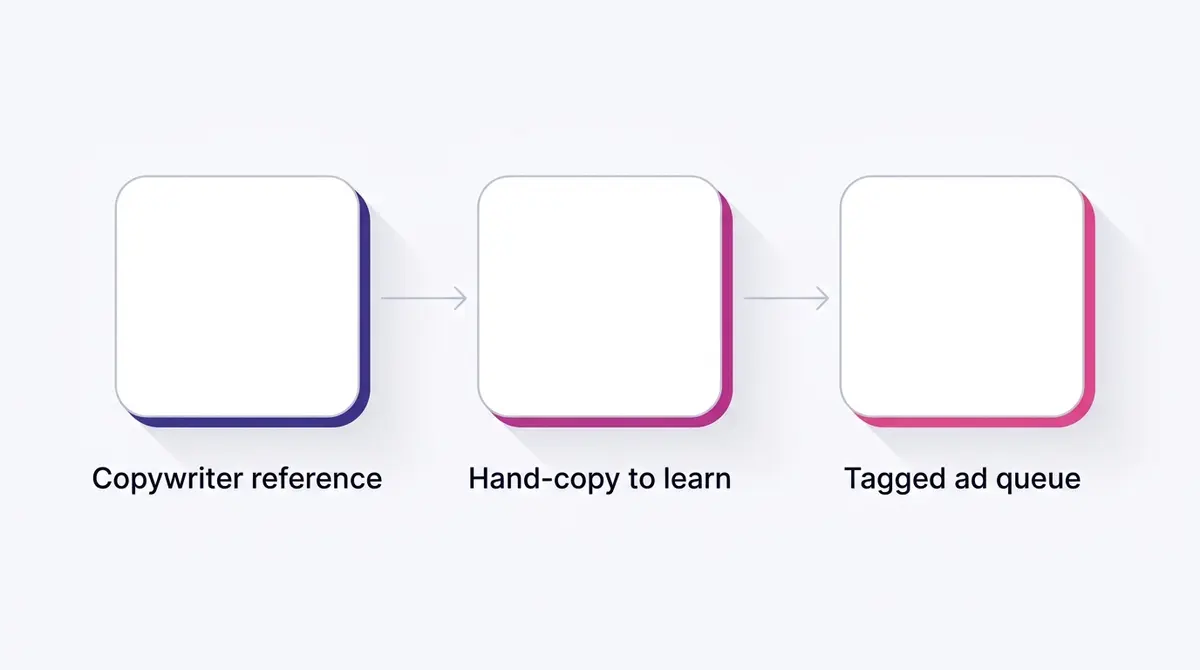
Knowing the heritage changes how you treat the file. This is not a trend to ride. It is a discipline that produced the best direct-response advertising of the last half century, and the only thing that has changed is the medium. The ads now run on Facebook and Instagram instead of in magazines and mailboxes, but the habit is identical: collect the proven, study the structure, write your own.
Why creative is the lever worth obsessing over
If you are going to spend real time curating a swipe file, you should know what the payoff is. The cleanest independent number comes from Nielsen Catalina Solutions, whose analysis found creative is the single largest driver of a brand's advertising sales lift, at 47%. That beats every other factor measured: reach at 22%, brand at 15%, targeting at 9%, and recency at 5%. In plain terms, the ad itself does more to drive sales than who you target or how often you reach them.
| Factor | Share of sales lift |
|---|---|
| Creative | 47% |
| Reach | 22% |
| Brand | 15% |
| Targeting | 9% |
| Recency | 5% |
That is the figure to anchor on because it comes from a neutral third party. Meta, citing Nielsen and Google on its own properties, reports higher numbers still: creative driving 56% of sales ROI per Nielsen, and 70% of campaign success per Google. Treat those as directional vendor figures rather than settled fact, since Meta is quoting them about its own platform. Meta and Nepa also report a directional 1.2 to 2.7x lift in long-term sales for ads that follow creative best practices, which is useful colour but, again, a vendor-of-itself number.
The conclusion holds even on the conservative reading. Targeting and budget are largely set by Meta's automation now. Creative is the lever you still own outright. A swipe file is simply a system for pulling that lever well, by making sure the structures you build from are ones that have already worked.
It also explains why a swipe file beats raw inspiration. Starting from a blank page, you gamble that whatever you invent will land. Starting from a proven structure, you stack the odds: the hook type already stopped scrolls, the format already held attention, the angle already moved a buyer. You are not copying the result, you are inheriting the reasoning behind it and applying it to your own product. In a channel where creative is the dominant variable, that head start compounds across every test you run.
What to save: evidence, not just aesthetics
The entry bar is the whole game. Save ads that show evidence of having worked, not ads that merely look good. You usually cannot see another advertiser's spend or sales, so you read proxies instead. The strongest proxy is longevity: an ad a brand has kept running for weeks is an ad that is almost certainly paying for itself, because nobody funds a loser for a month. A format or hook you keep seeing repeated across a category is another signal, because repetition across smart advertisers rarely happens by accident.
The free Meta Ad Library is the cleanest place to find this. It is the one ad-research tool you can discuss without caveats, and it shows you what is live, how long a creative has been running, and every active variant a brand is testing. A long-running creative there is a candidate worth saving. Our Meta Ad Library guide walks through reading it for exactly these signals, and our competitor ad research guide covers turning that reading into a repeatable habit.
One discipline to keep yourself honest: a saved ad has to clear a bar, not just exist. Per WordStream's directional 2025 benchmarks, the average Facebook traffic ad runs a 1.71% click-through rate at a $0.70 cost per click, and instant-form lead ads convert at 7.72%. Those are aggregated benchmarks, not laws, but they are a useful gut check. If a creative would obviously land below the average for its objective, it is not proof of anything and does not belong in your file. Save the ones that look like they are clearing the bar by a margin.
How to tag an ad so the file stays usable
Saving is half the job. Tagging is what turns a pile into a queryable library. Tag every entry on four axes, and the file will answer real questions instead of forcing you to scroll.
The first three are hook, format, and angle. Hook is the opening move that stops the scroll: a question, a bold claim, a before state, a curiosity gap. Format is the build: static, video, carousel, or UGC. Angle is the argument the ad makes: save money, save time, avoid embarrassment, belong to a group. Together these let you find structural matches. When you need a UGC video with a curiosity hook arguing time-saved, the file hands you every one you have saved.
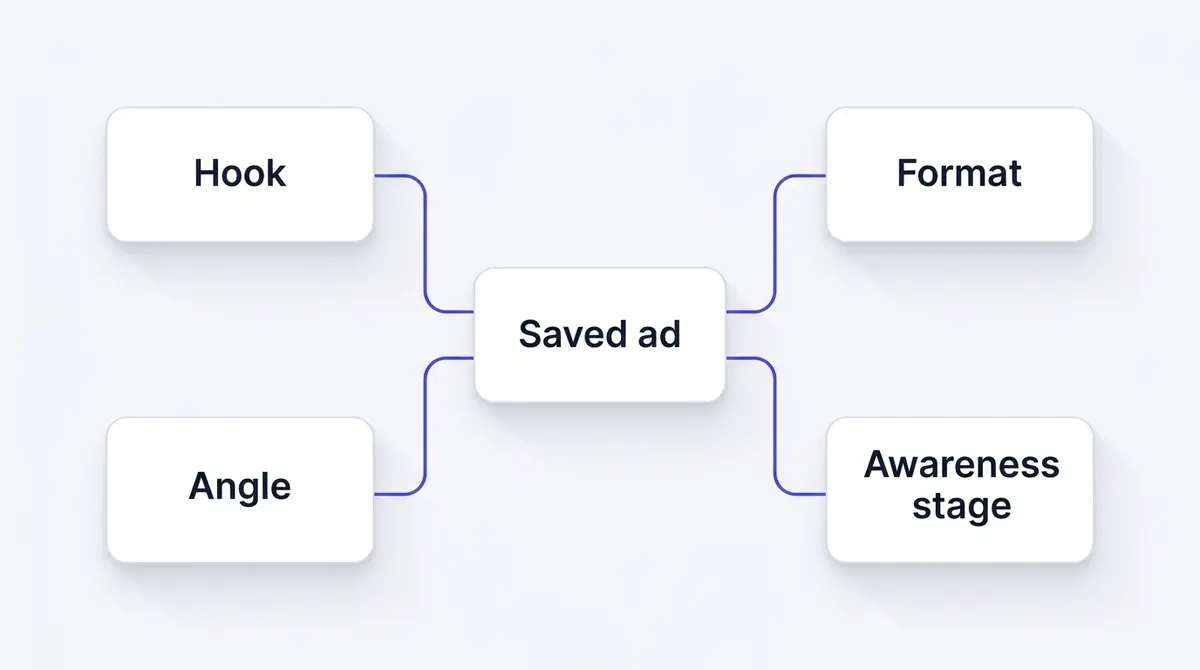
The fourth axis is the one most marketers skip, and it is the most powerful: customer awareness stage. This comes from Eugene Schwartz's 1966 classic Breakthrough Advertising, which sorts every prospect into one of five stages. Unaware: they do not know they have the problem. Problem aware: they feel the problem but do not know solutions exist. Solution aware: they know solutions exist but not your product. Product aware: they know your product but are not convinced. Most aware: they are ready and just need the offer. A hook that lands for a most-aware buyer (here is 30% off, today only) falls flat on an unaware one, and the reverse is true too. Tagging by stage means you stop pulling a product-aware discount ad as a reference when what you actually need is a problem-aware education hook. Our Facebook ad hooks guide breaks down which hook types map to which stage.
A practical tagging entry
A complete entry takes one line. For a long-running skincare ad you might write: Format static, Hook before state, Angle visible result, Stage problem aware, why it works: leads with the pigmentation problem the buyer already feels, then shows the fade. That one line is worth more than the screenshot, because it tells future-you exactly when to reach for it.
The why-it-works note is the part that separates a tagger from a student. Tags are mechanical, anyone can label a video as a video. The note forces you to articulate the mechanism: why does this opening stop the scroll, why does this proof close the sale, what objection does this sequence quietly defuse. Write it in plain language a colleague could act on. Over a few dozen entries those notes start to rhyme, and you will notice the same handful of mechanisms recurring across unrelated brands. That pattern recognition, not the screenshots, is the real asset you are accumulating.
Organizing the file once it outgrows one folder
One flat folder works right up until you manage more than one thing. Add a second client, a second brand, or a second funnel stage and a single list of tagged ads turns back into a pile you scroll. The fix is a layer above the per-ad tags: collection-level structure, where the file is split into boards or folders before you ever open an individual entry.
Split it along the dimension that matches how you actually work. An agency keeps one board per client, so nobody pulls a skincare testimonial into an appliance pitch by accident. An in-house team running several brands keeps one board per brand, each with its own voice and proof. A team running one brand hard splits by campaign, or better, by funnel stage. Funnel-stage boards are the most reusable cut, because they line up with the awareness stages you are already tagging: a top-of-funnel board collects the unaware and problem-aware education hooks, a middle-of-funnel board collects the solution-aware comparison and proof, and a bottom-of-funnel board collects the product-aware and most-aware offers. When you sit down to write a retargeting ad, you open the bottom-of-funnel board and every reference in it is already pointed at a buyer who is close. Our Facebook ad funnel guide maps those stages end to end.
The boards are cheap to maintain and they compound. A solo operator might run three boards and a few dozen entries. An agency with eight clients might run forty boards and never lose a reference, because the structure does the remembering instead of the person.
From swipe to framework to template
There is a ladder hiding inside every good swipe file, and naming its rungs is what turns saving into shipping. The swipe is the bottom rung: the complete, published ad exactly as it ran, captured whole. The framework is the middle rung: the structure you pull out of it once you understand why it works, stripped of the brand-specific words and images. The template is the top rung: the fill-in-the-blank you build for yourself or your team so the framework ships fast and on-brand every time.
| Rung | What it is | What it holds | When you use it |
|---|---|---|---|
| Swipe | A proven ad captured as it ran | The full creative, plus tags and a why-it-works note | While studying |
| Framework | The reusable structure behind it | Hook type, format, awareness stage, the order of the argument | While planning |
| Template | A fill-in-the-blank build | Slots for your hook, your proof, your offer, your CTA | While shipping, across the team |
You climb the ladder once per structure, then reuse the top rung forever. A problem-aware before-and-after you saw work in skincare becomes a framework (problem the buyer already feels, visible result, proof, offer), which becomes a template a writer fills with your product in twenty minutes. That template is also exactly what a creative brief is built from, so the file feeds the brief directly. Our creative brief guide shows how a saved structure turns into a brief a designer can build from.
Who pulls from the file, and what else it is good for
Most advice assumes a solo marketer with a private folder. The file gets far more valuable the moment more than one person draws from it. A shared, commented board where a strategist, a writer, and a designer all pull from the same tagged references means everyone builds from the same proven structures instead of three people guessing in three documents. The why-it-works note stops being a private memo and becomes the brief: the writer reads why the hook lands before rewriting it, the designer reads which proof closes the sale before laying it out. A shared file is where the tagging discipline pays back hardest, because the work you did once is now leverage for the whole team.
The strongest reference in any file is usually not a competitor's ad. It is your own past winner. When you save an ad that worked for you, the proof is real, the voice already fits, and the offer is one you can actually run again. Most files are built entirely from other people's ads, which is a mistake: feed your own winners back in, tagged the same way, and they become the first thing you reach for, because rebuilding a structure that already converted for your customer beats borrowing one that converted for someone else's.
Swipe outside your own category on purpose, too. The mechanisms that stop a scroll are not industry-specific, so a curiosity hook that works for a finance newsletter can carry a skincare ad, and a founder-story structure from a kitchen-appliance brand can carry a supplement. Lateral swiping is where genuinely fresh angles come from, because everyone in your category is already copying the same three references. Tag a cross-industry save by the structure, not the product, so you remember to apply it sideways.
The file also earns its keep before you write a single ad. Use it to pitch creative direction: showing a stakeholder three proven structures you intend to build from is far more persuasive than describing an idea in the abstract. Use it for side-by-side comparison: lining up five saved ads from one category on a single board reveals the angle a whole market leans on, and the gap nobody is filling. And use it for ongoing monitoring: re-open a board every couple of months and check which saved ads are still live, because the ones that keep running are the ones still paying for themselves. Then test your own version of the structure that survives, which is its own discipline our A/B testing guide walks through.
Turning a saved ad into an on-brand answer, never a copy
Here is where the swipe file pays off, and where most people cross a line they should not. You pull a proven structure, then you rewrite it completely for your own brand, voice, and offer. You borrow the hook type, the format, the awareness stage, the angle. You do not borrow the words, the images, or the brand-specific claims. The hand-copy heritage was a private drill to train instinct, never a method for shipping someone else's ad with the logo swapped.
This is not only an ethics point, it is a legal one. Lifting a competitor's copy or creative wholesale risks copyright infringement and passing off, and it almost never works commercially anyway, because their ad was engineered for their customer and their proof, not yours. A brand like Skinlycious running a testimonial video for skin that cleared after weeks of one routine teaches you that the testimonial-video-plus-visible-result structure works in skincare. It does not give you their testimonial. A brand like Shakura running a problem-solution static for fading dark spots and pigmentation shows you the problem-first structure for a beauty buyer who already feels the issue. The specific offer in such an ad is theirs and stays theirs; what you take is the shape of the argument, not the price. A brand like Beyond Collagen+ running a UGC ad for the daily collagen scoop a busy mum actually keeps up shows the everyday-routine UGC angle, which you would rebuild around your own product and your own customer's day.
Once you have your on-brand version, test it properly. Meta's auction rewards creative that earns engagement, so the structure you swiped only matters if your execution lands. An ad set needs roughly 50 optimization events within a rolling 7 days to exit the learning phase and deliver reliably, per Meta's Help Center, so give each variant enough budget and time to clear that floor before you judge it. Build a few on-brand variants of one swiped structure, run them against each other, and let the data, not your taste, pick the winner. Our Facebook ad hooks guide pairs well with this when you are generating those variants.
Keeping the file alive instead of letting it rot
A swipe file decays if you do not maintain it. Ads stop running, offers change, and a structure that crushed it last year can feel tired now. Build two small habits to keep it useful. First, a regular cull: every quarter, open the file and remove anything you would no longer build from, and re-tag anything whose category has shifted. A file you trust is one you have pruned. Second, a tight entry ritual: nothing enters without all four tags and a one-line why-it-works note. If you cannot articulate why an ad works, you do not understand it well enough to learn from it yet, so it waits outside.
Capture the asset, do not just bookmark it
A file built on links rots, because the ads behind them disappear. A standard commercial ad shows in the Meta Ad Library only while it is actively running: stop the campaign and the ad drops out, so a saved link points at nothing. Only ads about social issues, elections, or politics are kept long term, stored for seven years whether active or not, and ads that delivered in the EU are archived for one year after their last impression, per Meta's Transparency Center. None of that retention helps the skincare or supplement ad you actually want to keep.
So capture the creative itself, not a link to it. Save the image or a screen recording of the video, the primary text, and the headline, so the reference survives the campaign ending. Where you can, grab the landing page it pointed to as well, because the ad and its destination are one argument, and the structure only half makes sense without seeing where the click was sent. A file of captured assets is one you can still learn from in a year. A file of dead links is a graveyard with extra steps.
The format matters less than the discipline. A spreadsheet works. A Notion board works. A folder of images with a naming convention works. What does not work is saving without tagging, because retrieval is the entire value, and an untagged file collapses back into a graveyard within weeks. Choose the lightest system you will actually keep up, and put the energy into the entry bar and the tags rather than the tooling.
The end goal is a short, fast loop: see a proven ad, save it tagged, pull it when you write, rebuild it on-brand, test it with enough volume, and feed the winners back as new references. When research, generation, editing, and Meta launch all sit in one place, a platform like AdPlay.ai keeps that loop tight instead of scattered across a screenshot folder, a design tool, and Ads Manager. But the discipline comes first and the tooling second. A marketer with a tightly tagged file of three dozen proven structures and the habit of rebuilding them on-brand will out-create a competitor with a thousand untouched screenshots every single time.
Example ad angles
Representative hooks and formats from the category.
“Testimonial ad for skin that cleared after weeks of one routine”
“Problem-solution ad for fading dark spots and pigmentation”
“UGC ad for the daily collagen scoop a busy mum actually keeps up”
By the numbers
Frequently asked questions
What is a swipe file in advertising?
A swipe file is a curated collection of proven ads and copy that you keep as a working reference. The idea comes from direct-response copywriting, where writers saved tested sales letters and advertisements to study what worked. The key word is proven: a swipe file holds creative that beat a real bar, not every screenshot you happened to take. You use it to learn structures and to write your own version, never to copy.
Where does the term swipe file come from?
It comes from old-school direct-response copywriting. Writers and creative directors kept what Wikipedia describes as a collection of tested and proven advertising and sales letters, used as a reference of ideas. Copywriter Gary Halbert is widely credited with popularizing, and possibly coining, the term. His practice was to hand-copy proven ads so he could feel why they worked, which is a learning exercise, not a license to clone.
What should I save in a swipe file?
Save ads that show evidence of working: a brand running the same creative for weeks, a format you keep seeing repeated, or a hook you can tell is doing heavy lifting. Capture the full creative, not just the headline, plus the format, the angle, and a one-line note on why it works. The free Meta Ad Library is the cleanest place to find ads that have been live long enough to suggest they earn their spend.
How do I tag ads in my swipe file?
Tag every saved ad on four axes: hook type, format, angle, and the customer awareness stage it targets. Awareness stage comes from Eugene Schwartz's 1966 framework: unaware, problem aware, solution aware, product aware, and most aware. Tagging this way means you can pull every problem-aware testimonial video in seconds when you sit down to write, instead of scrolling a folder hoping to recognize the right reference.
Is using a swipe file the same as copying ads?
No, and the difference matters legally and strategically. You borrow the structure, the hook type, the format, the awareness stage, the angle, then rewrite everything in your own brand voice with your own offer. Literal copying of a competitor's copy or creative risks copyright infringement and passing off, and it rarely works anyway because it speaks to their customer, not yours. The hand-copy heritage was a private learning drill, not a shipping method.
How many ads should a swipe file hold?
Quality beats volume. A tight file of a few dozen ads you have actually studied and tagged beats a thousand unsorted screenshots you will never open. The discipline is in the entry bar, not the size. If an ad is not tagged with its hook, format, angle, and awareness stage, and you cannot say in one line why it works, it does not belong in the file yet.
How does a swipe file connect to actually launching ads?
A swipe file is the front of your creative pipeline. You pull a proven structure, rewrite it on-brand, then build and test it. Meta's auction rewards engagement, and an ad set needs roughly 50 optimization events within 7 days to exit the learning phase, so test a few on-brand variants of a saved structure with enough budget to give Meta the volume it needs to judge them.
What is the difference between a swipe file, a moodboard, and a template?
A swipe file holds complete, proven ads you keep as reference. A moodboard is looser: colours, layouts, and visual vibes you like, with no requirement that any of it was tested or earned its place. A template is the opposite of loose, a fill-in-the-blank build you make from a proven structure so your team ships it fast and on-brand. The progression runs swipe file (the proven ad), to framework (the structure you extract), to template (the reusable build). A moodboard inspires a look, a swipe file teaches a structure, and a template ships it.
Sources
- 1.Wikipedia, Swipe file (2024)
- 2.Copywriter's Handbook, The Origin of Copywriting Swipe Files (2024)
- 3.B-PlanNow, Schwartz's 5 Levels of Customer Awareness (2024)
- 4.Marketing Charts, Creative Quality Has Biggest Impact on Ad Effectiveness (2017)
- 5.Nielsen, Want a Successful Ad? Get Creative (2017)
- 6.Meta for Business, High-Quality Creative Increases Ad ROI (2021)
- 7.WordStream by LocaliQ, Facebook Ads Benchmarks 2025 (2025)
- 8.Meta Business Help Center, About the Learning Phase (2025)
- 9.Meta Transparency Center, Ad Library Tools (2026)
Keep exploring
Turn ad research into winning ads
Research the ads that work, generate the creative on-brand, and launch to Meta, all in one tool.
7-day free trial · No credit card required