
Facebook Ad Funnel: TOFU MOFU BOFU (2026)
How to build a full-funnel Meta strategy across TOFU, MOFU and BOFU: the creative, objective and budget split each stage needs.
Updated August 2026 · Xanny Lee, CEO
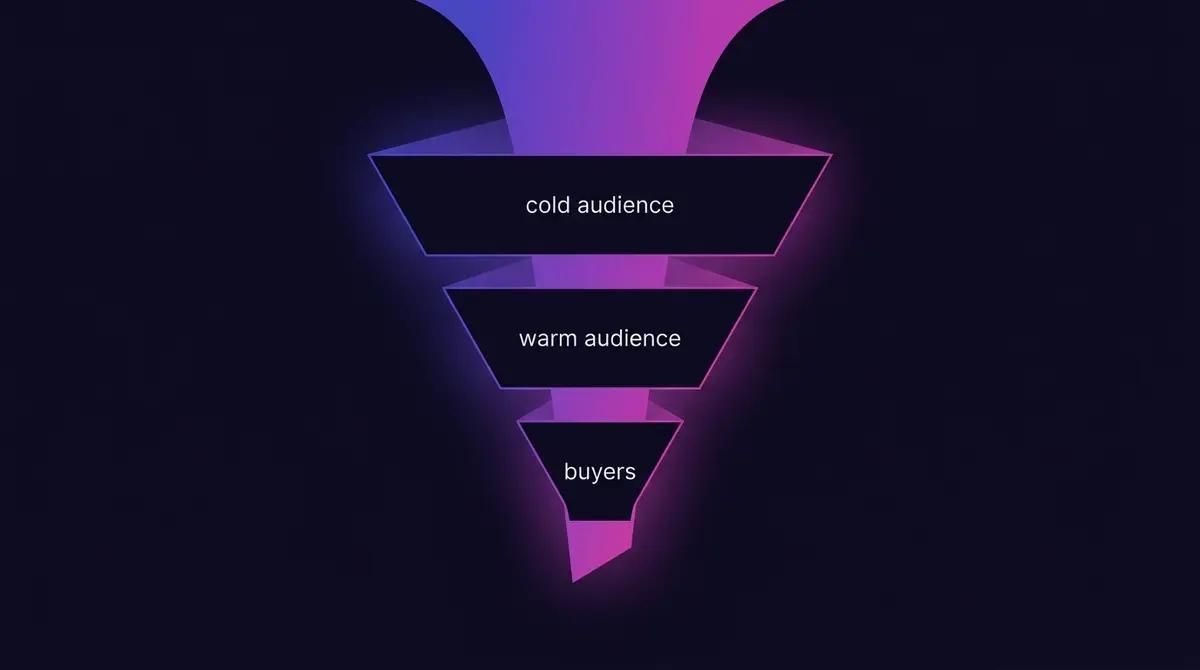
A Facebook ad funnel runs three jobs as separate campaigns: TOFU reaches cold audiences with cheap short-form video, MOFU warms them with UGC and social proof, and BOFU closes with offer-led conversion ads. Lead with prospecting (around 70-80% of budget for newer brands) and grow retargeting only as a warm pool fills, since retargeting delivers a median ROAS of 3.61 versus 2.11 for prospecting (Focus Digital, 2025), 71% higher.
You have a budget, a product people want, and a single ad set trying to do everything at once: introduce the brand, build trust, and close the sale in one impression. It rarely works, because a cold stranger and a warm shopper need different things from you. A full-funnel structure splits that one impossible ad into three honest jobs, each with its own campaign, creative, and objective. Here is how the three stages fit together and what to put in each.
What a Facebook ad funnel actually is
A funnel is not a clever audience trick. It is the simple admission that a stranger and a shopper are different people who need different ads. The person seeing your brand for the first time wants to be entertained or intrigued for three seconds. The person who watched your video last week wants proof it works. The person who clicked your product page yesterday wants a reason to buy today. Trying to serve all three with one ad means each gets a compromise.
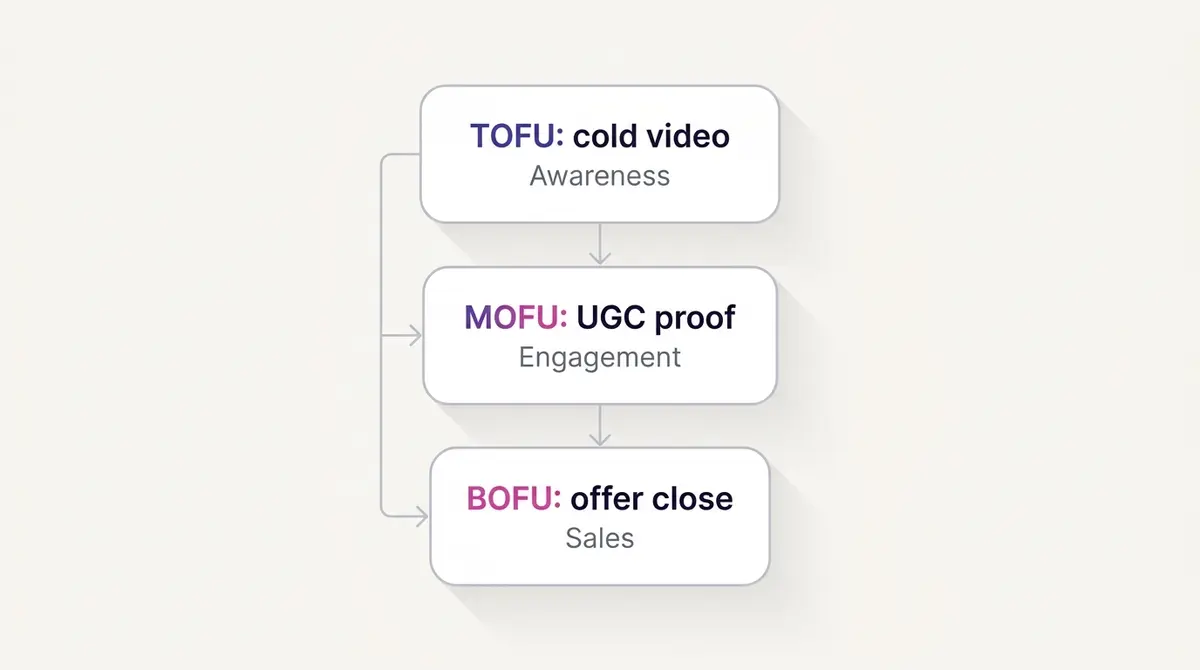
The three stages have names borrowed from sales. Top of funnel, or TOFU, is cold prospecting: reaching people who have never heard of you. Middle of funnel, or MOFU, is warming: turning a flicker of attention into real consideration. Bottom of funnel, or BOFU, is closing: converting warm audiences with a clear offer. The trick that makes the whole thing work on Meta is that each stage feeds the next. People who engage with your TOFU ads become the audience for your MOFU ads, and people who engage there become your BOFU audience. The funnel is a pipeline, not three separate pools you buy from scratch.
The financial reason to bother is stark. Focus Digital's analysis of 2025 data found retargeting campaigns delivered a median ROAS of 3.61 against 2.11 for prospecting, roughly 71% higher. Warm audiences convert far more efficiently than cold ones. But you cannot retarget people you never reached, which is why a funnel that skips straight to BOFU starves itself. You have to spend at the top to earn the efficiency at the bottom.
Here is the whole funnel in one view: who each stage talks to, the creative that fits, and the numbers that actually judge it. The rest of this guide is just the detail behind these three rows.
| Stage | Who you are talking to | Creative that fits | Primary KPIs to judge it on |
|---|---|---|---|
| TOFU | Cold strangers who have never heard of you | Cheap short-form video, many variants | CPM, cost per 3-second video view, how fast your warm audiences grow |
| MOFU | People who engaged but have not bought | UGC and testimonial reels, social proof | CTR, cost per landing-page view, cost per lead |
| BOFU | Warm viewers, page visitors, cart abandoners | Offer-led statics and carousels, one clear CTA | ROAS, cost per purchase, frequency |
Map each stage to a Meta objective
Meta Ads Manager offers six campaign objectives, the set WordStream documented for 2026: Awareness, Traffic, Engagement, Leads, App Promotion and Sales. This is the current ODAX list, and it matters that you use these names rather than the pre-2022 set, because the old labels (Brand Awareness, Reach, Conversions, Video Views, Lead Generation, Catalog Sales) no longer exist as top-level objectives. Each funnel stage maps cleanly onto one or two of the six.
| Stage | Job | Objective | Optimization |
|---|---|---|---|
| TOFU | Introduce the brand to cold audiences | Awareness or Engagement | Reach or video views |
| MOFU | Warm engaged people into consideration | Engagement or Traffic, or Leads | Landing-page views or instant-form leads |
| BOFU | Close warm audiences on an offer | Leads or Sales | Conversions, often Advantage+ Sales |
At the top, the Engagement objective optimized for video views is the quiet workhorse, because it builds a video-view audience cheaply while you reach cold people. The middle can run Traffic to send warm viewers to a page, or capture them with a native instant form under the Leads objective. The bottom is where the Sales objective earns its keep, often through Advantage+ Sales, Meta's AI-automated campaign type renamed from Advantage+ Shopping in early 2025. Meta has extended that automation to Leads campaigns too, reporting around 10% lower cost per qualified lead in testing, a vendor figure worth treating as directional rather than a guarantee.
TOFU: cheap short-form video does the introducing
The top of the funnel has one job, and the cheapest creative that does it well is short-form video. The case is not aesthetic, it is behavioural. Wyzowl's 2026 research found that 63% of consumers would most like to watch a short video to learn about a product or service, far ahead of text articles at 12% or infographics at 7%. The same study reports 82% of marketers say video gives a good ROI and 93% say it has helped increase brand awareness. Sprout Social adds that 48% of social users are most likely to interact with short-form video under 60 seconds on Facebook. The format that earns attention is also the format that builds your retargeting pool.
That last point is the engine of the whole funnel. When someone watches your TOFU video, Meta lets you build an engagement custom audience from those viewers, by watch percentage (25, 50, 75 or 95%) or ThruPlay, with no website Pixel required. A cheap 6 to 15 second reel is therefore doing two jobs at once: introducing the brand and quietly stocking the warm audience you will retarget next week. A brand like Skinlycious can run a Problem and Solution ad for a skin concern introduced to a cold audience, hook hard in the first second, and within days have a video-view pool worth far more than the reach it bought.
Keep TOFU creative cheap and plentiful. You are not closing here, so do not crowd the frame with offers and disclaimers. Lead with a hook, show the product in use, and let curiosity carry the click. The goal is the lowest cost per qualified view you can find, because every view is a deposit into the MOFU and BOFU audiences. Short-form is also where you should test most aggressively: producing many short variations is faster and cheaper than polishing one long film, so you can run more hooks against the cold audience and let the cheapest qualified view decide the winner.
Judge TOFU on the right numbers. It will almost never show a strong direct return on ad spend in the reporting, because its job is not to convert, it is to fill the warm audiences that convert later. Watch cost per qualified view, view-through rate, and how quickly your video-view and engagement audiences are growing, not purchases attributed to the campaign. (More on why per-campaign ROAS misreads the top of the funnel in the measurement section below.) The Traffic objective is a useful cheap-click proxy here, running at an average CPC of $0.70 and a 1.71% CTR in 2025 (WordStream), though for pure pool-building the video-view optimization usually buys attention more cheaply than clicks.
Target the cold audience: broad, Advantage+ Audience, and the lookalike loop
Before any of that works, you have to answer the first practical TOFU question: who do you point the prospecting campaign at? In 2026 the honest answer for most accounts is broad. Advantage+ Audience is Meta's machine-learning targeting, and for conversion objectives it is now the default audience setting (Meta Business Help Center, 2026). You hand it your Pixel and customer signal plus optional audience suggestions, and it looks for buyers far more widely than any list you could stack by hand. Paired with strong creative, broad targeting now routinely matches or beats a hand-built interest stack, because the system reads who responds to the ad faster than you can guess it.
Detailed-interest targeting still earns its place when you genuinely need to constrain reach: a niche product with an obvious affinity, a strict age or location rule, a category Meta keeps misreading. The choice is not broad versus interests as a religion, it is how much you trust the signal you can feed the machine. If you want the full trade-off, broad versus detailed targeting and the mechanics of Advantage+ Audience each go deeper than there is room for here.
The part most funnels miss is the loop running the other way. Everyone knows the TOFU video seeds the warm pool. Fewer brands close the second loop: feeding bottom-funnel buyer data back up to sharpen cold prospecting. Once BOFU starts producing purchasers, build a lookalike from your highest-value customers, not all buyers, so the match points at quality. Meta needs a source custom audience of at least 100 people from a single country to build one (Meta Business Help Center, 2026), which is another reason a new account leans on broad until its buyer list grows. Feed that lookalike (or supply it as an Advantage+ Audience suggestion) into TOFU, and your cold prospecting gets smarter every month the funnel runs. That is the real reason a full funnel compounds: the top fills the warm pool, and the bottom teaches the top who to look for next. Lookalike audiences covers how to build and size them.
MOFU: UGC and social proof answer "does it work?"
Once someone has met your brand, the question in their head changes from "what is this?" to "does it actually work for someone like me?" The middle of the funnel exists to answer that, and the creative that answers it best is user-generated content and social proof: real customers, real results, real voices. A polished brand film rarely lands here. A testimonial reel does.
This is the stage where you retarget. Build an audience of people who watched at least 50% of your TOFU video, then serve them content that deepens belief. A brand like Shakura can run a Testimonial ad for pigmentation eased after weeks of treatment, shown only to those video viewers, so the message meets people who already know the product exists. You can also widen the warm pool here using Page and Instagram engagers, or capture interested prospects directly with a native instant form under the Leads objective, building a first-party list entirely on-platform.
The economics of the middle reward this patience. WordStream's 2025 benchmarks put the average CTR for Leads campaigns at 2.59%, higher-intent than the 1.71% average for Traffic campaigns, at an average cost per lead of $27.66, up roughly 21% year over year. Meanwhile the Leads campaign conversion rate slipped to 7.72% in 2025 from 8.67% the year before. Costs are rising while conversion holds or softens, which is precisely the argument for warming people in the middle rather than going cold-to-conversion. A warm prospect who has seen a testimonial converts at a price a cold stranger never will.
| Metric (Facebook, 2025) | Traffic campaigns | Leads campaigns |
|---|---|---|
| Average CTR | 1.71% | 2.59% |
| Average CPC | $0.70 | $1.92 |
| Cost per lead | n/a | $27.66 |
| Conversion rate | n/a | 7.72% |
Source: WordStream Facebook Ads Benchmarks 2025.
Sequence the retargeting, and exclude what you have already caught
The warm pool is not one bucket. Someone who abandoned a full cart an hour ago and someone who half-watched a video three months ago are at very different distances from a purchase, and serving them the same ad wastes both. Sequencing means breaking the warm audience into recency tiers and escalating the message touch by touch: the closer to a decision, the more direct and offer-led the ad gets.
Meta lets you set a custom audience's recency anywhere from 1 to 365 days when you build it (Meta Business Help Center, 2026). Only that 365-day ceiling is a fixed rule. The tiers inside it are judgment you tune to your sales cycle, but this is a sane starting frame:
| Warm segment | Suggested recency window | What the next ad should say |
|---|---|---|
| Cart or checkout abandoners | 3 to 7 days | The exact product, the offer, a low-friction reason to finish now |
| Product and page viewers | around 14 days | Proof and a clean answer to the obvious objection |
| All site visitors | around 30 days | A reminder plus social proof, lighter on the hard sell |
| Video viewers, Page and Instagram engagers | 90 to 180 days | Reintroduce the brand with a fresh angle |
The second half of clean sequencing is exclusions, and it is the step most funnels skip. Each campaign should exclude the audiences that belong to a stage below it. In your cold TOFU campaign, exclude your warm engagement and website custom audiences plus recent purchasers, so prospecting only pays to reach genuine strangers. In MOFU, exclude the people already sitting in your BOFU pool and anyone who has bought. Without these exclusions, your three campaigns enter the same auction bidding against each other, and you end up paying conversion-level prices to reach people who already converted. That overlap is the single most common reason a funnel silently cannibalizes itself, and it never shows up as an error, only as a slowly rising cost per result. Build the warm segments once as reusable custom audiences and apply them as exclusions everywhere they belong.
BOFU: an offer closes the warm audience
The bottom of the funnel is the only place where it is right to be direct about price, urgency and the call to buy. Your audience here is small and warm: people who watched your videos, opened your instant form, visited your product page. They do not need to be convinced the product exists. They need a reason to act now. That reason is usually an offer, framed cleanly, with a single obvious next step.
Run BOFU under the Sales objective, often through Advantage+ Sales, served to your engagement custom audience and any Pixel-based site visitors. A brand like Medicube can run a Discount or Offer ad for a bundle served to the warm engagement audience, a carousel that shows the products, states the deal, and ends with one CTA. Because the audience is already warm, the creative can be heavier on substance and lighter on hooks. This is where a clean offer quoted verbatim, such as a "$10 off your first bundle" promotion, does the persuading rather than the creative gymnastics that earn attention at the top.
For the Sales objective to optimize well, signal quality matters. Meta's Conversions API, configured alongside the Pixel under a dataset in Events Manager, feeds server-side purchase events back to the algorithm so it can find more buyers like the ones you already have. It is one of the dimensions Meta grades in its Opportunity Score, the 0 to 100 setup-quality rating in Ads Manager. Meta reports advertisers who adopt its Opportunity Score recommendations saw a roughly 5% median decrease in cost per result, a vendor figure to read as directional. The practical takeaway holds regardless: clean conversion tracking makes your BOFU campaign cheaper, so wire up the Conversions API before you scale the offer.
A starting budget split, and how it should move
The most common question about funnels is also the one with the least honest answer online: what percentage goes to each stage? No neutral source endorses one exact TOFU, MOFU and BOFU split, so be suspicious of any blog that quotes a magic number. What the evidence does support is a tiered logic that moves with the size of your warm audience.
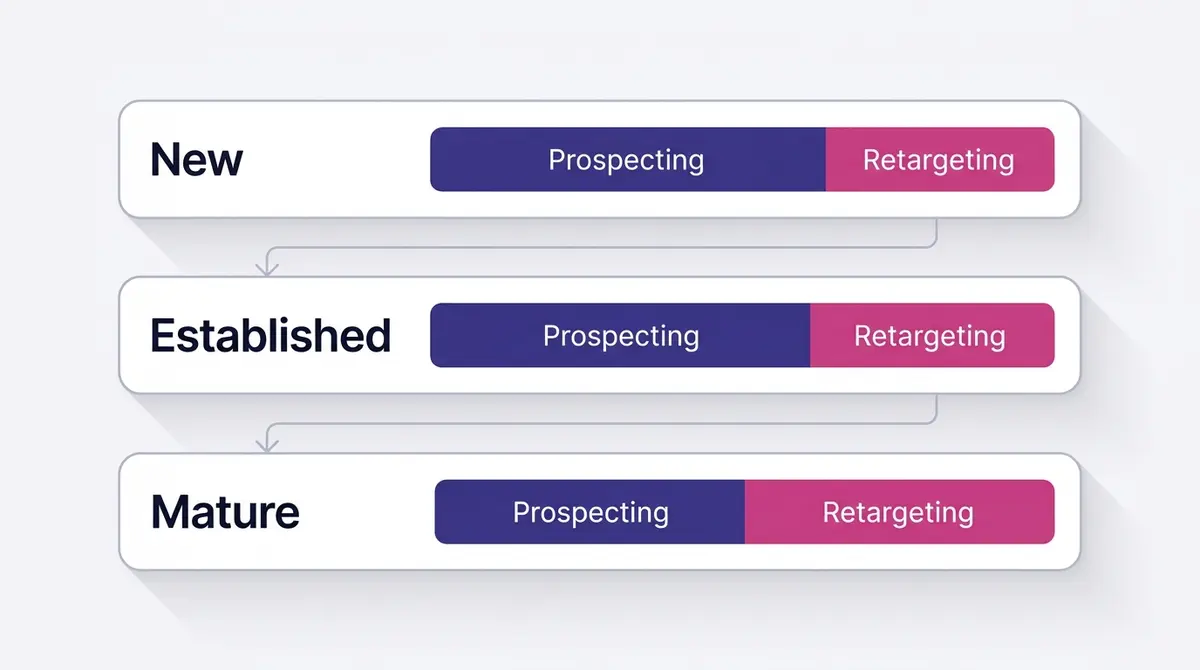
Lebesgue's 2024 guidance, which is a vendor source and so directional, frames the split by brand maturity: roughly 70-80% prospecting and 20-30% retargeting for new brands, shifting toward 50-60% and 40-50% once established, and 30-40% and 60-70% for mature brands with deep warm pools. The reasoning is sound even if the exact figures are not gospel. A new brand has almost nobody to retarget, so most of the money has to go cold. A mature brand has a huge warm audience that converts at the 71% ROAS premium Focus Digital found, so it can lean on retargeting.
| Brand stage | Prospecting (TOFU) | Retargeting (MOFU and BOFU) |
|---|---|---|
| New | 70-80% | 20-30% |
| Established | 50-60% | 40-50% |
| Mature | 30-40% | 60-70% |
Source: Lebesgue, 2024 (directional vendor guidance).
If you have read elsewhere that you should put most of your budget on proven bottom-funnel campaigns, that is not a contradiction, it is the same logic at a different point on the table. That advice assumes a large, established warm pool, which is exactly the mature row above where retargeting carries 60-70%. A new account has almost nobody to retarget, so the same logic sends most of the money up top. The variable both rules turn on is the size of your warm pool, not a fixed percentage, so read any "spend most on what converts" rule as advice for an account that already has something to retarget.
A worked example makes the drift concrete. Say you have USD 3,000 a month and a young brand. Start near 75/25: about $2,250 into TOFU prospecting and $750 into a combined retargeting campaign. Run that for four to six weeks while the warm pool fills. As your video-view and engagement audiences grow large enough to fund a real BOFU campaign, migrate toward 50/50, roughly $1,500 and $1,500, and split the retargeting budget into separate MOFU and BOFU campaigns. These are round illustrative numbers to show the shape of the move, not a benchmark: your own split is dictated by how fast your warm audiences actually grow.
The rule that ties it together: do not move budget into retargeting faster than your warm pool fills. For most brands that means four to six weeks of consistent TOFU spend before BOFU has enough audience to scale into. Watch the size of your video-view and engagement audiences in Ads Manager. When they are large enough that your BOFU frequency is climbing, that is the signal to shift more budget down the funnel. Until then, fund the top, because efficiency at the bottom is something you earn, not something you start with.
A practical way to read the split is as a feedback loop rather than a fixed dial. Each week, look at three numbers: the size of your warm audiences, your BOFU frequency, and your blended cost per result. If BOFU frequency is creeping past three or four and results are getting more expensive, you are saturating a warm pool that is too small, so the answer is more TOFU, not more BOFU budget. If your warm audiences are large and your retargeting ROAS is holding near the 3.61 median Focus Digital reported, you can safely move spend down the funnel. The mistake is treating the percentages as a setting you choose once. They are an output of how full your funnel is, and they should drift as the brand grows.
Measure the funnel: attribution, lag, and blended ROAS
A funnel is easy to kill by accident, because the metric that judges the whole thing is not the metric that judges any one stage. Each campaign has to be read on its own job. TOFU is judged on CPM, reach, cost per 3-second or qualified view, hook rate, and how fast your warm audiences are growing, never on direct ROAS, because converting was never its job. MOFU is judged on CTR, CPC, cost per landing-page view, and cost per lead, the signals that someone moved from aware to interested. BOFU is the only stage where ROAS, cost per purchase, and conversion rate are the point, watched alongside frequency so you catch a warm pool getting tired.
Attribution is where good funnels get strangled. Meta's default setting is 7-day click and 1-day view (Meta Business Help Center, 2026); the longer click windows it once offered were trimmed after Apple's 2021 app-tracking changes. A last-click view of the world hands all the credit to the BOFU ad that closed the sale and none to the TOFU video that created the customer weeks earlier. If you read per-campaign ROAS in isolation, TOFU always looks like a loser and the temptation is to cut it, which quietly drains the pool that makes BOFU profitable. The honest number is blended ROAS: total revenue divided by total ad spend across all three stages. Read the account as one machine. A blended ROAS holding near the 3.61 median Focus Digital reported for retargeting is a healthy funnel even when the TOFU line looks unprofitable on its own.
The lag is the other thing to plan for. A cold audience needs time to move through TOFU and MOFU before a meaningful retargeting pool exists, usually four to six weeks of consistent top-funnel spend. Push offer-led BOFU ads before that pool fills and you are paying conversion-level prices to reach people who barely know you, the most expensive way to advertise. Judge the funnel on a month of data, not a week, and judge it blended.
Running the three stages as separate campaigns
Build the funnel as three distinct campaigns in Meta Ads Manager, not one campaign with three ad sets. Separation gives each stage its own objective, its own budget, and its own clean reporting, so you can see what TOFU, MOFU and BOFU each contribute and fund them independently. Bundled into one campaign, the algorithm will quietly pour your budget into whichever ad set finds the cheapest results, usually cold reach, starving the warm audiences that actually convert.
Each campaign needs the right creative job, and producing three different kinds of creative on a steady cadence is the real operational challenge. TOFU wants a stream of cheap short-form videos. MOFU wants testimonial and UGC edits cut from real customers. BOFU wants offer-led statics and carousels that change with every promotion. That is a lot of distinct creative work, and the loop only stays healthy if you can research what is working, generate on-brand variations, edit them, and launch each to the right campaign without the production becoming the bottleneck. A platform like AdPlay.ai can shorten that research-to-launch loop so each stage stays fed with fresh creative.
The volume and the refresh cadence are not the same across stages, because fatigue hits each pool differently. TOFU faces the largest, constantly-refreshing cold audience, so it can carry the most concurrent variants and rotate them broadly without burning out fast. BOFU points at a small warm pool, so frequency climbs quickly there: the same person sees your offer again and again, and the ad fatigues soonest at a given spend. The practical rule is to refresh BOFU and MOFU creative more often relative to their audience size, and watch frequency as the early warning. When BOFU frequency creeps past three or four and cost per result rises, the fix is usually a fresh angle, not a higher bid. The mechanics are worth knowing in full: ad fatigue and a healthy ad frequency cover the warning signs and the cadence per stage.
For the persuasion structure inside each ad, the AIDA framework for Facebook ads maps neatly onto the funnel, attention and interest at the top, desire in the middle, action at the bottom. To build the warm audiences your MOFU and BOFU campaigns depend on, see Facebook retargeting, and for the UGC that powers the middle of the funnel, how to make UGC ads covers the creative job in detail.
Common funnel mistakes
Most funnels do not fail on strategy, they fail on the same handful of avoidable habits. Scan this list before you launch and again whenever results drift:
- Skipping the top. Going straight to BOFU with a tiny warm pool means paying conversion prices to reach near-strangers. You cannot retarget people you never reached.
- Killing TOFU on ROAS. The top of the funnel was never built to convert. Judge it on cost per view and audience growth, or you switch off the very thing that makes the bottom profitable later.
- No exclusions. Three campaigns with overlapping audiences bid against each other and pay to re-reach people who already bought. Exclude lower-funnel and recent-purchaser audiences from everything above them.
- Shifting budget faster than the pool fills. Retargeting only works when there is a warm audience to retarget. Move spend down the funnel as the pool grows, not on a calendar.
- One campaign doing three jobs. A single campaign forces one objective and lets the algorithm chase the cheapest reach, starving the warm stages. Run three.
- Never refreshing creative. Each stage fatigues, and the small BOFU pool fatigues fastest. A decaying ad needs a new ad, not a new audience.
- Reading per-campaign ROAS instead of blended. Last-click flatters the closer and buries the introducer. Read the account as one number.
Treat the funnel as one connected machine: cheap video at the top earns the warm audience, social proof in the middle earns the belief, and a clean offer at the bottom earns the sale.
Example ad angles
Representative hooks and formats from the category.
“Problem and Solution ad for a skin concern introduced to a cold audience in a 6 to 15 second reel”
“Testimonial ad for pigmentation eased after weeks of treatment, retargeted to video viewers”
“Discount or Offer ad for a bundle served to the warm engagement audience”
By the numbers
Frequently asked questions
What does TOFU, MOFU and BOFU mean for Facebook ads?
TOFU is top of funnel: cold prospecting that introduces your brand to people who have never heard of you, usually with cheap short-form video. MOFU is middle of funnel: warming people who have engaged, with UGC and social proof. BOFU is bottom of funnel: closing warm audiences with offer-led conversion ads. Each stage is best run as its own campaign with its own objective, audience, and creative.
How should I split my budget across the three stages?
No neutral source endorses one exact split. For a newer brand, weight heavily toward prospecting: roughly 70-80% to cold reach and 20-30% to retargeting, because your warm pool is still small (Lebesgue, 2024, directional). You will also hear the opposite advice, put most of the budget on proven bottom-funnel campaigns, and both can be right: that rule assumes a large, established warm pool a new account does not have yet. Shift toward retargeting only as the pool fills over four to six weeks. The split is an output of how full your funnel is, not a number you set once.
How do I stop my TOFU, MOFU and BOFU campaigns from competing for the same people?
Use audience exclusions. In each cold prospecting ad set, exclude your warm engagement and website custom audiences plus recent purchasers, so TOFU only pays to reach genuine strangers. In MOFU, exclude the people already in your BOFU pool and anyone who has bought. Without exclusions your three campaigns bid against each other in the same auction and you pay conversion-level prices to reach buyers who already converted, which is the most common way a funnel quietly cannibalizes itself.
What retargeting time windows should I use for each stage?
Meta lets you set a custom audience's recency anywhere from 1 to 365 days (Meta Business Help Center, 2026). A practical, tunable starting point: retarget cart abandoners on a tight 3 to 7 day window while intent is hot, product and page viewers around 14 days, all site visitors around 30 days, and video viewers or Page and Instagram engagers on a longer 90 to 180 day window, since that interest decays more slowly. Only the 365-day ceiling is a Meta rule. The tiers inside it are judgment you match to your sales cycle.
Should I use broad / Advantage+ Audience or detailed interests at the top of the funnel?
For most accounts in 2026, broad. Advantage+ Audience is Meta's machine-learning targeting and is now the default audience setting for conversion objectives (Meta Business Help Center, 2026): you hand it your Pixel and customer signal plus optional audience suggestions, and it finds buyers more widely than a hand-stacked interest list. Detailed-interest stacking still has a place when you need to constrain reach for a niche product or a strict demographic, but paired with strong creative, broad targeting now routinely matches or beats it.
Do I need a website Pixel to build a retargeting audience?
Not for the first warm pool. Meta lets you build engagement custom audiences entirely on-platform from people who watched a video (25, 50, 75 or 95% or ThruPlay), engaged with your Page or Instagram account, or opened an instant form (Meta Business Help Center, 2026). That means cheap TOFU video can seed a MOFU and BOFU audience with no website tracking at all. You still want the Conversions API for accurate sales optimization at BOFU.
Can I run a full three-stage funnel on a small budget?
Yes, but compress it. On a small budget, concentrate spend on TOFU first to build a warm pool you can actually retarget, because tiny BOFU and MOFU audiences will not exit Meta's learning phase. Many small accounts run two stages early (cheap TOFU video plus one retargeting campaign that blends MOFU and BOFU) and split into three only once the warm audiences are large enough to fund separately. Expect a lag either way: a meaningful retargeting pool usually takes four to six weeks of consistent TOFU spend, so do not judge the funnel on week-one sales.
What is Advantage+ Sales and when do I use it?
Advantage+ Sales is Meta's AI-automated campaign type for the Sales objective, renamed from Advantage+ Shopping in early 2025. It is best at the bottom of the funnel, where it can serve offer-led conversion ads to your warm engagement audience. Meta has also extended Advantage+ automation to Leads campaigns, reporting around 10% lower cost per qualified lead in testing (directional, Meta-reported).
Sources
- 1.WordStream, Every Facebook Ad Objective Available in 2026 and When To Use Them (2026)
- 2.WordStream, Facebook Ads Benchmarks 2025 (2025)
- 3.Focus Digital, Facebook Ads Average ROAS 2025 Report (2025)
- 4.Lebesgue, Prospecting vs. Retargeting Facebook Ads (2024)
- 5.Wyzowl, Video Marketing Statistics 2026 (2026)
- 6.Sprout Social, Social Media Video Statistics (2026)
- 7.Social Media Today, Meta Rolls Out Updates to Advantage+ AI Ad Targeting Tools (2025)
- 8.Meta Business Help Center, Create an Events Engagement Custom Audience (2026)
- 9.Meta Business Help Center, About Lookalike Audiences (2026)
- 10.Meta Business Help Center, About the Attribution Setting (2026)
- 11.Meta Business Help Center, About Advantage+ Audience (2026)
Keep exploring
Turn ad research into winning ads
Research the ads that work, generate the creative on-brand, and launch to Meta, all in one tool.
7-day free trial · No credit card required