
AIDA Framework for Facebook Ads (2026)
What Attention, Interest, Desire, Action look like in a real Facebook ad: worked hooks, primary text, and headlines that carry one product to checkout.
Updated August 2026 · Xanny Lee, CEO
AIDA stands for Attention, Interest, Desire, Action: the sequence a piece of ad copy walks a stranger through, from noticing to buying. In the Facebook feed the framework compresses into one creative: the visual and the first line win attention in about two seconds, the next lines build interest with specifics, proof builds desire, and the headline and button carry the action. The stakes sit in the benchmarks: Facebook traffic campaigns average a 1.71% click-through rate at $0.70 per click (WordStream, 2025), and the hook is the lever that moves both.
You know the product and the offer, and the primary text box is still blank, because every draft comes out reading like a spec sheet nobody would stop scrolling for. AIDA fixes that by giving every line of the ad a job: win Attention inside two seconds, hold Interest with specifics, build Desire the reader can feel in their own kitchen, then ask for Action in plain words. Below, one generic product, a ceramic non-stick pan from a cookware brand, runs through all four stages, with the actual hooks, primary text, and headlines written out at each step so you can lift the moves for your own ad.
Why AIDA still fits a two-second feed
AIDA is the oldest framework in advertising that still earns its keep: Attention, Interest, Desire, Action, a sketch of how a stranger becomes a buyer. The lineage is more precise than the usual one-line origin story. An anonymous attention-interest-conviction formula ran in the trade paper Printers' Ink on 9 February 1898. Advertising pioneer E. St. Elmo Lewis put his own three-step version, attract attention, awaken interest, create conviction, in The Book-Keeper in 1903, then stated the full four-step shape ("attract attention, maintain interest, arouse desire, get action") in a Rochester talk on 6 January 1910. The acronym itself came later: C. P. Russell first spelled out AIDA in Printers' Ink on 2 June 1921, noting the letters spell the opera Aida (Wikipedia, 2026). So the framework is older than the name, and Lewis is the right person to credit, just not for the four-letter shorthand most posts hang on him.
The Facebook feed did not retire it; the feed compressed it. Facebook ads could reach 2.28 billion people as of January 2025 (DataReportal), nearly all on a phone with a thumb already moving, and video accounts for 60% of time spent on the platform (Hootsuite, 2025). That two-second window is not a figure of speech. Meta's own Facebook IQ research found people spend 1.7 seconds with a piece of content on mobile against 2.5 seconds on desktop, and it takes only 0.25 seconds of exposure for someone to recall mobile feed content at a statistically significant rate (Meta Facebook IQ, 2016). A quarter of a second buys recognition; under two seconds is the whole audition. Nobody reads an ad top to bottom there, so the four stages no longer arrive as separate pitches.
They stack inside one creative: Attention in the visual and first line, Interest in the lines a reader skims before tapping See more, Desire in the middle copy and its proof, Action in the headline and button. The rest of this post writes all four for one product, a ceramic non-stick pan from a cookware brand (no invented name, just the copy) so you can lift each move.
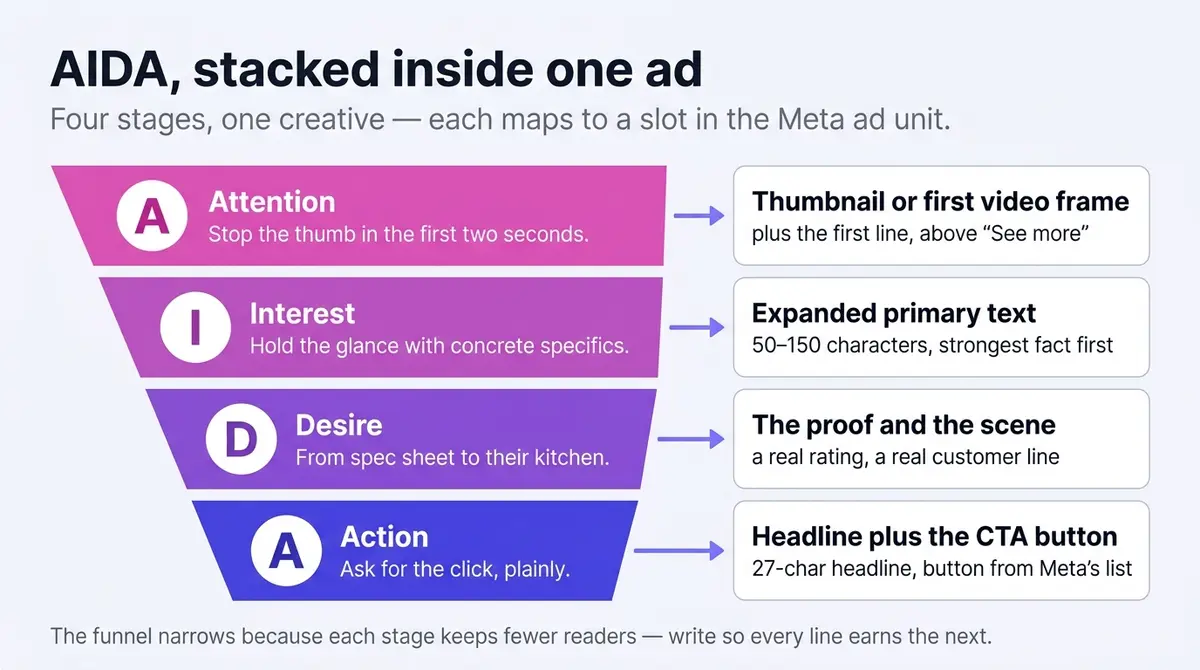
Where each AIDA stage lives in the ad unit
Before the copy, it helps to see the physical real estate. The four stages are not abstract: each maps to a specific slot in the Meta ad unit, with its own size constraint, and writing to the slot stops good copy from landing in the wrong place.
| Stage | Where it lives in the ad | Spec or constraint |
|---|---|---|
| Attention | The thumbnail or first video frame, plus the first line of primary text (the part above "See more") | The visible part of primary text is roughly the first two to three lines before the feed truncates it |
| Interest | The expanded body of primary text, read only after a tap | Primary text recommended at 50-150 characters (Meta, 2026); front-load the strongest specific |
| Desire | The proof inside the primary text and the content of the image or video itself | No fixed limit; this is where the scene and the social proof do their work |
| Action | The headline (the bold line under the media), the description line, and the CTA button | Headline 27 characters (Meta, 2026); the button is picked from Meta's fixed set, not typed |
The CTA button is worth one note because newcomers expect to write it. You cannot: it is a dropdown choice from Meta's fixed list (Shop Now, Learn More, Sign Up, Book Now, Get Offer, and so on), so the Action stage's verb is chosen, not composed. That is a constraint and a gift, because the proven buttons are already there.
Writing AIDA into one Facebook ad, stage by stage
Here is the whole framework worked through one product, a ceramic non-stick pan from a cookware brand, with the actual hooks, primary text, and headlines written out at each stage. Read it as one continuous piece of copy that happens to do four jobs, because that is how it lands in the feed.
Attention: win the first two seconds
Attention lives in two slots at once: the opening frame or thumbnail, and the first line of primary text that shows above the See more fold. Both have to fire inside that 1.7-second mobile window, and the recall research says a clear image can register in a quarter of a second, so the visual carries as much of the hook as the words do. The first line's job is not to sell the pan. It is to stop the thumb. Most ads fail here by announcing instead of hooking:
Introducing our new ceramic non-stick pan, now available online.
Nobody's feed has room for "introducing". Three stronger openers for the same pan:
The egg slid out before the spatula touched it.
Your "non-stick" pan stopped being non-stick about eight months ago.
We cooked 100 straight breakfasts in one pan. No oil. Nothing stuck.
The first is a tiny visual story you see without trying. The second names a quiet annoyance the reader has already noticed in their own kitchen. The third sets up proof the rest of the ad has to pay off. Each pairs with an obvious opening frame: the egg sliding in close-up, the scratched pan, the breakfast-counter montage.
Live feeds run the same moves in their own voice. A representative angle from fitness brand Fitness Achievers is a curiosity hook written the way a friend texts: "eh, got any gym nearby ah?" Different product, same job as the egg. It reads like the viewer's own thought, so the thumb stops without being asked to.
Write ten of these before you pick one. The hook is the highest-leverage sentence in the whole ad, so the first ten minutes of writing belong to it.
Interest: earn the lines after the hook
Attention bought you one more glance. Interest pays for it with specifics. Adjectives evaporate ("premium", "game-changing", "must-have"); facts stick:
One egg, no oil, nothing sticking, after a year of daily cooking. Ceramic coating with no PFAS, so nothing flakes into your food. Oven-safe to 500°F, dishwasher fine, and the handle stays cool on the stove.
The test for the Interest block: if a line would survive unchanged in a competitor's ad, it is filler, not interest.
Placement matters too. Meta's ads guide recommends keeping primary text to 50-150 characters (Meta, 2026), and the mobile feed truncates longer copy behind See more, so the hook and your strongest specific must land before the fold. Everything below it is for readers who have already leaned in.
There is a named principle here, the hinge between Interest and Desire: a feature is what the product is, a benefit is what it does for the reader. "Ceramic coating, no PFAS" is a feature; "nothing flakes into your food" is the benefit it buys. Interest can run on features, but to make them want the pan, every feature has to be cashed out into a benefit they feel. That translation is the next stage.
Desire: move from the spec sheet to their kitchen
Interest is about the product. Desire is about the reader's life with it, so the copy shifts from spec to scene:
Sunday pancakes where the first one doesn't tear. Fish skin that crisps and actually releases. A 30-second rinse while the coffee brews, instead of a soak and a scrub.
Then attach proof, because desire without belief is just decoration:
Rated 4.8 by more than 2,000 home cooks. "I cooked an egg with no butter just to test it. It slid out like a screensaver."
Those numbers are placeholders. In your ad, use the real review count and a real customer sentence verbatim, typos included if they read human: manufactured proof reads manufactured, and the feed has trained everyone to smell it.
Sometimes the proof carries the whole stage. A representative angle from skincare brand Berlanco is pure social proof: a ten-year brand, stocked in 300 pharmacies, "not a scam". That last phrase sounds blunt until you remember what a cold scroller is actually thinking about an unfamiliar product. The ad answers the objection before it forms, and in a category fighting skepticism, that is desire work.
It helps to know which desire the copy is pulling on, because "make them want it" is too vague to act on. Psychologist Steven Reiss, after surveying more than 6,000 people, mapped human motivation to 16 basic desires (Ohio State University, 2000), and a handful do most of the work in ad copy: saving (the pan that outlasts three cheap ones), tranquility (no scrubbing, no PFAS in the food), family (pancakes the kids actually eat), and status (the tool people ask about). Each scene line above tugs one of those levers. Pick the one your buyer feels most and write toward it, rather than listing every nice thing the product does.
Action: ask for the click in plain words
This is where polite ads die. The reader is one tap from your product page, and the ad has to say what to do and give one true reason to do it now:
Last line of primary text: Free shipping ends Sunday. Tap Shop Now and it ships the same day.
Headline: 30-night trial. If anything sticks, send it back. Button: Shop Now
Three slots carry Action, and only two are yours to write: the last line of primary text and the headline are free text, but the button is picked from Meta's fixed dropdown (Shop Now, Learn More, Sign Up, Book Now, Get Offer, and the rest), so match the verb to the ask rather than trying to invent one. The urgency must be real: an actual end date, an actual guarantee. Manufactured countdowns burn the trust you will need for the retargeting ad. The honest version is everywhere once you look: a representative Glad2Glow angle prices a five-piece skincare bundle at RM58.50 for Ramadan, a real number tied to an occasion the buyer can check on a calendar. And the ask is worth sweating, because the click is the cheapest thing you buy all funnel: Facebook traffic campaigns average a 1.71% click-through rate at $0.70 per click across industries (WordStream, 2025). An ad that nails the first three stages and then mumbles the ask leaves the easiest win on the table.
Writing the headline that carries Action
The headline is its own discipline. Meta's ads guide recommends a Facebook feed headline of 27 characters (Meta, 2026), and the feed truncates anything longer, so spend that tiny space on the offer, not the brand name. Four shapes earn it:
| Headline shape | Why it works | 27-character example |
|---|---|---|
| The risk reversal | Removes the reason not to click | "30-night trial, free returns" |
| The number | A digit stops a scanning eye | "4.8 stars, 2,000+ reviews" |
| The benefit | One outcome, no feature | "Eggs that never stick" |
| The deadline | A real reason to act now | "Free shipping ends Sunday" |
The assembled ad, and your 20-minute version
Stacked into one creative, the four stages flow as a single piece of copy: the hook, then the specifics, then the proof, then the dated ask, with the headline carrying the offer and the button the click. No transitions, no "and that's not all", each line just hands to the next. Now run the same pass on your own product, timeboxed:
- Hooks (8 minutes). Write ten first lines. Keep the two that name a problem or show a moment.
- Specifics (4 minutes). List five facts only your product can claim. Keep three.
- Scene and proof (4 minutes). One sentence of the buyer's life with the product, plus one real proof point.
- The ask (2 minutes). Headline, button, and one true reason to act this week.
- Read aloud (2 minutes). Cut every word that does not pull its weight.
AIDA beyond the static product ad
The pan is the easy case: a visible product and a benefit you can photograph. The framework holds just as well when there is nothing to shoot and when the format is video instead of a text box.
AIDA for a service, not a product
The pan makes AIDA easy: the product is visible and the benefit is a slidey egg. People assume the framework stalls when there is nothing to photograph, but it does not. Take a bookkeeping app for freelancers, where the words carry more but the four jobs do not change.
Attention: "You owe more tax than you think, and you will find out in March."
Interest: Connects to your bank in two minutes, sorts every transaction, and shows your real tax bill updating as you earn. No spreadsheet, no shoebox of receipts.
Desire: The Sunday night where you already know the number, instead of the April surprise. Used by 40,000 freelancers who stopped dreading the email from their accountant.
Action: Free for your first month. See your live tax number before you pay anything.
For an intangible service, Attention leans on a fear (the surprise bill), Interest sells the absence of work, Desire trades the slidey egg for a feeling of control, and the proof is a user count rather than a rating. The same holds for B2B, where Desire leans on credibility (case results, a logo wall) and Action is a demo or a quote, not a checkout. AIDA does not care what you sell; it only asks each line to do its job.
AIDA as a video script, second by second
With most feed time now going to video, a video ad is just AIDA stretched across a timeline instead of stacked in a text box. The stages map to seconds, and the whole thing has to read with the sound off, so every stage needs an on-screen line, not just a voiceover.
| Time | AIDA stage | What is on screen | Overlay text |
|---|---|---|---|
| 0-2s | Attention | The egg sliding out of the pan in close-up | "No oil. Nothing stuck." |
| 3-10s | Interest | Hands cooking, quick cuts of the coating and cool handle | "Ceramic, no PFAS, oven-safe" |
| 10-18s | Desire | A family breakfast, the easy 30-second rinse | "Sunday pancakes, zero scrubbing" |
| 18-22s | Action | End card with the offer and button | "30-night trial. Shop now." |
Front-load ruthlessly: the first second is the most-skipped, so the strongest visual and the hook line belong there, not after a logo sting. Caption everything, because the structure has to survive a muted, half-glanced watch.
Mapping AIDA onto the campaign funnel: cold, warm, retargeting
The four stages live inside one creative, but a campaign rarely runs on one creative. A prospecting ad shown to a cold audience and a retargeting ad shown to a warm one are doing different jobs, and AIDA tells you how to reweight the same four stages for each, rather than writing two unrelated ads.
A cold audience, the prospecting layer that maps to Meta's awareness and traffic territory, has never heard of you. Every stage has to be present, but the weight sits hard on the front: Attention and Interest do most of the work, because a stranger gives you nothing on trust. The full sequence runs, hook to specifics to scene to ask, and the hook gets the longest setup it will ever get. This is where the egg-sliding-out opener and the "your non-stick pan stopped being non-stick" line belong.
A warm or retargeting audience, the people the Pixel already tagged as visitors, add-to-carts, or video viewers, is a different reader. They have already had the Attention and Interest conversation; running the long hook setup again wastes the impression and reads like you forgot you met. So you invert AIDA and lead with Desire and Action: the proof, the scene of owning it, the offer, and a real deadline. The retargeting version of the pan ad skips the "what is this" and opens on the close.
| Audience | Funnel layer | AIDA weighting | What the ad leads with |
|---|---|---|---|
| Cold (prospecting) | Awareness, traffic | Full sequence, weighted to Attention and Interest | The hook and the specifics, with the offer at the end |
| Warm (engaged, not converted) | Consideration | Compress Attention, lead Interest into Desire | A reminder plus the strongest proof point |
| Retargeting (cart, visitors) | Conversion | Skip Attention setup, lead with Desire and Action | The proof, the offer, and the deadline up front |
Running identical copy to both is one of the most common reasons retargeting underperforms, and it shows in the numbers: warmer audiences convert at a higher rate, so wasting them on a cold-style hook is expensive. The contrast between the layers also explains the cost gap a media buyer sees: Facebook traffic campaigns average a 1.71% click-through rate at $0.70 per click, while Leads campaigns, which ask for more, average a 2.59% CTR at $1.92 per click, a 7.72% conversion rate, and a $27.66 cost per lead across industries (WordStream, 2025). The further down the funnel the ask, the more the Desire and Action stages have to carry.
How Meta automated delivery changes the AIDA model
AIDA was built for one hand-crafted ad with the four stages arranged in order. Meta's automated delivery quietly breaks that assumption, and it is worth being honest about how. With Advantage+ creative, you can supply multiple images, videos, headlines, primary texts, and CTAs, and Meta automatically creates variations with different text combinations and media enhancements, testing up to 150 creative combinations and delivering the highest-performing mix per person (Meta, 2026). The system, not you, decides which hook pairs with which proof line for which viewer.
That changes the job. AIDA stops being "arrange the four stages in order in one ad" and becomes "supply strong raw material for each stage and let delivery assemble it." You write many hooks for Attention, many specific primary-text openers for Interest, several proof angles for Desire, and the offer and button for Action, and the auction finds the winning combination. The framework still tells you what good raw material looks like at each stage, which is exactly what the asset library needs. It just no longer dictates the running order.
The honest caveat: automated combination can shred a hand-built A-to-D narrative. If your ad depends on the hook setting up a payoff three lines later, or on a sequential story where line two only makes sense after line one, a system that swaps and recombines those lines can break the logic. So lock the creative manually for brand-sensitive ads, regulated categories, and any sequential narrative, where standard enhancements can be turned off at the ad level. Use the framework as a brief for the asset library when the stages are modular, and as a fixed blueprint when the story has to stay in order.
Diagnose a broken ad by stage: the metric that exposes each failure
The strongest reason to keep AIDA on the wall is diagnostic. When an ad underperforms, the framework tells you which stage broke, and each stage has a Meta metric that exposes the failure, so you rebuild the right line instead of guessing.
| Stage | The symptom in the data | What it means |
|---|---|---|
| Attention | Low hook rate, low 3-second video views, low thumb-stop | The opening frame and first line did not stop the scroll |
| Interest | Steep drop between 3-second and 15-second views, low CTR | They stopped, then the body lost them before the click |
| Desire | High CTR but low conversion rate, high cost per result | The click came, but the page or the proof did not close it |
| Action | Add-to-cart with no purchase, weak landing-page conversion | They wanted it, but the ask or the checkout leaked them |
Read it top to bottom. A weak hook rate sends you back to the first two seconds, not the offer. A healthy CTR with a stalled conversion rate is never an Attention problem: the hook worked, so the fix is the Desire stage or the page behind the click. Tying each break to its metric is what turns "why is my ad not converting" from a shrug into a single line to rewrite, and it is the layer most copy-formula posts skip entirely.
AIDA vs PAS vs FAB: when to reach for each
AIDA is one formula in a small toolkit, and picking the right one for the ad saves rewriting:
| Framework | Stands for | Best when |
|---|---|---|
| AIDA | Attention, Interest, Desire, Action | The product demonstrates well and you can build forward from a hook to a click |
| PAS | Problem, Agitate, Solution | The buyer already feels a pain and the relief sells harder than the product |
| FAB | Feature, Advantage, Benefit | A spec-heavy product where you must translate every feature into what it does for the reader |
These are lenses, not rivals: a strong PAS problem doubles as an AIDA hook. The rule of thumb is AIDA when the demonstration sells, PAS when the pain sells. You will also see AIDA variants (Arthur Sheldon's AIDAS added a Satisfaction stage in 1911, and earlier formulations such as Lewis's own leaned on a Conviction step), which exist mostly to patch a blind spot in AIDA itself: the original stops at the first sale.
Where AIDA breaks down, and the mistakes to check before you spend
That blind spot is worth naming first. AIDA models the first sale and nothing after: no stage for satisfaction, repeat purchase, or loyalty, which is exactly what the Satisfaction variant tries to fix. It assumes a clean linear march from Attention to Action, but real buyers skip stages, an impulse buyer goes from hook to tap, and academic reviews have found the strict hierarchy a poor predictor of behaviour. It also overcharges an established brand, whose name the reader already trusts: it can skip most of the sequence and just state the offer. So use AIDA as a checklist for cold, new-customer creative, and drop stages deliberately when the audience is warm or the brand is known.
Within that scope, most failing ads break at one stage, and the breaks are predictable enough to check before you spend a cent:
- Attention given away. Opening with the brand name or "Introducing" asks for attention instead of earning it. Lead with the moment or the problem.
- Interest with nothing to hold. Stacked adjectives ("premium, game-changing, must-have") carry no information. Swap each for a fact the reader could repeat at dinner.
- Desire with no proof. An unverifiable claim reads as a claim, not a reason. Pin a review count, a rating, or a real customer line to the benefit.
- An ask left to chance. Ending without a literal instruction and one true reason to act now leaves the cheapest conversion in the funnel unclaimed.
- A buried hook. If the truncated preview shows only setup, the ad never starts. The hook and your strongest specific have to clear the See more line.
That gives you copy worth producing, and production is the fast half: with the framework set, a tool like AdPlay.ai generates matching on-brand image and copy variants from your brand kit, you cut the video or fine-tune the static in the editor, and the finished ad launches to Meta from the same place. If the publishing mechanics are the unfamiliar part, how to run a Facebook ad covers objective, budget, and launch.
By the numbers
Frequently asked questions
Who invented AIDA and when?
AIDA stands for Attention, Interest, Desire, Action, the sequence a buyer moves through: notice the ad, want to know more, want the product itself, then take a step such as clicking or buying. An anonymous attention-interest-conviction formula appeared in Printers' Ink on 9 February 1898; advertising pioneer E. St. Elmo Lewis published a three-step version in 1903 and stated the full four-step shape in a Rochester talk on 6 January 1910. The four-letter acronym came later, first printed by C. P. Russell in Printers' Ink on 2 June 1921. So Lewis is the right person to credit for the model, though not for the acronym itself. It survives because it describes people, not a channel: in a Facebook ad the four stages compress into one creative, the visual and first line winning attention, the next lines building interest and desire, and the headline and button carrying the action.
Does AIDA still work for Facebook ads in 2026?
Yes, but the weighting has shifted. In the feed, attention is decided in roughly the first two seconds, so the hook does far more work than it did in print. Interest and desire have to compress into a few scannable lines, and action is mostly handled by the ad unit itself, the headline plus the CTA button. Treat AIDA as a checklist applied to one piece of creative rather than four separate assets and it maps cleanly onto how people actually scroll.
What is a hook in a Facebook ad?
The hook is whatever earns the first two seconds: the opening frame of the video or the image, plus the first line of primary text. Good hooks name a specific problem ('your non-stick pan stopped being non-stick'), show a small surprising moment (an egg sliding out untouched), or open a question the viewer wants answered. Announcements ('Introducing our new...') are the weakest openers because they ask for attention instead of earning it.
How long should Facebook ad primary text be?
As long as it stays interesting, but front-loaded without exception. Meta's own ads guide recommends 50-150 characters of primary text, and the mobile feed truncates longer copy behind a 'See more' link, so the hook and your strongest specific must land in the first line or two. Short copy of two to four lines suits impulse products and retargeting; longer copy can work for considered or expensive products, because the people who expand it are qualifying themselves. Test both and judge by cost per result, not by taste.
Which Facebook ad metric tells me which AIDA stage is failing?
Each stage has a metric that exposes its break. Weak Attention shows up as a low hook rate or low 3-second video views: the opening did not stop the scroll. Weak Interest shows as a steep drop between 3-second and 15-second views or a low CTR: they stopped, then the body lost them. Weak Desire shows as a high CTR with a low conversion rate or high cost per result: the click came but the proof or the page did not close it. Weak Action shows as add-to-cart with no purchase or weak landing-page conversion: they wanted it, but the ask or the checkout leaked them. As a reference, WordStream's 2025 study puts the average CTR for Facebook traffic campaigns at 1.71% across industries at $0.70 per click; treat that as a floor to beat, and if yours sits under 1%, fix the hook before touching budget.
What are the limitations of the AIDA model?
Three are well documented. It models acquisition, not retention: there is no stage for satisfaction, repeat purchase, or loyalty, which is why Arthur Sheldon's AIDAS variant added a Satisfaction step in 1911. It assumes a tidy linear path, but buyers often jump stages, an impulse buyer can go from Attention to Action in one tap, and reviews show it is a weak predictor of actual behaviour. And an established brand with existing trust can skip most of the sequence. Treat it as a copy checklist for new-customer ads, not a law of how everyone buys.
How does AIDA work for a retargeting audience versus a cold prospecting audience?
The framework holds; the emphasis moves with the funnel layer. A cold prospecting audience has never heard of you, so the full sequence runs and the weight sits on Attention and Interest, with the longest hook setup the ad will ever get. A warm or retargeting audience, the visitors and add-to-carts the Pixel already tagged, has had that conversation, so you invert AIDA and lead with Desire and Action: the proof, the scene of owning it, the offer, and a real deadline up front. Running identical copy to both is one of the most common reasons retargeting underperforms, since the warmer audience is more likely to convert and a cold-style hook wastes it.
How does Meta's Advantage+ automated creative change how I write AIDA copy?
It moves AIDA from one hand-built ad to a brief for an asset library. With Advantage+ creative you can supply several images, videos, headlines, and primary texts, and Meta automatically creates and tests variations, up to 150 creative combinations, and delivers the best-performing mix per person (Meta, 2026). So you write many hooks for Attention, several specific openers for Interest, a few proof angles for Desire, and the offer for Action, and the system assembles the winner. The framework still tells you what good raw material looks like at each stage. The caveat: automated recombination can break a hand-crafted ad that depends on line two paying off line one, so for brand-sensitive, regulated, or sequential-story ads, lock the creative and turn the enhancements off at the ad level.
Sources
- 1.DataReportal, Essential Facebook Statistics and Trends (2025)
- 2.WordStream, Facebook Ads Benchmarks 2025 (2025)
- 3.Hootsuite, Facebook Statistics for Marketers (2025)
- 4.Meta, Facebook Feed Image Ads Guide (2026)
- 5.Wikipedia, AIDA (marketing) history and variations (2026)
- 6.Ohio State University, New Theory of Motivation Lists 16 Basic Desires (2000)
- 7.Thrive Themes, Copywriting Formulas Guide (2026)
- 8.Meta Facebook IQ, Capturing Attention in Feed With Video Creative (2016)
- 9.Meta for Business, Advantage+ Shopping Campaigns (2026)
- 10.Meta Business Help Center, About Advantage+ Creative (2026)
Keep exploring
Turn ad research into winning ads
Research the ads that work, generate the creative on-brand, and launch to Meta, all in one tool.
7-day free trial · No credit card required