
How to Write a UGC Ad Script (2026)
A beat-by-beat UGC ad script structure with example lines, timing, and a template for every ad type, plus how to brief, license, and generate the matching phone-shot creative.
Updated December 2026 · Likit Sae Lee, CTO
A UGC ad script is built on five beats: a 3-second hook that names the problem or product, a relatable first-person problem, a phone-shot product reveal, a proof or demo beat, and one spoken call to action. Keep the whole cut to roughly 15 to 30 seconds, because short videos finish far more often (Vidyard found 65% of viewers watch sub-one-minute videos to the end). Lead with the hook: the first 1.5 to 3 seconds carry the recall load, and creative is the single biggest driver of incremental sales, accounting for 49% of the lift per an NCSolutions meta-study. Write in the creator's own voice, add captions for sound-off viewing, and brief the brand into the hook rather than after it.
You have seen the format a thousand times because it works: a real person, a phone held at arm's length, no studio, no script that sounds scripted. The problem is that a UGC ad lives or dies in its first three seconds and its last five, and most briefs leave both to chance. A good UGC script is not a paragraph of selling points handed to a creator. It is a tight sequence of beats with timecodes, example lines, and one clear ask, written so the camera feels like a friend, not a brand. Here is the structure that maps to how people actually watch, beat by beat, with a full sample script you can adapt.
Why the script is the lever, not the budget
You can buy more reach, refine your targeting, and rebuild your audiences, and still watch a campaign underperform if the creative is flat. The numbers say the script is where the work happens. An NCSolutions meta-study of roughly 450 CPG campaigns found that the creative itself drove 49% of short-term incremental sales lift, ahead of brand at 21%, reach at 14%, targeting at 11%, and recency at 5%. The ad you make matters more than where you point it.
UGC borrows a second advantage on top of that: trust. Nielsen's global study of 28,000-plus people across 56 countries found that 92% trust recommendations from people they know, and 70% trust opinions posted online by other consumers, well above any paid-ad format. A UGC script wins because it sounds like one of those people. Lose that voice and you lose the premium. The structure below exists to protect it: tight enough to perform, loose enough to still sound human.
There is also a hard ceiling on attention. Short videos finish far more often: Vidyard's analysis of 943,305 videos found 65% of viewers watch a sub-one-minute video to the end, versus about 20% for videos over 20 minutes, and Wistia's report across over 13 million business videos confirms it, the shorter the video, the higher the engagement. Your script has seconds, not minutes.
The five beats of a UGC ad script
Every strong UGC ad runs the same arc. Five beats, each with a job, each on a clock.
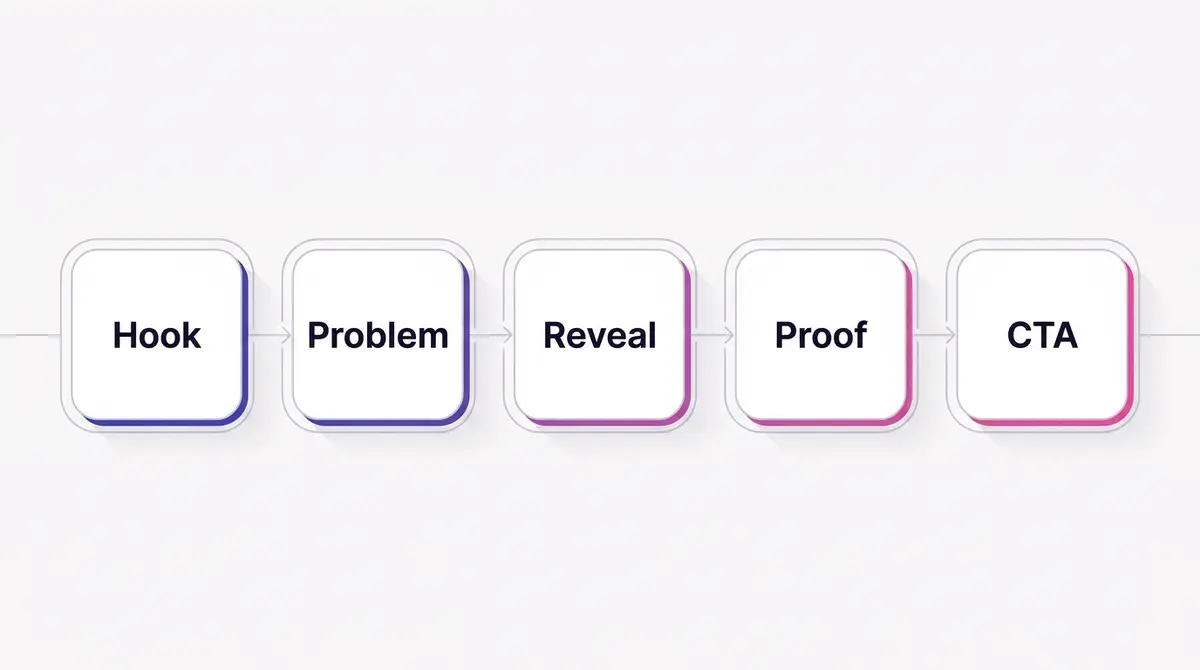
- Hook (0:00 to 0:03). State the problem or show the product. This is the beat that decides whether the rest gets watched.
- Relatable problem (0:03 to 0:07). A first-person "me too" moment that earns recognition.
- Product reveal (0:07 to 0:12). The product in-hand, phone-shot, native.
- Proof or demo (0:12 to 0:25). The credibility beat: a real before-and-after, a result, or a review.
- Call to action (0:25 onward). One short, spoken ask. One action.
The beats are not equal in difficulty. The hook is the hardest and the most important, the proof beat is where belief is won, and the call to action is where most scripts get lazy. Treat the middle, the problem and the reveal, as connective tissue: necessary, but not the place to spend your best lines.
Beat one: the 3-second hook
The first three seconds carry the recall load. As little as about 1.5 seconds of active attention can be enough for ad recall when the brand leans on distinctive assets, per an Amplified Intelligence study covered by The Media Leader (treat that figure as directional, and note it is contingent on those assets being present). The direction is unambiguous: lead with the point, and put the brand cue in frame early.
The brand-lift evidence backs this even on a fast scroll. A Nielsen study commissioned by Facebook across 173 studies found that viewers exposed to a video for three seconds or fewer still showed a 47% lift in ad recall and a 44% lift in purchase intent (a Meta-commissioned figure, so directional, but it reinforces that the hook does work). The takeaway for the script: brief the brand or the problem into the hook itself, not after a warm-up.
Avoid the slow open. "Hi guys, so today I wanted to talk about" is three seconds spent on nothing. Start mid-action, on the face, with the problem already named, in one of a few reliable shapes: a stated pain ("I had given up on fixing my breakouts"), a bold claim, a pattern interrupt, or a curiosity gap ("nobody told me why my skin stayed red").
Write three to five hooks per script, not one. The hook is the highest-variance line in the ad, so it is the line you most want to test rather than guess. Keep the rest of the beats fixed and swap only the opening, which isolates what actually earns the watch. The testing section below shows how to read the result.
There is a visual half to the hook, too, and scripts often forget it. The first frame matters as much as the first line. A creator's face mid-sentence, a held-up before photo, or a hand already squeezing the product all stop the scroll harder than a static intro card. Pair the spoken hook with a visual hook: what the viewer sees in frame one should reinforce what they hear, so even a sound-off viewer gets the point. The caption in those first frames carries the spoken hook for anyone watching muted, which is most of the feed.
A hook formula bank you can fill in
You rarely need to invent a hook from scratch. Most working openers are a few shapes with a blank to fill, so keep some on hand and write your three to five variations fast. These map cleanly onto a UGC first line; the hook guide holds the deeper library.
- The mistake: "The thing I kept getting wrong about problem."
- The timed proof: "I used product every day for number weeks, and here is the honest result."
- The identity call: "If problem is wrecking your thing, stop scrolling."
- The insider: "I work in field, and this is the one I actually keep buying."
- The objection flip: "I thought common doubt, so I almost never tried it."
- The list: "Number things nobody tells you about topic."
Fill the blank with the specific, never the generic. "Two weeks" beats "a while," and "my postpartum hair loss" beats "my hair." The concrete detail is what makes a stranger believe a real person is talking, which is the whole reason UGC outperforms a polished spot.
Beats two to four: problem, reveal, proof
The relatable problem (0:03 to 0:07) is the trust beat. It is first person, specific, and a little vulnerable: "I tried three different cleansers and my skin just got worse." This is where the 92% who trust people they know lean in, because the creator sounds like one of them. Keep it short. The recognition does the work, not the detail.
The product reveal (0:07 to 0:12) shows the product in-hand, on a phone, in natural light. Do not cut to a polished pack shot. The reveal should feel like a friend turning their phone to show you the bottle on their bathroom shelf. Name it plainly: "So I started using this."
The proof or demo (0:12 to 0:25) is the credibility beat and earns the most screen time after the hook. This is where the 70% who trust other consumers' opinions decide to believe you. Show, do not tell: a visible before-and-after, a real result, a genuine review on screen, or a quick demo that proves the claim. Spoken proof with no visual is the weakest version. The social-proof guide breaks down which proof types carry the most weight. A brand like Shakura runs a Before and After angle here with its real offers; a brand like Skinlycious leans on a testimonial of skin that cleared after weeks of trying everything. Whatever the proof, it has to be visible, not just asserted.
Match the proof to the awareness of the audience. A cold prospecting audience that has never heard of you needs the most concrete, undeniable proof: a side-by-side result, a number, a third-party review they can read on screen. A retargeting audience that already knows the product can be moved with a softer demo or a single testimonial. Using soft proof on a cold crowd is the mistake, because a vague "I love it" carries no weight against a stranger's skepticism.
Keep the demo honest. "Same lighting, no filter" over a real before-and-after does more than any superlative, because the credibility of UGC rests on it not feeling staged. The moment the result looks too perfect, the trust premium evaporates and the ad reads as a brand pretending to be a person. When in doubt, show the unglamorous version.
| Beat | Timecode | Job | Mandatory element |
|---|---|---|---|
| Hook | 0:00 to 0:03 | Earn the watch | Problem or product in first frame |
| Problem | 0:03 to 0:07 | Earn recognition | First-person "me too" line |
| Reveal | 0:07 to 0:12 | Introduce the product | Product in-hand, phone-shot |
| Proof or demo | 0:12 to 0:25 | Win belief | A visible result or review |
| Call to action | 0:25 onward | Earn the action | One spoken ask |
Beat five: the call to action
Most scripts collapse at the end. The call to action should be one action, spoken in the creator's voice, and specific. "Tap the link and use my code for your first order" beats "check it out." Do not stack three asks. Do not bury it under a five-second outro. Say it once, clearly, while the proof is still fresh on screen, and let the caption reinforce it for sound-off viewers.
Keep the verb concrete and the friction low. If the ad's goal is a lead, the ask points at the form ("tap below and answer two quick questions"). If it is a sale, it points at the product. One ad, one action.
Match the ask to where the viewer sits, the same way you match the proof. A cold prospect meeting you for the first time is not ready for "buy now," so a softer ask ("tap to see how it works") respects that they are still deciding. A warm retargeting viewer who already knows you can take the urgent version ("use my code before it sells out"). The rule of thumb: the colder the audience, the softer the verb and the smaller the commitment. The funnel-stage guide maps which ask fits the top, middle, and bottom of the funnel.
Timing and the native feel
Pace the whole cut to finish before the thumb wins. Hook by 0:03, product in-hand by about 0:05, and the call to action landing inside 30 seconds. Facebook's mobile-video study found that the ads winning highest aided recall were mobile-first, introducing the brand quickly at around 20 seconds average length, while slow traditional-narrative ads showed the brand early only 38% of the time (Meta-own research, so directional). The lesson holds: tight and brand-forward wins. If you are weighing a longer cut, the video ad length guide covers where length helps and where it hurts.
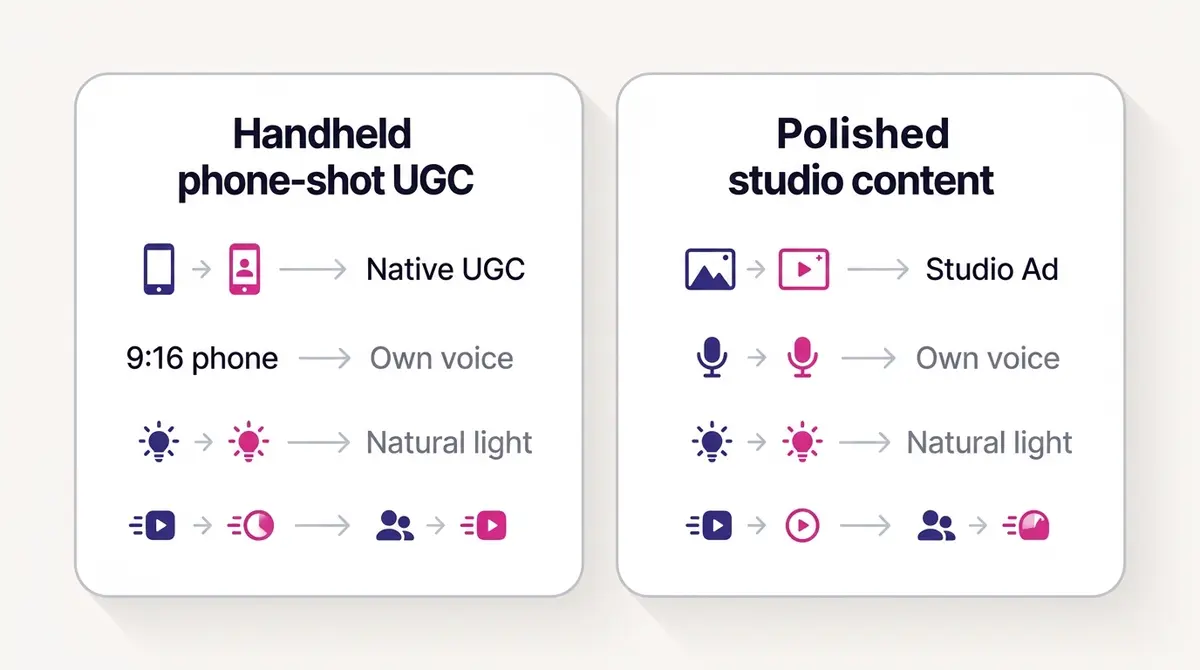
Native is a checklist, not an accident:
- Vertical 9:16, shot on a phone, not cropped from a wide studio frame.
- Natural light and a real setting: a bathroom, a kitchen, a car.
- Handheld with small, natural movement, not a locked tripod.
- The creator's own voice, not a separate polished voiceover.
- Burned-in captions for sound-off viewing, with the hook line fully legible in the first frames.
Native does not mean careless. Framing, audio, and lighting still have to be clean. It means the ad reads as a person sharing, not a brand broadcasting. A brand like Medicube runs this as a How-to or Demo: problem, nightly-routine reveal, then before-and-after proof, all phone-shot.
A sample UGC ad script you can adapt
Here is a full worked script for a skincare testimonial, in first person, captioned, with timecodes. Swap the product and the proof for your own.
Product: a calming serum. Goal: first purchase. Length: about 28 seconds.
0:00 to 0:03, Hook (on face, close, mid-action): "I spent two years and way too much money trying to calm my skin." (Caption: "2 years. Too much money.")
0:03 to 0:07, Problem: "Every new cleanser just made it redder, and I honestly gave up." (Caption: "Nothing worked.")
0:07 to 0:12, Reveal (turns phone to show bottle in hand): "Then a friend told me to stop layering everything and just try this one serum." (Caption: product name on screen.)
0:12 to 0:25, Proof or demo (split screen or before-and-after photos held up to camera): "This was my skin three weeks ago. This is now. Same lighting, no filter. The redness actually calmed down." (Caption: "3 weeks. No filter.")
0:25 to 0:28, Call to action (back on face): "Tap the link and use my code for your first bottle." (Caption: "Link below.")
Note what the script does not do. It does not open with a logo, it does not list five ingredients, and it does not stack three asks at the end. The hook states the pain in the first frame, the proof is shown not claimed, and the call to action is one verb. For a transformation variant, a brand like Fitness Achievers swaps the skincare beats for a progress story: relatable struggle, coach reveal, then a visible results shot, same five-beat spine.
UGC ad-type templates: one spine, many formats
The five beats are the spine. The format is how you dress them. A before-and-after, an unboxing, and a founder story all run the same hook, problem, reveal, proof, and ask, but each opens on a different angle and leans on a different kind of proof. Pick the format that fits your product and your audience's awareness, then re-skin the same structure.
| Ad type | Best hook angle | Proof beat leans on | Typical call to action |
|---|---|---|---|
| Problem and solution | Stated pain in the first line | A visible result that fixes the pain | "Tap to fix problem" |
| Before and after | The "this was me" reveal | Side-by-side, same lighting, no filter | "Get your own result" |
| Unboxing or first impression | "It just arrived, let's open it" | A genuine first reaction on camera | "Order yours, link below" |
| Founder story | "I built this because problem" | Why it exists and what it fixes | "Try what we made" |
| Tutorial or how-to | "Here is how I actually use it" | A clear demo that proves the claim | "Get the steps, link below" |
| Comparison | "I tried the old way, then this" | The two side by side, honest gaps | "See why I switched" |
| Skeptic or objection | "I did not think this would work" | The moment it changed their mind | "Try it, judge for yourself" |
| Day in the life | "A normal day, with this in it" | The product working in a real routine | "Make it part of yours" |
| Listicle | "Number reasons I keep buying this" | Each reason shown, not just said | "Tap for all number" |
Two cautions. Keep the comparison honest: name the old way as a category, not a real rival brand, and show the genuine gap, not a rigged win. And the skeptic angle only lands if the doubt is one your audience actually holds.
Two more scripts: the same spine, a new category
To prove the spine is not a skincare trick, here are two tighter scripts in other categories. Same five beats, different proof.
A problem-and-solution script for a kitchen appliance. Goal: first purchase. Length: about 22 seconds.
0:00 to 0:03, Hook (holding up a scorched pan): "I was wrecking a pan a month before this."
0:03 to 0:08, Problem and reveal (turns to the appliance on the counter): "Everything stuck, everything burned, so I swapped to this one." (Caption: product name on screen.)
0:08 to 0:18, Proof or demo (cooks an egg, slides it off clean): "Watch. Nothing sticks, no oil, no scrubbing after." (Caption: "Zero scrubbing.")
0:18 to 0:22, Call to action (back on face): "Tap the link, it is the lowest price I have seen it." (Caption: "Link below.")
A how-to and unboxing micro-script for a daily supplement. Goal: first purchase. Length: about 18 seconds.
0:00 to 0:03, Hook (opening the parcel): "The one everyone keeps asking me about just landed."
0:03 to 0:09, Reveal and how-to (scoops into a glass): "One scoop, shake it, done. That is the whole routine." (Caption: "1 scoop, that's it.")
0:09 to 0:14, Proof (drinks, then shows the label): "No chalky taste, and it actually has the thing I was looking for." (Caption: key ingredient on screen.)
0:14 to 0:18, Call to action: "First-order code is in my bio." (Caption: "Code in bio.")
The spine never moves. Only the props, the proof, and the words change, which is why one good structure can carry a whole content calendar.
Get the rights before you run it: permissions and audio
A script and a finished video still are not enough to run a creator's content as a paid ad. You need the right to advertise with it. To run the ad from the creator's own handle, which keeps the "a real person posted this" feel, Meta's mechanism is Partnership Ads (formerly Branded Content Ads), and it requires the creator to grant you permission first, for a single post or at the account level, through Meta's partnership tools (Meta Business Help, About Partnership Ad Permissions, 2026). If you run the footage from your own page instead, agree usage rights with the creator in writing before you film: how long you can run it, on which placements, and whether you can re-edit it.
Audio carries its own trap. The trending song that made the organic post pop usually cannot follow it into a paid ad. Meta's broader music catalog is licensed for personal, non-commercial posts, not advertising, so business accounts draw from the Meta Sound Collection, a library of royalty-free tracks and sound effects cleared for use in ads (Meta Business Help, How to Add Music to Ads Using Ads Manager, 2026). Use a copyrighted track without a license and the ad can be muted, blocked, or removed. Plan the sound from a cleared source, or let the creator's real voice and clean captions carry it.
Common UGC script mistakes and how to fix them
The same handful of errors kill most UGC scripts. Each one trades away the format's built-in advantage.
- The slow intro. A logo, a "hey guys," or a setup line spends the most valuable seconds you have. With completion this hard to earn (only 65% finish even a sub-one-minute video, per Vidyard) you cannot afford a warm-up. Fix: cut the first line and start on the problem.
- No visible proof. A creator saying "it really works" with no result on screen asks the viewer to take a stranger's word for it. Fix: show the before-and-after, the review, or the demo. Proof you can see beats proof you can only hear.
- A stacked call to action. "Follow, like, and check the link in bio and use my code" is four asks competing for one moment. Fix: one action, said once.
- Mismatched length. A 60-second UGC ad for a cold feed audience loses most of its watchers before the proof. Fix: hold the cut to 15 to 30 seconds and let a longer version live where intent is higher.
Run the script through one question before you brief it: would a real person say this to a friend? If a line reads as marketing copy, rewrite it in plain speech. The closer the script sits to how someone actually talks, the more of the trust premium it keeps. The AIDA framework guide is a useful cross-check here, because the five UGC beats are essentially AIDA, attention, interest, desire, action, compressed into a phone-shot 30 seconds.
Test the hook, then refresh the winner
A script is a hypothesis until the numbers judge it, and the first number to read grades the hook directly. A 3-second video play counts each time someone watches for at least three seconds (Meta Business Help, About Video Ad Metrics, 2026); divide those plays by impressions and you get the hook rate that practitioners use as a thumbstop signal. A low hook rate almost always means the opening, not the audience, so you fix the first line, not the targeting. ThruPlay, which Meta counts at fifteen seconds or completion, reads how far the body held viewers after the hook did its job. For what a healthy hook rate looks like, see the hook-rate benchmark guide.
The loop is simple. Ship three to five hooks against the same body, read the hook rate once you have enough impressions to trust it, cut the openers that did not land, and move budget to the winner. Then watch for fatigue: when the winning hook's rate slides and frequency climbs, the audience has seen it too often, and the fix is a fresh angle, not a louder repeat of the same one. The creative refresh guide covers how often to cycle in new creative before fatigue eats the result.
From script to finished creative: briefing and generating
A script is a brief in disguise. The five beats, the timecodes, and the single call to action are exactly what a creator needs, and exactly what a generation tool needs to build the matching visuals. Hand the creator the beats, then lock two lines and free the rest: the hook and the call to action are mandatory and word-for-word, because they carry the recall and the action, while the problem, reveal, and proof stay paraphrasable so the creator says them the way they actually talk. Over-scripting the middle is the fastest way to make UGC feel like an ad. For a reusable scaffold, the video ad script template gives a fill-in structure; for a deeper brief, see the UGC creative brief guide, and for the wider production picture, how to make UGC ads walks through sourcing and editing.
You do not have to film every angle to find out which one works. Once the beats are written, you can storyboard the reveal and proof frames, generate on-brand visuals to pressure-test the hook and the angle, and only commission a live shoot for the variations that earn it. Keeping research, generation, editing, and Meta launch in one place, on a platform like AdPlay.ai, means the winning script moves from concept to live ad without the brief getting lost between tools, though the principle holds regardless of the tools. The script comes first either way: write the beats, prove the angle, then put a real person, or a tested visual, in front of the right audience.
Example ad angles
Representative hooks and formats from the category.
“Testimonial ad for skin that finally cleared up after weeks of trying everything”
“How-to or Demo ad for the nightly routine that calmed visibly red, bumpy skin”
“Founder or UGC ad for sneaking a collagen scoop into a busy mum's morning”
By the numbers
Frequently asked questions
How long should a UGC ad be?
Aim for roughly 15 to 30 seconds. Short videos finish far more often: Vidyard found 65% of viewers watch a sub-one-minute video to the end, versus about 20% for videos over 20 minutes, and Wistia reports that engagement rises as length falls across over 13 million business videos. Get your hook out by 0:03, the product in-hand by about 0:05, and the call to action before the viewer's thumb wins. Facebook's own mobile-first study found that the ads winning highest aided recall averaged around 20 seconds, so tight is the target, not a fallback.
What makes a good UGC hook?
A hook that says the problem or shows the product in the first three seconds, in the creator's real voice. The first 1.5 to 3 seconds carry most of the recall load, and even a 3-second-or-fewer exposure lifted ad recall 47% in a Nielsen study commissioned by Facebook (treat that Meta-commissioned figure as directional). Brief the brand or problem into the hook itself, not after a slow intro: 'I tried everything for my breakouts' beats 'Hi guys, today I want to talk about.' Start mid-action, on the face, with a stated pain or a bold claim.
Should the creator read from a script word for word?
Give them the beats and example lines, not a teleprompter paragraph. The whole point of UGC is that it sounds like a person, not a brand, and Nielsen found 92% of people trust recommendations from someone they know. Mark the five beats with timecodes and one mandatory line each (usually the hook and the call to action), then let the creator paraphrase the middle in their own words. Over-scripting is the fastest way to make UGC feel like an ad and lose the trust premium that makes it work.
What are the main types of UGC ads, and does each need a different script?
The common types are problem-and-solution, before-and-after, unboxing or first-impression, founder story, tutorial or how-to, comparison, skeptic or objection-handler, day-in-the-life, and the listicle ('3 reasons I keep buying this'). They do not need different scripts, they need the same five-beat spine re-skinned. Hook, problem, reveal, proof, and call to action stay constant; what changes is the opening angle and the proof you lean on. A before-and-after leans on a side-by-side result, an unboxing on a genuine first reaction, a founder story on why the product exists. Pick the format that fits your product and your audience's awareness, then fill the same structure.
Why does the proof beat matter so much?
Because it is where belief is won, and because creative is the biggest sales lever you control. Nielsen found 70% of consumers trust opinions posted by other people, well above any paid format, and an NCSolutions meta-study of roughly 450 CPG campaigns attributed 49% of short-term incremental sales lift to the creative itself, ahead of brand, targeting, and reach. Show a real result on screen: a visible before-and-after, a genuine review, a demo that proves the claim. Spoken proof without a visual is the weakest version.
Do I need a creator's permission to run their UGC as a paid ad?
Yes. Filming or commissioning the content is not the same as having the right to advertise with it. To run an ad from the creator's own handle, Meta uses Partnership Ads (formerly Branded Content Ads), which requires the creator to grant you permission through Meta's partnership tools, per Meta Business Help. If you run the footage from your own page instead, agree usage rights in writing first: the duration, the placements, and whether you can edit it. One more catch: the trending song from the organic post usually cannot be used in a paid ad, so business accounts pull from Meta's royalty-free Sound Collection, because the broader music catalog is licensed for personal posts, not advertising.
How do I make a UGC ad feel native and not like an ad?
Shoot vertical 9:16 on a phone, in natural light, handheld with small natural movement, and let the creator use their own voice rather than a polished voiceover. Open in the middle of the action instead of a logo or intro card. Facebook's mobile-video research found that ads which introduced the brand quickly won aided recall, while slow traditional-narrative ads showed the brand early only 38% of the time. Add burned-in captions, since a large share of the feed scrolls with the sound off, and keep the hook line legible in the first frames. Native does not mean sloppy: framing, lighting, and audio still have to be clean. It means the format reads as a person sharing, not a brand broadcasting.
Can I generate the matching creative from a script instead of filming it?
Increasingly, yes, for the static and concept stages. Once your five beats and hook lines are written, you can storyboard the reveal and proof frames, generate on-brand visuals to test the angle, and only commission a live creator shoot for the winners. The script comes first either way: the beats, timecodes, and the single call to action define the brief, whether a human reads it or you build the visuals around it. A clear script makes every downstream step, briefing, generating, editing, and launching, faster and more consistent.
Sources
- 1.Vidyard, Video in Business Benchmark Report (65% finish sub-one-minute videos) (2025)
- 2.Marketing Charts, Creative's Still the Biggest Driver of Sales (NCSolutions, creative = 49% of incremental sales) (2023)
- 3.Nielsen, Consumer Trust in Online, Social and Mobile Advertising Grows (92% trust people they know; 70% trust online opinions) (2012)
- 4.MarTech, Even Brief Video Views Drive Brand Lift, Facebook-Nielsen Study Finds (2015)
- 5.Social Media Today, Facebook Mobile Video Creative Study (2017)
- 6.Wistia, State of Video Report (shorter video, higher engagement) (2026)
- 7.The Media Leader, Just 1.5 Seconds Is Enough for Ad Recall (Amplified Intelligence) (2025)
- 8.Meta Business Help Center, About Partnership Ad Permissions (2026)
- 9.Meta Business Help Center, How to Add Music to Ads Using Ads Manager (Sound Collection) (2026)
- 10.Meta Business Help Center, About Video Ad Metrics on Facebook and Instagram (3-second plays, ThruPlay) (2026)
Keep exploring
Turn ad research into winning ads
Research the ads that work, generate the creative on-brand, and launch to Meta, all in one tool.
7-day free trial · No credit card required