
Social Proof Ads That Convert (2026)
Why social proof moves buyers, the proof types and formats that win, how to source and disclose it ethically, the engagement that proves an ad, and how to turn one real review into a converting ad.
Updated September 2026 · Xanny Lee, CEO

Social proof ads use the voices and actions of real customers (testimonials, reviews, ratings, UGC, founder vouches, repeat-order and 'X people bought' cues) to do what brand copy cannot: borrow trust. People buy under uncertainty, and 97% of consumers read reviews before deciding, per BrightLocal's 2026 survey. A product with just five reviews is 270% more likely to be bought than one with none, according to Spiegel Research Center at Northwestern. The format works because shoppers trust other shoppers: Nielsen found 88% trust recommendations from people they know more than any advertising channel.
A shopper scrolling Instagram does not trust your headline, and they are right not to. Every brand says its product works. What changes the math is hearing it from someone who is not selling anything: a customer with the same skin, the same budget, the same doubt the buyer is feeling right now. That borrowed credibility is the entire job of a social proof ad, and when it is built from a real review rather than a polished claim, it can outperform creative that cost ten times as much to produce. The mechanics are simple. The discipline of sourcing it honestly is where most brands slip.
Why social proof moves buyers
Every purchase is a small bet placed under uncertainty. The buyer cannot test the product before paying, cannot be sure it suits them, and cannot fully trust the person trying to sell it. Psychologist Robert Cialdini named the shortcut people reach for in exactly this state: social proof. When we are unsure what to do, we look at what others like us have done and copy it, treating their choice as evidence of the correct one. An ad interrupts a person mid-scroll in precisely that uncertain frame, which is why the actions and words of other customers land harder than any claim the brand can make about itself.
The trust data explains the size of the effect. Nielsen's 2021 research found 88% of consumers trust recommendations from people they know more than any other channel. Its earlier 2012 global study put the same idea in sharper relief: 92% trusted earned media, the word-of-mouth and recommendations of friends and family, above all forms of advertising, with online reviews sitting just behind personal recommendations at 70% trust. The gap between those numbers and the trust people extend to brand advertising is the entire opportunity. A social proof ad does not try to out-argue the skeptic. It hands the microphone to someone the skeptic already believes.
Reliance on proof is not niche, and it is still rising. BrightLocal's 2026 survey found 97% of consumers read online reviews for local businesses, and 41% now say they always read reviews when searching for a business, up sharply from 29% the year before. Reading reviews is no longer a step careful shoppers take; it is the default. An ad that carries proof inside the creative meets that habit head-on instead of forcing the buyer to leave and go hunting for reassurance elsewhere.
The psychology, in plain terms
Three mental forces make social proof persuasive, and naming them helps you build creative that triggers each one deliberately.
The first is informational social influence: when we lack the knowledge to judge a product, we borrow the judgment of the crowd. A review telling a buyer how a serum felt on similar skin gives them information they cannot get from a spec sheet. The second is risk reduction. Seeing that others bought and were satisfied lowers the felt cost of being wrong. The third is similarity. Proof from someone who reads as a peer (same age, same problem, same hesitation) outperforms proof from a generic spokesperson, because the buyer can picture themselves in the outcome.
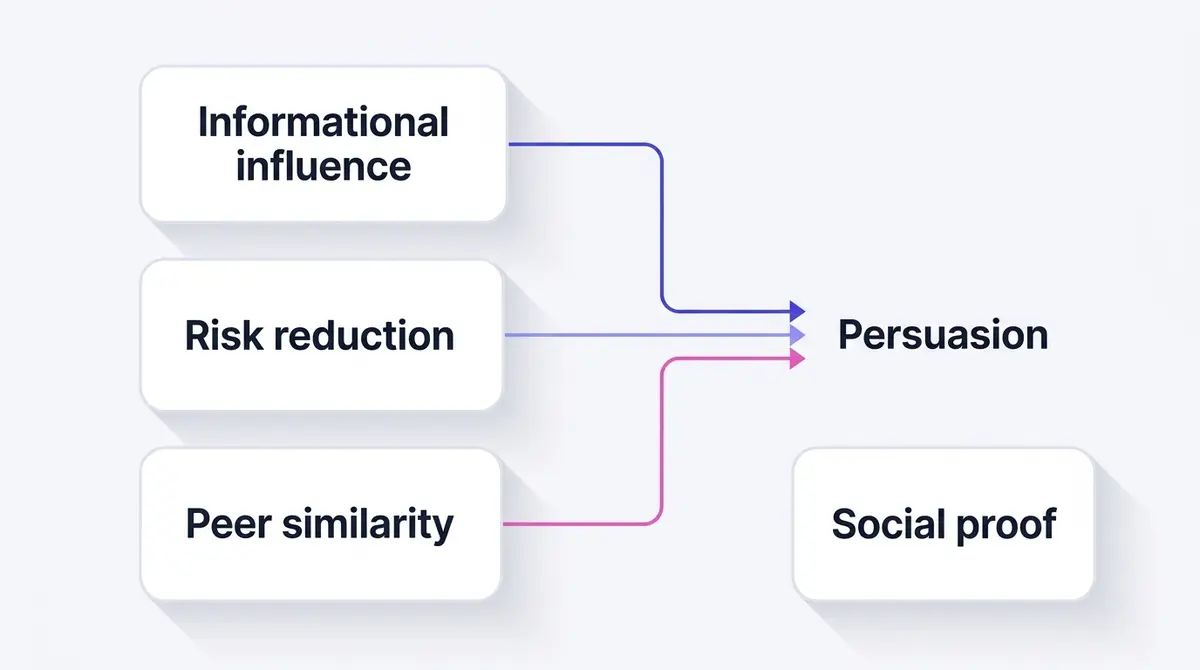
This is also why the most persuasive proof is specific rather than glowing. "Great product, love it" triggers none of the three forces. "My pigmentation faded after six weeks and I stopped wearing foundation" carries information, reduces a specific risk, and lets a similar buyer recognize their own situation. When you collect or select proof for an ad, hunt for that texture. The detail that feels almost too small to include is usually the line doing the persuading.
What counts as social proof
Before you pick a layout, take stock of what proof you actually have, because social proof comes in more shapes than a customer quote. Cialdini's original work split it into several distinct kinds, and modern advertising has added a few more. Naming them helps you reach for the proof you own instead of forcing the one you wish you had. Types and formats are different questions: the type is the kind of trust signal, the format is how you stage it in the feed.
| Type of proof | What it is | Who it convinces |
|---|---|---|
| Customer or peer proof | Reviews, ratings, and UGC from ordinary buyers | The shopper who wants to hear from someone like them |
| Wisdom of the crowd | 'Over 10,000 sold', best-seller badges, repeat-order rates | A cautious buyer reassured by the numbers |
| Expert or authority proof | A dermatologist, dietitian, or named specialist vouching for it | A buyer who wants a credentialed opinion |
| Influencer or creator proof | A trusted creator's endorsement to their own audience | Followers who already trust that voice |
| Press and media proof | 'As featured in' logos from real coverage | A buyer who weighs third-party validation |
| Awards and certifications | Industry awards, test results, trust and safety badges | A risk-averse or compliance-minded buyer |
| Case studies | A detailed, named result with the steps and numbers | A considered, higher-ticket buyer |
| Founder proof | The person who built it standing behind a result | An early buyer of a new brand |
Two rules keep this honest. Use the proof you genuinely have, and never borrow a badge you have not earned: an 'As featured in' strip pointing at coverage that does not exist is the fastest way to lose the trust the format was meant to build. Then match the type to the buyer. A skincare shopper wants peer proof and maybe a dermatologist's word; a software buyer wants a case study with numbers; a brand nobody has heard of yet leans hardest on the founder and the first few honest reviews.
The formats that carry proof
Social proof is a strategy, not a single layout. Different formats suit different proof and different stages of awareness. The table below maps the main ones to what they do best.
| Format | Best for | The proof it carries |
|---|---|---|
| Video testimonial | Emotional, high-consideration products | A real person's face, voice, and result, hard to fake |
| Review or rating card | Fast testing, many proof points | A verbatim quote plus a star rating |
| UGC (user-generated content) | Native feel, lower production cost | A customer's own footage of using the product |
| Founder vouch | New brands, authority plus story | The person who built it standing behind a result |
| Repeat-order cue | Consumables, subscriptions | The fact that customers come back |
| 'X people bought' herd cue | Scaling a proven product | Volume as evidence of safety |
Video deserves its own note. Wyzowl reports that 85% of people say a video has convinced them to buy something, and 89% say video quality affects their trust in a brand. Those are vendor-reported figures, so treat the exact numbers as directional, but the direction is clear: a clean, real, unstaged testimonial video earns trust that a shaky or over-produced one squanders. The goal is not cinematic polish. It is believability, which often means letting the footage look like something a customer actually filmed.
The herd cue ('over 10,000 sold', 'join 3,000 happy customers') is the purest form of social proof, because it is the crowd itself as the argument. It needs no narrative, just an honest number. A brand like Beyond Collagen+ leans on a repeat-order angle, showing the customers who reorder every month, which is the same herd logic wrapped in loyalty: people keep coming back, so it must work. For consumables and subscriptions, the repeat order is a stronger signal than a one-time sale, because anyone can be persuaded to try something once; coming back is the part that is hard to fake.
The review and rating card sits at the opposite end of the production spectrum from video, and that is its advantage. It costs almost nothing to make, renders the proof in a single scannable frame, and lets you test ten different customer quotes in the time it takes to film one testimonial. BrightLocal's finding that roughly half of consumers, 49% in its 2024 survey, trusted reviews as much as a personal recommendation, a share that has drifted down across recent years, shows the review still carries weight close to word of mouth. The card format simply puts that trusted artifact, the review, directly into the ad rather than asking the buyer to go find it.
UGC sits between the two. It feels native because it is filmed by a real customer on a real phone, and that lack of polish is the proof. The trick is to keep it looking like content, not like an ad wearing a costume. When a customer's own footage of unboxing or using the product runs in the feed, it reads as a recommendation from a peer rather than a pitch from a brand, which is exactly the 88% trust gap Nielsen measured working in your favour.
Influencer endorsement and customer UGC are not the same proof
Two of those types get blurred together, and the difference matters when you decide what to make. Customer UGC works through similarity: a real buyer who looks and sounds like your audience, so the viewer pictures themselves in the result. Influencer or creator proof works through borrowed trust and authority: the audience already follows that person and extends their credibility to whatever they recommend. UGC is cheaper, scales across many faces, and reads as a peer. A creator costs more, reaches a warm following you do not own, and carries the weight of an established voice. Neither is strictly more credible; they convince different people for different reasons.
The mechanics differ too. Customer UGC you film, license, and edit yourself. Creator content usually runs through Meta's Partnership Ads format (formerly Branded Content Ads), which lets you promote the creator's own post from their handle with their authorization, so the attribution stays honest and the post keeps its native look. That account-level permission, sometimes called whitelisting, is what lets a brand run paid ads from a creator's identity rather than reposting the video as the brand. For the production side, our guides on how to make UGC ads and writing a tight UGC creative brief go deeper.
Sourcing proof ethically
The fastest way to destroy the trust a social proof ad borrows is to fake it. Sourcing proof honestly does more than satisfy the law; it is what makes the proof persuade at all.
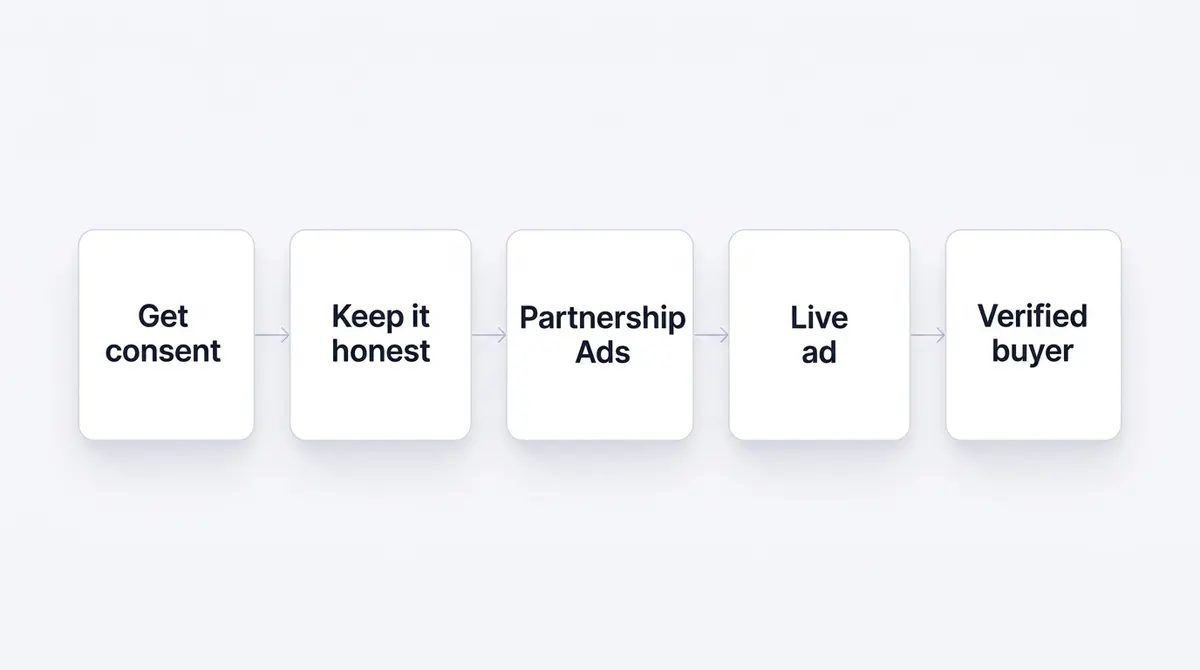
Start with permission. Before any customer's words, photo, or video appears in a paid ad, get written consent and keep it on file. For creator and customer videos, Meta's Partnership Ads format (formerly Branded Content Ads) is the compliant route: it lets you run the post from the customer's own handle with their authorization, so the attribution stays honest and the creator is credited. Fabricated testimonials and unauthorized UGC carry a practical risk on top of the ethical one: they can trigger policy enforcement that surfaces in your Account Quality dashboard and put delivery at risk.
Disclosure is the other half of consent. When a reviewer or creator was paid, gifted the product, or given any incentive, that material connection has to be disclosed, because a viewer reads an endorsement differently once they know money or free product changed hands. The US Federal Trade Commission's endorsement guides (16 CFR Part 255) require any connection a consumer would not expect, including 'monetary payment or the provision of free or discounted products', to be disclosed clearly and conspicuously. On Meta that maps to the Paid partnership label, which the Partnership Ads format applies to a creator's post automatically. The label is not a tax on trust: an honest 'paid partnership' tag costs far less credibility than an undisclosed endorsement that a sharp commenter outs in the replies.
Then resist the urge to perfect the proof. This is where the Spiegel Research Center's finding becomes a practical rule rather than a statistic. Purchase likelihood peaks between 4.0 and 4.7 stars and actually falls as ratings approach a flawless 5.0, because a perfect score reads as fabricated. PowerReviews found 85% of consumers deliberately seek out negative reviews before buying. A few honest, mixed reviews build more trust than a wall of five-star raves. The ethical path and the effective path are the same path: show real proof, imperfections included, and the buyer believes it.
One more guardrail. Never edit a review into something the customer did not say. Trimming for length is fine; changing the meaning is not. If a testimonial needs heavy rewriting to sound good, it is not the testimonial you should be running.
There is also a practical sourcing habit worth building. Reviews do not appear on schedule, so the brands with the deepest proof banks are the ones that ask for it systematically: a short request after a customer's second order, a reply prompt under a happy comment, a one-question post-purchase email that asks what changed. The goal is volume of honest, specific reviews, because the more you collect, the more often you find the rare line that states a precise outcome in the customer's own words. With 41% of consumers now saying they always read reviews before choosing a business, per BrightLocal's 2026 data, the proof bank is not a nice-to-have; it is inventory you will draw on for every ad you run.
When you go looking, the proof is usually already sitting in places you do not think of as a content library:
- The comments under your own ads and organic posts, where buyers vouch unprompted
- Product-page reviews and the questions-and-answers on your store and on marketplace listings
- Support tickets and chat logs, where customers describe the exact problem you solved
- Post-purchase survey replies and the open-text box on a satisfaction form
- Reddit threads, forums, and Facebook groups in your category
- Replies to your email and SMS, and DMs on Instagram
- Organic clips customers already filmed on TikTok or Instagram, used only with permission
Mine all of them, then reject the weak ones before they reach a creative. A review fails the bar if it could describe any product ('great quality, fast shipping'), if it praises without naming an outcome, or if it is so polished it reads like the brand wrote it. Keep the specific, slightly imperfect ones; those are the lines that convert.
How to turn a real review into an ad
The highest-leverage skill in this whole discipline is converting one written review into a piece of creative. Here is the repeatable method.
Find a review with a quotable line. You are looking for a single sentence that states a specific, believable outcome in the customer's own voice. Lead with that line as the headline, set large, over the product or the result it describes. Add the star rating as a visual and a small 'verified buyer' marker, the two cues that signal the proof is real. Keep the customer's exact phrasing underneath, including any slightly awkward, human texture. Close with a clear call to action.
That is the entire build. The discipline is in what you do not do: you do not polish the language into brand-speak, you do not invent a five-star average, and you do not pair the quote with a stock image that contradicts what the review describes. The Spiegel finding that just five reviews lift purchase likelihood by 270% means you do not need a huge bank of testimonials to start. Five specific, credible reviews are enough raw material for a month of rating-card variations.
For products where the result is visual, the before-and-after testimonial is the strongest single layout. A brand like Skinlycious can run a customer's four-week skin progress as a video testimonial, pairing the visible change with the customer's own account of it. A brand like Shakura can lift a five-star pigmentation review and build a quote card around the real result, keeping the customer's RM offer verbatim if their ad referenced one (a peel for RM99 instead of RM399, say), because the example is the proof. The image and the words have to agree; the moment the visual oversells what the review actually said, the trust breaks.
One caution before you reach for that layout: Meta restricts it in exactly the categories where it is most tempting. Meta's Health and Wellness advertising standard prohibits side-by-side before-and-after comparison imagery for weight loss and for anti-aging treatments such as Botox, dermal fillers, and wrinkle products, and it bars creative that implies negative self-perception. General cosmetic procedures may show a before-and-after only without those negative-self-image tactics, and all weight loss and cosmetic ads must target people 18 and older. The compliant workaround is to show the result on its own, a close-up of clear skin rather than a split-screen, and let the customer's words carry the change. Our before-and-after ads guide walks the compliant versions in detail.
A few selection rules separate proof that converts from proof that just looks nice. Choose reviews that name a specific outcome over reviews that praise in general. Choose the customer who reads as your buyer's peer over the most articulate reviewer. Prefer a review that names and then overcomes a doubt ('I was sure it would not work on oily skin, but') because that line does the objection-handling for you. And weight recency: a review from last month carries more weight than a glowing one from two years ago, the same way Nielsen's trust figures rest on people believing the proof is current and real. The strongest testimonial ad is often not the most flattering quote in your bank; it is the most relatable one.
The engagement under your ad is proof too
Here is a kind of social proof most advertisers leave on the table: the reactions, comments, and shares that pile up under the ad itself. A scroller reads '2,300 likes and 180 comments' as a verdict the crowd has already reached, before they read a word of your copy. That accumulated engagement is real proof, and it is fragile, because of how Meta handles ad creative.
Every time you create a fresh ad, Meta mints a new ad object whose engagement count starts at zero. Duplicate a winning ad into a new ad set and the copy launches with no likes, no comments, no shares, even though the original gathered thousands. The fix is to run new ad sets off the same underlying post. Meta's Ads Manager lets you create an ad from an existing post (you select it by its post ID rather than uploading the creative again), so every ad set points at one post object and the social proof compounds in one place instead of resetting each time. Consolidating engagement onto one post also feeds the engagement rate ranking in Meta's ad relevance diagnostics, the signal that compares how much your ad is liked, commented on, and shared against rivals for the same audience.
The practical move: when a creative wins, do not duplicate the creative. Reuse its post ID across your scaling ad sets so the proof a new viewer sees keeps growing rather than starting over.
The comment section, and how to manage it
That same engagement is double-edged. The comment thread under a paid ad is unfiltered third-party validation, which is exactly why a scroller trusts it, and exactly why it can sink an ad. A top comment reading 'arrived in two days, works as described' does some of your selling for free. A top comment reading 'is this a scam?' or 'still waiting on my refund' poisons the ad for everyone who scrolls past, and Meta reads negative feedback into your quality ranking on top of it.
So treat the comments as part of the creative, not an afterthought:
- Read them. Check the threads on every ad that is spending, the same way you check cost per result.
- Respond fast to genuine questions and complaints, in public. A calm, helpful reply under an angry comment reassures the hundred silent readers more than it placates the one complainer.
- Hide, do not delete, spam and abuse. Hiding keeps the comment count and removes the noise without the optics of censoring criticism.
- Pin a helpful comment to the top so the first thing a new viewer reads is proof, not a doubt.
- Seed the thread honestly. A real customer's answer to a common question, left to sit at the top, pre-empts the hesitation the next buyer is about to feel.
You will not control every comment, and you should not try to. A few critical replies that you answer well read as more honest than a thread scrubbed clean.
What kills a social proof ad
Most failed social proof ads fail for the same handful of reasons. Run a new creative past this list before it goes live:
- The quote is too polished. If it reads like the brand wrote it, the proof evaporates. Keep the customer's own, slightly imperfect phrasing.
- The praise is generic. 'Great product, love it' triggers none of the persuasion; a line that names a specific outcome does.
- The visual contradicts the words. A stock photo that oversells what the review actually said breaks the ad the moment a viewer notices.
- The testimonial looks staged. An over-produced 'customer' video reads as a hired actor, which is worse than no video at all.
- The quote is too long to scan. A feed viewer reads one strong line, not a paragraph; lead with the sentence that lands and trim the rest.
- The rating is suspiciously perfect. A wall of flawless 5.0 raves reads as fabricated; a believable spread outsells it.
- The proof is stale. A glowing review from two years ago carries less weight than a specific one from last month.
None of these are fixed by spending more on production. They are fixed by choosing more honest, more specific proof.
Matching proof to the buyer's stage
Not every proof format belongs at every point in the funnel. A cold audience meeting your brand for the first time responds to broad credibility: a video testimonial that tells a relatable story, or a herd cue that signals safety in numbers. They do not yet care about the fine print of a specific feature.
A warmer audience, people who clicked, browsed, or abandoned a cart, responds to proof that resolves the specific doubt holding them back. This is where retargeting and review cards earn their keep. A buyer hesitating on price wants a review that says the product was worth it. A buyer worried about a side effect wants the review that addresses exactly that. Because BrightLocal found 85% of consumers say positive reviews make them more likely to use a business, the job at this stage is matching the right positive review to the right lingering objection.
A founder vouch works across stages but does something particular: it adds authority to the social proof. When the person who built the product stands behind a customer's result, you stack Cialdini's authority principle on top of social proof. A brand like Fitness Achievers can run the coach standing behind a member's transformation, which lets the founder's credibility and the member's real result reinforce each other in one piece of creative.
Measuring whether proof actually sells
Trust is the mechanism, but conversions are the scoreboard. A social proof ad that earns warm comments while selling nothing is a brand exercise, not a performance one, and you only know which you have if you measure to the purchase, not the like.
Make sure your social proof creative is firing real conversion events. With Meta's Conversions API sending server-side events into your dataset (the container Events Manager now uses in place of the old pixel-only setup), you can see which testimonial or rating angle actually drives sales rather than just engagement. When a testimonial proves itself, scaling it through an Advantage+ sales campaign lets Meta find more of the people likely to respond to that specific proof, instead of you guessing the audience by hand.
Test proof the way you test any creative: one variable at a time. Run a video testimonial against a static rating card on the same audience, or two different customer quotes against each other, and judge them on cost per result. Keeping research, generation, editing, and Meta launch in one place, with a platform like AdPlay.ai, shortens the loop between spotting a winning testimonial in the wild and shipping your own version of it. For the deeper craft, our guides on studying rival proof in the Meta Ad Library, writing stronger Facebook ad hooks, and sharper Facebook ad copywriting each pick up where this one leaves off. The brands that win with social proof are not the ones with the most testimonials. They are the ones who stay honest, test relentlessly, and let real customers do the talking.
Example ad angles
Representative hooks and formats from the category.
“Testimonial ad for skin that cleared up after a customer's 4-week routine”
“Review ad for the pigmentation result one customer rated five stars”
“Repeat-order ad for the loyal customers who reorder Beyond Collagen+ every month”
By the numbers
Frequently asked questions
What is a social proof ad?
A social proof ad uses the words, ratings, or visible actions of real customers to persuade, instead of relying on the brand's own claims. Common formats include customer testimonials, review and star-rating cards, user-generated content (UGC), founder vouches, and herd cues like 'over 10,000 sold'. The shared logic is that a stranger trusts another buyer more than they trust a seller, so the ad borrows that trust to lower the buyer's perceived risk.
Why does social proof work so well in ads?
Because buying is an uncertain decision, and under uncertainty people copy what others do as a mental shortcut for the correct choice, a principle psychologist Robert Cialdini named social proof. The trust data backs it up: Nielsen found 88% of global consumers trust recommendations from people they know more than any advertising channel, and 92% trust earned media above all other advertising. A real customer voice carries credibility your own copy structurally cannot.
Can I use before-and-after photos in a Meta ad?
Sometimes, with limits. Meta's Health and Wellness advertising standard prohibits side-by-side before-and-after comparison imagery for weight loss and for anti-aging treatments such as Botox, dermal fillers, and wrinkle products, and it bans any creative that implies negative self-perception. General cosmetic procedures may show a before-and-after only without those negative-self-image tactics, and all weight loss and cosmetic ads must target people 18 and older. The safe move in restricted categories is to show the result on its own, a close-up rather than a split-screen, and let the customer's words carry the change.
What is the difference between an influencer ad and a UGC ad, and which is more credible?
They convince different people. UGC works through similarity: a real customer who looks and sounds like your audience, so the viewer pictures themselves in the result, and it is cheap to scale across many faces. An influencer or creator ad works through borrowed trust: the creator's existing followers extend their credibility to whatever the creator recommends, reaching a warm audience you do not own. Neither is strictly more credible. UGC tends to win on relatability and cost, creator content on reach and authority, so most accounts run both.
Do I have to disclose when a review or creator in my ad was paid or given the product free?
Yes. The US Federal Trade Commission's endorsement guides require any material connection a consumer would not expect, including payment or free or discounted product, to be disclosed clearly and conspicuously. On Meta, creator content runs through the Partnership Ads format, which applies the Paid partnership label automatically. Skipping disclosure is both a legal risk and a trust risk, because a viewer who later learns the endorsement was paid discounts everything it said. An honest 'paid partnership' tag costs far less credibility than a hidden one that gets exposed in the comments.
Does putting the likes and comments on the ad itself help, and how do I keep them when I duplicate it?
It helps a lot: the reactions, comments, and shares stacked under an ad are proof a scroller reads before your copy. The catch is that duplicating an ad creates a new ad object whose engagement starts at zero. To keep the proof, run new ad sets off the same post instead of copying the creative. Meta's Ads Manager lets you create an ad from an existing post, selected by its post ID, so every ad set points at one post and the likes and comments compound in one place rather than resetting each time.
How do I handle negative comments under a social proof ad?
Read the threads on every ad that is spending, then respond in public to genuine questions and complaints. A calm, helpful reply reassures the silent majority more than it placates the one complainer, and it reads as honest. Hide, rather than delete, spam and abuse: hiding removes the noise without dropping the count or the optics of scrubbing criticism. Pin a helpful comment to the top so a new viewer's first read is proof, not a doubt. A few well-answered critical replies look more credible than a thread wiped clean.
Where do I find customer reviews to turn into ads if I do not have many yet?
More places than a review widget. Mine the comments under your own ads and posts, product-page and marketplace reviews, support tickets and chat logs, post-purchase survey replies, replies to your email and SMS, and category threads on Reddit and in Facebook groups. Customers also film organic clips on TikTok and Instagram you can use with permission. The Spiegel Research Center found a product with just five reviews is 270% more likely to be bought than one with none, so a handful of specific, credible reviews is enough raw material to start.
Sources
- 1.BrightLocal, Local Consumer Review Survey 2026 (2026)
- 2.BrightLocal, Local Consumer Review Survey 2024 (2024)
- 3.Nielsen, Beyond Martech: Building Trust With Consumers (2021)
- 4.Nielsen, Consumer Trust in Online, Social and Mobile Advertising Grows (2012)
- 5.Spiegel Research Center, Northwestern University, How Online Reviews Influence Sales (2017)
- 6.PowerReviews, Consumers Depend on Reviews (2018)
- 7.Wyzowl, State of Video Marketing 2026 (2026)
- 8.Wikipedia, Social proof (2026)
- 9.Meta Transparency Center, Health and Wellness Advertising Standard (2026)
- 10.Meta Business Help Center, Create Ads From Existing Posts in Meta Ads Manager (2026)
- 11.Meta Business Help Center, About Ad Relevance Diagnostics (2026)
- 12.Meta Business Help Center, About Partnership Ads (2026)
- 13.Federal Trade Commission, Disclosures 101 for Social Media Influencers (2019)
- 14.Legal Information Institute, 16 CFR 255.5 Disclosure of Material Connections (2023)
Keep exploring
Turn ad research into winning ads
Research the ads that work, generate the creative on-brand, and launch to Meta, all in one tool.
7-day free trial · No credit card required