
The 5 Stages of Buyer Awareness in Ads (2026)
How buyer psychology maps to ads: Eugene Schwartz's five awareness stages, Cialdini's persuasion principles and the biases behind each hook, proof and offer.
Updated December 2026 · Xanny Lee, CEO

Eugene Schwartz's framework (Breakthrough Advertising, 1966) sorts every prospect into five awareness stages: unaware, problem-aware, solution-aware, product-aware and most-aware. Each stage needs a different hook, proof and offer. Only the most-aware stage responds to a hard discount, and the Ehrenberg-Bass Institute estimates only about 5% of any audience is in-market at a given moment, so a buy-now offer aimed at a cold crowd misses 95 of every 100 people you reach.
You run a campaign with a sharp 20% off offer and a tight audience, and it dies. The targeting was fine. The problem was the message landing years ahead of the prospect. Most people you reach have never thought about your category, let alone your brand, and a hard offer asks them to leap five stages in one ad. Eugene Schwartz named those stages sixty years ago, and the math behind them still decides whether your creative connects or gets scrolled past.
The framework that decides if your ad connects
Eugene Schwartz wrote it down in 1966, in a book called Breakthrough Advertising, and the idea has outlasted every channel that has come and gone since. As explained in GrowthMarketer's 2024 breakdown of the framework, every prospect you reach sits in one of five awareness stages. They are not a funnel you draw on a whiteboard. They are a measure of how far the reader's own mind has travelled toward the purchase, before your ad ever shows up.
The five stages run like this. The unaware prospect has no problem in mind. The problem-aware prospect feels a pain but does not know a fix exists. The solution-aware prospect knows a category of fix exists but not which brand to trust. The product-aware prospect knows your product and is weighing it against rivals. The most-aware prospect is ready to buy and just needs a reason to act now.
The reason this matters for ad creative is simple. The job of the ad changes completely at each stage. The same words that make a most-aware buyer click make an unaware prospect scroll. Get the stage right and an ordinary offer works. Get it wrong and a brilliant offer dies, not because the product is weak but because the message arrived years early.
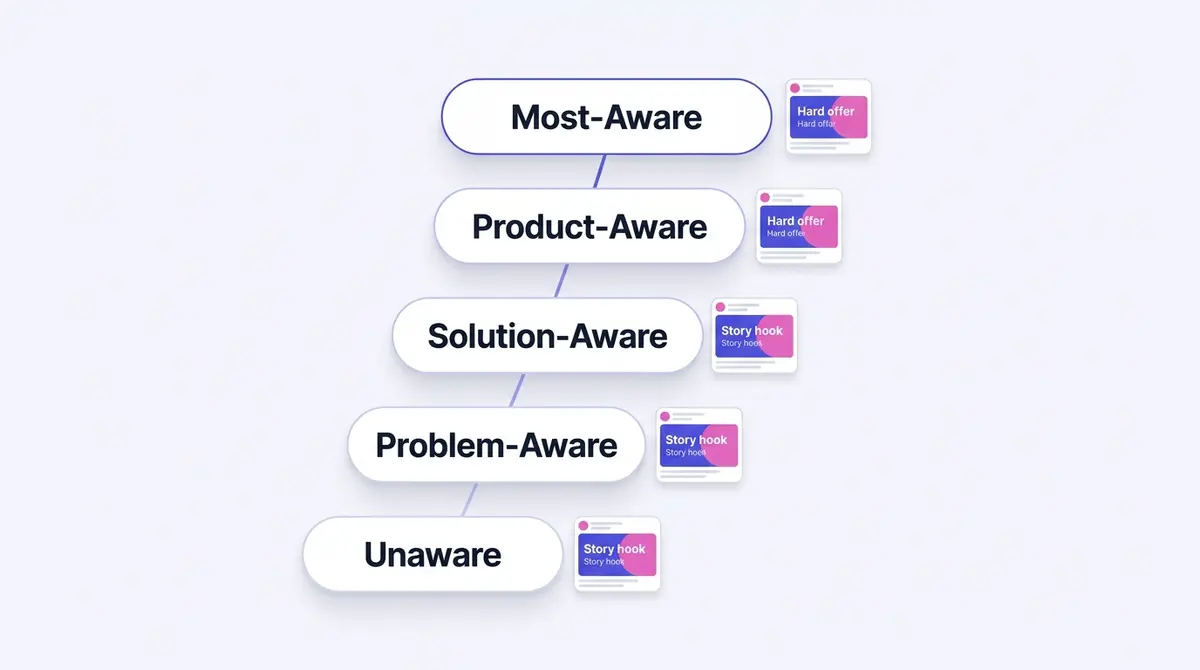
Why most of your audience is colder than you think
Here is the figure that reframes the whole exercise. The Ehrenberg-Bass Institute, summarising work by Professor John Dawes, estimates that at any given moment only about 5% of a market is actually in-market and ready to buy. This is the 95:5 rule. The 5% headline comes from Ehrenberg-Bass's B2B research, so treat the exact share as directional, but the out-of-market principle generalises to consumer categories too: at any moment only a small slice of any audience is actively shopping. The other 95% are out-of-market: unaware, or aware of a problem but nowhere near a purchase decision.
Sit with what that does to a cold prospecting campaign. You build a clean lookalike audience, you write a sharp offer, you launch. Roughly 95 of every 100 people the ad reaches have no reason to care about your price, because they were not shopping for your category in the first place. The targeting was not the failure. The message was aimed at the 5% and shown to everyone.
This is also why "buy now, 20% off" so reliably flops on a cold audience. A discount is a most-aware message. It assumes the reader already wants the thing and is only deciding when. Show it to a problem-aware or unaware crowd and you are answering a question they have not asked. The ad does not feel relevant, and on a platform where relevance drives delivery, irrelevant ads get throttled and starved of reach.
The 95:5 rule also reframes what you should expect a single campaign to do. If only about 5% of the people you reach are ready to buy, then a prospecting ad that converts a slice of that 5% and quietly warms the rest is doing its full job. The mistake is to write off the campaign because the other 95% did not buy on the spot. They were never going to. What you want from them is the first nudge up the ladder: a few seconds of attention, a flicker of recognition, a reason to remember the brand when their problem finally surfaces. That memory is an asset you are building even when the sale does not land today, which is why brands that only ever run hard offers tend to plateau.
Creative beats targeting, so message-match is the real lever
Marketers tend to obsess over audiences and underweight the message. The data says they have it backwards. An NCSolutions and Nielsen analysis of around 450 sales-effect studies, reported through Westwood One in 2024, attributed 49% of a campaign's incremental sales lift to creative, with 21% to brand, 14% to reach, 5% to recency and just 11% to targeting. Treat the exact percentages as directional, since they are drawn from one body of CPG research, but the ranking is the point: creative outweighs targeting by more than four to one.
The older, canonical version of this finding goes further. Nielsen Catalina Solutions' 2017 analysis found that when creative is strong it can drive up to 89% of a digital campaign's in-market sales lift, and up to 80% on TV. Pair the two and the message reads as current: creative was the dominant lever in 2017 and remained the dominant lever in the mid-2020s update.
For awareness staging, this is the whole argument. Here "creative" means far more than visual polish; it is whether the hook, proof and offer match where the reader actually is. A perfectly targeted ad with a most-aware offer aimed at a problem-aware audience is a creative mismatch, and the studies say creative mismatch is the most expensive mistake you can make. Laser targeting cannot rescue a message pitched at the wrong stage.
Why buyers feel first and justify second
Behind "creative beats targeting" sits a model of how people actually decide. In Thinking, Fast and Slow (2011), Daniel Kahneman split thinking into two modes. System 1 is fast, automatic and emotional: it reacts, recognises and judges in an instant, with no sense of effort. System 2 is slow, deliberate and analytical: it weighs and checks, and it is lazy, so it stays out of the way until something forces it to engage. Most everyday choices run on System 1.
A feed is System 1's home turf. A thumb moving at speed, attention measured in fractions of a second, judgments made on feeling and familiarity before any reasoning starts. That is why a spec sheet loses to one image that makes someone feel something. The scroller is not evaluating your features. They are reacting, and the reaction decides whether they stop.
Emotion and logic are not rivals across the ladder, though. They trade places. The early stages, unaware and problem-aware, are almost pure System 1: you earn attention with feeling, story and a flash of recognition, not argument. The later stages wake System 2 up, because a product-aware or most-aware buyer is actively comparing and now wants the specs, the reviews and the guarantee. The reliable pattern is to sell on emotion and let logic justify: the feeling makes the buyer lean in, and the facts let them say yes without feeling reckless. Open with a spec sheet to a cold audience and you are asking a sleeping System 2 to do work it will not do for a stranger.
What each stage needs: hook, proof and offer
Each stage is a different conversation. Below is the map most ad teams keep within reach when they brief creative, because it turns an abstract framework into a concrete decision about what to put on screen.
| Stage | Reader's mindset | Hook the ad needs | Proof that works | Offer to make |
|---|---|---|---|---|
| Unaware | No problem in mind | A story or a surprising fact, no product | Relatability, intrigue | None. Just earn attention |
| Problem-aware | Feels the pain, no fix in mind | Name and agitate the pain | The reader feels seen | Soft: a free guide or quiz |
| Solution-aware | Knows the category, not the brand | Here is how this kind of fix works | Mechanism, comparison | A low-friction next step |
| Product-aware | Weighing your product vs rivals | Why ours is the better one | Reviews, specs, guarantee | A trial, a bundle, a reason to choose |
| Most-aware | Ready, needs a nudge | The offer itself | Scarcity, risk reversal | A hard offer with urgency |
A few rules of thumb make this practical. At the unaware stage, do not mention the product at all. Your only job is to stop the scroll and earn a few seconds, usually with a story or a counter-intuitive claim. At the problem-aware stage, describe the daily frustration so precisely that the reader thinks you have been reading their mind. At the solution-aware stage, explain the mechanism, because the reader is now comparing approaches and wants to understand how yours works. At the product-aware stage, prove you are the better choice with reviews, ingredient or spec detail and a guarantee. Only at the most-aware stage does a hard offer belong, and there it is exactly right: a deadline, limited slots and a money-back promise convert people who were already going to buy.
The most common error is jumping two or three stages in a single ad. A founder who lives and breathes the product forgets that the viewer does not. So the ad opens with the product name, dives into features, and closes with a discount, which is a perfect most-aware ad shown to an audience that is mostly problem-aware. The fix is not better targeting. It is writing one stage earlier than feels natural. When in doubt, assume your cold audience is colder than your gut says, and let the warmer ads in your retargeting do the work of advancing them.
There is also a tone shift across the ladder that is easy to miss. Early-stage ads earn the right to be heard by being useful or entertaining, so they read like content. Late-stage ads earn the click by being clear and direct, so they read like offers. An ad that mixes the two, a chatty story that suddenly hard-sells a coupon, satisfies neither stage. Keep each creative honest about the single conversation it is having.
The persuasion principles behind each stage
The stage tells you what conversation to have. Persuasion principles tell you why that conversation lands. Robert Cialdini set out six in his 1984 book Influence and added a seventh, unity, in Pre-Suasion in 2016: reciprocity, commitment and consistency, social proof, authority, liking, scarcity and unity. They are not tricks. They are the shortcuts people lean on to decide quickly, which is exactly the System 1 ground an ad plays on. Each one pulls hardest at a particular stage, so reading them against the ladder turns an abstract list into a brief.
| Principle | What it does | Pulls hardest at | How it shows up in the ad |
|---|---|---|---|
| Liking | We say yes to brands we warm to | Unaware, problem-aware | A real face, a founder, a human tone |
| Reciprocity | A genuine gift creates an urge to give back | Problem-aware | A useful free guide, quiz or sample |
| Authority | We trust credible expertise | Solution-aware | An expert, a clinic, a credential explaining the mechanism |
| Commitment and consistency | Small yeses lead to bigger ones | Solution, product-aware | A low-friction first step before the real ask |
| Social proof | We copy people like us | Product-aware | Review counts, ratings, real customer video |
| Scarcity | We want what is limited | Most-aware | A real deadline, a limited batch, a closing cohort |
| Unity | We trust those who share our identity | Every stage | Speaking as "us": the same community, faith or life stage |
Two of these deserve a note. Social proof does so much work at the product-aware stage that it earns its own playbook: the types, the counts and how to film it are covered in social proof ads. And unity threads through the whole ladder rather than sitting on one rung. An ad that speaks to a shared identity, the same city, the same stage of life, the same community, feels like it came from inside the group rather than from a brand selling at it. That sense of "this is for people like me" is often what makes an otherwise ordinary hook land.
The cognitive biases that tilt a buying decision
If persuasion principles are the levers, cognitive biases are the wiring they pull on. A bias is a predictable shortcut the mind takes, and a handful of them decide more outcomes than any audience setting. Naming them makes them usable.
Anchoring. The first number a buyer sees becomes the reference point for every number after it. Show $249 before $149 and the $149 reads as a saving; show $149 on its own and it is just a price. This is why a struck-through original beside the current price converts at the product-aware and most-aware stages: the anchor is doing the persuading, not the discount. Picture a high-ticket appliance store that opens its offer on the $249 original, then reveals $149. Nothing about the product changed, only the reference did, and the same $149 now feels like $100 kept rather than $149 spent. The catch is that the original has to be a price you genuinely charged, or the anchor crosses into deception.
The decoy effect. Add a deliberately worse third option and the one you want starts to look obvious. The Decision Lab gives a clean version: small popcorn at $3, medium at $6.50, large at $7. The medium exists only to make the large feel like a no-brainer. A three-tier offer card where the middle tier sits just under the top tier works the same way, nudging buyers up to the tier you actually want to sell.
Loss aversion. Prospect theory (Kahneman and Tversky, 1979) found that a loss feels about twice as powerful as an equivalent gain. That is why "your cart is about to expire" pulls harder than "save 10%": dodging a loss beats winning the same amount. It belongs at the most-aware stage, and only when the loss is genuine.
Framing. The same fact lands differently depending on the words around it. "Ninety percent fat-free" beats "ten percent fat." "Join 12,000 members" beats "we have a few thousand customers." At every stage, frame the true proof toward the gain.
Bandwagon. People do what they see others doing. "Best-seller", "ten thousand sold" and sold-out flags work because the crowd itself is the proof, the bias sitting underneath social proof. It pulls at the product-aware stage, where the buyer is choosing between options they already know exist.
Mere exposure. People prefer what feels familiar, and familiarity grows with repetition. This is the quiet payoff of the 95:5 rule: the out-of-market people who see your brand today buy more readily when their problem finally surfaces, because the name already feels known. Steady presence compounds in a way one-off blasts never do.
Biases describe how people genuinely decide; they are not switches to flip on a weak product. Used to make a true message land, they are just good communication. Used to misrepresent the offer, they tip into manipulation, which is where scarcity earns its own section.
Scarcity and urgency without the backfire
Scarcity is the lever the stage map points at for the most-aware buyer, and it works for a clear reason: it triggers loss aversion. A genuine deadline, a limited batch or a closing enrolment threatens a loss, and a looming loss moves people who already want the thing and only need a reason to act now.
It is also the lever most often faked, and faking it backfires twice. Buyers have seen a thousand "Only 1 left" banners that reset on refresh, so a hollow countdown trains them to distrust everything else you say. And regulators and platforms are watching. The US Federal Trade Commission's 2022 report, Bringing Dark Patterns to Light, singles out false scarcity claims, the "Only two left in stock" line when stock is plentiful, and fake countdown timers as deceptive practices. Meta's Advertising Standards prohibit deceptive or misleading content, so a fake-urgency ad risks rejection, and a habit of them risks the account.
The honest version is simple and just as effective: only claim scarcity that is true. If the batch is genuinely limited, name the number. If the sale really ends Sunday, name the day and honour it. If enrolment really closes, close it. Real scarcity converts as well as the fake kind and costs nothing in trust. This is exactly where the most-aware retargeting pool earns its keep: a real deadline aimed at cart abandoners and repeat visitors who already know the brand, the audiences covered in Facebook retargeting and abandoned cart ads, is scarcity used precisely as the framework intends.
How to diagnose a stage mismatch inside Meta
You do not have to guess whether your message matches your audience. Meta's ad relevance diagnostics give three reads on every ad: Quality Ranking, Engagement Rate Ranking and Conversion Rate Ranking, each scored Above Average, Average or Below Average, as described in Meta's own Business Help Center documentation. These are vendor signals, so read them as in-account diagnostics rather than proof of effectiveness, but they are unusually honest about stage mismatch.
The pattern to learn is this. Below-average engagement usually means the wrong hook for the stage: your creative is asking the audience to care about something they are not ready to care about. Good engagement with below-average conversion rate ranking usually means the opposite problem at the other end: people are interested, but the offer or landing page is pitched too far ahead of where they are. They engaged with a problem-aware hook, then hit a most-aware checkout, and the gap lost them.
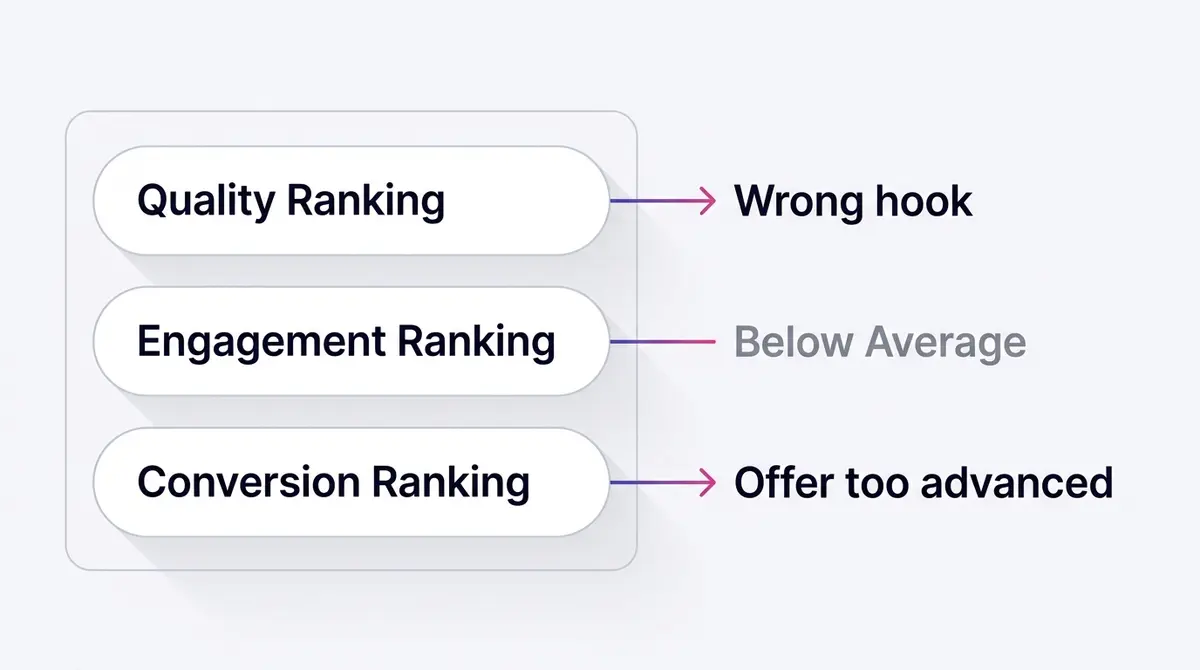
Read this way, the diagnostics tell you which lever to pull. Fix a low engagement ranking by moving the hook earlier, toward the audience's real stage. Fix a low conversion ranking on an otherwise engaging ad by softening the ask, adding a step, or sending warmer traffic before the offer. The temptation is to blame the audience and rebuild the targeting. The diagnostics usually point at the message.
How conversion rates expose the gap between cold and warm
You can see the awareness gap in the conversion numbers themselves. Per WordStream's 2026 Google Ads benchmarks, the average conversion rate across all industries is 8.18%, with a spread from 2.64% in Finance and Insurance up to 16.22% in Animals and Pets. These are search figures and a vendor dataset, so treat them as directional, but they illustrate something important: this is what happens when intent is high.
Search captures people who are typically solution-aware or most-aware. They typed the query. They are already looking. That is why a high-intent click converts in the high single or double digits. A brand-new, cold prospecting audience on a feed, made of people who were not searching for anything, converts far below those numbers, because most of them are sitting in the unaware and problem-aware stages where no purchase decision is even active yet.
The lesson is not that cold prospecting is bad. It is that you should not judge a cold campaign by warm-traffic benchmarks. A problem-aware Story ad that earns cheap attention and engagement is doing its job even if it sells nothing directly, because its job is to move strangers one rung up the ladder, not to close them.
This is where a lot of media budgets quietly leak. A team sets a single conversion-rate target across cold and warm campaigns, sees the cold prospecting ads fall short of it, and pauses them. The warm retargeting ads then post strong numbers, so the team shifts more budget there, and the audience pool the retargeting depends on slowly dries up because nothing is refilling the top of the ladder. Six weeks later the warm ads stall too, and nobody can see why. The honest way to judge each stage is on its own job: cold ads on cheap reach and engagement, mid-stage ads on click-through and add-to-cart, late-stage ads on conversion and return.
Laddering one customer up the stages
The most powerful use of the framework is sequencing. Instead of one ad for everyone, you run several ads, each matched to a stage, and let your audience definitions and retargeting carry the same person upward. Binet and Field's analysis of the IPA Databank, summarised by System1 Group, found that the most effective long-run split is roughly 60% brand-building to 40% sales activation. Read in awareness terms, that is about 60% of budget speaking to the unaware and problem-aware crowd and about 40% harvesting the most-aware.
The reason to run different ads for the same person, rather than one ad on repeat, is that buyers loop. Think with Google's research into the messy middle describes shoppers cycling between exploration and evaluation rather than walking a straight line. In one experiment across 310,000 simulated purchase scenarios, a fictional brand that layered behavioural-science advantages won up to 87% share of preference. The takeaway for sequencing: meet the looping buyer with the right message at the moment they loop, not the same message every time.
A worked example makes it concrete. Imagine a single beauty brand running four ads up the ladder. A brand like Skinlycious opens with a problem-aware Story that names the daily frustration of breakout-prone skin before it ever mentions a routine. People who watch or engage get retargeted with a solution-aware angle, the way a brand like Shakura runs a before-and-after testimonial that proves a brightening method to shoppers already comparing options. Those who click through and browse see a product-aware comparison, the kind a brand like Beyond Collagen+ uses to argue why its formula absorbs better than the sachet you already tried. Finally, cart abandoners and repeat visitors get a most-aware offer, the way a clinic like UR Klinik runs a limited-slots booking deal aimed at people who already know the brand and just need a nudge. Four ads, one ladder, each matched to a stage.
Putting the framework to work this week
Start by auditing your live ads against the five stages. Take each creative and ask one question: which stage is this written for. You will almost certainly find a cluster of most-aware offers running to cold audiences, which is the single most common mismatch and the cheapest to fix. Move those offers to retargeting and write something earlier for the cold pool.
Then build the sequence. Write one genuinely good problem-aware ad for cold prospecting, no offer, just a named pain and a relatable story. Set up retargeting so engagers see a solution or product-aware ad next, and so cart abandoners see your hard offer. Check the relevance diagnostics after a week and let them tell you whether the hook or the offer is the thing to fix. Keeping research, creative, editing and Meta launch in one place, as a platform like AdPlay.ai does, makes it faster to spin up the three or four staged variants a proper ladder needs rather than betting everything on one ad.
The framework is sixty years old, but the math underneath it is current: most of your audience is colder than you assume, creative outweighs targeting by a wide margin, and the right message for the stage is what actually moves people. For the hooks that open each stage, see the guide on Facebook ad hooks. For the words that carry the proof, see Facebook ad copywriting. And to find out which staged ad actually wins, see Facebook ad creative testing.
Example ad angles
Representative hooks and formats from the category.
“Problem and Solution ad for the breakout-prone skin that needs naming before the product”
“Testimonial ad for pigmentation faded after this brightening treatment”
“Discount or Offer ad for book your treatment this week and save your slot”
By the numbers
Frequently asked questions
What are the five stages of buyer awareness?
Eugene Schwartz defined them in 1966 as unaware (no problem in mind), problem-aware (feels the pain but does not know a fix exists), solution-aware (knows the category of fix but not your brand), product-aware (knows your product, weighing it against rivals) and most-aware (ready to buy, just needs a reason now). Each stage sits at a different distance from the purchase, so each needs a different ad.
Why does a discount offer flop on a cold audience?
Because a hard offer assumes the viewer already wants the product, and most do not. The Ehrenberg-Bass Institute estimates only about 5% of any audience is in-market at a given moment. The other 95% have no reason yet to care about your price. The ad gets scrolled because it answers a question they have not asked.
Do people buy on emotion or logic?
Both, but in that order. Daniel Kahneman's Thinking, Fast and Slow describes a fast, emotional System 1 that runs most everyday judgments and a slow, deliberate System 2 that only engages when forced. A feed scroll is almost pure System 1, so feeling stops the scroll and earns attention, while logic, the specs, reviews and guarantees, lets a warmer buyer justify the decision they already feel. Sell on emotion early, then hand over the proof at the stage where the buyer starts comparing.
How do I use scarcity and urgency in ads without it backfiring, and is fake urgency against the rules?
Only claim scarcity that is true: a real deadline, a genuinely limited batch, a closing enrolment. It works because of loss aversion, the finding that a loss feels about twice as powerful as an equivalent gain, so it suits most-aware buyers who already want the product. Fake urgency backfires twice: shoppers distrust a countdown that resets on refresh, and the US FTC's 2022 dark-patterns report plus Meta's Advertising Standards both treat false scarcity and fake timers as deceptive, which can get an ad rejected. Honest scarcity converts just as well and costs nothing in trust.
What proof works best at each stage?
Unaware needs a relatable story or a surprising fact. Problem-aware needs a vivid description of the pain so the reader feels seen. Solution-aware needs a mechanism, how the fix actually works, often with a comparison. Product-aware needs reviews, ingredient or spec detail and a guarantee. Most-aware needs scarcity and risk reversal: limited slots, a deadline, a money-back promise.
Can one ad work for all five stages?
Rarely, and trying usually weakens it. An ad written for the most-aware reads as pushy to the unaware, and an ad written for the unaware feels slow to the most-aware. It is more effective to run several ads, each matched to one stage, and let your audience definitions and retargeting decide who sees which.
How does Meta tell me my message is mismatched to my audience?
Meta's ad relevance diagnostics give three reads: Quality Ranking, Engagement Rate Ranking and Conversion Rate Ranking, each scored Above Average, Average or Below Average. Below-average engagement usually means the wrong hook for the stage. Good engagement with below-average conversion ranking usually means your offer is too advanced for the traffic you are sending it.
How do I ladder a customer from unaware to most-aware?
Run a sequence, not a single ad. Start with a problem-aware story to cold audiences, retarget the people who engage with a solution or product comparison, then retarget cart abandoners with a most-aware offer. Each ad moves the same person one rung up the ladder rather than asking strangers to leap to the top.
Sources
- 1.GrowthMarketer, The 5 Stages of Awareness (Eugene Schwartz) (2024)
- 2.B-PlanNow, The Schwartz Pyramid: Guide to the 5 Levels of Customer Awareness (2024)
- 3.Ehrenberg-Bass Institute, The 95:5 Rule: Why B2B Growth Starts Long Before the Purchase (2024)
- 4.NCSolutions / Nielsen via Westwood One, Five Keys to Advertising Effectiveness (2024)
- 5.Nielsen, Want a Successful Ad? Get Creative (2017)
- 6.System1 Group, The Long and Short of It (Binet & Field, IPA) (2023)
- 7.Think with Google, How People Decide What to Buy Lies in the Messy Middle (2020)
- 8.WordStream, Google Ads Benchmarks 2026 (2026)
- 9.Meta Business Help Center, About Ad Relevance Diagnostics (2025)
- 10.ASU W. P. Carey News, The Gentle Science of Persuasion, Part Seven: Unity (Robert Cialdini) (2025)
- 11.The Decision Lab, System 1 and System 2 Thinking (Daniel Kahneman) (2025)
- 12.The Decision Lab, Loss Aversion (Kahneman and Tversky, prospect theory) (2025)
- 13.The Decision Lab, The Decoy Effect (Asymmetric Dominance) (2025)
- 14.Federal Trade Commission, Bringing Dark Patterns to Light (2022)
- 15.Transparency Center, Meta Advertising Standards (2026)
Keep exploring
Turn ad research into winning ads
Research the ads that work, generate the creative on-brand, and launch to Meta, all in one tool.
7-day free trial · No credit card required