
The Facebook Ad Creative Brief (2026)
The brief that turns one insight into a shippable Facebook ad: the seven fields, why vague briefs fail, a worked example, and a fill-in template.
Updated December 2026 · Likit Sae Lee, CTO
A Facebook ad creative brief is a one-page document that turns a single insight into a shippable ad by fixing seven fields: objective, audience and awareness stage, the core insight or angle, the message hierarchy, format and specs, mandatories and legal, and references. Most briefs fail not from missing fields but from vague single-line asks: the BetterBriefs / IPA study of 1,700-plus marketers found that around 33% of marketing budget is wasted on poor briefs and misdirected work, and while 80% of marketers think they write good briefs, only 10% of agencies agree. A tight brief leads with one message, names the awareness stage so the angle matches what the buyer already knows, and travels cleanly into generate, edit, launch, and measure.
You hand the maker a line: 'we need a Facebook ad for the new serum, make it pop.' To you that reads as a clear ask. To the person building it, it is noise, and the proof is uncomfortable. Across a global study of marketers and agencies, the gap between what briefers think they wrote and what makers actually received is enormous, and roughly a third of the budget burns in the space between. The fix is not a longer document. It is a one-page brief that fixes seven fields, leads with a single insight, and travels intact from the idea into the ad you ship, edit, launch, and measure. This is what each field is, why the vague ones fail, and how to fill them in.
Why a one-line ask is the most expensive thing in your account
Hand someone "make a Facebook ad for the serum, make it premium," and you have not given them a brief. You have given them a guess to make on your behalf. The cost of that guess is not theoretical. The BetterBriefs Project, a global study run with the IPA across more than 1,700 marketers and agencies in over 70 countries, concluded that roughly 33% of marketing budget is wasted on poor briefs and misdirected work. A third. That is the single most defensible number in this entire discipline, and it traces directly to documents that felt fine to the person who wrote them.
The reason it feels fine is the gap. In the same study, 80% of marketers believed they wrote good briefs, while only 10% of the agencies receiving those briefs agreed. The strategic-direction gap was wider still: 78% of marketers said their briefs gave clear direction, against 5% of agencies. On plain language, 83% of marketers were confident their briefs were clear; 7% of agencies were. A 2022 UK best-practice guide developed with Mark Ritson put the same point bluntly, with only 6% of agencies reporting that the client briefs they receive carry clear strategic direction.
The asymmetry is the lesson. You cannot feel your own brief's vagueness, because you already hold the context the words are missing. The maker holds none of it. So the rework arrives: in the global study, 69% of marketers and 73% of agencies agreed that rebriefs happen too often, burning time and money. A creative brief is not bureaucracy. It is the cheapest insurance you can buy against building the wrong ad, and the seven fields below are what it has to cover.
There is a second cost the numbers do not show directly: speed. Every rebrief is a round trip, and on Facebook, where you want to test several angles a week and kill the losers fast, those round trips compound. A vague brief does not just produce a worse ad; it produces it slower, because the first version comes back wrong and the clock resets. The teams that ship the most creative are rarely the ones with the biggest budgets. They are the ones whose briefs are clear enough that the first build is close enough to test. Clarity upstream is what buys volume downstream, and volume is how you find the winner.
The seven fields every Facebook brief needs
WordStream's 2024 guide lists nine core components for a general creative brief: overview, objectives, messaging, audience, brand guidelines, competitors, references, timeline and deliverables, and distribution. That is a sound checklist, and the same source notes that 67% of marketers find the briefs they actually work from completely or partially ineffective, so having the list is clearly not enough. For a single Facebook ad, the nine collapse into seven working fields, each sharpened to the feed.
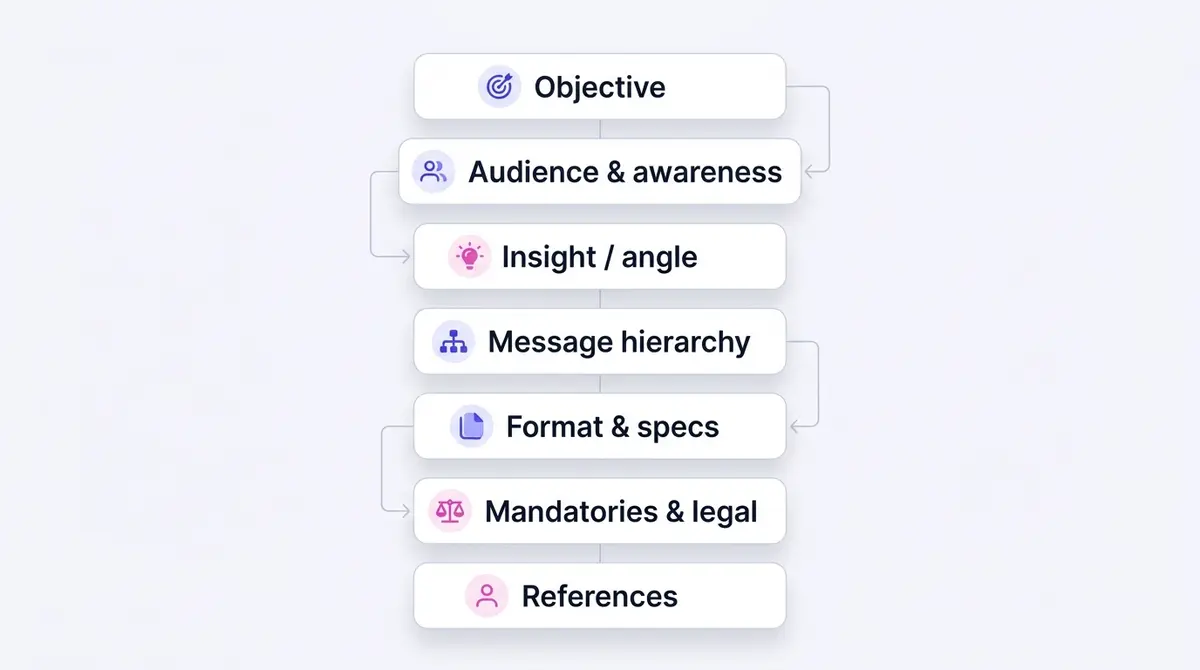
| Field | The question it answers | The most common failure |
|---|---|---|
| Objective | What live Meta campaign type is this ad for? | Naming three outcomes at once |
| Audience and awareness stage | Who sees it, and what do they already know? | A demographic with no awareness stage |
| Core insight or angle | What true thing makes this stop the scroll? | A feature list dressed as an insight |
| Message hierarchy | What is the one takeaway, then the support? | Five equal claims, no hero |
| Format and specs | What format, ratio, and safe zones? | Left to the maker to guess |
| Mandatories and legal | What is required, what risks rejection? | Discovered after the ad is built |
| References | What proven work shows the bar? | A mood with no concrete example |
The objective field has to name a 2026 campaign type, not a feeling. That means an Advantage+ sales campaign, a leads campaign running instant forms, a traffic campaign, or an awareness campaign. Meta renamed Advantage+ Shopping to Advantage+ sales campaigns in early 2025, so a current brief should use that name and never "ASC" or "Shopping." The objective is not a footnote; it decides the call to action, how the offer is framed, and how aggressive the hook can be.
If you are migrating from a generic creative brief, you will notice that a few standard fields are not boxes of their own here, and that is on purpose. Tone of voice is not a separate field: it rides inside the mandatories and the brand kit, and it shows up again in the wording of the hero message, so it is enforced where it actually gets used rather than admired in a box no maker rereads. The competitor set folds into references: instead of a standalone competitors field, you drop the two or three rival or category ads you are reacting to straight into the references, each annotated with what you are doing differently. And who writes the brief and who signs it off are not fields at all. They are the process around the brief, which is the next thing to pin down.
Who owns the brief, and the one sign-off that stops rebriefs
A brief with no owner is a brief that gets rewritten after the ad is built. So name one. The owner is whoever is accountable for the result, usually the marketer or strategist running the campaign, not the maker and not a committee. That person writes the brief, but they gather input before they write it, because the quiet killer of creative timelines is the stakeholder who stays silent through the brief and then objects to the finished ad: the founder who hates the color, the compliance lead who flags a claim, the sales head who wanted a different offer. Every one of those is a rebrief, and rebriefs are the line item the data already indicted, with 69% of marketers and 73% of agencies in the BetterBriefs study agreeing they happen too often.
So pull the opinions forward. Before the brief reaches the maker, the owner collects what each stakeholder needs (the legal constraint, the must-mention feature, the offer that is locked) and folds it into the fields. Then there is one approval, by the owner, against the page. After that the brief is closed for the duration of this build, and new opinions do not reopen it, they go into the next brief. One owner, input gathered up front, a single sign-off: that is the whole governance a one-page brief needs, and it is the difference between a maker who builds once and a maker who builds three times.
Lead with the insight, because creative is the biggest lever
A weak brief over-invests in targeting and starves the creative, which is exactly backwards. Meta's own Facebook IQ, citing Nielsen, reports that around 56% of a campaign's sales ROI is driven by the creative itself. Treat that as directional, since it comes through Meta, but the direction is well supported across the industry: the ad, not the audience setting, is the lever that moves results most. A Meta and Nepa study put the long-term sales lift from following Meta's creative best practices at 1.2x to 2.7x, again directional, and a Nestle KitKat case in Spain found high-creative-quality ads were about 12% more effective at driving sales in marketing-mix modelling.
If the creative is the biggest lever, then a vague creative brief wastes the most leveraged input you have. This is why the core insight field is the one that deserves the most thought. An insight is not a feature. "Contains niacinamide" is a feature. "You have tried four serums and your skin still looks tired by 3pm" is an insight, because it names a truth the buyer recognizes about themselves. The angle is how you dramatize that insight in the ad. A brief that ships a feature list and calls it an angle is the most common quiet failure in the whole process.
The insight gets sharper when the audience field gets narrower. Force it down to one person, not a demographic bracket. "Women 25 to 45" is a targeting input you set in Ads Manager, not a brief. Name the single buyer you are picturing and the job she is hiring the product to do: the new mother who wants her pre-pregnancy skin back before a family wedding, the shift worker whose 3pm energy crash is costing him at work. When the brief names one real person and the specific job the product is being hired for, the angle almost writes itself, because you are no longer addressing a segment, you are answering one person's problem.
Match the angle to where the buyer is. Eugene Schwartz's 1966 model in Breakthrough Advertising remains the canonical frame: five stages of awareness, from unaware through problem-aware, solution-aware, and product-aware, up to most-aware. A problem-aware viewer needs the problem made vivid before the product appears. A most-aware viewer needs the offer and a deadline. Naming the stage in the brief is what stops a maker from building a product-demo ad for an audience that does not yet know it has the problem.
Concept, angle, execution: the three rungs to keep straight
The core insight field hides a ladder, and naming the three rungs stops the brief from locking the wrong one. The concept is the big idea, the creative territory: real customers filming their results in their own bathrooms. The angle is the specific message inside that territory: the tone change you can see in the mirror, not just in a lab. The execution is the build: the shots, the edit, the color, the cast. A brief should lock the concept and the angle and leave the execution open, because the concept and the angle are strategy and the execution is craft. For a fuller menu of angles to choose between, the creative angles guide is the companion to this field, and the copywriting frameworks guide covers how to structure the message once the angle is set.
This is where the second failure mode lives, the one that gets far less attention than vagueness but costs just as much: over-prescription. A brief that dictates the font, the exact shot order, the music, and the voiceover word for word has stopped being a brief and become a list of instructions, and it throws away the one thing the maker is there to add. Constrain the what, free the how. Lock the message, the claims, the offer, and the mandatories, the things that have to be true. Leave the visual execution open, the things a good maker will do better than you can specify. The test is simple: if a talented maker reads your brief and has no room to make a single creative decision, you have written a spec sheet, not a brief, and you will get back exactly what you pictured, which is rarely the best thing the idea could have become.
Message hierarchy: pick the one thing it must say
The average person spends about 1.7 seconds with a piece of mobile content on Facebook, per a Meta figure reported via Adweek. Treat the exact number as directional, but the implication is hard to argue with: your ad gets one message through, maybe two, and the rest is decoration. So the brief has to rank.
Message hierarchy means writing down, in order, what the viewer must take away. The hero message is what the ad is about; everything else supports it or gets cut. A brief that hands over five claims of equal weight forces the maker to choose the hierarchy for you, and they will usually choose wrong, because they are guessing at which claim you actually care about. Consider a brand like Shakura running a pigmentation angle. The weak brief says "highlights our results, ingredients, price, clinic credentials, and reviews." The strong brief says: hero message is one visible pigmentation result; support is the timeframe; everything else is omitted from this ad. One message, built to survive a 1.7-second scroll.
The format and specs field is where you stop the next round of rework. Name the format (single image, video, carousel), the aspect ratios for feed, Stories, and Reels, the safe zones so text is not cropped, the maximum length for a video, and the deliverable count. Leaving this to the maker is how you get a beautiful 1:1 image that looks broken in a 9:16 Reel. Pin the specs before the angle is even chosen and one insight ships clean across every placement.
Briefing a video or a UGC ad needs more than a ratio
The format field above is enough for a static. A video is a different brief, because a video has time, and time has to be directed. Stop at "a 30-second video, 9:16" and you have specified the container, not the content, so the maker fills the seconds with guesses.
A video brief adds four things. First, the hook: name what happens in the opening frames, not just that there should be a hook. The average person spends about 1.7 seconds with a piece of mobile content on Facebook, so the first frame carries the ad, and the brief should say what it shows (the result, the problem, the surprising claim) before the logo appears. Second, a shot list: the rough sequence of shots or scenes, plus any B-roll or product footage the maker has to have on hand. Third, on-screen text and captions: most of the feed plays on mute, so the message has to land with the sound off, which means the brief should call for captions and name the key on-screen lines. Fourth, voiceover or script direction: the tone, the pacing, and which words are locked versus which the maker can write.
For a creator-led UGC ad, add the casting note (who the person reads as: the new mum, the gym regular) and how scripted versus natural it should feel, because a UGC ad that sounds like a read advert defeats its own format. The video ad script template turns these notes into a shot-by-shot document, the UGC creative brief guide covers the creator specifics, and the safe zones guide is where the on-screen-text rules live so captions are not cropped behind the interface.
Mandatories, legal, and the references that set the bar
The mandatories and legal field is two jobs in one box. Mandatories are the non-negotiables: the logo, the legal price format, a required disclaimer, the brand font. The legal half is where you flag anything that could get the ad rejected in Meta's Account Quality hub. This is not paranoia for regulated verticals; it is the cheapest possible insurance.
Skincare, supplements, and clinics carry the most claim risk, so the brief has to anticipate it. Health claims, before-and-after framing, and income claims all draw policy scrutiny. A brand like Skinlycious turning "fix dull skin" into a single-message static needs the brief to state plainly which claims are allowed and which are not, before anyone builds. A clinic like UR Klinik running a leads ad with an instant form needs the medical disclaimers and the consent language baked into the brief, not bolted on after a disapproval. Flagging a risky claim costs a sentence in the brief. Discovering it at launch costs the whole production cycle.
There is a quieter line item inside this field in 2026: Advantage+ creative. Meta's AI enhancement layer can auto-generate image variations, expand backgrounds, add music, and tweak text, and some of those automatic changes can quietly break a mandatory or soften a legal-sensitive claim. The brief should say which Advantage+ creative enhancements are allowed and which are switched off, so an auto-expanded background does not crop your logo or an auto-added overlay does not reframe a regulated claim. It is one line, and it saves a confusing disapproval later.
References close the gap that words cannot. Show one or two proven ads or frames that hit the bar, and annotate why: "this hook because it names the problem in the first frame," not just "this vibe." A reference without a reason is a mood board, and a mood board is what people reach for when the brief failed to say the thing precisely. Two or three well-chosen references with one annotated reason each will teach a maker more about your bar than a paragraph of adjectives ever will.
References raise an obvious question the brief has to answer: where do they come from? Two places. The first is your own swipe file, a running collection of ads, hooks, and frames you saved because they worked, which is why keeping one is a habit worth building (the swipe file guide covers how). The second is free and public: Meta's Ad Library, a searchable database of the ads currently running across Facebook and Instagram, open to anyone without an account. Search a competitor or an adjacent category, find the ad that nails the angle you are chasing, and drop it into references with your annotated reason. It is the most neutral source of live reference ads there is, and the Meta Ad Library guide walks the search filters.
A worked example, field by field
Here is a complete brief for one ad, so the abstraction lands.
| Field | Filled in |
|---|---|
| Objective | Advantage+ sales campaign, optimizing for Purchase |
| Audience and awareness stage | Women 28 to 45 with uneven skin tone; problem-aware (they know the problem, not the fix) |
| Core insight or angle | They have tried whitening products that did nothing; angle leads with one honest before-and-after |
| Message hierarchy | Hero: visible tone change in a set timeframe. Support: the real offer. Cut: ingredient science |
| Format and specs | 9:16 video for Reels and Stories plus a 1:1 cutdown for feed; hook in the first 2 seconds; under 30 seconds; text inside safe zones |
| Mandatories and legal | Logo lower-left; the real offer shown verbatim, a peel for RM99 instead of RM399; no implied medical cure; before-and-after shown with the standard disclaimer to clear Account Quality |
| References | One past testimonial video that opens on the result; annotated: 'first frame is the proof, not the product' |
| Measure | Judged on Purchase via the dataset and Conversions API; secondary read on thumbstop and hook rate |
Notice that the offer in the mandatories line keeps its real currency. That is deliberate. A proven example's own offer travels verbatim because the example is proof, and changing it would make the proof a fiction. Everything else in the brief is a decision, ranked and named, with nothing left for the maker to guess.
The fill-in template you can copy
Keep your reusable version to one page. A brief that spans a whole campaign often runs one to two pages in common practice, but for a single ad one page is plenty, and the constraint is the point: a page forces the ranking the message hierarchy field demands. The fields, in order, with a prompt for each:
- Objective: the live Meta campaign type this ad is accountable for (Advantage+ sales, leads with instant forms, traffic, awareness).
- Audience and awareness stage: who they are, plus the Schwartz stage (unaware, problem-aware, solution-aware, product-aware, most-aware). Keep cold, warm, and hot in the targeting layer, not here.
- Core insight or angle: the one true thing about the buyer that makes them stop, then how the ad dramatizes it.
- Message hierarchy: the single hero message, then ranked support, then an explicit "cut" line for what this ad deliberately omits.
- Format and specs: formats, aspect ratios, safe zones, max length, deliverable count.
- Mandatories and legal: required elements, plus claims to avoid for Account Quality, plus any Advantage+ creative enhancements that are allowed or switched off so they do not conflict with mandatories.
- References: one or two proven ads, each annotated with the reason it works.
- Measure: the dataset and Conversions API events, and the in-platform reads (thumbstop, hook rate) that will judge it.
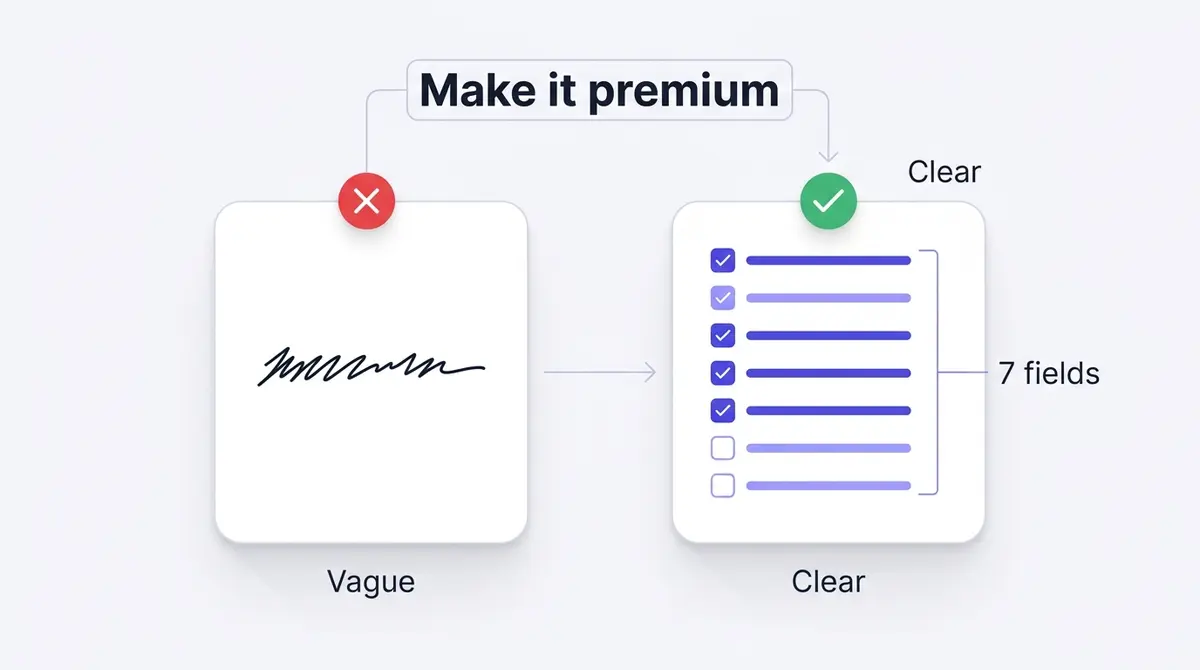
Print it. If a field holds an opinion instead of an instruction ("make it premium," "drive awareness"), it is not finished. The test is whether someone who has never spoken to you could build the right ad from the page alone.
The brief is a living document, so version it
The first brief is version one, not the final word. The measure line feeds the next brief: the winning hook becomes the control, and the next brief iterates against it, a new hook, a different opening offer, a fresh CTA, while everything that already worked stays fixed. That is how a single insight turns into a test sequence instead of a one-off, and the creative testing guide covers how to read which variable actually moved the result.
The teams that ship the most creative keep this organized with a naming convention, because by the tenth variation a file called "serum-ad-final-v2-NEW" tells nobody anything. A simple, consistent scheme that encodes concept, angle, format, and iteration (for example "tone-result_problem-aware_9x16_v3") means anyone can read a file name and know which brief it came from and what it was testing, which is exactly what you need when the results land and you are deciding what to brief next. The brief does not die at launch. It rolls forward, one tested learning at a time.
How the brief travels into generate, edit, launch, measure
A brief earns its keep only if it survives past approval. Map each field to a downstream owner and it becomes a working spec rather than a folder document. The insight and the message hierarchy drive what gets generated. The format and specs drive what gets edited. The objective sets the campaign type at launch, and the mandatories and legal field is what keeps that launch clear of Account Quality. The measure line names the dataset and Conversions API events the ad will be judged on, so the next brief starts from evidence rather than another guess.
That handoff is also where modern tooling helps, because the brief stops being retyped at every stage. When research, generation, editing, and Meta launch live in one place, like AdPlay.ai, the angle you wrote, the specs you pinned, and the offer you locked carry through without translation loss between four disconnected tools, and the result feeds straight back into the next brief. If you want to go deeper on the upstream and downstream pieces, the UGC creative brief guide covers the same discipline for creator-led ads, the hooks guide sharpens the first message your hierarchy depends on, and the campaign setup guide is where the objective field lands in Ads Manager. The brief is small. What it prevents is a third of your budget walking out the door.
Example ad angles
Representative hooks and formats from the category.
“Problem and Solution ad for the brief that turns 'fix dull skin' into a single-message static”
“Testimonial ad for the message hierarchy that leads with one pigmentation result, not five claims”
“Feature Callout ad for the leads brief with mandatories and clinic legal baked in”
By the numbers
Frequently asked questions
What is a Facebook ad creative brief?
It is a one-page document that turns a single insight into one shippable ad. A useful brief fixes seven fields before anyone opens a design tool: the objective, the audience and its awareness stage, the core insight or angle, the message hierarchy, the format and specs, the mandatories and legal, and the references. The point is not paperwork. It is alignment, so the person making the ad builds the thing you actually pictured rather than a plausible guess.
Why do most creative briefs fail?
Because a vague single-line ask reads as clear to the person who wrote it and as noise to the person who has to build from it. The BetterBriefs / IPA study found that 80% of marketers think they write good briefs while only 10% of agencies agree, and the gaps on strategic direction (78% vs. 5%) and clear language (83% vs. 7%) are just as wide. The failure is almost never a missing field. It is a field filled with an opinion instead of an instruction, like 'make it premium' with no definition of what premium looks like here.
What should the objective field actually say?
Name the live Meta campaign type the ad is built for, not a vibe. In 2026 that means an Advantage+ sales campaign, a leads campaign with instant forms, a traffic campaign, or an awareness campaign, because the objective shapes the call to action, the offer framing, and even the aspect ratio. 'Drive awareness and sales and leads' is three briefs pretending to be one. Pick the one outcome this ad is accountable for and write it as the campaign type, so the brief lands cleanly when someone builds the campaign in Ads Manager.
How does customer awareness stage change the brief?
Eugene Schwartz's 1966 model puts every buyer at one of five awareness stages: unaware, problem-aware, solution-aware, product-aware, and most-aware. The angle has to match the stage. A problem-aware viewer needs the problem named and made vivid before any product appears, while a most-aware viewer just needs the offer and a reason to act now. Note that this is the message-awareness layer, separate from cold, warm, and hot audience temperature, which is the targeting layer you set in Ads Manager.
What is message hierarchy and why does it matter?
Message hierarchy is the deliberate ranking of what the viewer must take away first, second, and third. A weak brief lists five equal claims and the maker spreads attention across all of them, so none lands. A strong brief names the single hero message, then ranks the supporting points beneath it. This matters more on Facebook than almost anywhere because the average person spends only about 1.7 seconds with a piece of mobile content, per Meta figures, so the first message has to carry the ad on its own.
What belongs in the mandatories and legal field?
Everything that is non-negotiable and everything that could get the ad rejected. Mandatories cover the logo, the disclaimer, the legal price format, and any required brand element. The legal half flags claims that risk policy rejection in Meta's Account Quality hub, which matters most for skincare, supplements, and clinics: health claims, before-and-after framing, and income claims all draw scrutiny. Flagging them in the brief, before production, is far cheaper than discovering them when a finished ad is disapproved at launch.
How is a Facebook brief different from a general creative brief?
The bones are the same; WordStream lists nine components every creative brief should carry, and a Facebook brief honors all of them. The differences are platform-specific. The objective field must name a live Meta campaign type, the format field must hit the current Facebook and Instagram aspect ratios and safe zones, the message hierarchy must survive a sub-2-second scroll, and the legal field must anticipate Meta's policy review. It is a general brief sharpened to the feed it ships into.
Who should write the creative brief, and who signs it off?
One person owns it, usually whoever is accountable for the result, the marketer or strategist running the campaign, not the maker building the ad and not a committee. That owner gathers input from every stakeholder first (the founder, the legal or compliance lead, the offer owner), folds it into the fields, then closes the brief with a single sign-off before it reaches the maker. The point of one owner and one approval is to stop the most common rebrief: a silent stakeholder who surfaces an objection only after the ad is built. New opinions raised after sign-off go into the next brief, not this one.
Sources
- 1.BetterBriefs / IPA, One third of marketing budgets could be wasted on poor briefs (2021)
- 2.BetterBriefs / IPA, New better-briefing best-practice guide with Mark Ritson (2022)
- 3.WordStream, How to Write a Creative Brief (template, 9 components) (2024)
- 4.Meta Facebook IQ, High-Quality Creative Increases Ad ROI (2022)
- 5.Adweek, How brands can win over customers as attention spans decrease (2024)
- 6.Marketing Week, Best-practice guide unveiled to tackle ineffective briefs (2022)
- 7.B-PlanNow, Schwartz's pyramid: the 5 levels of customer awareness (2024)
- 8.Meta Transparency Center, Ad Library tools (searchable database of active ads) (2026)
Keep exploring
Turn ad research into winning ads
Research the ads that work, generate the creative on-brand, and launch to Meta, all in one tool.
7-day free trial · No credit card required