
Creative Is the New Targeting (2026)
Why Meta's automation moved the result from the audience to the ad, and how to operationalise a creative-first strategy by shipping distinct concepts at velocity.
Updated August 2026 · Xanny Lee, CEO

For years marketers treated targeting as the main lever. The evidence never agreed: across roughly 450 sales-effect studies, creative drove 49% of advertising's sales lift while targeting drove just 11%, per NCSolutions and Nielsen (via Westwood One, 2024). Meta's automation has now caught up to that math. The Andromeda retrieval engine and the GEM ranking model evaluate your creative as the primary signal of who sees the ad, so the audience-building work the marketer used to do is largely absorbed by the machine. The remaining human lever is the creative input: shipping a wider, fresher set of genuinely distinct concepts, faster.
You used to win on Facebook by building a smarter audience: a tighter interest stack, a sharper lookalike, an exclusion list nobody else thought of. That edge is quietly disappearing, not because targeting stopped mattering but because Meta now does it better than you can, automatically, on every impression. What is left in your hands is the ad itself. The question for 2026 is not who you reach. It is how many distinct, fresh concepts you can put in front of the machine, and how fast.
The number marketers have been ignoring for years
Ask a roomful of performance marketers what drives sales, and most will point at the audience. When Advertiser Perceptions surveyed 122 marketers, targeting came out as the perceived number one sales driver, rated at 24%, according to Westwood One's 2024 write-up. It feels right. Targeting is where you spend your time, where the dashboards live, where a clever exclusion list feels like a secret weapon.
The data tells a different story, and it is not close. NCSolutions and Nielsen analysed roughly 450 sales-effect studies for their "Five Keys to Advertising Effectiveness" work, also reported via Westwood One. Creative quality and context drove 49% of the sales lift. Targeting drove 11%. Brand contributed 21%, reach 14%, and recency the remaining 5%. So marketers overrate targeting by more than double its real contribution, and underrate creative by roughly two and a half times.
| Sales driver | Perceived weight | Real contribution |
|---|---|---|
| Creative (quality and context) | Underrated | 49% |
| Brand | Mid | 21% |
| Reach | Mid | 14% |
| Targeting | 24% (rated #1) | 11% |
Read that table twice. The lever marketers obsess over is the weakest of the four big ones, and the lever they treat as a finishing touch is the strongest by a wide margin. This study predates Meta's recent automation, which is exactly the point. Creative always carried the result. The targeting fixation was a place to hide, and the machine has now quietly taken that hiding place away.
It is worth being honest about why the targeting fixation took hold. Targeting felt controllable in a way creative never did. You could open Ads Manager, tighten an audience, exclude a segment, and feel like you had done something measurable, while a creative brief was soft, subjective, and slow to prove out. Targeting also produced the kind of tidy case study marketers love to share: a narrowed audience, a lower CPA, a clean before-and-after. The problem is that most of those wins were noise. Across a large enough sample, the audience knob simply did not move sales the way the creative did, and the NCSolutions and Nielsen split is what that truth looks like once you average out the lucky campaigns.
How Meta automated the lever you used to pull
Throughout 2024 and 2025, Meta rebuilt the plumbing of ad delivery around machine learning, and two systems matter most. The first is Andromeda, the ads retrieval engine that launched on 2 December 2024. Retrieval is the opening stage of delivery: before any auction runs, the system has to narrow tens of millions of eligible ads down to a few thousand realistic candidates for a given person. Meta's own engineering blog reports that Andromeda enabled a 10,000x increase in the complexity of the models doing that filtering, and delivered a 6% recall improvement to the retrieval system plus an 8% ads-quality improvement on selected segments. Those are Meta's own numbers, so read them as directional, but the architecture is the real signal: Meta describes using an efficient hierarchical index built to scale across a large volume of ad creatives. The engine is purpose-built to evaluate creative at scale.
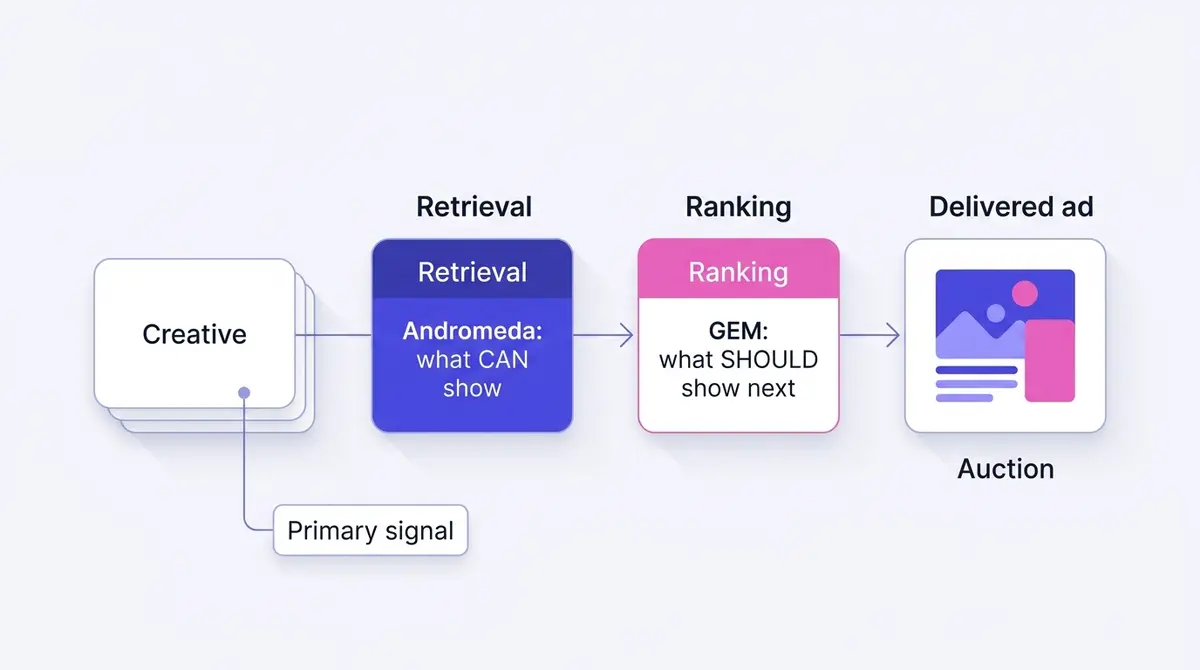
The second system is GEM, the Generative Ads Recommendation Model, announced on 10 November 2025. If Andromeda decides what can be shown, GEM decides what should be shown next: it is the LLM-scale ranking brain that scores the surviving candidates. Meta reports GEM lifted ad conversions by 5% on Instagram and 3% on Facebook Feed. Again, Meta's own figures, so directional. Sitting on top of both is the Advantage+ suite, the automation that runs campaigns end to end. Meta reports Advantage+ shopping advertisers see an average $4.52 return on ad spend, roughly 22% higher than advertisers not using that automated targeting, and the same page cites a 19% cost-per-action improvement in a Southeast Asia A/B test. Directional, but the trend is unmistakable.
Stack these together and the conclusion writes itself. Retrieval, ranking, and audience matching are now automated machine-learning problems that Meta solves better than any manual setting you can configure. Search Engine Land, a neutral trade publication, put it plainly in January 2026: Meta has shifted away from audience-first advertising to creative-first matching, where the creative became the primary signal. Andromeda decides what can show. GEM decides what shows next. The marketer's old job, telling Meta who to reach, has been absorbed.
What is left for the human: the creative input
If the machine handles delivery, the human handles the input. That is not a downgrade. It is the highest-leverage place a marketer has ever stood, because the systems that decide everything downstream all read the same thing: your creative. A distinct, high-quality ad survives retrieval, scores well in ranking, and earns the engagement that lowers its own cost. A dull or derivative one gets filtered out before the auction even runs.
This reframes the daily work. The hours you used to spend slicing interest stacks now go into producing concepts. The skill that used to matter most, audience architecture, matters less than the skill of generating a wider, fresher set of genuinely different ideas. The evidence backs the priority well beyond a single study. Create with Google has put creative at around 70% of advertising effectiveness, a figure its own head of creative cited publicly in 2019. That is a vendor estimate measured under its own conditions, so treat it as directional. But it points the same direction as the neutral NCSolutions and Nielsen split: the ad is the result, and the audience knob is a rounding error next to it.
There is a discipline here that is easy to miss. Feeding the engine well is not only about volume of ads. It is also about the quality of signal you send it. The cleaner your dataset and your Conversions API events, the better Andromeda and GEM can match your creative to the right people, which means the creative carries even more of the result. Good signal in, good matching out, and the ad does the rest.
This also changes who needs to be in the room. In an audience-first world, the media buyer was the centre of gravity, and the creative team handed assets down a chain. In a creative-first world the order inverts: the people who can generate a strong, varied set of concepts become the ones holding the result, and the media buyer's job shifts toward keeping signal clean and reading the loop, not micromanaging audiences. Teams that still treat creative as a downstream production task, briefed late and judged on polish rather than spread, are organised for the lever that no longer matters most.
Distinct concepts, not headline swaps
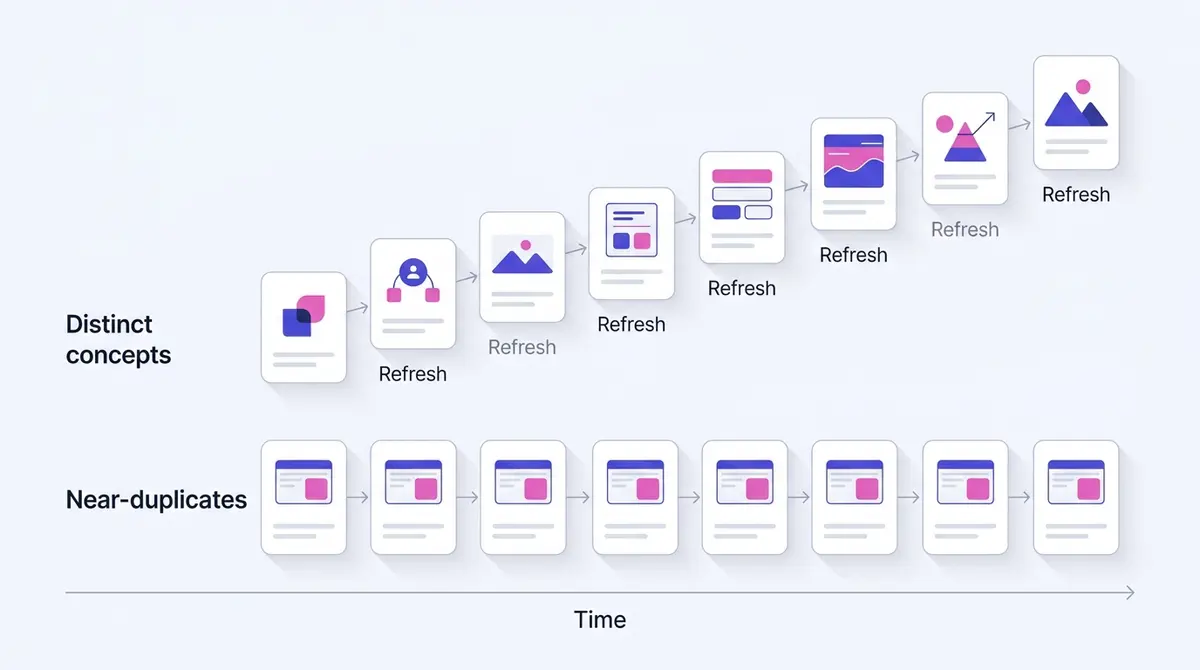
Here is where most teams get the new game wrong. They hear "ship more creative" and respond by spinning out fifty variants of the same ad: a different headline, a recoloured button, a new font on the same image. The systems are not fooled. The retrieval and ranking models treat visually and conceptually similar variants as effectively the same ad, so a wall of near-duplicates gives the engine almost no new signal to work with. You have made fifty ads and offered the machine one idea.
What feeds the engine is concept-level diversity: different angles, different formats, different messages that approach the product from genuinely separate directions. A testimonial video, a before-and-after static, a problem-solution demo, and a founder talking to camera are four concepts. Four colours of the same banner are not. The strategic shift is from optimising one idea to a tight finish, toward generating a portfolio of distinct ideas and letting delivery pick the winners.
| Old creative habit | Creative-first habit |
|---|---|
| Fifty variants of one concept | A handful of genuinely distinct concepts |
| Headline and colour swaps | New angles, formats, and hooks |
| Polish one ad before launch | Ship a spread, let delivery decide |
| Refresh quarterly | Refresh before fatigue sets in |
A caution on the numbers. You will see vendor and agency blogs prescribe an exact count, "upload 15 to 20 concepts per ad set," and so on. No Meta documentation or neutral study confirms a specific number, so do not treat any hard figure as fact. The qualitative rule holds: more distinct concepts, refreshed more often, beats a fixed quota of near-duplicates. For a structure that keeps these tests honest, our guide on creative testing lays out how to isolate concepts so you learn which angle actually moved results.
There is an uncomfortable truth under the case for diversity that sharpens it: most concepts you ship will underperform, not a handful but most, and nobody picks the winner reliably in advance. The ad a team was certain about often flops while a throwaway carries the quarter. That is why betting the budget on one polished ad is the riskiest move available: if you knew which idea would win, you would make one and stop. You do not, so the rational play is to give delivery several genuinely different shots and let it surface the one that lands. The point is not volume. It is enough distinct tries that one pays, with diversity making sure they are not all the same try.
A concept matrix: angles and formats
"Ship distinct concepts" is easy to say and hard to do with a blank brief in front of you. A matrix fixes that. Put angles down one side and formats across the other, and every cell is a different ad waiting to be made. The angle is the argument the ad makes. The format is how it reaches the feed. Cross a working set of each and you can generate a week of separate ideas in an afternoon instead of recolouring one.
| Angle | What it argues | A strong format | Hook type |
|---|---|---|---|
| Before and after | The product changes a visible state | Static or short video | Visual contrast |
| Testimonial | A real person vouches for the result | UGC video | A face and a claim |
| Problem and solution | Names a pain, then resolves it | Demo video | The tension, stated first |
| Comparison | Beats the obvious alternative | Carousel or split video | A reversed expectation |
| Founder to camera | The maker explains why it exists | Talking-head video | A question or confession |
| Social proof | A crowd or a number validates it | Static or carousel | A count or a stat |
| Unboxing | Shows what actually arrives | Reels-native video | Anticipation |
| Offer-led | Leads with the deal and a deadline | Static or short video | Urgency |
Treat the table as a generator, not a checklist. A testimonial as a UGC video, a before and after as a static, a problem-solution as a demo, and a comparison as a carousel are four cells, four concepts, one product, and the engine reads that as four ideas rather than one. Our guide to creative angles builds out the angle list, and the hooks guide covers the opening line each angle needs.
Iterating a winner lives in the same matrix. When a concept wins, do not clone it twenty times, because the system reads the copies as the same ad. Ask what actually won, the angle, hook, format, creator, or offer, isolate that element, and remix it into new cells. If a problem-solution demo wins on its problem framing, keep that framing and rebuild it as a testimonial, a founder explainer, and a carousel: fresh concepts carrying the proven part into new territory, instead of a wall of near-duplicates that starves the engine.
Velocity: shipping fresher creative, faster
Diversity solves one half of the problem. Velocity solves the other. Audiences fatigue, the calendar shifts, and a concept that won in May is invisible by August, so a creative-first strategy is not a one-time burst of ideas. It is a refresh rhythm: a steady cadence of new concepts entering the system before the existing ones tire out.
The rising-cost backdrop makes velocity non-negotiable. WordStream's 2025 benchmarks, drawn from hundreds of US campaigns, show the average Facebook cost per lead climbed to $27.66, up 20.94% year over year. That is neutral data, and it carries a hard lesson: when the auction gets more expensive, you cannot buy your way back to your old cost per result. The same benchmarks show the average traffic-campaign CPC fell 6.67% to $0.70 while CTR rose to 1.71%, which tells you clicks got cheaper exactly where creative resonated and costlier where it did not. The separation between winning and losing auctions is now a creative separation, not an audience one.
Velocity is where most teams hit a wall, because the old production model cannot keep up. Briefing an agency, waiting on a designer, routing approvals, and launching one polished ad a fortnight is a cadence built for a world where the audience was the lever. In a creative-first world it starves the engine. The teams that win in 2026 are the ones that compress the distance between idea and live ad: research what is working, produce a spread of distinct concepts, ship them to Meta, read the result, and feed the next round, on a loop that turns in days, not months.
There is a compounding effect hiding in that cadence. Every concept you ship teaches you something the dashboard cannot tell you in advance: which angle a category responds to, which hook earns the cheaper click, which format holds attention past the third second. A team refreshing weekly runs four times as many of those experiments a month as a team refreshing quarterly, so it learns four times faster and feeds the delivery systems a steadily sharper set of inputs. Velocity is not only about staying ahead of fatigue. It is about accumulating creative knowledge that the slower team never gets to buy at any price.
Modular production: the engine behind velocity
Shipping a steady stream of distinct concepts sounds exhausting until you stop building each ad from scratch. The teams that keep pace treat creative as interchangeable parts, not finished objects. Break an ad into components: hooks, product and b-roll footage, value-prop lines, demonstration clips, captions, and call-to-action end cards. Build a small library of each, and a new concept becomes an assembly job rather than a production from zero.
The discipline is the one from the matrix: assemble distinct concepts, not near-duplicates. Bolting a new hook onto the same body to mint a fortieth variant is the headline-swap trap in fresh packaging. Recombining a different angle, format, and demonstration into something genuinely new is what modular production is for.
Meta's own tooling leans into this. Advantage+ creative applies automatic adjustments and tests modified versions of your assets against the originals, delivering whichever performs better for each viewer, per Meta's Business Help Center. Dynamic creative takes the components you upload, images, videos, headlines, and descriptions, and mixes them into combinations it tests for you. Both squeeze variation out of a concept once it exists. Neither does the human job of inventing the distinct concepts in the first place. Our guides to dynamic creative and Advantage+ creative enhancements cover using them without blurring concepts into sameness.
Reading the test: the metric ladder
If creative is the lever, you have to read which concept actually pulled it, and cost per result alone will not tell you why. Climb the metric ladder one rung at a time, because each rung diagnoses a different part of the ad.
| Rung | Metric | What it reads |
|---|---|---|
| 1 | Hook rate (3-second video plays over impressions) | Did the opening stop the scroll? |
| 2 | Hold or watch-through (ThruPlay, completions) | Did the middle keep them? |
| 3 | CTR | Did the message earn the click? |
| 4 | Cost per result | Did the click become a buyer at a price you can pay? |
Meta counts a 3-second video play when someone views three seconds, or 97% of a video shorter than three seconds, and a ThruPlay when a video is watched to completion under fifteen seconds or for at least fifteen seconds when longer, per Meta's Business Help Center. So hook rate and hold rate sit on Meta's own counted events, even though neither is a default Ads Manager column. A concept with a strong hook rate and a weak CTR has an opening that grabs attention and a message that does not sell. A weak hook rate sinks everything beneath it, so fix the first two seconds before you touch the offer.
None of these numbers mean much without enough spend behind the concept. Meta's own threshold is the learning phase: an ad set generally needs about 50 optimization events within roughly seven days to exit it, and one that cannot get there shows as Learning Limited, per Meta's Business Help Center. So you cannot read fifty concepts on a shoestring at once. Fund a sensible spread per test enough to clear that bar, then stagger the rest. Our guide on how many creatives to run per ad set covers sizing the spread.
Spotting fatigue before it costs you
Velocity only works if you know when to refresh, and "refresh before it tires" is useless without signals. Fatigue is measurable, and it shows up as a pattern across a few numbers rather than one alarm. Watch them together, because any single one can wobble for an unrelated reason.
| Signal | What to watch | Act when |
|---|---|---|
| CTR | Week-over-week direction | It declines several days running |
| Cost per result | Trend at a steady budget | It climbs while the offer is unchanged |
| Frequency | Average views per person | It keeps rising as the metrics above turn |
| Engagement | Reactions, comments, saves | They thin out on a once-lively ad |
The tell is the combination. Frequency climbing while CTR falls and cost per result rises is the textbook fatigue signature. Frequency on its own is not the trigger, because there is no single official number at which an ad goes stale, and a strong ad can run hot for a while. What matters is the turn: the point where rising exposure stops buying results and starts costing them.
It also pays to separate creative fatigue from audience fatigue. Creative fatigue is the ad wearing out: people have seen this exact concept and scroll past. Audience fatigue is the pool saturating regardless of the creative. A fresh concept fixes the first; a broader audience or a new segment fixes the second. Confuse them and you tune the wrong lever. Our guide to creative fatigue goes deeper on the signals, and the refresh cadence guide covers how often to feed fresh concepts in before any of this shows up.
A practical operating model for 2026
Pulling it together, here is how a creative-first team actually runs. Start with research, not with a blank canvas. Look at what concepts are already earning attention in your category, because the fastest way to a strong spread of angles is to study the ones that already work. The free Meta Ad Library is the one tool every marketer can use for this: it shows the live ads any advertiser is running, so you can map the angles a category is using before you produce a single frame. Our guide to ad targeting covers how to set the broad guardrails that let automation do the narrowing once your creative is in market.
Then produce for diversity. A representative spread might look like a brand such as Skinlycious running a testimonial UGC video on brighter skin after switching serums, a brand like Dasher Smart Home running a problem-solution demo of controlling every light and lock from one phone tap, and a brand like Fitness Achievers running a before-and-after carousel of a member who trained around a nine-to-five and still cut body fat. Three angles, three formats, one product category. That is concept diversity, and it is what the engine reads.
Set your audience to broad and your signal to clean. Use a correct dataset and the Conversions API so Andromeda and GEM have good input, set sensible geography and exclusions, then stop tuning. Launch the spread, let delivery rank it, and watch cost per result rather than cost per reach. When a concept fatigues, replace it with a fresh one before frequency drags the whole account up. The loop is the strategy: research, generate, launch, measure, repeat.
That compounding only happens if you write down what you ran. A spread of concepts with no memory teaches you nothing twice. Keep a single log, a sheet is plenty, with a row per concept capturing the angle, hook, format, audience, and the numbers that came back, then read it after each cycle so next month's spread starts from evidence instead of a blank page.
| Field to log | Example |
|---|---|
| Angle | Problem and solution |
| Hook | The first-week mistake most buyers make |
| Format | Short vertical video |
| Audience | Broad, country level |
| Result | Hook rate, CTR, cost per result, frequency |
The practical obstacle is rarely the idea. It is the friction between idea and live ad, which is why teams that keep research, generation, editing, and Meta launch in one place tend to refresh faster than those stitching five tools together. A platform like AdPlay.ai keeps that loop in a single flow, so the velocity the new delivery systems reward becomes a habit rather than a heroic effort. For the underlying mechanics of how the retrieval engine reads your creative, our guide to Meta's Andromeda engine goes deeper.
What this changes about your next quarter
The shift is concrete, not philosophical. Audit where your team's hours actually go this week. If most of them are spent inside Ads Manager tuning audiences, you are pulling a lever the machine already pulls better, and the NCSolutions and Nielsen data says that lever was worth 11% all along. Move those hours upstream into creative: more distinct concepts, refreshed more often, fed to delivery on a tight loop.
None of this means targeting is worthless or that you stop setting an audience. It means the centre of gravity moved. Delivery automated, costs rose, and the creative became the primary signal the whole system reads. The marketers who internalise that, and rebuild their week around producing and refreshing distinct concepts at velocity, will quietly out-perform the ones still hunting for a perfect lookalike. Creative was always the bigger lever. Now it is the only one left in your hands, and that is the best news a marketer with a good idea has had in years.
Example ad angles
Representative hooks and formats from the category.
“Testimonial ad for visibly brighter skin after switching from a pricier serum”
“Problem and Solution ad for controlling every light and lock from one phone tap”
“Before and After ad for the member who trained around a 9-to-5 and still cut body fat”
By the numbers
Frequently asked questions
What does 'creative is the new targeting' actually mean?
It means the lever that decides your results has moved from the audience you build to the ad you make. Meta's delivery systems now identify and match audiences automatically, so manual targeting adds less and less. The creative is the input the machine reads to decide who should see your ad, which makes the concept, hook, and format the place where wins and losses are now decided.
Is targeting dead on Facebook ads?
No, but its marginal value has shrunk. You still set a starting audience, exclusions, and geography, and those guardrails matter. What no longer pays off is obsessively narrowing interest stacks or chasing the perfect lookalike, because Meta's retrieval and ranking models refine the audience far past what manual settings can. The NCSolutions and Nielsen data put targeting's real sales contribution at 11%, well below the 24% marketers assume.
What is Andromeda and why does it matter for creative?
Andromeda is Meta's ads retrieval engine, launched in December 2024. It is the first stage of delivery: it filters tens of millions of candidate ads down to a few thousand before the auction ranks them. Meta reports it enabled a 10,000x increase in model complexity for retrieval. It evaluates creative heavily, so a distinct, high-quality ad is more likely to survive retrieval and reach the auction at all.
How is GEM different from Andromeda?
They are two stages of the same pipeline. Andromeda decides what can be shown by retrieving candidate ads, and GEM, Meta's Generative Ads Recommendation Model announced in November 2025, decides what should be shown next by ranking them. Meta reports GEM lifted ad conversions by 5% on Instagram and 3% on Facebook Feed. Both figures are Meta's own, so treat them as directional.
Should I still split-test audiences?
Test creative first, audiences second. A clean creative test isolates concepts against a broad, automated audience so you learn which idea resonates. Audience tests still have a place for major shifts in geography or product line, but the highest-leverage experiment in 2026 is concept versus concept. See our guide on creative testing for a structure that keeps the variables clean.
How many ad concepts should I run?
More distinct concepts than you probably run now, but quality gates the count. The systems treat visually similar variants as effectively the same ad, so swapping a headline or recolouring a button does not give the engine new signal. What counts is concept-level diversity: different angles, formats, and messages. Ship as many genuinely distinct ideas as you can produce and refresh, rather than chasing a fixed number.
How do I know when a creative is fatiguing, and which signals should I watch?
Fatigue is measurable, and it shows up as a pattern rather than a single alarm. Watch CTR declining week over week, cost per result climbing at a steady budget, frequency rising, and engagement thinning on a once-lively ad. The reliable signature is the combination: frequency climbing while CTR falls and cost per result rises together. There is no official frequency number at which an ad goes stale, so judge the turn, the point where more exposure stops buying results and starts costing them, then replace the concept before it drags the account up.
Why are rising ad costs an argument for creative-first?
Because you cannot buy your way out of a more expensive auction. WordStream's 2025 benchmarks put the average Facebook cost per lead at $27.66, up nearly 21% year over year. When the cost to reach people climbs, the only lever that reliably lowers your cost per result is better, fresher creative that earns engagement, because engaged ads win auctions more cheaply.
Sources
- 1.Westwood One, Marketers Vastly Understate the Sales Effect of Creative and Overestimate Targeting (2024)
- 2.NCSolutions, Five Keys to Advertising Effectiveness (e-book): Creative 49%, Brand 21%, Reach 14%, Targeting 11%, Recency 5% (2023)
- 3.Engineering at Meta, Meta Andromeda: Supercharging Advantage+ Automation With the Next-Gen Personalized Ads Retrieval Engine (2024)
- 4.Engineering at Meta, Meta's Generative Ads Model (GEM): The Central Brain Accelerating Ads Recommendation AI (2025)
- 5.Search Engine Land, Inside Meta's AI-Driven Advertising System: How Andromeda and GEM Work Together (2026)
- 6.WordStream (LocaliQ), Facebook Ads Benchmarks 2025 (2025)
- 7.Meta for Business, Advantage+ Shopping Campaigns (2024)
- 8.BW Businessworld, 70% of Advertising Effectiveness Depends on the Creative: Ross Jauncey, Head, Create With Google (2019)
- 9.Meta Business Help Center, About the Learning Phase (2026)
- 10.Meta Business Help Center, About ThruPlay (2026)
- 11.Meta Business Help Center, 3-Second Video Plays (2026)
- 12.Meta Business Help Center, About Advantage+ Creative (2026)
Keep exploring
Turn ad research into winning ads
Research the ads that work, generate the creative on-brand, and launch to Meta, all in one tool.
7-day free trial · No credit card required