
Hari Raya Ad Playbook for Malaysia (2027)
The week-by-week Ramadan-into-Raya ad arc for Malaysian brands: brand film, mid-Ramadan offer, final-week push, and post-Raya duit-Raya retargeting.
Updated January 2027 · Xanny Lee, CEO

Hari Raya is Malaysia's biggest ad season, and the brands that win run a four-stage arc across the roughly 30 days from Awal Ramadan to Aidilfitri. For the 2027 planning window, fasting is expected to begin Monday 8 February 2027 and Hari Raya Aidilfitri falls on Wednesday 10 March 2027 (both moon-sighting dependent, so confirm closer to the date). Start with an emotional balik-kampung brand film in the first fortnight while CPMs are calmer, move to an RM-anchored festive offer mid-Ramadan, run a hard conversion push in the final week, then retarget the duit-Raya spend after the festival. GrabAds research reported by Marketing-Interactive found 84% of Malaysians plan to spend more during Ramadan and 76% are open to trying new brands, so the window rewards SMEs who show up early, not just the loudest brand on raya morning.
From the first night of terawih the Malaysian feed changes character. Baju raya drops, kuih pre-orders, duit-raya packet designs and balik-kampung films stack up faster than anyone can scroll, and the auction gets more crowded every week until Aidilfitri. The prize is enormous: GrabAds research surfaced by Marketing-Interactive put 84% of Malaysians as planning to increase Ramadan spending, and Criteo data reported by the same outlet pegged Malaysia at the highest average sales uplift in Southeast Asia during the first two weeks of fasting. The brands that capture it rarely start with a hard sell on raya eve. They run a sequence: seed reach with an emotional film early, convert with a clear festive offer in the middle, push hard in the final week, then chase the duit-raya spend after the day itself. This playbook lays out that arc week by week, the numbers behind it, and how a small Malaysian brand can research, make and launch the creative for each stage.
Why Hari Raya is the season every Malaysian brand plans around
Nothing else on the Malaysian calendar concentrates intent like Ramadan into Aidilfitri. The whole country shifts spending at once: new baju raya for the family, kuih and hampers, duit-raya, jewellery, and the long drive balik kampung. GrabAds research surfaced by Marketing-Interactive found 84% of Malaysians planning to increase their spending during Ramadan, with food and beverage, fashion and apparel, and personal healthcare leading the categories. Treat that figure as directional since it comes from a vendor study, but the direction is unmistakable, and Criteo data reported by the same outlet put Malaysia at the highest average sales uplift in the region during the first two weeks of fasting, roughly plus 40%.
The reach to match that demand is already in place. DataReportal's Digital 2026 report put Facebook's advertising reach in Malaysia at 23.0 million people, equal to 63.7% of the population, and Instagram at 16.1 million, or 44.6%. Across all platforms there are 30.7 million active social media identities, 85.0% of everyone in the country. For a festival that the whole nation observes, Facebook, Instagram, Reels and Stories together let you reach almost every connected adult. The hard part is not access, it is showing up at the right moment in the season with creative people actually want to watch.
There is an SME-sized opening inside all of this. The same GrabAds research found 76% of Ramadan shoppers open to trying new brands. Loyalty loosens during the season, baskets get bigger, and a small brand with a sharp festive angle can win customers it would never reach in a quiet month. That is the case for running a real campaign rather than a single raya-eve post.
Before Awal Ramadan: build the runway first
The arc starts before fasting does. The week before Awal Ramadan is when you get the runway right, because a campaign that launches cold on the first night of terawih wastes its cheapest, calmest fortnight sitting in a review queue. Use that prep week for four jobs.
First, clear ad review early. Meta reports that most ads are reviewed within 24 hours, though some take longer, so submit your brand film and your first offer creative a few days ahead and schedule them to start rather than racing approval on launch night. Second, run an account-quality pre-flight: in Meta Business Suite, open Account Quality and confirm your ad account and Page carry no restrictions, since a mid-season disable can cost you the whole window. Third, get measurement firing: confirm your Pixel and Conversions API dataset are sending events so your conversion stages can optimize, and check your payment method has headroom for higher festive budgets. Fourth, seed the audiences you will sell to later: make sure your Custom Audiences of site visitors, past buyers and video viewers are built and large enough to retarget, and have your creative cut to 9:16, 4:5 and 1:1 before the rush.
Treat this as a checklist you clear once, not a scramble you repeat each week. Everything that follows assumes the account is healthy, the tracking is clean, and the first two creatives are already approved and queued.
The four-stage Ramadan-into-Raya arc
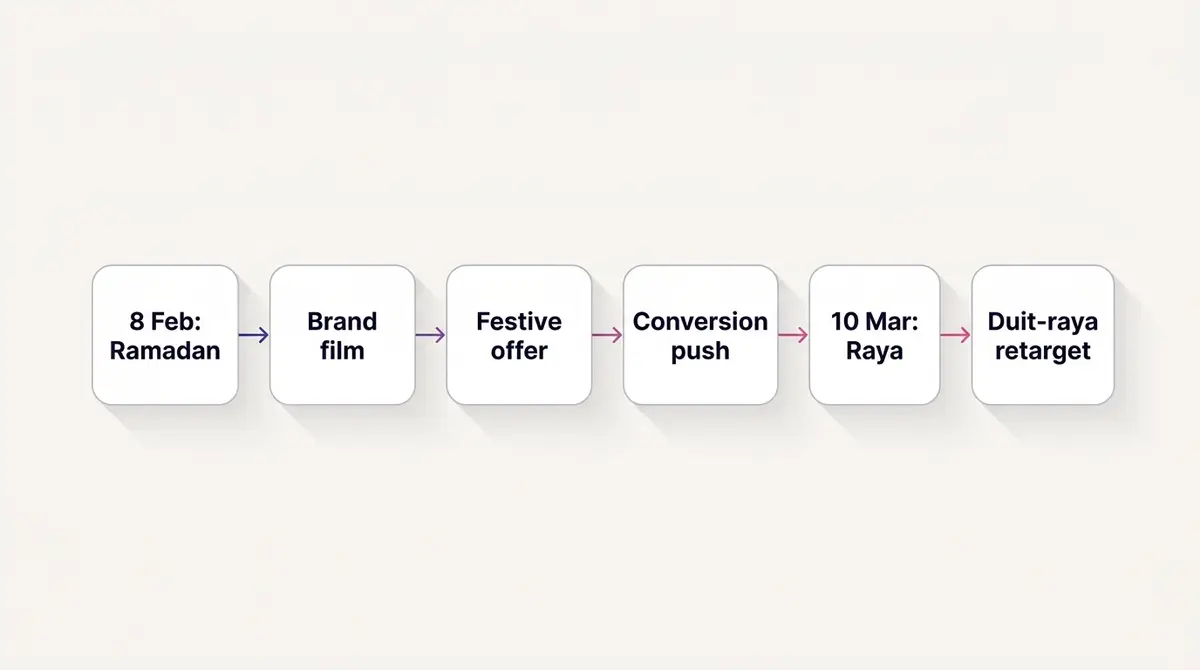
The brands that win do not run one ad. They run a sequence timed to the fasting calendar. For the 2027 planning window, Awal Ramadan is expected on Monday 8 February 2027 and Hari Raya Aidilfitri falls on Wednesday 10 March 2027, per PublicHolidays.com.my, with an additional holiday the following day. Both dates depend on official moon sighting, so build your plan around them but confirm closer to the date and leave plus or minus one day of slack when you book flights, delivery cut-offs and launch times.
That gives you a roughly 30-day runway. Spread across it, the arc looks like this.
| Stage | When | Job | Format and offer |
|---|---|---|---|
| Brand film | Week 1 to 2 of Ramadan | Seed reach, warm audiences, build emotion | 9:16 video, no hard offer |
| Festive offer | Week 2 to 3 | Convert early baju-raya intent | Static or carousel, RM-anchored bundle or free postage |
| Conversion push | Final week before raya | Sell best-sellers before delivery cut-off | Static or short video, urgency and cut-off date |
| Duit-raya retarget | After 10 March | Capture angpau spend, replenish | Retargeting video or static, gift or reset angle |
The logic is simple. Reach and emotion are cheapest early, before every competitor crowds the auction, so that is when you run the film that has no offer attached. The middle of the month is when shoppers start actually buying baju raya, so that is when the offer lands. The final week is the most contested and most expensive, so you spend it on your warmest audiences and your strongest products, not cold prospecting. And the day itself is not the finish line, because the duit-raya wave keeps spending alive for a week or more afterward.
Budget follows the same shape. Think of the arc as a curve, not a flat daily spend. Put a light slice early to fund the film and let the learning phase settle on cheap impressions, scale the middle as intent rises, and reserve the largest single share for the final week when both demand and prices peak. Then hold a meaningful retargeting slice for after raya, because that spend is the most efficient of the whole campaign. A common mistake is to load everything onto the last seven days; by then the audiences you should be selling to do not exist yet because you never ran the film that would have created them. Front-loading even a modest brand-film budget is what makes the expensive final week affordable, since you are converting warm pools instead of buying cold reach at peak rates. Meta's own data showed worldwide average price per ad rising 14% year over year in Q4 2024 (a Meta-own figure, directional), with impression growth led by Asia-Pacific, which is the structural reason festive auctions get pricey: demand keeps outpacing attention every season.
A workable starting split, to adjust once results come in, puts roughly 15% to 20% of the season's budget on the early film, 30% on the mid-Ramadan offer, the largest share of 35% to 40% on the final-week push, and the remaining 15% or so on post-raya retargeting (these are planning proportions, not a Meta-published rule). Match the structure to the job: run the film as a reach or video-views campaign, hand the offer and push stages to an Advantage+ Sales setup so the system can optimize against your warm pools, and keep a separate, dedicated retargeting ad set for the duit-raya window. Keep the ad-set count lean. A handful of well-fed ad sets exit the learning phase faster than a dozen starved ones.
Which category peaks in which stage
Not every category sells on the same clock. The GrabAds research named food and beverage, fashion and apparel, and personal healthcare as leading Ramadan categories, with gold and jewellery a long-standing raya gift on top, but they do not all move at once, so weight your spend to when your own products actually sell. Use the sequence below as a planning guide rather than a sourced benchmark.
| Category | When it tends to peak | Lead stage |
|---|---|---|
| Balik-kampung travel | Earliest, before and into week 1 | Prep and brand film |
| Food, beverage and groceries | Steady across the whole month | Every stage |
| Fashion and apparel (baju raya) | Middle weeks of Ramadan | Festive offer |
| Personal healthcare and beauty | Mid into the final week | Festive offer and push |
| Hampers and gift sets | Builds toward raya | Conversion push |
| Gold and jewellery | Latest, final week and after | Push and duit-raya |
Stage one: the early-Ramadan brand film
The first fortnight is for story, not selling. This is when you run the balik-kampung film: the family reunion, the sedondon outfits, the table laid for buka puasa, the long-awaited homecoming. The point is to attach your brand to the emotion of the season before anyone is in a buying mood, so that when intent peaks later your name already feels like part of raya.
A brand like Afabelle Hijab fits this stage naturally, running a lifestyle film where a homecoming and a coordinated family look carry the story and the tudung simply completes it. No price, no discount code, just a 9:16 Reels or Stories piece built to be watched and reshared. Vertical short-form is the right format here because that is how festive video travels. Meta reported Reels are reshared over 4.5 billion times a day across Facebook and Instagram, a Meta-own figure best treated as directional, but it explains why an emotional raya film can earn organic reach far beyond what you pay for. If you want to go deeper on the craft of the format, the Facebook video ad guide covers hooks, length and structure, and the Instagram Reels ads guide covers the placement your festive film will live in.
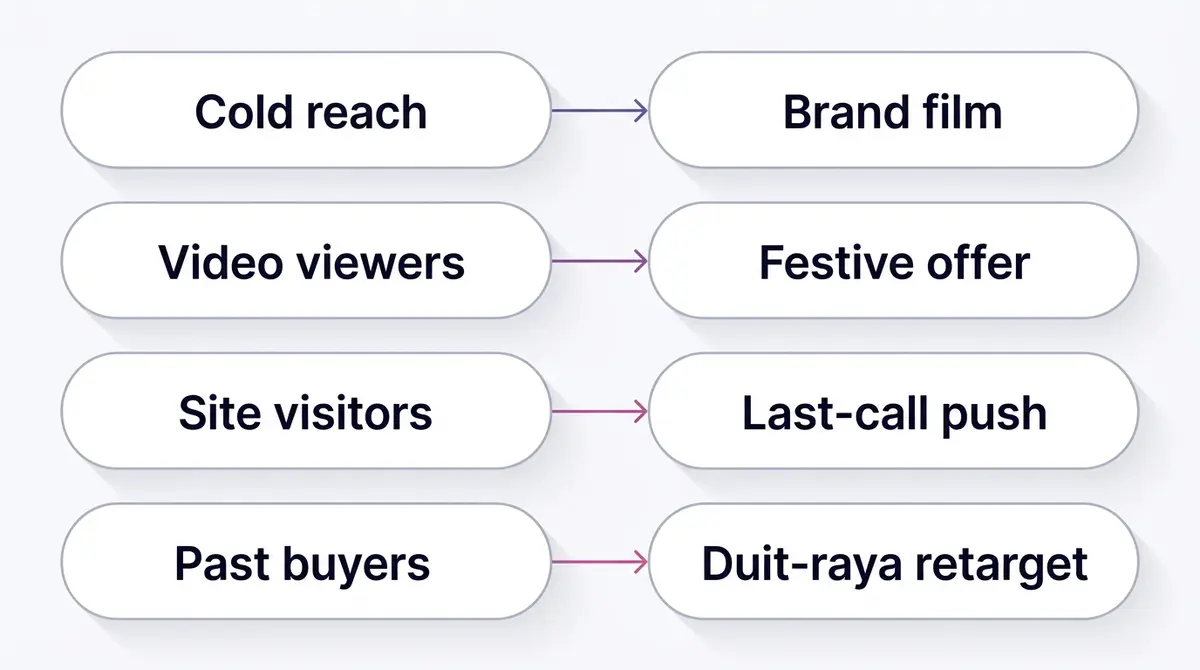
Run this stage as a reach or video-views campaign, and build your retargeting pools from it. Everyone who watches a meaningful chunk of the film becomes a warm audience you will sell to in the next two stages. That is the quiet payoff of going brand-first early: you are not just buying impressions, you are assembling the audiences that make the back half of the campaign cheap.
A few craft notes make the difference between a film people scroll past and one they finish. Hook in the first two seconds with a recognisable raya moment, not a logo, because viewers decide almost instantly whether to keep watching. Design the piece to work with the sound off, since most feed viewing is silent, by carrying the story through faces and captions rather than dialogue alone. Keep it short, ideally under fifteen seconds, so it can run cleanly as a Reel and a Story without recutting. And resist the urge to bolt a discount onto the end; the moment you add an offer the algorithm and the viewer both reclassify it as a sales ad, and you lose the cheap reach that made this stage worth running. The film's only job is to make your brand feel like part of someone's raya.
Stage two: the mid-Ramadan festive offer
By the second and third week of fasting, baju-raya buying is in full swing. Now the offer earns its place. The job of this stage is to convert the early intent you seeded, so the creative gets specific: the product, the festive value, and a reason to buy now rather than wait for the last-minute rush.
A brand like Afabelle Hijab can run a mid-Ramadan offer here, pairing its raya tudung collection with an RM-anchored mechanic such as a bundle price or free postage before a cut-off. Notice the framing. There is no neutral source for a standard raya discount percentage, so do not invent an "RM X off" benchmark. Lean on the season's verified category strength instead: fashion and apparel is one of the top Ramadan categories in the GrabAds research, which means the demand is there and your offer just has to make the choice easy. A static or carousel that shows the collection, names the bundle, and stamps the delivery cut-off does that job.
This is also where Meta's automation does real work. For sales and leads objectives, Advantage+ is now on by default in campaign setup, and Meta reported its Advantage+ sales campaigns reached a roughly US$20 billion annual revenue run-rate, growing 70% year over year (a Meta-own figure, directional). Turn the Advantage+ toggles on, feed the system your festive creative, and let it find the buyers among the warm pools you built in stage one. To make the offer concrete in the unit itself, the Facebook carousel ad guide shows how to split one budget across several festive pieces.
For many Malaysian SMEs the sale does not close in a checkout, it closes in a chat. Kuih, hampers and made-to-order baju raya are routinely pre-ordered over WhatsApp, so the messaging route belongs in your festive plan. Meta runs ads that click to WhatsApp, set up under a messaging or engagement objective, which open a conversation straight from the ad instead of sending people to a site. Meta reported click-to-message ads as one of its faster-growing formats, with US revenue up more than 50% year over year in Q4 2025 and paid WhatsApp messaging crossing a US$2 billion annual run-rate (both Meta-own figures, so treat them as directional). If pre-orders and questions are how your festive customers buy, point at least one offer-stage campaign at WhatsApp and staff the inbox for fast replies. The WhatsApp ads in Malaysia guide walks through the setup.
Stage three: the final-week conversion push
The last week before raya is the loudest and most expensive stretch of the season. Every competitor is shouting, the auction is at its peak, and shoppers are racing delivery cut-offs. This is not the week to introduce a new emotional concept. It is the week to push your best-selling festive products on the warmest audiences you have, with urgency that is true rather than manufactured: real stock limits, real delivery deadlines.
The big-ticket categories carry their own urgency here. Gold and jewellery is a long-standing raya gift and a duit-raya splurge, and a brand like Bene Jewellery fits this stage with a showcase ad positioning gold as both the gift to give and the treat to keep. Lead with delivery reassurance: a buyer paying for a meaningful gift wants to know it arrives before raya. Keep the creative simple, put the cut-off date on the image, and point the spend at past buyers, cart abandoners and the video viewers from your stage-one film. Cold prospecting in the final week is the most expensive impression of the season, so reserve the cold reach for earlier and spend the peak on warm intent.
Stage four: the post-Raya duit-Raya spend
The day of Aidilfitri is not the end of the campaign. Duit-raya circulates, angpau gets spent, and people treat themselves, buy gifts, and replenish after a month of festivity. This is a warm, high-intent window that most brands ignore because they switched everything off on raya eve.
A brand like EARTH & ME fits this stage with a problem-and-solution angle: a post-feasting skin and wellness reset bundle, UGC-style, aimed at the duit-raya spend after the festival. The point is that your campaign arc has earned you a large warm audience by now, and retargeting them costs far less than the pre-raya auction did. The Facebook retargeting guide covers how to build and segment those pools. Run gift and self-treat angles, replenishment reminders, and reset bundles against your video viewers, site visitors and past buyers. The InMobi Ramadan guide noted that around nine in ten Malaysian shoppers make mobile purchases roughly weekly during the season (a vendor figure, directional), which tells you the buying habit does not switch off the moment the fasting ends.
There is a second reason to keep spending after raya: it is when the competition disappears. Most brands exhaust their budget and attention on raya eve and go quiet for a fortnight, so the auction loosens just as a willing-to-spend audience remains active. Lower competition plus warm audiences plus genuine intent is the cheapest combination of the whole season, and it is sitting there for the few brands disciplined enough to plan for it. Practically, that means keeping at least one retargeting campaign live through the week after Aidilfitri, refreshing the creative so frequency does not climb, and segmenting the message: a gift angle for those who bought for others, a self-treat or reset angle for those who bought for themselves, and a simple replenishment nudge for past buyers whose product is due to run out. The arc that started with an emotional film a month earlier closes by quietly converting the audience that film created.
Keep the tone right for a fasting month
Ramadan is a month of worship before it is a sale, and the brands that earn goodwill treat it that way. The emotional beats that land are connection, gratitude, family and homecoming, not a frantic countdown clock. A hard-sell tone that works on 11.11 can read as tone-deaf in the first weeks of fasting, when the mood is reflective and people are tired by late afternoon. Lead with the feeling, let the offer follow.
A few guardrails keep you on the right side of the line. Keep imagery and language respectful: festive, warm and inclusive rather than gimmicky. Mind the fasting state in daytime creative, where lingering food shots can land badly before iftar. And consider a giving angle, since charity (sedekah) and contribution are central to the month: a brand that ties a campaign to a genuine sumbangan or community gesture, and means it, builds the kind of association a discount never will. The test is simple. If the ad would feel out of place shown to a family at the buka puasa table, rework it. Respect is not a constraint on festive selling, it is what makes a brand welcome in the feed during the season people care about most.
The Ramadan daily clock: when in the day to spend
Fasting reorders the day, and your ad schedule should follow it rather than a normal nine-to-five pattern. Criteo's Ramadan retail analysis, reported by Branding in Asia, mapped how Malaysian online sales move through the fasting day. Sales dip during iftar itself, roughly 19:00 to 20:00, while people break fast with family. They climb again through the evening and stay elevated late into the night, and there is a second pre-dawn lift around the sahur window of 05:00 to 06:00. Lunchtime is the strongest daytime stretch. In other words, the browsing and buying does not stop, it shifts to after-terawih scrolling and the quiet pre-dawn hours.
| Daily window | What people are doing | What to run |
|---|---|---|
| Sahur, pre-dawn (around 05:00 to 06:00) | Awake, eating, browsing on the phone | Keep conversion ads live; a real buying window |
| Daytime fast, with a lunchtime peak | Working, planning purchases | Reach and consideration; offers land at lunch |
| Iftar (around 19:00 to 20:00) | Breaking fast, away from the phone | Expect a dip; do not over-spend here |
| After terawih, late evening | Relaxed, scrolling, shopping | Push your strongest offers and retargeting |
| Late night into early hours | Peak browsing | Conversion ads; this is prime time |
The practical move is simple: do not let a daily schedule switch your ads off at midnight, when a willing audience is most active. If you run ad scheduling (available on a lifetime budget), weight delivery toward the after-terawih and pre-dawn windows for your conversion stages, and treat the iftar hour as the one predictable lull. Everyone is reachable; the question is catching them when the phone is in their hand.
Frequency, fatigue and the balik-kampung delivery squeeze
A month-long sequence creates two operational problems the calm arc diagram hides: your audience sees your ads too often, and your couriers slow down at the worst moment. Plan for both.
Start with frequency, which is impressions divided by reach, the average number of times one person has seen your ad. Over thirty days against the same warm pools that number climbs fast, and Meta's own guidance is to watch frequency alongside your results: when performance drops as frequency rises, your audience is fatiguing and the fix is fresh creative, not a bigger bid. Build three to five variations per stage so the system has options to rotate, and retire any hook the moment its cost per result starts drifting up. The early brand film and the final-week push should never be the same edit recut; new angles keep the same audience engaged across the arc.
Then the logistics. The final week collides with the balik-kampung exodus, when couriers slow down or pause as the whole country travels home. Protect your conversion push by setting an honest delivery cut-off and putting that date on the creative, so a buyer paying for a raya gift knows it will arrive in time. As the cut-off passes, switch the offer rather than killing the campaign: promote self-pickup, e-vouchers or gift cards that need no shipping, and digital or made-to-order items that travel as a booking instead of a parcel. A clear cut-off protects your reputation; a fulfilment-free fallback protects the last days of revenue.
Reading whether the arc is paying back
A season this expensive needs a number you can trust, or you cannot tell a stage that is scaling from one quietly burning budget. Set your targets and your reading rules before launch, not in the middle of the rush.
Decide your ROAS target by margin, not by a borrowed benchmark. If a festive bundle sells for RM150 and RM60 of that is gross margin, your break-even is a ROAS of 2.5 (RM150 divided by RM60), the point where the margin on the sales exactly covers the ad spend. Below that line you lose money on every order; a 3x ROAS turns a profit and a 1.5x is well underwater. Knowing that line is what tells you when to scale a stage and when to cut it. For a sense of what a result tends to cost on Meta in this market, the Facebook ads cost in Malaysia guide sets out the benchmarks to plan against.
Two settings decide what the numbers even mean. The default attribution window for a new ad set is 7-day click and 1-day view, so a purchase counts if it happens within seven days of a click or one day of a view; keep the same window all season so your stages stay comparable. And respect the learning phase: an ad set stabilises after roughly fifty optimization events in about seven days, so do not judge a stage in its first forty-eight hours, and do not make significant edits that reset it mid-flight. Read each stage against its own job. The brand film is winning if it builds cheap reach and large video-view audiences, not if it sells; only the offer, push and retarget stages should be judged on ROAS.
Research, make and launch each stage
Before you make a single ad, study what is already winning. The free Meta Ad Library lets you search any Malaysian advertiser and see every ad they are currently running across Facebook and Instagram, raya campaigns included, so you can read the hooks, formats and offer framing competitors are leaning on this season. Walk through it with the Meta Ad Library guide and look for the angle gap: the emotional beat or offer mechanic nobody in your niche has claimed yet.
| Stage | Research question | Creative output |
|---|---|---|
| Brand film | Which emotional beat is uncontested in my niche? | 9:16 story video |
| Festive offer | What bundle or value makes the choice easy? | Static or carousel with offer |
| Conversion push | What is my proof and my delivery promise? | Urgency static or short video |
| Duit-raya retarget | What replenishment or gift angle fits post-raya? | Warm-audience retargeting |
From research to launch, the workflow is the same at every stage. You decide the angle, you make the creative to match it, you edit it to the right ratios for Reels, Stories and feed, and you launch to Facebook and Instagram. Meta reported more than four million advertisers now use at least one of its generative-AI creative tools (a Meta-own number, so directional), which signals how normal AI-assisted festive creative has become, including tools that animate a static product shot into video for the early film stage.
This is the loop a tool like AdPlay.ai is built to close: research the live raya winners in the Malaysian archive, generate the on-brand emotional video or static for each stage, edit it, and launch straight to Facebook, Instagram, Reels and Stories. Whether you assemble the season by hand or with help, the discipline that wins is the same. Plan the four-stage arc around the confirmed Ramadan and raya dates, run the right creative at the right moment, and keep selling through the duit-raya wave after the day. For the wider calendar of Malaysian sale seasons to slot this into, see the Malaysian marketing calendar, and the Chinese New Year ad playbook runs the same staged arc for the other big gifting season.
Example ad angles
Representative hooks and formats from the category.
“Lifestyle ad for a balik-kampung homecoming where the tudung completes the family's sedondon look”
“Showcase ad for gold as the Raya gift and the duit-raya splurge”
“Problem and Solution ad for a post-feasting skin and wellness reset after Aidilfitri”
By the numbers
Frequently asked questions
When should I start running Hari Raya ads in Malaysia?
Start in the first week of Ramadan, not the final week before raya, and prep in the week before fasting even begins. For the 2027 window, fasting is expected to begin around 8 February 2027 with Aidilfitri on 10 March 2027 (both subject to moon-sighting confirmation, so plan for plus or minus one day). That gives you roughly 30 days to run a full arc: an emotional brand film while CPMs are calmer in the first fortnight, a festive offer mid-Ramadan, a conversion push in the final week, and duit-raya retargeting after the day. Use the runway week to clear ad approvals, check your account quality and seed your audiences, so nothing launches into a cold review queue. A brand that only launches in the last week is buying the most expensive impressions of the season with cold audiences.
What is the best week-by-week Ramadan-to-Raya ad sequence?
Four stages mapped to the fasting calendar. Week 1 to 2 of Ramadan: a balik-kampung or family brand film, no hard offer, to seed reach and warm audiences cheaply. Week 2 to 3: an RM-anchored festive offer such as a bundle or free postage, since this is when shoppers start buying baju raya. Final week before raya: a conversion push on your best-selling festive products with urgency and clear delivery cut-offs. After raya: retarget the duit-raya spend window with gifts, replenishment and post-feasting reset offers.
What time of day should I run my Hari Raya ads during Ramadan?
Schedule around the fasting clock, not a normal nine-to-five. Criteo's Ramadan retail analysis, reported by Branding in Asia, found Malaysian online sales dip during iftar itself (roughly 19:00 to 20:00) as people break fast, then climb through the evening and stay high late into the night, with a second lift in the pre-dawn sahur window around 05:00 to 06:00 and a strong lunchtime peak during the day. So keep budget live overnight, weight your conversion ads toward the after-terawih and pre-dawn hours when phones are in hand, and never let a daily schedule switch your ads off at midnight when a willing audience is most active. Treat the iftar hour as the one predictable lull.
What kind of offer works for a Hari Raya promotion?
Frame it around the season's top spending categories rather than chasing a fixed discount number. GrabAds research reported by Marketing-Interactive named food and beverage, fashion and apparel, and personal healthcare as leading Ramadan categories, and big-ticket gold and jewellery is a long-standing raya gift and duit-raya splurge. Practical offers that travel well: an RM-anchored festive bundle, free postage before a delivery cut-off, a gift-with-purchase, or early access for past buyers. There is no neutral source for a standard 'RM X off' threshold, so lead with the mechanic and the festive value, not an invented benchmark.
How do I keep my Raya creative from going stale over a month-long campaign?
Plan for fatigue from the start, because thirty days against the same warm pools pushes frequency up fast. Frequency is impressions divided by reach: the average number of times one person has seen your ad. Meta's guidance is to watch it alongside your results, and when performance drops as frequency climbs, that is the signal to refresh the creative rather than raise the bid. Build three to five variations per stage so the system has fresh options to rotate, retire any hook the moment its cost per result starts rising, and lean on new angles instead of running the same film all month. The early brand film and the final-week push should never be the same edit recut.
How do I research what Raya ads are already winning before I make mine?
Study the live festive creative in your category. The free Meta Ad Library lets you search any Malaysian advertiser and see every ad they are currently running on Facebook and Instagram, including their raya campaigns, so you can read the hooks, formats and offer framing that competitors are leaning on this season. Pair that with last year's seasonal winners if you have them. The goal is not to copy but to spot the angle gaps: which emotional beats or offer mechanics nobody in your niche has claimed yet.
How long after Hari Raya should I keep advertising?
Longer than most brands think. Hari Raya is not a single day; the celebration runs through the month of Syawal with open houses (rumah terbuka), visiting and continued gifting, so the selling window stretches for weeks past 10 March 2027, not just the duit-raya days right after. Keep at least one retargeting campaign live through the open-house weeks, selling gift, replenishment and post-feasting reset angles to the warm audiences your arc built. Because most competitors switch off on raya eve, the auction loosens just as a willing-to-spend audience stays active, which makes this the most efficient stretch of the whole season.
Do I need anything set up before the season starts so my ads are not restricted?
Yes, run a pre-flight check before fasting begins. In Meta Business Suite, open Account Quality to confirm your ad account and Page have no restrictions, since a mid-season disable can cost you the whole window. Make sure your Pixel and Conversions API dataset are firing so your conversion campaigns can optimize, and confirm your payment method has headroom for higher festive budgets. Ads Manager also surfaces an Opportunity score with setup recommendations you can clear before launch.
Sources
- 1.PublicHolidays.com.my, Hari Raya Aidilfitri 2026/2027/2028 dates (2026)
- 2.PublicHolidays.com.my, Awal Ramadan 2027/2028 dates (2026)
- 3.DataReportal, Digital 2026: Malaysia (2026)
- 4.Meta Platforms Q4 2024 Earnings Call Transcript (2025)
- 5.Marketing-Interactive, GrabAds: 84% of Malaysians to increase Ramadan spending (2024)
- 6.Marketing-Interactive, Criteo: Malaysia +40% sales uplift in first fortnight of Ramadan (2024)
- 7.InMobi, Ramadan Marketing Guide 2025: Malaysia (2025)
- 8.TimeAndDate, Holidays and Observances in Malaysia 2027 (2026)
- 9.Branding in Asia, Insights for Southeast Asia Retailers for Ramadan 2024 (Criteo data) (2024)
- 10.Meta Newsroom, 2026: AI Drives Performance (click-to-message growth) (2026)
- 11.Meta Business Help Center, About Ads in Review (2026)
- 12.Meta Business Help Center, About Attribution Models and Attribution Settings (2026)
- 13.Meta Business Help Center, Frequency (2026)
- 14.Meta Business Help Center, About the Learning Phase (2026)
Keep exploring
Turn ad research into winning ads
See what 16,000 Malaysian brands advertise, then generate on-brand creative, all in one tool.
7-day free trial · No credit card required