
Florist Facebook Ads in Malaysia (2026)
How Malaysian florists actually build Meta campaigns: the chat-versus-checkout split across 59 live advertisers, catalogue ads at 22% of the pool, and the wreath copy rules.
Updated October 2026 · Xanny Lee, CEO
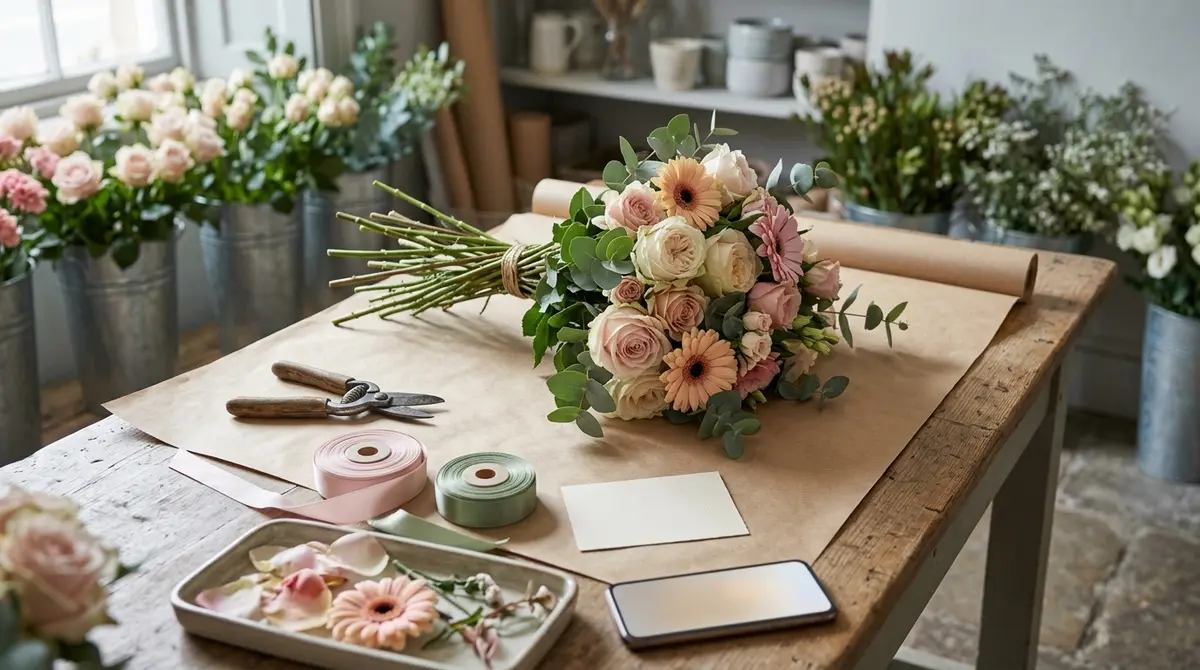
Read on 9 September 2026, with no major Malaysian gifting festival in the month either side, the archive held 400 distinct live creatives from 59 Malaysian florist and gifting advertisers. The split inside that pool is the campaign decision. Counted by advertiser, 33 of the 59 lead with a chat button, but counted by creative, 264 of the 400 lead with a checkout button, because a handful of large advertisers carry most of the creative volume: 232 of those 264 come from the eleven advertisers that run catalogue ads, and BloomThis alone accounts for 128. Catalogue formats make up 22.2% of that florist pool against 3.3% across the whole live Malaysian archive, which is the strongest single signal about how this category is built.
Monday morning, and the order book from the weekend is open on the counter beside the wrapping bench. Three arrangements nearly missed their window on Saturday. The phone holds forty portrait clips nobody has cut, WhatsApp is doing the job a checkout page does elsewhere, and Ads Manager wants an objective before it will let you do anything at all. That objective is the decision this guide is about, because the Malaysian florists advertising right now are not all making the same one, and the two answers pull the whole build in different directions.
The split that decides everything downstream
Read the Malaysian archive for live florist and gifting creatives on 9 September 2026 and one number does most of the work. Not the volume. The call to action.
The pool is built mechanically so you can reproduce it. Take every live Malaysian creative matching the exact phrase "florist" or the exact phrase "bouquet", deduplicate by perceptual hash so one arrangement photographed five ways counts once, then keep only advertisers whose page name contains florist, flower, flora, floral, bloom, bunga, petal, bouquet, fleur or the character 花. No hand-picking, no judgment calls, which is why the counts here run larger than any curated sample of this category. That leaves 400 distinct live creatives across 59 advertisers. Re-run the same recipe a week later and the totals move by a few creatives either way, because the live flag turns over as each ad is re-checked. The shape below does not move.
Now count the call to action twice, and the two counts disagree with each other.
Counted by creative, this is a checkout category. 264 of the 400 creatives carry a checkout or product-detail button, against 96 that carry a chat button and 30 that push to a profile or a Learn More. Checkout here means Shop Now on 220 of them, Order Now on 22 and See Details on 20, plus two strays.
Counted by advertiser, it is a chat category. Group the 400 creatives by the shop that ran them and take each shop's dominant button, and 33 of the 59 advertisers lead with a conversation, against 18 leading with a checkout.
| Where the ad sends the buyer | Creatives (n=400) | Advertisers whose dominant button this is (n=59) |
|---|---|---|
| Checkout or product detail, mostly Shop Now | 264 | 18 |
| Conversation, WhatsApp or a Page or Instagram message | 96 | 33 |
| Browse, a profile visit or Learn More | 30 | 6 |
| No button on the creative | 10 | 2 |
Read the advertiser column as a lean rather than an exclusive choice. Petite Fleur Kuala Lumpur, the most mixed shop in the pool, ran ten chat creatives against eight checkout and five profile visits at the same read, and a shop running two ads can flip its own row with one new one.
The inversion has a mechanical cause and it is worth stating plainly, because it is the difference between reading the archive and being misled by it. A few large advertisers publish an enormous number of creatives each. BloomThis alone accounts for 128 of the 400, 58 of them catalogue ads. Floristika runs 22, Flower Chimp 17, FlowerSugarMY 22. Meanwhile the typical conversation-led shop, Petals & Chocs at four creatives, Daima Florist JB at three, Aiflorist by Carman at two, publishes a handful and keeps them running.
Concentration is doing more of the work here than the catalogue format is, and the numbers separate the two cleanly. Eleven of the 59 advertisers run any catalogue creative at all, and 232 of the 264 checkout creatives come from those eleven, but only 89 of the 264 are catalogue ads. The rest is ordinary video, image and carousel work from the same large shops. The checkout majority is a story about a few big shops advertising heavily, not about a feed assembling ads on its own.
So if you read the feed and conclude "everyone is running Shop Now", you have counted ads. If you read the shopfronts and conclude "everyone closes in WhatsApp", you have counted shops. Both are true and they lead to different campaigns.
Two builds, and the objective each one needs
Ads Manager makes you choose the objective before anything else, and the objective is not a style preference. It is the definition of the event Meta optimises delivery towards. Pick the wrong one and the algorithm spends your budget chasing something your business never produces.
If the order closes on your own site, the optimisation event is a purchase, the pixel has to fire it, and the campaign is a sales objective with a catalogue behind it once your range outgrows hand-built creative.
If the order closes in a WhatsApp thread, there is no purchase event on any website, because there is no website in the path. A sales objective in that world sends Meta hunting for a signal it will never receive. The messaging destination is the correct build, and the optimisation event is the conversation that starts.
| Decision | Checkout-led build | Conversation-led build |
|---|---|---|
| Objective | Sales, optimised for purchase | Engagement or Sales, optimised for messaging conversations started |
| Destination | Product page on your own domain | WhatsApp, Messenger or an Instagram DM |
| Catalogue | Required once the range outgrows hand-built creative | Optional, and useful mainly for assembly |
| Creative unit | One per product, assembled by Meta | One per occasion, written by you |
| What closes the order | Card checkout | A person typing a reply |
| How you know it worked | Purchase event, matched to the product id | Conversations started, then your own order book |
| The failure mode | Pixel fires product ids the catalogue does not contain, so retargeting quietly degrades into prospecting | Nobody answers the thread within the window a buyer who is already late will wait |
The mechanics under each of those cells already have proper homes. Radius targeting around a delivery zone is worked through in the guide to Facebook ads for Malaysian bakeries and dessert shops and again from a different angle in the restaurant and cafe playbook. Setting up the click-to-WhatsApp destination itself, including the pricing difference between a user-initiated and a business-initiated conversation, sits in the WhatsApp ads guide. This page is about which of the two builds you are in, not how to configure either.
Catalogue ads run at nearly seven times the market rate here
The second first-party finding is the sharpest thing in the data, and unlike the call-to-action split it needs no interpretation at all. It is a facet count over the whole live Malaysian archive against the same facet over florist queries.
| Pool | Live creatives | Catalogue share | Carousel share |
|---|---|---|---|
| Whole live Malaysian archive | 225,820 | 3.3% | 3.6% |
| Exact phrase "florist" | 399 | 7.3% | 15.8% |
| Exact phrase "flower delivery" | 602 | 14.5% | 6.0% |
| Exact phrase "bouquet" | 719 | 16.8% | 15.4% |
| Deduplicated florist advertiser pool | 400 | 22.2% | 16.3% |
Across every live Malaysian ad in the archive, 3.3% run as catalogue ads and 3.6% as carousels. Inside the florist pool those numbers are 22.2% and 16.3%, which is close to seven times the market rate on catalogue and four and a half times on carousel. Roughly two in five florist creatives are one or the other, against roughly one in fourteen across the market.
Why this category and not others is not something the archive can answer, and guessing would dress a hunch as a finding. What is defensible is the shape of the product. A florist sells fifty variations of one thing, differing by flower, size, wrap and price, all of which photograph well and all of which change with supply. That is the inventory shape a feed handles better than a designer does. The full format breakdown of the 400 reads 107 video, 89 catalogue, 78 single image, 65 carousel, 38 dynamic creative and 23 multi-image posts, so video still leads on raw count. It is the two feed-driven formats that are anomalous.
If carousels are where you start, the carousel ad format guide covers card counts and the mechanics of ordering.
Building a catalogue when the order closes in a chat
Forty eight of the 59 advertisers in this pool run no catalogue creative at all, so a catalogue is plainly not the entry ticket. Eleven do, and those eleven are where most of the creative volume sits.
Before you build one, there is a Malaysian constraint that has to be right or everything downstream is wasted. Malaysia is not on Meta's supported-countries list for Shops on Facebook and Instagram, so product tagging in posts is unavailable here regardless of how the catalogue is built. That is the position at the September 2026 read, and country lists move, so check the list before you plan a quarter around it. Advantage+ catalog ads are a separate product and they are open, asking only that you add or sync products with a catalog and connect a data source, which Meta names as the Meta Pixel, the Conversions API or the Meta app SDK. No country gate is stated on that requirement. The Instagram shopping guide for Malaysia works through which features survive that split, and it also flags something counterintuitive for this category: Meta's design requirements page for Instagram Stories ads recommends 1.91:1 for Advantage+ catalog ads, while just over half of the 400 florist creatives in this pool are portrait. If you build a catalogue, you are running two creative tracks, not one.
The feed structure, the field mapping and the product-set mechanics are set out in the guide to setting up a Meta product catalog, and there is no reason to restate them here.
What is worth saying is the version for a shop whose checkout is a person. You can connect a catalogue to a campaign and still send the click into WhatsApp. The catalogue then does assembly rather than checkout: it decides which of your forty arrangements this particular viewer sees, and the conversation still opens where you can quote a delivery window and take a payment screenshot. Petite Fleur Kuala Lumpur is the proof that the two are not mutually exclusive. At the 9 September 2026 read it had WhatsApp Message, Shop Now and a catalogue creative live together across 23 ads.
Occasion is the product set, not flower type
Here is where the catalogue work pays back, and it is the one structural decision most florist feeds get wrong.
The obvious way to organise a florist catalogue is by what the thing is. Roses, tulips, sunflowers, hampers, stands. That mirrors the wrapping bench and it is useless for advertising, because nobody searches their memory for tulips. They remember that their mother's birthday is Thursday.
Organise the product sets by occasion instead, and every ad you run stops being a flower ad and becomes an answer to a deadline. The Malaysian archive shows the occasion set clearly, in the advertisers' own copy and in three languages, and every creative named below was live at the 9 September 2026 read. The Flower Prince runs graduation bouquets from RM58, built around photographs at the ceremony. 520 D'Love florist advertises grand-opening flower stands as a business gift, and separately runs a set of arrangements under RM100 with prices per item on the card, from RM39 for sunflowers up to RM89 for a rose balloon bouquet. Mcvis Florist Penang runs a ready-stock grand-opening basket with same-day dispatch Penang-wide, island and mainland. Daima Florist JB runs a condolence wreath set delivered to funeral parlours, memorial halls and residences across Johor Bahru, Skudai and Iskandar Puteri. Leyana Florist runs get-well and birthday arrangements in Malay.
Every one of those is an occasion, not a flower. Build the product sets that way and the catalogue can target them separately, which is the whole reason product sets exist.
The language split in the pool matters for the same reason. Of the 400 creatives, 288 are labelled English, 55 Chinese and 23 Malay, with the balance mixed or unlabelled. That is not one audience. Reading the creatives, the condolence and grand-opening lines in this pool lean Chinese, while the get-well and celebration arrangements are where the Malay copy sits. Treating all of it as one set with one caption throws away the specificity that makes an occasion ad work in the first place.
What a September with no festival in it actually shows
Run length is the one thing a live archive can measure honestly, and the reading only means anything if it is taken on a date with no festival in it.
9 September 2026 qualifies. Chinese New Year was in February, Raya in March, Mother's Day in May, and Deepavali is still two months ahead. One objection is worth naming rather than ducking. It is 9.9, one of the twelve double-date mega sales, so if anything the date loads the pool towards fresh sale creative rather than away from it, and the run lengths are the answer to that: 88 of the 400 had already been running 90 days or more when the snapshot was taken, so they long predate the sale. On that date, 59 Malaysian florist advertisers had 400 distinct live creatives running.
| Run length already reached | Creatives | Share of the 400 |
|---|---|---|
| 30 days or more | 264 | 66% |
| 90 days or more | 88 | 22% |
| 180 days or more | 52 | 13% |
| 365 days or more | 12 | 3% |
| Median across the whole pool | 54 days |
One coincidence in that table is worth flagging so it does not read as a copy-paste error. The 264 creatives already past 30 days is the same number as the 264 carrying a checkout button, and the two are independent facets of the same pool that happen to land on the same integer.
Two honest caveats belong with those numbers, and both cut against reading them too hard.
The first is a measurement floor. Run length is measured from an ad's start date to that ad's own most recent check in the archive, not to today, so every figure above is a "ran at least this long" and never a current run length. The refresh cadence across the archive is uneven, so some of these are undercounts.
The second is the one that kills a tempting claim. It is natural to look at when these ads started and infer a seasonal shape. Do not. A pool filtered to live ads is biased towards recent starts by construction, because the ads that started earlier and stopped are excluded from it. Any month-by-month curve drawn from a live-only pool describes the filter, not the market. That is why the claim here is deliberately flat: 400 creatives, 59 advertisers, on a day with no festival, 88 of them already past 90 days and the longest past 700. A festival-only category could not produce that in September, and that is the entire inference available.
What the festive overlay adds on top of a working evergreen base is a separate question with a proper answer in the Malaysian marketing calendar.
Wreath and condolence creative against Meta's Personal Attributes standard
This is the part of a florist account most likely to get a creative rejected.
Condolence is a real advertised line here. On 9 September 2026 the live Malaysian archive held 148 creatives mentioning wreaths and six mentioning condolence explicitly, and the named examples are unambiguous: Mcvis Florist Penang runs a same-day funeral wreath ad Penang-wide, Blessing Florist advertises LED funeral wreaths on a peninsula-wide delivery list running from Johor through Melaka, Negeri Sembilan and the Klang Valley to Perak, Penang and Kedah, and Daima Florist JB runs a condolence wreath set into funeral parlours, memorial halls and residences. That middle list is worth a second look, because a shop quoting half the peninsula on a wreath ad is telling you this demand is not a neighbourhood trade.
Sitting under all of it is a demand floor that is dated, neutral and unglamorous. The Department of Statistics Malaysia recorded 198,992 deaths registered in 2024, up 1.0% or 2,027 on the 196,965 registered in 2023, with the crude death rate easing from 5.9 to 5.8 per 1,000 population. That is a category with a floor under it in every month of the year, which is exactly why florists advertise it in September.
Now the policy. Meta's Privacy Violations and Personal Attributes standard bars ads that assert or imply personal attributes, and it enumerates them: race, ethnicity, religion, beliefs, age, sexual orientation or practices, gender identity, disability, physical or mental health including medical conditions, vulnerable financial status, voting status, membership in a trade union, criminal record, or name. It also prohibits implying that the advertiser is aware of someone's personal attributes or those of their family.
Bereavement and grief are not on that list. Write that as not caught by the enumerated list, never as safe, because the standard is not a safe harbour and Meta enforces past the letter of it.
Two enumerated limbs are genuinely reachable in a wreath ad, and knowing which two is the whole of the practical guidance.
Religion and beliefs is enumerated. A wreath ad that describes what you supply for a particular rite is describing a product. A wreath ad written in the second person to a reader of a particular faith is implying you know something about that reader. The subject matter is identical. The construction is not.
Physical or mental health including medical conditions is enumerated, and it reaches the reader's family, because the policy prohibits implying knowledge of the personal attributes of a user's family. Copy that presumes the reader has somebody dying is the version at risk, not the wreath.
The rewrite is mechanical once you see it. Describe the service, the geography and the timing. Do not address the reader's circumstance. Daima Florist JB's own live copy is the pattern, and it reads like a delivery notice rather than a sympathy card: same-day arrangement and delivery, to funeral parlours, memorial halls and residences, with the districts named. Nothing in that sentence claims to know anything about the person reading it. The general rewrite patterns across categories are collected in the Personal Attributes policy guide.
What naming a cut-off does to your legal position
Every florist ad in this category eventually makes a timing promise, because timing is the product. Same-day delivery, order by 3pm, guaranteed before the party. At the 9 September 2026 read, Leyana Florist had a Malay line promising that an order placed today arrives today, and Ipoh Fresh Flower a static creative whose four ticks were breathtaking bouquets, same-day delivery, free delivery and a free message card.
The instinct is that naming a cut-off is the risky move and staying vague is the safe one. On the Malaysian text, that is backwards.
Section 55 of the Consumer Protection Act 1999 implies a guarantee that services "will be completed within a reasonable time", but read the qualifier that follows it. The guarantee applies "where the time for the services to be carried out is not (a) determined by the contract; (b) left to be determined in a manner agreed by the contract; or (c) left to be determined by the course of dealing between the parties."
Section 55 is a residual default. It fills a silence. A florist who publishes a cut-off time and a delivery window has determined the time by contract and has displaced a vague statutory standard with the specific one it wrote itself. That is a better position, not a worse one, because "reasonable" is decided by somebody else afterwards and "by 6pm today" is decided by you in advance.
Two precisions that a compliance summary usually blurs. Section 53 is the separate guarantee that services are carried out with reasonable care and skill, and it applies whatever the timing says. And section 55 sits in Part VIII of the Act, which the criminal penalties in section 25 do not reach. A missed delivery window is a civil matter, a claim before the Tribunal for Consumer Claims, not an offence.
Where the criminal exposure genuinely sits is Part II, six Parts earlier, and it is a different problem from a missed slot. Section 13(1) makes it bait advertising to advertise goods or services for supply at a specified price that you do not intend to supply, or have no reasonable grounds for believing can be supplied at that price in reasonable quantities for a reasonable period. Section 18 then deems the advertisement to have been made by the person claiming to supply, so an agency running it does not move the liability. The Malaysian travel advertising guide works both provisions through in full, with the section 13(2) defence and the section 25 penalty bands, against a category built on the same from-RM grammar.
| The promise as written | What it commits you to | What tests it |
|---|---|---|
| "Delivered fast" | Nothing specific, so the statutory reasonable-time default applies | CPA 1999 s.55, a civil claim before the Tribunal |
| "Same-day delivery, order by 3pm" | The window you named, on the days you named it | Your own stated term, which displaces s.55 |
| "Guaranteed same-day, Klang Valley" | Capacity to fulfil across the whole area, every day it runs | CPA 1999 s.55 on timing, s.53 on how the job is done |
| "Same-day roses from RM89" | Real stock at that price, in reasonable quantity, for a reasonable period | CPA 1999 s.13(1) bait advertising, with s.18 putting it on you |
One more instrument belongs here in a sentence rather than a section. Content Code 2022 (Third Edition), Part 8 paragraph 6.1 gives an advertiser five working days from the Complaints Bureau's request to submit documentary evidence for a claim, extendable only at the Bureau's discretion under paragraph 7.4, which means a same-day guarantee needs a delivery log you can export rather than a memory of a good week. That regime is set out in full in the guide to ad claim substantiation in Malaysia.
A supply shock is an argument against leading on price
May 2026 gave this category a live stress test, in the run-up to the convocation season and the 20 May gifting date, and it changes what a sensible offer looks like.
Reporting from The Star on 19 May 2026 quotes named florists rather than an industry aggregate, and the figures should be attributed the same way. Roy Tan, a branch manager at a Central Market florist, said supplies from Cameron Highlands to his shop had dropped by about 50%, affecting gerbera, daisy, sunflower, lily and chrysanthemum. Neela Veni, an operations manager at another Central Market flower shop, put local gerberas down 70% and sunflowers down 50%. Ben Lee, managing a Petaling Jaya shop, reported roses and daisies down 50% and added that his sales had also dropped by 20%. Prices moved with it: a few stalks of local gerbera at RM12 against RM20 imported, a local bundle of roses about RM40 against about RM60 imported.
That is a concentrated supply base doing what concentrated supply bases do. In a second report the same day, The Star put the floriculture industry at roughly RM500mil annually and the highlands at more than 80% of Malaysia's cut flower exports, and, citing trade data, said Malaysia reportedly recorded RM309.67mil in cut flower exports in 2024, ranking eighth globally. Hold that export figure loosely. The paper hedges it with "reportedly", and the Agriculture Department's own last published number is a different series, RM417.3mil of export revenue in 2021 against RM403mil in 2020. The Agriculture and Food Security Minister, Datuk Seri Mohamad Sabu, is quoted in that article on the response rather than on any of those figures, saying the ministry would check the affected areas and work through Fama and the Agriculture Department.
The campaign consequence is specific. If your headline promise is a named flower at a named price, a supply shock breaks the ad and the section 13 problem arrives with it, because you are advertising at a price you no longer have reasonable grounds to believe you can supply. If your headline promise is the delivery, a supply shock changes what goes in the box and nothing else. Several of the longest-running creatives in this pool lead on same-day delivery and a free message card rather than on a rose count, against a national delivery expectation built on over 899 million parcels as at the third quarter of 2024 and 52 million in 2015, on figures the Deputy Communications Minister gave in the Dewan Rakyat citing MCMC. That is a durable choice rather than a stylistic one, and it is the one promise a bad week in the highlands cannot take away from you.
The retargeting window for a buyer who decides in minutes
This is where a florist account should look least like the categories it usually gets grouped with, and the clearest contrast in this corpus is a wedding vendor.
The wedding and events guide argues, correctly for that business, that Page and Instagram engagers should be held at Meta's 730-day ceiling for those two sources, because the gap between a couple first seeing a vendor and signing with one is measured in seasons rather than days. That ceiling is source-specific rather than general, and a lead-form audience expires at 90 days no matter who runs it. A short window empties before the decision is made.
Run that logic on a florist and it inverts. A buyer opens Instagram, remembers a birthday tomorrow, and orders inside the hour. There is no shortlist and no consideration period, which is why so much of the conversation-led copy in this pool sells the dispatch and the reply rather than the range. Somebody who watched your Reel in January and did not buy is not holding an open decision. The occasion that prompted the view is long past.
Two build consequences follow. Size the intent-based windows to the span in which the occasion that triggered the visit is still ahead of the buyer, and stop treating a stale engagement pool as an asset. Then put the budget a wedding vendor would spend on long retention into prospecting, because here the next order comes from a new occasion rather than a warmed lead. The mechanics of stacking and sizing those windows sit in the retargeting guide.
None of that is visible in Ads Manager, because Ads Manager cannot see when the buyer first met you. Your delivery diary can. If the gap between a first touch and a paid order in your own records runs to weeks rather than hours, the windows above are wrong for your shop and your records win.
What the archive cannot tell you
One boundary, stated plainly, because it is the most common place a category guide starts inventing.
The archive behind every first-party figure on this page holds creative metadata only. Brands, hooks, formats, languages, buttons, start dates. It holds no spend, no cost per click, no cost per mille, no return on ad spend and no conversion data of any kind. Nothing on this page is a cost benchmark, and no Malaysia-specific florist cost figure exists in any neutral, dated source we could verify. If you find one quoted confidently somewhere, ask whose account it came from.
The general Malaysian cost picture is a separate, separately sourced question, covered in what Facebook ads cost in Malaysia. A week of your own spend beats any published benchmark anyway.
Choosing your build, and running both
Most florists reading this already know which half they are in. The order book says it. If deliveries are quoted and confirmed in chat threads, you are the conversation build and the messaging objective is correct. If orders arrive with an order number and a card payment, you are the checkout build and the catalogue is the next piece of work.
The interesting case is the shop that is genuinely both, and the archive says it is a real position rather than a compromise. At the 9 September 2026 read, Petite Fleur Kuala Lumpur had WhatsApp Message creatives, Shop Now creatives and a catalogue creative live together across 23 ads, and The Flower Prince mixed Shop Now, Order Now and a Page message across 16. What makes that work is that each campaign is built for one destination and measured on one event, rather than one campaign hedging across both.
Three questions settle it for a shop that is unsure. Where does the money actually change hands today. Whether a person is genuinely available to answer within the window a late buyer will wait, which is minutes rather than hours. And whether your range is stable enough that a feed is less work than building creative by hand, which for most single-outlet shops it is not yet.
Answer those and the objective picks itself. Then the work is the part no platform does for you: shoot the occasions, name the cut-off you can actually hold, and structure the sets around the deadline the buyer is already behind on. Searching a live archive of Malaysian ads, such as AdPlay.ai, is the fastest way to see how the shops already running in this category have answered the same three questions.
By the numbers
Frequently asked questions
Which campaign objective should a Malaysian florist actually run?
Work backwards from where the order closes, because the objective has to match that and nothing else. If the order closes on your own site with a card payment, you want a sales objective pointed at a website conversion, with the pixel firing purchase events and a catalogue behind it once you have more than a handful of products. If the order closes in a WhatsApp thread where somebody types a delivery address and sends a payment screenshot, a sales objective sends Meta hunting for an event it will never see, and the account optimises towards nothing. In that case you want the messaging destination, so the optimisation event is the conversation that starts. The archive says both are real choices here rather than one being correct: across 59 live Malaysian florist advertisers on 9 September 2026, 33 led with a conversation button and 18 led with a checkout button. The mistake is not picking either one. It is picking the checkout objective because it sounds more serious and then closing every order by hand in a chat anyway.
Do I need a product catalogue if my orders close in WhatsApp?
Not to run ads, and 48 of the 59 live advertisers in this pool have no catalogue creative at all. But the pool also shows what a catalogue buys you when you do build one. The eleven advertisers running catalogue ads publish most of the creative volume between them, though three of those eleven run fewer than five ads each, so the volume is concentration in a few large shops rather than something a catalogue confers on its own. What it does confer is assembly, because Meta builds the ad per product rather than per campaign, which is why catalogue formats reach 22.2% of florist creatives against 3.3% across the whole live Malaysian archive. The useful middle position for a shop that closes in chat is to build the catalogue for the assembly and keep the chat as the destination, so the ad still shows the right arrangement to the right person and the conversation still starts where you can actually answer it. Build it when your range is stable enough that a feed is less work than hand-building creative, not before.
Is Instagram product tagging available to a Malaysian florist?
No, and any checklist that tells you to tag products in your posts was written for another country. Malaysia is not on Meta's supported-countries list for Shops on Facebook and Instagram, and being located in a supported country is a requirement for that feature set including product tagging. That was the position at the September 2026 read, and country lists move, so check the list before you plan a quarter around it. What is open to you is the other half, Advantage+ catalog ads, which asks only for a catalog and a connected data source such as the Meta Pixel, the Conversions API or the app SDK. There is no country gate on that. So the catalogue work is worth doing here, it just leads to ads rather than to shoppable posts, and the guide to Instagram shopping ads from Malaysia sets out exactly which features survive that distinction.
Does naming a same-day cut-off increase my legal exposure?
It does the opposite of what most people assume. Section 55 of the Consumer Protection Act 1999 implies a guarantee that a service will be completed within a reasonable time, but only where the time is not determined by the contract, not left to be determined in a manner the contract agrees, and not left to be determined by the course of dealing between the parties. It is a residual default. A florist who publishes a 3pm cut-off and a same-day window has determined the time by contract and has replaced a vague statutory standard with the one it chose. Naming the cut-off does not create the exposure, it defines it. What you then have to do is hold it, because a stated promise you miss is a broken term rather than an argument about what reasonable means.
Can I advertise funeral wreaths and condolence flowers on Facebook?
Yes, and Malaysian florists visibly do. Six live Malaysian creatives mentioned condolence and 148 mentioned wreaths at the 9 September 2026 read, including same-day funeral wreath ads running in Penang and Johor Bahru. Bereavement and grief are not among the attributes Meta's Privacy Violations and Personal Attributes standard enumerates, so write that as not caught by the enumerated list rather than as safe. Two enumerated limbs are genuinely reachable in this category. Religion and beliefs is one, the moment copy is written to a specific faith's rites and addressed at the reader rather than describing the service. Physical or mental health including medical conditions is the other, the moment copy implies the reader's family member is ill or dying. The rewrite that clears both is to describe what you deliver and where, rather than what you think has happened to the reader.
How long should a florist's retargeting window be?
Much shorter than the categories this business is usually grouped with, and that is a real build difference rather than a preference. A wedding vendor is right to hold Page and Instagram engagers at Meta's 730-day ceiling for those two sources, because a couple books a year or more ahead. That ceiling is source-specific rather than general, and a lead-form audience expires at 90 days whatever the category. A florist's buyer is remembering a birthday tomorrow. Somebody who watched your Reel nine months ago and did not buy is not carrying an unclosed decision, they are a stranger who once saw a bouquet. Keep the intent windows tight, in the range where the occasion that prompted the visit is still ahead of the buyer, and put the long-life budget into prospecting instead. Then measure it, because your own enquiry log is the only honest source for how far ahead your customers actually order.
Is this category only worth advertising around festivals?
The September read argues against that framing directly. On 9 September 2026, with Chinese New Year seven months behind, Raya six months behind, Mother's Day four months behind and Deepavali still two months ahead, 59 Malaysian florist advertisers had 400 distinct live creatives running. Of those, 264 had already run 30 days or more and 88 had run 90 days or more. A category that only switched on for festivals could not produce that in September. The honest caution is that this says nothing about how the year is shaped, because a live-only pool is biased towards recent starts by construction, and any seasonality claim built on it would be an artefact of the filter.
What does a florist ad cost in Malaysia?
No neutral, dated, Malaysia-specific florist benchmark exists that we could verify, and the archive cannot supply one because it holds creative metadata only, never spend, cost per click, cost per mille or return on ad spend. Anyone publishing a florist-specific Malaysian cost per lead is either quoting one account or inventing it. What you can do is read the general Malaysian cost picture, which is sourced separately, and then build your own number from your own account within a week of spending: cost per conversation started, then the share of conversations that become orders, then average order value. Two of those three come out of your order book rather than Ads Manager, which is why so few florists ever calculate the third.
Sources
- 1.Department of Statistics Malaysia, Vital Statistics Malaysia 2025 (2025)
- 2.Bernama, MCMC parcel volume figures given in the Dewan Rakyat, 19 February 2025 (2025)
- 3.The Star, Season not so rosy for bloom trade, 19 May 2026 (2026)
- 4.The Star, Concerted effort to assist floriculture industry, 19 May 2026 (2026)
- 5.Meta Transparency Center, Privacy Violations and Personal Attributes advertising standard (2026)
- 6.Meta for Business, Meta Advantage+ catalog ads (2026)
- 7.Consumer Protection Act 1999 (Act 599), reprint as at 1 November 2021, Laws of Malaysia (Attorney General's Chambers) (2021)
- 8.Instagram Help Center, Supported Countries for Shops on Facebook and Instagram (2026)
- 9.Meta Business Help Center, Design requirements for Instagram Stories ads (2026)
- 10.Meta for Developers, Engagement Custom Audiences retention maximums by event source (2026)
- 11.The Malaysian Communications and Multimedia Content Code 2022 (Third Edition), Content Forum (2022)
Keep exploring
Turn ad research into winning ads
See what 16,000 Malaysian brands advertise, then generate on-brand creative, all in one tool.
7-day free trial · No credit card required