
UGC vs Studio Facebook Ads: Which Wins
UGC-style vs polished studio Facebook ads: where each wins by funnel stage and audience, the cost and trust tradeoffs, and why running both beats picking a side.
Updated November 2026 · Xanny Lee, CEO
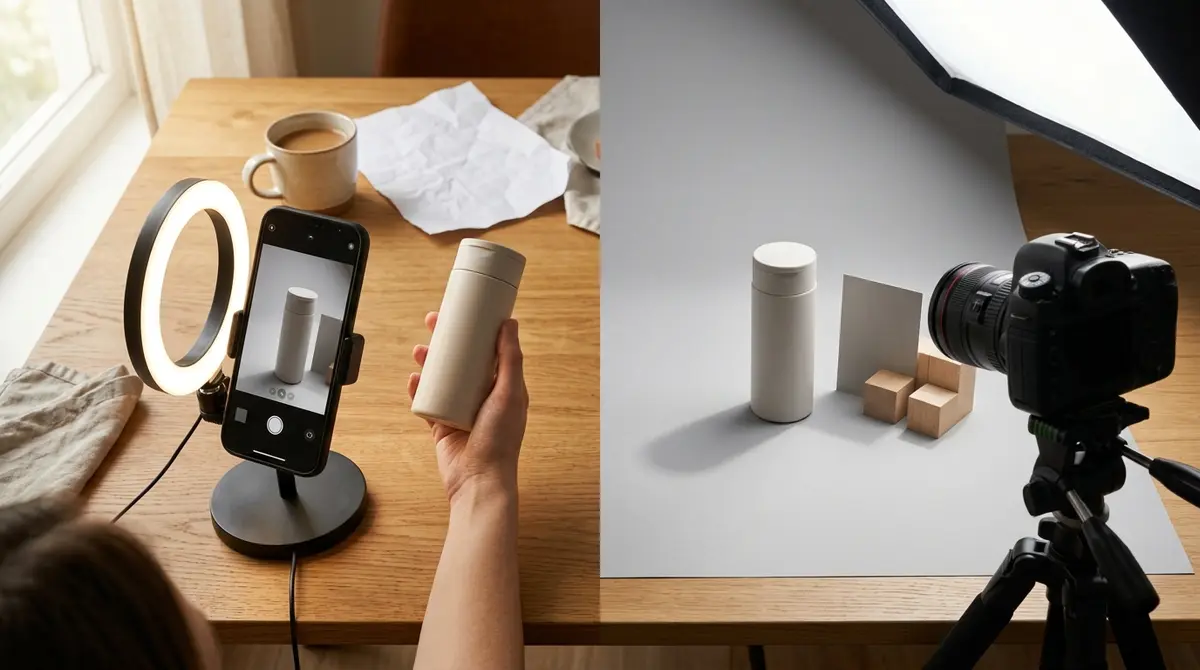
Neither UGC-style nor studio-style creative wins outright: the right choice depends on funnel stage, audience temperature, and what you can measure. Raw, phone-shot UGC tends to earn trust and stop the scroll with cold audiences, which matters when 88% of people trust recommendations from people they know (Nielsen, 2021), while polished studio creative carries brand and premium positioning where credibility is the job. Because Meta's delivery system now reads the creative itself to decide who sees an ad, the reliable move is to run both styles against each other in the same ad set and let cost per result, not taste, pick the winner.
You have the budget approved and one decision stalling the whole thing: shoot it raw on a phone so it feels like a friend's recommendation, or produce it properly so the brand looks the part. The argument gets treated like a personality test when it is really a measurement question. Both styles win, in different places, for different audiences, at different points in the funnel. This guide maps where each one earns its keep, what it actually costs you, and how to stop debating taste and let the auction decide.
What UGC-style and studio-style actually mean
Strip away the jargon and this is a comparison of two looks, not two technologies. UGC-style creative looks like it was made by a real person on a real phone: handheld, front-facing, lit by a window, talking straight to camera, a little imperfect on purpose. Studio-style creative looks produced: controlled lighting, a tripod or gimbal, art direction, clean typography, a considered edit. The label UGC stands for user-generated content, but on Facebook and Instagram it long ago stopped meaning "content your users actually made." It now describes an aesthetic you can shoot deliberately, with a customer, a hired creator, or your own team, as long as the result feels unproduced.
That distinction matters because it separates this decision from three others it gets confused with. It is not the same as choosing between a static image and a video, which is a format question. It is not the same as writing the words a creator says to camera, which is scripting. And it is not the briefing document you hand a producer. Style sits above all of those: a UGC-style ad can be a photo, a video, or a carousel, and a studio-style ad can be any of them too.
Think of it as a spectrum rather than a switch. On one end sits the raw testimonial filmed in a kitchen. On the other sits the color-graded hero film. Most brands live somewhere in between, and most feeds mix both within a single scroll. A skincare brand might run a customer's bathroom-shelf routine next to a crisp product-on-marble still. A DTC apparel label might pair a fitting-room selfie video with an editorial lookbook cut. The question this guide answers is not which end of the spectrum is better in the abstract. It is which end serves a specific audience, at a specific moment, cheaply enough to keep testing.
The debate hides the real variable: creative drives delivery
Before picking a side, it helps to know what actually decides who sees your ad, because in 2026 the answer is mostly the creative itself. Meta's delivery has moved from advertiser-set targeting toward machine selection. In December 2024, Meta detailed Andromeda on its engineering blog, a retrieval engine that scans millions of candidate ads to surface the relevant ones for each person. In November 2025 it added GEM, a ranking model that scores those retrieved ads and that Meta reported lifted ad conversions by 5% on Instagram and 3% on Facebook Feed. Retrieval finds the candidates, GEM ranks them, and automated delivery spends against the result.
The practical consequence lands directly on this debate. When the system reads the creative and the conversion signal to decide placement, the old manual levers matter less and the creative carries more of the weight. So the interesting question is no longer "UGC or studio," it is "which piece of creative will the auction reward with cheaper delivery for this audience." That is a question you answer by feeding the system both styles and reading what it does with them, not by arguing about production values in a meeting.
Cost frames the stakes. Reach is not free and it is not getting cheaper: Gupta Media's tracker put the blended Meta CPM near $8.19 across 2025, with the year's most expensive single day, Cyber Monday 2024, hitting $17.70, more than double the annual baseline. You pay that price per thousand impressions no matter which style fills the slot. So the style debate is really an efficiency debate. The winning creative earns a lower cost per result against the same media price, and you cannot know which style wins that race by taste alone.
Where UGC-style tends to win
UGC-style creative earns its reputation at the top of the funnel, with cold audiences who have never heard of you. Two forces are at work. The first is camouflage: an ad that looks like a friend's post does not trigger the reflex that makes people scroll past anything that looks sold. The second is borrowed trust. Nielsen's 2021 global study, built on more than 40,000 respondents, found 88% of people trust recommendations from people they know above any other channel, and creative that mimics a peer talking to camera taps the edge of that instinct. It reads as a person's experience, not a brand's claim.
Native fit reinforces both. Facebook ads could reach 2.28 billion people as of January 2025 per DataReportal, and the overwhelming majority of that reach is a mobile feed scrolled with a thumb. Vertical, first-person, caption-forward footage is built for that surface. It occupies the full screen, communicates on mute, and delivers its hook in the first second the way the feed demands. A polished landscape film cut for a bigger screen often has to be squeezed and captioned after the fact, and it shows.
Economics matter at this stage too. Clicks on Meta are cheap in absolute terms: Gupta Media's tracker put the blended Meta cost per link click at $0.37 in October 2025, so a first click from a cold prospect is not what breaks the budget. Cold traffic is a numbers game where you need many angles to find the one that resonates, and UGC-style production lets you generate those angles fast and cheap. When the job is to stop a stranger's scroll and earn a first click, raw and authentic usually does more work per dollar than glossy and produced.
None of this makes UGC a guarantee. It is a strong default for cold audiences and top-of-funnel goals, worth treating as the hypothesis you test first, not the answer you assume.
Where studio-style tends to win
Polished creative earns its keep where credibility closes the sale rather than curiosity opening it. That is usually warmer in the funnel: consideration and conversion audiences who already know the brand and are weighing whether to trust it with money. Here, the signals a studio look sends, care, competence, permanence, become assets rather than liabilities. A considered purchase, a higher price point, or a category where safety and quality are the buying criteria all reward creative that looks like the brand has its act together.
Category is the clearest tell. Premium and luxury positioning is partly communicated by production quality itself: a phone-shot clip can undercut a price tag it was meant to justify. Regulated or trust-sensitive categories, where the buyer is scanning for legitimacy, often benefit from the composure a studio frame conveys. Products whose value is visual, jewelry, furniture, design-led goods, frequently need the clean light and controlled staging that make the thing look as good as it is. In these cases the polish is not vanity, it is information about the product.
There is also a brand-equity argument that outlives any single campaign. The feed is where a lot of brand impression forms, and a consistent, well-crafted look compounds recognition over months in a way a pile of disposable clips does not. Retargeting a warm audience is a good place for this: Contentsquare's 2026 benchmark found returning visitors convert at 2.9% against 1.7% for new visitors, and that gap is won at the moment of decision, where a clean, confident ad that reassures a ready buyer can be exactly the nudge that converts. The mistake is not making polished work. It is deploying it against a cold audience that needed a native hook first.
The cost and trust tradeoff, with a worked example
The honest tradeoff is not "cheap versus expensive." It is volume of tested ideas versus depth of a single impression. UGC-style production is cheap per asset and, more importantly, lets you put many distinct concepts into the auction quickly. Studio production is expensive per asset and yields fewer, higher-craft pieces. Because the price of reach is fixed at whatever the auction charges (that blended $8.19 Meta CPM from Gupta Media in 2025), the variable you actually control is how many fresh concepts you can afford to test per dollar of production.
A worked example makes the tension concrete. The inputs below are illustrative assumptions, not benchmarks, so plug in your own:
| Approach | Assumed production cost | Assets produced | Cost per usable concept |
|---|---|---|---|
| One studio shoot | $6,000 | 3 polished concepts | $2,000 |
| One UGC-style batch | $3,000 | 12 raw concepts | $250 |
At those assumed numbers, the UGC batch buys eight times as many shots at a winner for half the production spend. If even one in twelve concepts becomes a scalable winner, the cost of finding it is a fraction of the studio route, because winners are discovered by testing, not by predicting. This is the core reason UGC-style dominates prospecting: not that any single clip outperforms a studio film, but that the style lets you run enough at-bats to find the one that does.
The counterweight is where the studio spend earns back the difference. A single polished asset that lifts conversion rate on a large warm-audience budget, or that raises the perceived value enough to support a higher price, can return more than a dozen cheap clips that never move a considered buyer. So the real calculation is not "which is cheaper" but "where does each dollar of production do the most work." Spend on volume where you are still searching for the message. Spend on craft where you have found it and need it to convert and to carry the brand. And remember the trust half of the tradeoff: a fake-looking UGC ad can cost you the very credibility it was meant to borrow, while an over-produced ad to a cold audience can read as a stranger shouting. Neither failure shows up in the media rate. Both show up in cost per result.
A funnel-stage and temperature map
Put the two previous sections together and a simple map falls out. Match the style to the audience's temperature and the stage of the funnel, then treat the map as a set of hypotheses to test, not commandments.
| Funnel stage | Audience temperature | Style that tends to win | Why | Metric to watch |
|---|---|---|---|---|
| Top (prospecting) | Cold | UGC-style | Native feel stops the scroll and borrows peer trust | Hook rate, CTR, CPM |
| Middle (consideration) | Warm | Either, so test | Demonstration and proof matter more than polish level | CTR, cost per landing-page view |
| Bottom (conversion, retargeting) | Hot | Studio-style, often | Brand credibility and a clean offer close the sale | Conversion rate, cost per result, ROAS |
Read the middle row carefully, because it is where most of the money is decided and where the honest answer is genuinely "it depends." A warm audience has seen you before, so camouflage matters less, but they have not decided, so pure polish is not enough either. This is the stage that rewards a demonstration: the product doing the thing, a before-and-after, a real result. That can be shot either way, which is exactly why the middle of the funnel is the best place to run a UGC-versus-studio test rather than to assume.
The temperature lens is the tiebreaker when the funnel stage is ambiguous. Colder means less trust and more scroll resistance, which favors the native, authentic look. Hotter means the buyer is closer to a decision and scanning for reasons to believe, which is where craft and consistency reassure. When in doubt, ask how much the person already trusts you, and let that answer weight the style before any test even starts.
How to run both and let measurement decide
The whole point of this guide is that you do not have to choose in the abstract. You choose per audience, with evidence, by running a clean head-to-head. The setup is deliberately boring, because a fair test is a controlled one.
Put both styles in the same ad set, against the same audience and the same optimization event, as genuinely distinct concepts rather than a UGC clip and a studio clip of the same script. Isolate the style as the variable you are reading. Then give delivery enough budget and time to actually learn: Meta says an ad set exits the learning phase after roughly 50 optimization events within about seven days, and editing the creative, audience, or event mid-window restarts that clock. Starve the test of budget or judge it after a day and you are reading noise, not a result. Work backward from that floor. If a result costs you around $20 and you need about 50 to stabilize, the ad set needs to be funded to reach roughly that many events inside a week before any verdict is fair.
Then read the right numbers in the right order. Hook rate (three-second video views over impressions) tells you whether the opening stopped the scroll, which is the job of a cold-audience creative and the place UGC-style usually shows its edge. Cost per result tells you whether the whole thing paid off, which is the number that actually decides the winner. Watch them together: a UGC clip can win the hook and lose the sale, and a studio piece can lose the scroll but convert the ones it holds. The style that wins is the one that delivers the cheapest result for that audience, full stop, and it will often be different at the top and the bottom of the funnel.
Finally, treat the winner as temporary. Any style fatigues as frequency climbs and the same people see it too often, so the cadence that compounds results is a loop: research the angles already working, produce the next batch in both styles, launch them to Meta, read cost per result and hook rate, and feed the read into the next round. A platform such as AdPlay.ai keeps that loop in one place, but the discipline holds with any workflow. The advertisers who win the UGC-versus-studio question are not the ones with the strongest opinion. They are the ones who keep both in rotation and let the auction keep voting.
The mistakes to avoid, and a repeatable way to decide
Most of the disappointing results in this debate trace back to a handful of avoidable mistakes, and naming them is the fastest way to skip them.
The first is fake authenticity. A UGC-style ad that is obviously staged, over-scripted, or read off a card by someone who has never used the product reads as a commercial cosplaying as a friend, and it can burn trust faster than an honest studio ad would. The authentic look is a promise; breaking it is worse than never making it. The fix is a real experience underneath the raw footage, specific and true, not a polished script in casual clothes.
The second is polishing the wrong stage. Pouring the budget into a beautiful hero film and running it against a cold prospecting audience is the classic way to waste a shoot. The stranger scrolling past has no reason to slow down for a brand they do not know, however handsome the frame. Save the craft for the warm audiences and considered decisions where it converts, and let a cheaper native hook do the prospecting.
The third is judging on taste. The person who signs off the creative is almost never the target customer, and "I love this one" is not a metric. The whole argument dissolves once you let cost per result and hook rate speak, which is why the test setup above matters more than any opinion in the room. The fourth, and most common, is one-and-done: finding a winner, riding it until frequency kills it, and having nothing ready to replace it. Because delivery now leans so hard on the creative, a thin pipeline of fresh concepts is the real ceiling on performance, whichever style is winning this week.
With the traps out of the way, the clean answer to "UGC or studio" is a process, not a preference. Start from the audience: how cold is it, and how far from a decision. Cold and unaware leans UGC-style, because you need to stop a scroll and borrow trust from a feed that runs on peer recommendations, the instinct behind that 88% Nielsen figure. Warm and deciding leans studio-style, because credibility and a clean offer close, and a consistent look compounds the brand impression that shows up later in conversion rate. The middle is a genuine coin toss, which is precisely why it is the best place to test rather than guess.
Then let the money answer the rest. Reach costs the same either way, near that $8.19 blended Meta CPM, and delivery increasingly rewards whichever creative earns the cheapest result, so your edge is volume of tested ideas at the top and craft where it converts at the bottom. Run both in the same ad set, fund each test past the learning phase, read hook rate next to cost per result, retire the winner before it fatigues, and keep the pipeline full. Do that and the question stops being a debate you have to win with an argument. It becomes a number you read off the account, updated every week, for every audience, one honest test at a time.
By the numbers
Frequently asked questions
Do UGC-style ads actually convert better than studio ads?
Not universally, and any source that claims one always beats the other is selling a style, not reading data. UGC-style creative tends to win with cold, top-of-funnel audiences because it looks native in the feed and borrows the trust people place in peers: Nielsen's 2021 study found 88% of people trust recommendations from people they know above any other channel. Polished studio creative tends to win where brand credibility and premium positioning close the sale, often lower in the funnel. The only reliable answer for your account is to run both against each other in the same ad set and let cost per result decide.
Is UGC-style creative really cheaper than studio production?
Usually per asset, but the bigger saving is volume, not the unit price. A phone-shot batch lets you put many distinct concepts into the auction for the cost of one studio shoot, and more shots at a winner is what actually lowers cost per result. The price of reach is the same whichever style fills the slot: Gupta Media put the blended Meta CPM near $8.19 across 2025, so the money you control is how many fresh ideas you can test per dollar of production, not the media rate.
What is the difference between UGC-style ads and using influencers?
They are different axes. UGC-style is an aesthetic: raw, phone-shot, first-person footage that looks unproduced, and you can make it in-house, with a customer, or with a hired creator. Influencer marketing is about who is featured and whose audience you borrow. You can shoot UGC-style creative with no influencer at all, and an influencer can just as easily appear in a polished studio ad. This page is about the style, not the sourcing.
Should top-of-funnel ads be UGC or studio?
Cold prospecting audiences usually respond better to creative that does not announce itself as an ad, so a UGC-style hook is the safer default at the top of the funnel. It reads like a post rather than a billboard, which lowers the guard and stops the scroll. That said, a strong studio concept can win cold too, so treat this as a starting hypothesis, not a rule, and confirm it with a head-to-head test in your own account.
Does polished studio creative hurt performance on Facebook?
Not inherently. It underperforms when it looks like a broadcast TV spot dropped into a feed of personal posts, because the mismatch triggers banner blindness and people scroll past. It wins when premium positioning and credibility are the job: considered purchases, higher price points, and warm audiences who already know the brand and want reassurance. The failure is rarely the polish itself, it is using polish where a native feel would have converted.
How do I test UGC against studio fairly?
Put both styles in the same ad set, against the same audience and objective, as genuinely distinct concepts rather than trivial variations. Give the ad set enough budget to exit the learning phase, which Meta says takes roughly 50 optimization events within about seven days, before you read anything into the numbers. Then judge on cost per result and hook rate, not on which one you personally like. Isolate the style as the variable so the result is clean.
Does the authentic UGC look still work now that everyone uses it?
The look alone was never the win. A UGC aesthetic wrapped around a weak idea still fails, and creative that fakes authenticity can erode the trust it was meant to borrow. Authenticity is a signal, not a template, so it works when the message underneath is genuinely useful, specific, and true to a real experience. Keep testing fresh concepts either way, because a style saturates faster than a good idea does.
Sources
- 1.Nielsen, Trust in Advertising global study (recommendations from people you know) (2021)
- 2.Gupta Media, The True Cost of Social Media Ads (CPM tracker) (2025)
- 3.Contentsquare, 2026 Digital Experience Benchmark (conversion rates) (2026)
- 4.Engineering at Meta, GEM Generative Ads Recommendation Model (2025)
- 5.Engineering at Meta, Andromeda Personalized Ads Retrieval Engine (2024)
- 6.Meta Business Help Center, About the Learning Phase (2026)
- 7.DataReportal, Essential Facebook Statistics and Trends (2025)
Keep exploring
Turn ad research into winning ads
Research the ads that work, generate the creative on-brand, and launch to Meta, all in one tool.
7-day free trial · No credit card required