
How to Make UGC Ads That Convert (2026)
The script skeleton, the no-studio shoot, the creator brief, and where AI-generated UGC-style video honestly fits: a working guide to UGC ads that convert.
Updated October 2026 · Xanny Lee, CEO
To make a UGC ad, script five beats (hook, problem, demo, proof, CTA), shoot it vertical on a phone in natural light, and open by naming the buyer's exact problem in the first three seconds. The format converts because it reads as a person's recommendation rather than a production: 47% of shoppers call user reviews the most influential content when researching a product, against 11% for brand-made social posts (Hootsuite, 2026). Brief one angle per video, ask the creator for three hooks against one body, and test several distinct angles instead of polishing one take. AI-generated UGC-style video makes that testing cadence affordable, while real creators still win wherever genuine testimony is the proof.
Somewhere in your feed right now, a person holding a product up to a phone camera is outselling a brand's entire studio catalog. That is the pull of UGC ads: they read as a recommendation, not a commercial, and buyers respond the way they respond to a friend's advice. The format is learnable. The script follows a five-beat skeleton, the shoot needs a phone and a window, and the brief that gets a usable take from a creator fits on one page. AI-generated UGC-style video has earned a place in that workflow too, though a human on camera still wins wherever the person is the proof.
Why UGC ads convert when polished ads stall
A UGC ad is paid advertising that looks like something a person would post: a face talking to a phone camera, a product demonstrated on a kitchen counter instead of a seamless backdrop, captions typed over the footage. The low polish is deliberate, because credibility is the point. Instagram ads alone reached 1.74 billion people in January 2025 (DataReportal), and a feed that dense trains people to skip anything that announces itself as an ad. A video that opens like a recommendation gets the two seconds of attention a commercial never receives.
The trust gap is measurable. Hootsuite's 2026 guide to user-generated content reports that 47% of shoppers call user reviews the most influential content when researching a product online, against 11% for a brand's own social posts. UGC ads convert by borrowing that grammar: a specific person, a specific problem, a specific result. That is also the honest caveat. Most UGC ads are commissioned, and the format keeps working only while the substance stays true. Fake the specificity and you have built an expensive commercial with bad lighting.
Build the script, then shoot it on a phone
Start with the angle, and mine it from your reviews
Before any script, decide what the video argues. That argument is the angle, and the best place to find one is the language your customers already use. Read your product reviews, the replies under your posts, the questions in support tickets, and the threads where people discuss the problem you solve, hunting for the exact phrase a buyer reaches for: the specific frustration, the moment the product clicked, the comparison to whatever they tried before. A review that says "I finally stopped buying a new sharpener every few months" is an angle, a hook, and a problem beat in one sentence.
Filter as you collect. A strong testimonial is concrete and earned ("six weeks in, the redness around my nose is gone"); a weak one is vague ("great product, love it"). Pull three or four distinct angles, not three phrasings of one: speed, price, a result that shows on camera. Collect customer photos and clips in the same pass, because shopper-shot visuals carry weight studio shots do not. In Bazaarvoice's 2022 Shopper Experience Index, a survey of 7,000 global shoppers, 74% said photos from other customers increase their likelihood of buying. Each angle you mine becomes one video brief.
The script skeleton: hook, problem, demo, proof, CTA
Nearly every converting UGC ad walks the same five beats in 30-45 seconds.
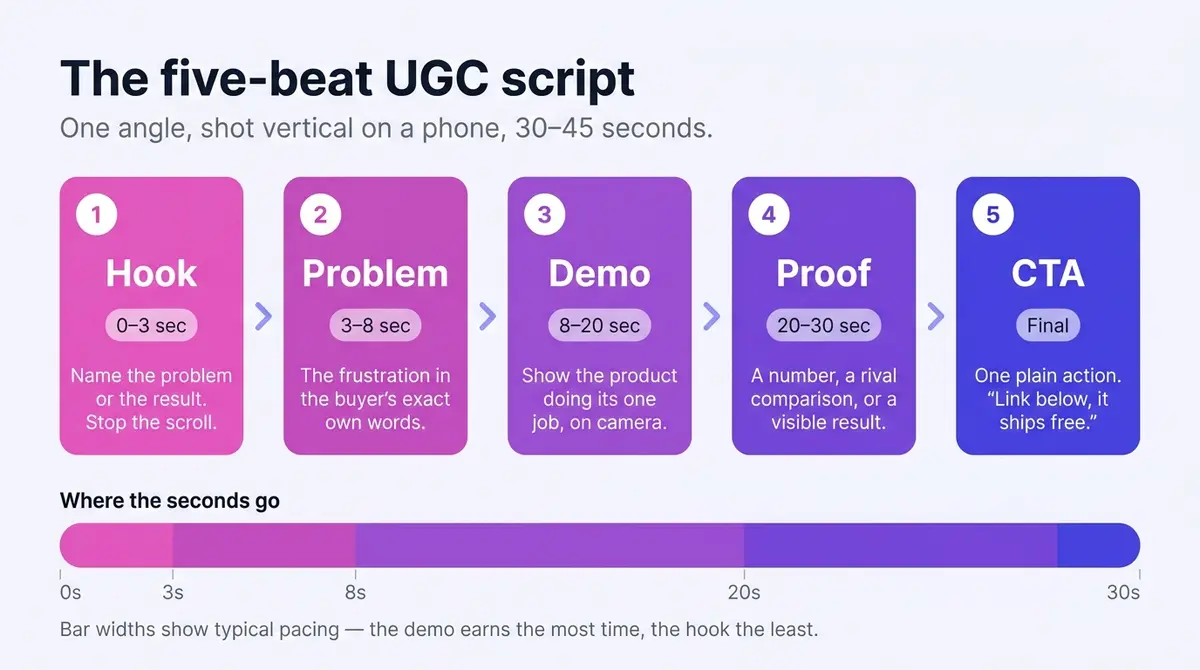
Hook (seconds 0-3). Name the problem or the result before anything else. Meta's creative guidance, published in December 2025, sorts working hooks into three types: a value promise ("this fixed the cable mess under my desk in ten minutes"), a statement of intent ("I tested this for a week so you don't have to"), and a question ("why does homemade cold brew always taste burnt?"). Viewers decide in the first few seconds whether the video deserves the rest of their attention, which makes the hook the highest-leverage line in the script. The shapes are easy to spot in any live feed. Coaching brand Fitness Achievers, for one, runs founder UGC built on the "I'll start gym next week" excuse, with the coach turning up at the door: a hook that names the exact procrastination its buyer is rehearsing.
A hook also works on three channels, and the strongest stack all three: the auditory hook (the spoken first line), the visual hook (a hand mid-action, a messy before state, a split-screen comparison, the product already unboxed), and the text-overlay hook (the caption that carries meaning with the sound off). Write the spoken line, then decide what the screen shows as it lands and what the silent scroller reads. A hook on only one channel leaks attention on the others.
Problem (3-8). Describe the frustration in the buyer's words, with one detail only a sufferer would know. "My third sharpener this year" beats "knives get dull."
Demo (8-20). Show the product doing the one thing it was bought for. Real hands, real use, the before state and the after state in the same shot if you can manage it. Hijab brand Mootiara runs the template cleanly: founder UGC in which a wrinkle-free hijab goes on instantly, in one motion, on camera. The demo is the whole argument.
Proof (20-30). A number, a comparison, a visible result. Evidence moves buyers even in casual formats: a Spiegel Research Center study (2017), cited in Hootsuite's 2026 guide, found products with just five reviews are 270% more likely to be purchased than products with none.
CTA (final seconds). One action, stated plainly. "Link below, it ships free" outperforms a clever sign-off.
A compressed example for a cold brew maker: "Why does homemade cold brew always taste burnt? (hook) I wasted a month of mornings on bitter sludge. (problem) This thing steeps overnight and pours clean, watch. (demo) Four hundred reviews say the same thing. (proof) Link below if your mornings need it. (CTA)"
Shoot it with a phone, not a studio
Everything in the skeleton above can be filmed in an afternoon with no crew. Shoot vertical at 9:16, since the ad will live in Reels, Stories, and the feed. Face a window for light, record in a quiet room or clip on a cheap lavalier mic, and prop the phone steady. Audio matters more than image quality: viewers forgive grain, not a script they cannot hear.
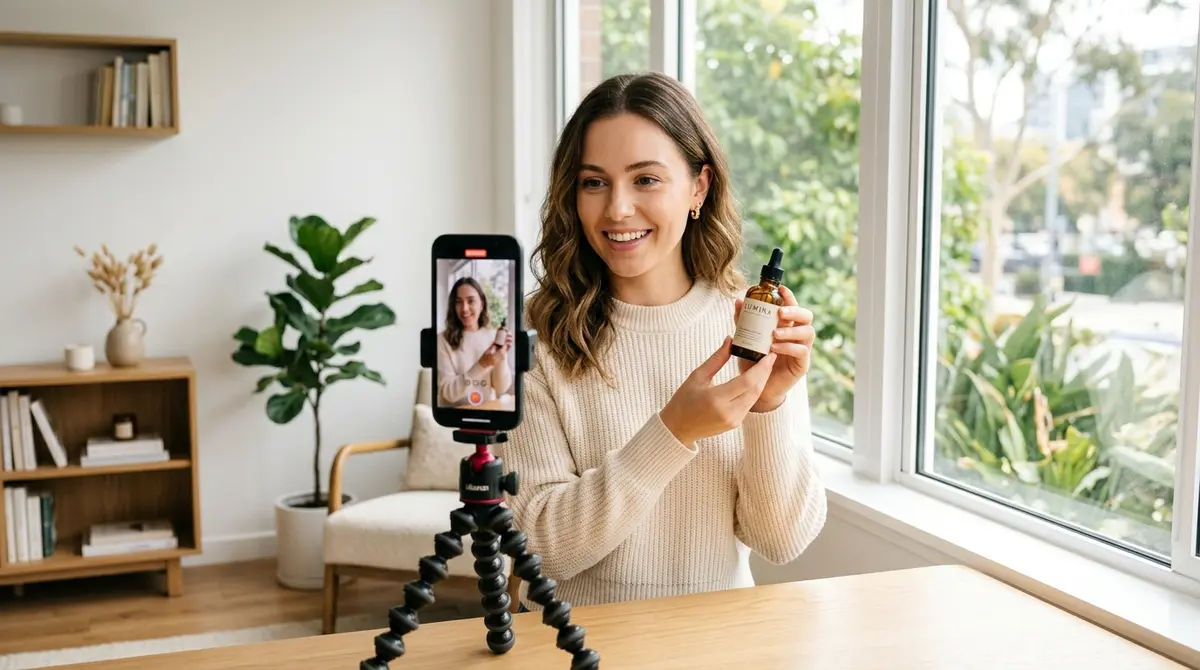
Film the hook more times than feels reasonable. Ten takes of the first line costs five minutes and gives you ten openings to test against the same body. Then collect 30 seconds of b-roll: hands on the product, the texture, the before state, the result. Those cutaways are what make the edit feel alive rather than like a monologue.
Edit for the sound-off scroll. Captions carry the script for everyone watching silently, and audio still pays for the rest: Meta reports that Reels campaigns using music or voiceover deliver up to 13% higher incremental conversions (Social Media Today, 2025). Keep cuts fast, trim every pause, and end before the viewer does.
Work with creators: brief, find, vet, and review
The one-page brief that gets a usable take
When you hire a creator, the brief decides the footage. One angle per brief: a video about odor, spills, and price is a video about nothing. Give the creator who the buyer is, the single problem this video addresses, and the claims they may and may not make on camera. Provide two or three hook lines to read as written, plus an invitation to improvise one in their own words, which is frequently the take that wins.
Specify beats, not a word-for-word script. Creators sound like themselves when they paraphrase and like hostages when they recite. List the mandatory shots (product in use, label legible, the result), the format (9:16, captions off so you can add your own, raw clips included), and the usage terms in writing. Ask for three hook variations against one body: that single request triples your testable creative for a fraction of the cost of three videos.
Where to find creators, and how to vet them
The brief above assumes a creator. There are three ways to find one. Creator marketplaces match you with people who shoot to brief and deliver footage you own, the fastest path to volume. Organic outreach means messaging creators whose existing posts already fit your category, slower but a closer fit. The most overlooked source is your own customers: someone who already loves the product makes the most believable testimony, and converting a happy review into a paid clip is cheaper than hiring a stranger.
Vet on substance, not follower count. The sourcing sweet spot for UGC is the micro tier, roughly 10,000 to 100,000 followers (Influencer Marketing Hub), because that band tends to pair a real niche audience with engagement a brand account rarely earns. Numbers are easy to inflate, so look past them: read the comments on past sponsored posts (real back-and-forth signals a live audience, walls of emoji can signal a bought one), check that the followers match your buyer on age, location, and interest, and ask for two or three previous brand videos to hear how they sound on camera before money changes hands.
Review the deliverable in checkpoints, not at the end
A first cut that misses the brief is expensive, because reshooting means another scheduling round. Build the review into four checkpoints instead of judging only the final file. Approve the concept before anything films (the angle, the hook lines, the mandatory shots, the claims allowed on camera), so a misunderstanding surfaces on paper, not on set. Review a rough draft next with feedback that is specific and timestamped ("at 0:04 the label is out of frame, reshoot that line facing the window"), never a vague "make it pop." Approve the final cut against a checklist: hook lands in three seconds, aspect ratio right, captions clean with the sound off, claims inside what you can substantiate. Then keep watching after launch, because the numbers are the last checkpoint and decide what you brief next.
Where AI UGC-style video fits, and where a creator wins
AI-generated video has earned a real place in this workflow, and it helps to be precise about which place. Adoption is no longer fringe: over 8 million advertisers now use at least one of Meta's generative AI ad creative tools, up from 4 million at the end of 2024, and in Meta's own large-scale test, advertisers using video generation saw a 3% gain in conversion rates (PPC Land, 2026).
Generation wins on speed and breadth. Testing ten hooks against three angles before commissioning a single creator, refreshing a fatigued winner with a new opening, showing a product whose value is visible on screen: these are generation jobs, because the bottleneck they remove is production time.
A human creator wins wherever the person is the proof. Genuine testimony cannot be generated, only faked, and synthetic footage presented as a real customer's experience misleads viewers and invites policy trouble. Complex physical demos, skin and hair results, anything a skeptical buyer will slow down and inspect: book the creator. Hair-care seller Candyta.Siti shows why. Its founder UGC about how fast shedding hair regrows with a shampoo and tonic set persuades because a real head of hair is on camera, and no generated stand-in could carry that claim. The honest pattern is to generate UGC-style variations to find the angle that converts, then put a real person behind the winner.
Run and place the ad across platforms
Run it from your account, or from the creator's handle
You have a choice the moment a creator delivers footage: run it from your own brand account, or run it under the creator's name. Your account is the default, where you own the file and publish it like any other creative. The creator's handle adds their name and audience signals, which the feed reads as more native and the platforms reward: Meta reports that partnership ads, which run from a creator's handle with a paid-partnership label, earn a 13% higher click-through rate than standard formats (eMarketer, 2025). The catch is permission and mechanics.
| Approach | Whose handle | What it needs | Use it when |
|---|---|---|---|
| Brand-account ad | Yours | The footage and usage rights | You want full control and the creator's name adds little |
| Partnership ad (Meta) | Creator's, with a paid-partnership label | Creator grants your business permission in Meta's partnership tools | The creator's name lends credibility on Facebook or Instagram |
| Spark Ad (TikTok) | Creator's | Creator sends you a Spark Ads authorization code | You want the native TikTok look and the post's existing engagement |
| Organic-only repost | Creator's | Creator posts to their own audience | You are buying reach, not a controlled paid placement |
The handoff is permission, not a file transfer. On Meta the creator approves your ad account in the partnership tools, and you build the ad against their post while keeping budget and targeting. On TikTok the creator generates an authorization code from the post and sends it to you, valid for a window of 7, 30, 60, or 365 days (TikTok Ads Manager Help Center). When that window closes the code stops working and any ad using it pauses, so match it to how long you plan to run the creative.
Match the cut to the platform
The same footage rarely performs identically everywhere, because each surface trains its audience differently. Shoot once at 9:16 with safe margins, then re-edit per placement.
| Surface | What the audience expects | Editing emphasis |
|---|---|---|
| TikTok | Native, of-the-moment, made by a person | Fast cuts, trend-aware audio, a spoken hook that lands in the first second |
| Instagram Reels | Polished but still personal | Clean captions, consistent look, a strong opening frame |
| Facebook feed | A clear problem-and-solution story | Works at 4:5 and square, can run a few seconds longer for context |
| YouTube Shorts | A useful or educational angle | Front-load the payoff, lean on the demo and a clear takeaway |
Two rules hold everywhere: captions for the muted scroll, and a hook in the first three seconds. The deltas are pacing and tone, not the skeleton.
Measure, fix the misfires, and run it as a weekly loop
Read the numbers that tell you it is working
"Read the results in a week" needs a scoreboard, and a UGC ad has a specific one. Read it as a funnel, top to bottom, because each metric points at a different part of the video to fix.
| Metric | What it measures | What a weak score points to |
|---|---|---|
| Hook rate | Three-second views over impressions: did the opening stop the scroll | Rewrite the first three seconds |
| Hold rate | Of those who stopped, how many kept watching | The body sags or runs too long |
| Click-through rate | Did the message earn a tap | Weak offer or a passive call to action |
| Conversion rate | Of clicks, how many bought | The landing page or the offer, not the ad |
| Cost per acquisition / ROAS | What a result costs, and whether it pays | The whole funnel against your margin |
Always diagnose from the top, because a low hook rate makes everything below it moot: no polishing of the body saves an opening nobody watches. The scoreboard exists so you stop guessing which part to change.
The mistakes that quietly kill a UGC ad
Most underperforming UGC ads share a short list of faults, and naming each makes it easy to catch in review:
- Over-rehearsed script. The creator sounds like they are reading, not recommending.
- Weak or generic hook. It opens on a logo or a slow pan instead of the problem or the result.
- Interchangeable value claim. "High quality, great value" belongs to any rival; name one specific, believable benefit.
- Passive call to action. It trails off instead of asking for the click.
- Ignored platform context. A glossy Reels edit dropped onto TikTok reads as an ad on sight.
- One polished video instead of several angles. Polishing one bet replaces testing, which is where winners come from.
Turn this into a week of tests
The teams that win with UGC ads are rarely the ones with the best single video. They are the ones testing the most distinct angles, because nobody can predict which framing of the problem will move buyers. Production used to be the constraint: one creator, two weeks, one video. Generation plus a real editor removes it, the workflow AdPlay.ai is built around, from generated UGC-style cuts through captions, voiceover, and launch to Meta.
So put the skeleton to work this week. Pull three angles from your reviews, comments, and support tickets, in the customers' own words. Write three hooks per angle. Generate or shoot the cheapest honest version of each, launch 3-5 to Meta on a small daily budget, a few dollars a day rather than hundreds, because ranking hooks takes impressions, not purchases (the walkthrough in how to run a Facebook ad covers objectives, budgets, and the learning phase). Read the results in a week: which hooks held the first three seconds, which angles earned clicks. Kill the losers, rewrite around the winner, and commission a creator for the angle that proved itself. That loop, run weekly, is how a UGC program compounds.
By the numbers
Frequently asked questions
What is a UGC ad, and how is it different from an influencer or partnership ad?
A UGC ad is paid advertising built to look like something a person would post: someone talking to a phone camera about a product in their own words. Most are commissioned. A brand pays a creator (or generates the video) and runs it as an ad, usually from the brand's own account. Influencer marketing pays for access to a creator's audience, where reach is the product. A partnership ad is the mechanical middle ground: the creative runs from the creator's handle with a paid-partnership label, so it carries that person's name and audience signals while you keep control of budget and targeting.
Where do I find UGC creators, and how do I vet them?
Three places: creator marketplaces that match you with people who shoot to brief, organic outreach to creators whose existing posts match your category, and your own customers, who already use the product and often shoot the most believable footage. Vet on substance, not follower count. Read the comments on past sponsored posts for real conversation rather than emoji reactions, check that their audience matches your buyer, and ask for two or three previous brand videos to judge how they sound on camera. A small, engaged following that fits your niche beats a large mismatched one.
How do I run a UGC ad from the creator's handle instead of my own account?
You ask the creator to grant your ad account permission, then run the creative under their name. On Meta this is a partnership ad: the creator approves your business in the partnership tools, the ad shows their handle with a paid-partnership label, and you set the budget and audience. On TikTok the creator generates a Spark Ads authorization code from their post (valid for 7, 30, 60, or 365 days) and sends it to you. Meta reports partnership ads earn a 13% higher click-through rate than standard formats, because the ad carries the creator's name and audience signals.
What metrics tell me a UGC ad is working?
Read the funnel in order. Hook rate (three-second views divided by impressions) shows whether the opening stops the scroll. Hold rate (the share of those viewers still watching later) shows whether the body keeps them. Click-through rate shows whether the message earns a tap, and conversion rate plus cost per acquisition or return on ad spend shows whether it earns money. Diagnose from the top: a weak hook rate means rewrite the first three seconds, a strong hook but weak hold means the body sags, and strong watching but weak clicks usually means the offer or the call to action, not the creative.
How much does a UGC ad cost, and what usage rights should I negotiate?
Most independent creators price per finished video, with add-ons for extra hook variations, raw footage, longer usage rights, and permission to run from their handle. Rates vary widely with experience, market, and category, so get two or three quotes first. Usage rights are a separate line item from production: you license the footage for a set window (a fixed number of days, or in perpetuity for more), and running it from the creator's handle costs more than running it from yours. Put the window, the platforms, and the renewal terms in writing, because rights that lapse mid-campaign force you to pause a winner.
Do I need to disclose that a UGC ad is an ad?
When you run the video as a paid placement from your own ad account, the platform labels it as sponsored automatically. Disclosure rules bite hardest when a creator posts to their own audience or when the ad runs from their handle: regulators such as the FTC require a clear disclosure of any material connection, and the platform's paid-partnership label exists for exactly that. Separately, scripted testimony must reflect the endorser's honest experience, and any product claim in the video needs the same substantiation it would need in any other ad.
Can AI make UGC ads?
AI can generate UGC-style ad video: a product shown in use, a voiceover, captions, all following the same hook-problem-demo-proof-CTA skeleton. It is strongest for testing many angles quickly and for products whose value is visible on screen. What it cannot supply is genuine testimony. Synthetic footage presented as a real customer's experience misleads viewers and risks breaching platform policy, and it is not a clone of a real person. A common pattern is to generate variations to find the winning angle, then put a real creator behind the winner.
Why do UGC ads fail to convert?
The usual culprits are a weak opening that never earns the next three seconds, a script so tightly read that the creator sounds like a hostage rather than a person, a generic value claim that any rival could make, and a vague call to action that asks for nothing. Two structural mistakes compound those: ignoring the platform (a polished Reels aesthetic dropped onto TikTok reads as an ad) and testing one polished video instead of several distinct angles. Fix the hook first, loosen the script into the creator's own words, name one specific benefit, and end with a single clear instruction.
Sources
- 1.Hootsuite, Complete Guide to User-Generated Content (UGC) (2026)
- 2.Bazaarvoice, Exploring the Shopper Experience Index 2022 (2022)
- 3.eMarketer, Meta Expands Partnership Ads to Turn Creator Content Into Performance (2025)
- 4.TikTok Ads Manager Help Center, How to Create Spark Ads (2026)
- 5.Influencer Marketing Hub, Macro Influencers Explained (2026)
- 6.Social Media Today, Meta Shares Tips on Reels Hooks and Creative Diversification (2025)
- 7.PPC Land, Meta Q1 2026 Results and AI Creative Tool Adoption (2026)
- 8.DataReportal, Essential Instagram Statistics and Trends (2025)
Keep exploring
Turn ad research into winning ads
Research the ads that work, generate the creative on-brand, and launch to Meta, all in one tool.
7-day free trial · No credit card required